

Ask anyone who has worked a shoe floor for a few seasons and they’ll tell you the same thing: the trouble rarely starts at size 16. It starts when a brand takes a pattern built for a 37 and grades it up mechanically, then ships it in pink and calls it a wide fit. The industry term for the drift between labels is vanity sizing, and it hits extended sizes hardest.
Pink women’s shoes and heels are a good test case, because the colour sells in every size and the manufacturing shortcuts show up faster on a pale finish than on black. What follows is what actually changes above a size 16, where the grading goes wrong, and which fixes are worth paying for.
Above a size 16, the shoe is a different object
Grading sounds technical and isn’t. A pattern is drawn once, usually around a 37 or 38, and then scaled up and down by a fixed step: roughly 5mm of length and 1.5mm of width per size. That step is a compromise, and it assumes a set of national size conventions that were never designed to line up, and it works reasonably well in the middle of the range, where most feet sit.
Past a 42, the compromise starts to show. A foot doesn’t get longer at the same rate it gets wider, and it certainly doesn’t get taller in the same proportion. When a factory applies a uniform scale, the shoe gains length faster than it gains the girth a bigger foot needs across the ball. The result is a shoe that’s long enough and still too tight.
This is the single most common complaint I hear from women above a size 16, and it’s almost never about the number on the box. It’s about the ball girth, which is the circumference around the widest part of the foot. That measurement grows by around 4-5mm per size in a real foot. In a mechanically graded shoe it often grows by 3mm.
Two millimetres per size doesn’t sound like much. Over three sizes it’s 6mm, and 6mm is the difference between a pair you wear for a wedding and a pair you take off under the table.
There’s a second number that changes and rarely gets mentioned: heel-to-ball length, the distance from the back of your heel to the widest part of your foot. It doesn’t scale with overall length, so a graded shoe can put the flex point of the sole in the wrong place. You feel that as a shoe that bends under your arch instead of under the ball, which makes walking feel like work even when nothing hurts.
Where the grading goes wrong first
The failures follow a pattern, and once you know it you can spot it before you buy.
- The heel counter stays narrow while the forefoot stretches, so the shoe grips at the back and pinches at the front.
- The shank, the stiff piece under the arch, doesn’t get longer, so the arch support sits in the wrong place on a longer foot.
- The toe box gains length but not height, which presses on the top of the toes in a way that never resolves.
- The sole plate is scaled in length only, so the foot overhangs at the sides even when the length is right.
Any one of those will make a pair feel wrong in a way that’s hard to describe at the till. All four together is what people mean when they say a shoe “just doesn’t fit my foot”, and it’s why so many returns in extended sizes are marked as “fit issue” with no further detail.
There’s a cheap check for the sole plate. Turn the shoe over and look at the widest point of the sole against the widest point of the upper. If the upper is wider than the sole at the ball, the plate wasn’t regraded. Put it back.
Toe box height is the other silent failure. Slide a finger across the top of your toes once the shoe is on. If you can’t, the box is too shallow, and no amount of walking will fix it. This is why some women above a 16 end up buying men’s styles: the toe box is deeper, the sole is wider, and the only cost is a slightly heavier look.
What an extended-size last should look like
A last is the wooden or plastic form a shoe is built around, and the difference between a good one and a lazy one is not visible on a product page. It is visible in three numbers: ball girth, heel-to-ball length, and toe box height. If a brand publishes any of them for extended sizes, that’s a signal they’ve thought about the range. If they publish only the length in centimetres, they’ve graded the pattern and moved on.
A proper extended last grows the ball girth by about 4-5mm per size, extends the shank so the arch support lands in the right place, and adds height to the toe box rather than just length. That’s three separate adjustments, and doing them costs money at the development stage, which is why so few high-street pairs bother.
You can test for it without any numbers. Put the shoe on a flat table and press down on the arch area. If the sole flexes there rather than at the ball, the shank is too short for the size. Then look at the heel counter from behind: it should be roughly as tall on a 43 as on a 37. If it looks shrunken, the pattern was graded in length only.
There’s also the question of fitting width. Some brands offer a single width and call it standard, which is fine below a 40 and less fine above it. A D-width fitting in an extended size is a real difference, not marketing, and it’s usually 4-6mm across the ball compared with the standard last.
If none of that information exists, you’re buying on trust, and the only sane response is to buy from somewhere with free returns and try two sizes.
Pink is a harder colour to make well in a big size
Here’s something the trade knows and doesn’t print. Pale colours, and pink especially, are less forgiving of a stretched pattern than black. A black upper hides a slight distortion in the lasting. A soft pink one shows every crease, every place the material was pulled harder on one side, and every tone difference between the left and the right shoe.
Dye lots matter more too. Extended sizes are often produced in smaller runs, sometimes weeks after the main run, and the pink can come out half a shade lighter or warmer. Two shoes from different runs can look identical under shop lighting and obviously different in daylight. If you’re buying a pair where the sizes were split across two orders, check both shoes side by side in natural light before you commit.
The finish is the other variable. Coated pink leather and patent don’t stretch. They flex a little and then crease. Suede and nubuck give you a couple of millimetres, which matters more in a size 43 than in a size 37, because that’s the size where the girth gap is most likely to be the problem. If a pink pair in an extended size has to work hard, suede is the friendlier material.
None of this makes pink a bad choice above a size 16. It makes it a colour that rewards trying on rather than ordering blind, and it explains why the same style can feel completely different in blush and in black.
Heel height past a size 16 is a stability question, not a style one
A 100mm heel on a size 37 foot and a 100mm heel on a size 43 foot are not the same proposition. The bigger foot has a longer lever from the ankle to the ball, and more mass sitting above that lever. The result is more load through the forefoot and more lateral wobble when you walk.
In practice, most women above a size 16 are more comfortable in 60-75mm than in 90mm and above, and it isn’t because of taste. It’s because the ankle has to do more work to keep the shoe upright, and a lower heel reduces the distance the foot can roll sideways.
Stability also comes from the base. A block heel with a 35mm-wide base is a different animal from a 6mm stiletto, and the difference gets bigger as the size goes up. If you want height and you’re past a 16, the block is the practical answer, and a slightly thicker sole under the ball helps more than any insole.
What doesn’t help is going up a heel height to compensate for a longer leg line. That’s a styling idea that works in photographs and fails on pavement.
One test worth doing at home: stand on one foot for thirty seconds in the pair. Most people can do that in a flat shoe without thinking. If the ankle wobbles within five seconds in a heel, the shoe is asking more of you than your week allows, regardless of how good it looks.
What to size up, and what never to size up
Sizing up is the default fix people reach for, and it’s right about half the time. The rule I’d give anyone is to size up for length and never for width.
If your longest toe touches the front of the shoe, size up. If your toes are pressed together at the sides, sizing up gives you a longer shoe with the same narrow ball, and it will still press. The fix for width is a different last, a wider fitting, or a style with adjustable straps. That’s it.
There’s a second rule that surprises people: don’t size up for a heel that slips. Heel slip in a new pair is usually a heel counter that’s too wide, not a shoe that’s too short. Sizing up makes it worse. A heel grip of 2-3mm, or a pair with an ankle strap, solves it properly.
Half sizes exist for a reason, and above a 42 they’re often the difference between a good fit and a compromise. If a brand offers a 43 and a 43.5, try both. It costs ten minutes and saves a return.
Measure both feet before you order, and use the bigger one. A 3mm difference between left and right is normal, and above a size 16 it’s often 5mm. Buying for the smaller foot means one shoe that fits and one that doesn’t, which is the most annoying outcome available.
The alteration that’s actually worth paying for
Most shoe alterations are a waste of money. Stretching a shoe wider works for about 3mm and only on real leather. Insoles change the volume but not the width. What does work, and works well, is a heel-lift adjustment on the counter, done by a cobbler who will also narrow the heel counter by a few millimetres.
That single adjustment fixes the most common extended-size problem: a shoe that fits across the ball and gaps at the heel. It costs less than a return shipping label in most cities, and it’s reversible.
The other alteration worth considering is a sole plate widening, which very few cobblers offer and most shouldn’t attempt. A half-sole in a slightly wider profile can be glued and stitched, but it changes the look of the shoe and isn’t worth it on anything under about 150 dollars.
What I’d skip entirely: padding the toe box, stretching patent, and anything described as “making the shoe fit your foot” by a shop assistant with a heat gun. Heat changes the shape temporarily and the material permanently, and the creases come back worse.
A five-minute checklist before you pay
None of the above matters if you skip the actual try-on, so here’s the version that fits in a shop visit.
- Try the pair at the end of the day, when feet are at their largest.
- Wear both shoes, not one, and walk on a hard floor for at least thirty steps.
- Check the sole edge from above: no overhang at the ball, none at the little toe.
- Push your foot forward as far as it goes and look at the gap behind your heel. More than 4mm means the shoe is long.
- Stand on one foot for thirty seconds and watch the ankle, not the mirror.
Five checks, five minutes. Most pairs fail at least one, and that’s the point: knowing which one failed tells you whether the problem is fixable. A heel gap is fixable with a grip. An overhanging little toe is not.
If you’re buying online, order two sizes from a shop that pays return shipping, and try them at home at the end of the day on a hard floor. Keep the tags on until you’re sure. It’s a slightly boring way to shop pink heels in a size 43, and it’s the only one that reliably works.
What the trade doesn’t say at the till
Three things, and they’re all about incentives. Extended sizes are made in smaller quantities, so brands put less money into the lasts, which is why the fit is more variable above a 42 than below it. Pink sells fast in photographs and slower in extended sizes, so those runs are often the first to be cut when a factory is behind. And the person fitting you is usually working from a size chart that assumes a standard foot.
None of that is a conspiracy. It’s just how the numbers work, and knowing it changes what you do at the till. Ask for the ball girth if the brand publishes it. Ask whether the pair you’re trying came from the same run. Try both shoes, not just the right one, and walk on a hard floor rather than a carpet.
There’s also a decent argument for buying the pink pair in a style you’ve already worn in another colour. You know the last fits, you know the heel height works, and the only new variable is the finish. That’s a much smaller bet than trying a new shape and a new colour in a size range where the grading is least reliable.
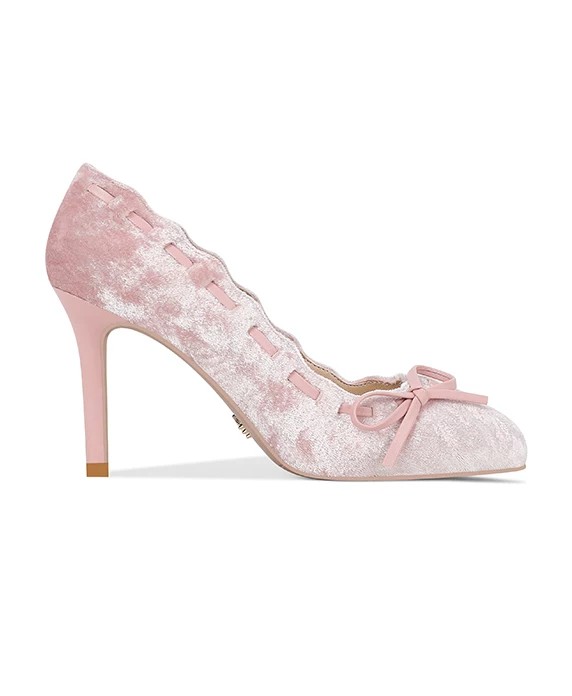
If you want a starting point, the pink high heels with a rounded toe are built on a shape that suits a wider foot better than a pointed last, and the pink slim-heel style runs noticeably narrower at the ball. Try the second one only if you know your width. Browsing the full heel collection with the sole-plate check in mind will filter out half of it in five minutes.
And if you’re replacing a pair you already loved, the honest advice is to check the wear pattern on an old pair before buying new. Where a shoe wears out tells you which part of the fit was wrong all along, and that’s more useful than any size chart.
Pink, above a 16, in a heel you can actually walk in. None of that is complicated once you stop trusting the number and start checking the sole, the girth, and the run the pair came from.
