

Last April I stood in a shop in Lisbon with a cardboard foot gauge in one hand and a black strappy sandal in the other, and the number on the box said 38 while my foot said otherwise. The sandal was the right length. It was still wrong. Two hours later my little toe was hanging over the sole like it had given up on the arrangement.
That afternoon taught me something the size chart never mentions. With closed shoes, length is most of the story. With heels, black sandals for women especially, the story is written across the ball of your foot, in the straps, and in how much of your weight the front of the shoe agrees to carry. You can buy the right size and still get the wrong sandal.
Here’s what I check now, in the order I check it, and the places where the chart quietly lies to you.
The chart measures your foot. The sandal sits somewhere else.
A size chart tells you one thing: heel to longest toe, in centimetres or in barleycorns if the brand is feeling historical. That measurement assumes your foot is standing flat on a solid surface with no slope. A heel changes the geometry before you’ve taken a step.
Put on a 90mm heel and your foot slides forward until the ball of your foot takes the load. Your arch lifts, your toes spread slightly, and the whole front of the foot moves maybe five to eight millimetres toward the tip of the shoe. That shift is why a sandal that fits barefoot can pinch after twenty minutes. The chart measured your foot at rest. The shoe fits your foot in motion.
The fix is annoyingly simple. Measure your foot twice: once flat, once with your heel lifted about 3cm on a book. The second number is closer to what the sandal actually has to hold, and for most women it’s 3-6mm longer than the first.
Most people skip this. Then they blame the brand.
Width at the ball matters more than length, and almost nobody measures it
Stand on a piece of paper and trace your foot. Now measure the widest part, which sits just behind the toes, across the ball. That number, not the length, decides whether a strappy sandal stays on your foot or saws at your skin by lunchtime.
Here’s the rough guide I use. Under 9cm at the ball: narrow, and most strappy sandals will gap at the sides. 9-9.6cm: average, and you can wear almost anything. Over 9.6cm: wide, and you need a sandal with adjustable straps or a wider sole, not just a bigger size.
If you size up to fix width, you get a longer shoe with a strap that now sits in the wrong place. The strap lands on the bony part of your instep instead of the soft hollow behind it. That’s the friction point. That’s the blister.
This is also why two women wearing the same 38 can have completely different experiences with the same pair. One has 9.2cm at the ball. One has 10.1cm. The chart can’t see the difference, so the brand writes “true to size” and moves on.
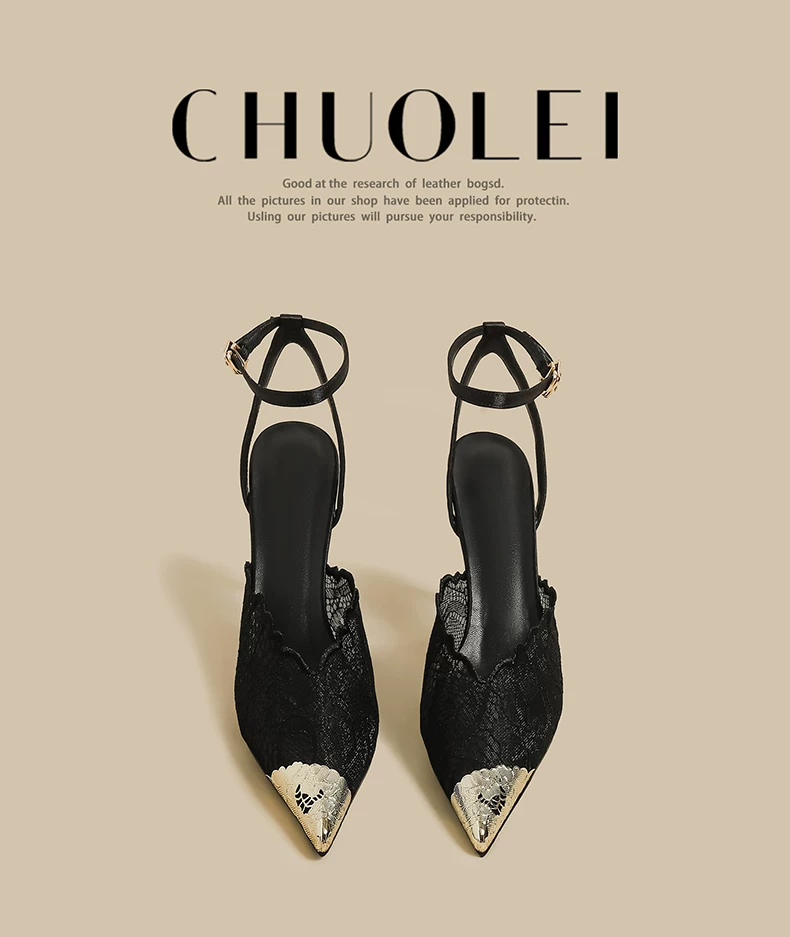
If you want a reference point, look at high-heeled sandals with a closed toe cap. The toe cap does part of the holding, which takes pressure off the instep strap. For wide feet, that’s a real advantage.
A 90mm heel quietly shortens the shoe you can wear
Heel height changes the usable length of a sandal, and it does it in a way that isn’t linear. At 40mm, most people can wear their normal size. At 70mm, the foot slides forward and the toes need about 3mm more room. At 100mm and above, the slide is closer to 8mm, and the toes start taking weight they were never designed to carry.
Physically, a high heel shifts load onto the forefoot. The history of the high-heeled shoe is mostly about status and silhouette, but the biomechanics are boringly consistent: the higher the heel, the more pressure per square centimetre under the ball of your foot. A 7cm heel can triple that pressure compared with flat shoes.
What that means at the shoe rack is simple. If you’re buying 100mm black sandals, size for the ball of your foot, not the length. If the sandal has a closed heel cup, the length matters less because your heel can’t slide back. If it’s a two-strap slide with nothing behind your heel, length matters a lot, because your foot will travel forward every time you take a step.
My rule: 100mm and open-backed means half a size up from your flat size, then rely on the straps to hold you. 70mm and closed-backed means your normal size, every time.
The two-tape method I use in the shop, ninety seconds flat
I don’t trust my memory of my own foot size, because it changes. Pregnancy, weight, long walks, summer heat. Mine went up half a size at 34 and never came back down. So I measure each time I’m buying something expensive.
You need a soft tape, a pencil, and a hard floor. That’s it.
- Tape one: heel to longest toe, standing, weight even on both feet.
- Tape two: across the ball, standing, at the widest point.
- Tape three, optional: around the instep, the highest part of your arch, because high insteps and low insteps need different strap positions.
Write the three numbers on your phone. Then, in the shop or on the product page, compare them to the brand’s own chart, not to the “fits true to size” line in the reviews. Reviews are useful for one thing: finding out whether a specific style runs narrow or wide. They’re useless as a substitute for your own numbers.
I also do one more thing that sounds excessive and isn’t. I measure both feet. Most people have a difference of 2-5mm between left and right, and if you’re buying a sandal with a fixed strap, the bigger foot wins. Always buy for the bigger foot.
This takes ninety seconds. It has saved me three returns in two years, which at current shipping costs is not a small thing.
EU 38 is not EU 38, and the chart won’t admit it
European sizes are supposed to be standardised. In practice, a 38 from one brand measures 24.1cm inside, and a 38 from another measures 25.0cm. Neither is lying. They’re using different lasts, different toe shapes, and different ideas about how much room a toe needs.
Add the US and UK conversions and it gets worse. A US 7.5 is usually an EU 38, but some brands treat it as a 37.5, and UK sizes run a full size below US for women. If you order a UK 5 expecting a US 7.5, you’ll get something closer to a US 7.
So don’t convert. Measure. If the brand publishes an internal length in centimetres, trust that number over every letter and digit on the box. If they don’t publish it, look for a store that lists it, or pick the size that matches your bigger foot and expect to exchange once.

Pointed toes are the worst offender. A pointed-toe sandal with a slim heel can have the same internal length as a round-toe pair and still feel a half size smaller, because the taper starts earlier and squeezes the toes together. When I buy pointed, I go up half a size and add a gel pad at the ball. That combination has never failed me.
Where black sandals forgive a bad size, and where they don’t
Black is the forgiving colour. It hides scuffs, it hides a slightly too-long sole, and it makes a strap look intentional even when it’s sitting 4mm off. That’s part of why black sandals sell better than any other colour in this category. But black doesn’t fix fit. It only hides the visual symptoms.
What actually forgives a bad size is the construction. A closed heel cup holds your foot back, so a slightly long sandal still works. An ankle strap does the same job from above. A wide front strap spreads pressure across the top of the foot, which is why block-heel sandals with one broad band feel easier than four thin ones.
What doesn’t forgive: thin straps over the toes, a sole that’s narrower than your foot, and any sandal where the only thing keeping it on is friction. Those three will hurt regardless of size, and no amount of breaking in will change the geometry.
If your feet are wide, look at the women’s shoe range sorted by style rather than by size, then check the sole width in the photos. It’s visible. Compare the sole edge to the model’s foot. If the foot overhangs, the last is narrow.
One more thing, and I’ll be blunt about it: if a sandal pinches across the top of your toes in the first minute, it will still pinch in week three. Leather stretches a few millimetres. It does not stretch a centimetre, and the straps that cut in are usually the ones that don’t stretch at all.
Day one lies, which is why I ignore break-in promises
Every product page says the sandal will soften. Some do. Most don’t, and the ones that don’t are usually the patent and the PU. Real leather moulds to your foot over maybe ten wears. Patent leather mostly keeps its shape and keeps its edge. Synthetic straps can go either way and you won’t know until you’ve worn them outside, which is exactly when you can’t return them.
So I test indoors, on carpet, for twenty minutes, at the end of the day when feet are at their largest. If something rubs at 9pm, it will rub at 9am on a hot day too. Feet swell by up to 5% over a day, and buying at 10am is how people end up with sandals that fit perfectly in the shop and terribly at dinner.
The other lie is “they’ll stretch with wear”. Sometimes true. Always slow. If you’re buying for a specific event, like the wedding-guest problem of grass and gravel, buy a pair you’ve already broken in. New shoes plus uneven ground plus eight hours standing is a bad combination, and I’ve watched it ruin more than one evening.
If a sandal does rub, the fix is usually a heel grip or a small piece of moleskin, not a bigger size. Podiatrists see a lot of forefoot pain from shoes that were too short, and the Mayo Clinic notes on foot pain are worth a read before you decide the pain is just something to live with.
What a product photo can and can’t tell you about the sole
Photos are the closest thing you get to holding the sandal, and most of them are shot to hide the boring parts. The sole is one of those parts. Look at the shot from below or the one where the shoe sits flat on a table, if the listing has it. That angle tells you more about fit than the four beauty shots combined.
What you’re looking for is the sole edge relative to the upper. If the upper overhangs the sole, the shoe is narrow and your foot will spill over the sides. If the sole extends 4-5mm past the upper, there’s room. On a black sandal this matters more than usual, because a foot that spills over a black sole is very visible and no amount of styling hides it.
Then check the arch. A sandal with a contoured footbed supports the middle of your foot and takes pressure off the ball. A flat slab doesn’t. You can usually see the curve in the side profile, and if the footbed looks like a plank, it probably is one. Flat sandals with a 90mm heel are the worst of both worlds: all the forward slide, none of the support.
Straps are the last visual clue. Count them and look at where they attach. A strap attached at the very edge of the sole will pull the upper sideways when you walk. A strap attached slightly inboard holds the foot down instead of squeezing it in. That’s a two-millimetre detail you can spot in a decent photo, and it’s the difference between a sandal you forget about and one you resent by noon. The basic construction hasn’t changed much since the earliest strap sandals were cut from a single piece of leather, which is why the strap position still decides everything.
Three pairs, three different fits, same size on the box
To make this concrete, here’s what the same nominal size did on three women I know, all of whom wear a 38 in flats. Names changed, numbers not.
Anna has a narrow foot, 8.8cm at the ball, and a high instep. On a strappy sandal with fixed loops she gapes at the sides and the strap presses the top of her foot. She needs adjustable buckles and a slightly deeper toe box, and she should never buy a slide with a fixed front band. Her size is a 38, and her fit problem has nothing to do with size.
Ruth is 10cm at the ball, average instep, and she walks 9,000 steps a day for work. On the same sandal she needs a 39 for width and then a heel grip to stop the length from sliding. She’s the classic case where sizing up is correct and the strap does the rest. Her real complaint is always the same: the sole is narrower than her foot, so her little toe sits on the edge of the sole and the upper cuts into it.
I’m the third case. 9.3cm at the ball, medium everything, and my issue is length. My left foot is 4mm longer than my right, which is unremarkable, and it means every pair I own is bought for the left foot and slightly loose on the right. A heel grip fixes the right. Nothing fixes a shoe bought for the smaller foot.
Three women, three fixes, one label. If you take anything from this, take the idea that the number on the box is a category, not a measurement. Your actual measurement is the thing you should be shopping with.
What I check before checkout, in order
Four things, in this order, and I don’t move to the next until the current one passes.
- Internal length in centimetres, compared with my bigger foot measured while standing.
- Sole width at the ball, compared with my own width plus 3mm of breathing room.
- Strap adjustability: buckles or elastic, not fixed loops, if my foot is anywhere near wide.
- Heel height versus my actual week: 70mm for a normal Tuesday, 100mm only if I’m sitting down for most of the event.
If a sandal passes all four, I buy it and stop looking. If it fails the first one, no amount of good styling saves it. That’s the whole method, and it’s the reason the pair in Lisbon went back to the shelf instead of into my suitcase.
Size charts are a starting point written by someone who has never seen your foot. The tape measure is the only thing in the process that knows what it’s talking about. Buy the number the tape gives you, not the number the box does, and black sandals stop being a gamble.
