

A wardrobe clear-out usually starts with clothes and ends with a pile of shoes nobody wants to admit to. The open-toe pairs are always in that pile. They look good in the box, they get bought for one event, and then they sit there because nobody worked out what they go with. The capsule wardrobe idea gets applied to coats and knitwear all the time, and almost never to shoes.
There’s a better way to buy them. Pick three pairs of heels for women open toe that cover different ground, then check that each one earns its place across a normal week rather than a single night out. Three pairs can produce nine outfits if the colours and heel heights are chosen with a bit of discipline. More than that, and the closet wins the argument.
What follows is the maths behind that, worked through pair by pair, plus the outfits that fail and the reasons they fail.
Three pairs, three jobs, no overlap
The first pair should be the quietest thing in the wardrobe: a nude or soft tan open-toe sandal at 60-70mm. It exists to disappear. Nude reads as an extension of the leg, which is why it works with a cream dress, a pale denim skirt, and a beige linen suit without any of them fighting it. At 70mm it’s wearable for a full working day, and that matters because this pair will get the most mileage.
The second is black, and it should be the sharpest silhouette of the three. 85-90mm, a slim heel, a clean vamp. Black open-toe heels do the evening work and the winter work, since black tights and an open toe is a combination that looks deliberate when the shoe is right and sloppy when it isn’t. The deciding detail is the vamp: if it cuts straight across the toes, tights will show through the gap and the whole thing looks accidental.
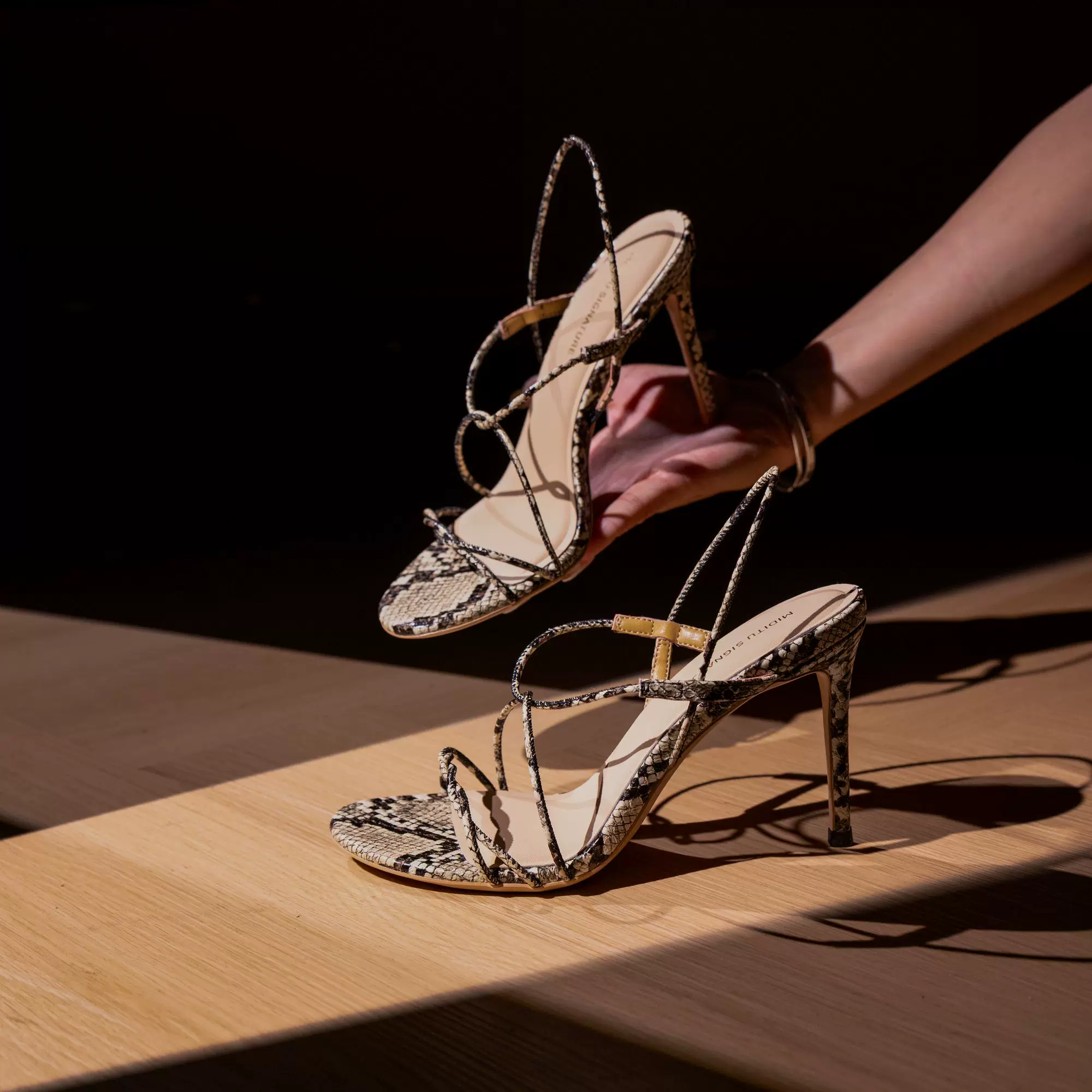
Pair three is the one people skip and later wish they hadn’t. A metallic, a deep red, or a print. Something with enough personality to carry a plain outfit on its own. This pair does the job that the other two can’t: it makes a white shirt and jeans look like a decision rather than a default.
Nine outfits, then: each pair with three distinct looks. That’s not a formula for a magazine spread. It’s a test you can run in your head before you pay, and it kills about half the pairs you were considering.
Why the open toe changes the whole outfit calculation
A closed pump hides a lot. An open toe exposes the one part of the foot that tells the truth about the rest of the outfit: whether the shoe was chosen or just worn. Toes out means the hemline has to be considered, the nail colour has to be decided, and the proportion of the leg has to work from the ankle down.
The hemline rule is the one that trips people. A midi skirt that ends at the widest part of the calf plus an open-toe shoe creates a very specific line from knee to toe, and if the shoe has an ankle strap that line gets cut in half. Shorten the hem by 3cm, or pick a shoe without the strap, and the same outfit suddenly works. This is why so many women describe a pair as “not flattering” when the actual problem is 3cm of fabric.
Nail colour is the second consideration, though most buyers overthink it. A sheer nude or a clean red covers 90% of situations, and a chipped polish is more visible in an open toe than any colour choice. The pair that gets worn is the pair that doesn’t demand maintenance.
Proportion is the third. A pointed open toe lengthens the foot and, by extension, the leg. A round open toe shortens both. If you’re 5’3″ and wearing a midi, the pointed shape is doing structural work that no amount of styling can replace. This is a large part of why the peep-toe silhouette keeps returning in collections aimed at shorter frames.
Nine outfits, written out so the maths is visible
Here’s the full grid, with the pairs numbered. Pair one is nude at 70mm. Pair two is black at 90mm. Pair three is the statement pair.
- Nude with wide-leg cream trousers and a white tee. The shoe disappears, the trousers do the work.
- Nude with a pale denim midi skirt and a navy knit. Summer office, no thought required.
- Nude with a beige linen suit. The only risk is matching two nudes badly, so keep the shoe half a shade lighter than the fabric.
- Black with a black slip dress. The open toe stops it reading as evening-only.
- Black with dark straight jeans and a blazer. This is the outfit that justifies the 90mm, because the heel is what makes the jeans look intentional.
- Black with black opaque tights and a wool midi. Works only if the vamp is cut high enough to hide the tights’ toe seam.
- Statement pair with a white shirt and blue jeans. The plainest clothes you own, plus one loud shoe.
- Statement pair with an all-black outfit. The shoe becomes the only colour in the frame.
- Statement pair with a slip skirt in a neutral. The shoe leads, the skirt supports.
That’s nine. Note what’s missing: pencil skirts with ankle straps, long maxi dresses with round toes, and anything where the shoe has to fight the hem. Those aren’t impossible outfits. They’re outfits that need a fourth pair, and a fourth pair is how the collection starts growing again.
The useful part of this exercise is the failures it predicts. If two of your nine outfits need the same pair, you don’t need three pairs. If one pair only appears once, it’s a costume, not a shoe.
The fitting-room test that decides in four minutes
Shopping online is fine until the pair arrives and the strap sits somewhere unexpected. In a physical shop, four checks in four minutes will tell you more than an hour of walking around.
First, stand still and look down. Can you see the edge of the sole under your little toe? If yes, the last is too narrow and no strap adjustment will fix it. Second, walk ten steps on a hard floor, not carpet. Carpet hides a loose heel and a sole that flexes in the wrong place.
Third, stand on tiptoe for five seconds. If your heel lifts out of the shoe by more than 5mm, the pair will slap when you walk and you’ll be gripping with your toes all evening, which is how forefoot cramps start. Fourth, check the toe overhang at the front. A 2-3mm overhang is normal and comfortable. A flush toe against the sole edge means the shoe is short, even if the length measurement says otherwise.
Four checks, and most bad pairs fail at least two. The ones that pass all four tend to stay in rotation for years, which is the only metric that matters when a pair costs more than a week of groceries.
Walk out of the shop with the pair you tested, not the pair you intended to buy. Open toes are unusually sensitive to small differences between styles, and a pair that looks identical on the shelf can sit 5mm further forward on the foot.
Two minutes, four checks, one decision.
One more thing in the fitting room, because it’s the cheapest test available: try the pair with the outfit you actually plan to wear it with, or a photo of it on your phone. Open-toe shoes are unusually sensitive to hem length, and a shop mirror at the wrong height will lie to you about proportion.
The week that broke one pair, and what it proved
A reader emailed last summer about a pair of black 90mm open-toe sandals she’d bought for a wedding. By day four of a work week she had two blisters and a theory that the shoes were badly made. They weren’t. The vamp was cut 6mm lower than the pair she’d owned before, and that 6mm put the edge of the shoe directly on the joint of her big toe.
That’s the pattern with open toes. The failure is rarely the heel height. It’s the position of one edge. A vamp that sits 5mm further back can turn a pair from all-day wearable to a two-hour shoe, and nothing in the product description tells you which one you’re buying.
Her fix was simple and slightly annoying: a self-adhesive forefoot pad, 3mm thick, which lifted her foot away from the edge. Total cost, about the price of a coffee. The pair then lasted the rest of the summer, though she never wore them for a full working day again.
The lesson generalises. When an open-toe pair hurts, look at where it hurts before you decide the size is wrong. Toe joint pain usually means the vamp is too far forward. Pain under the ball means the sole is too thin for the heel height. Heel slip means the strap is in the wrong place. Three different problems, three different fixes, and none of them solved by sizing up.
Wide feet, narrow vamps, and the 4mm that decides everything
Open-toe shoes are less forgiving of width than closed shoes, and the reason is structural. A closed pump can stretch across the ball over a few wears. An open toe has nowhere to stretch, because the edge of the shoe is already sitting against skin. If the sole is narrower than your foot, your toes will sit on the edge and the upper will cut into the joint.
The measurement that matters is ball width, taken across the widest part of your foot while standing. Anything over 9.6cm is wide by most brands’ lasts, and a standard open-toe sandal is built for something closer to 9.2cm. That 4mm gap is the whole problem, and no amount of breaking in closes it.
There are three workable fixes. Look for adjustable buckles on both straps, since two adjustment points spread the load instead of concentrating it. Choose a wider sole profile, which is visible in a side-on photograph if you compare the sole edge with the foot. Or accept a slightly longer shoe and hold the heel with a strap, which trades length for width. A belt-strap sandal with a built-in buckle is the shape that gives you the most adjustment for the least money.
The shape of the vamp matters too. One cut straight across the toes pinches the outer toes first, because the shoe is following an average foot and yours isn’t one. A curved or V-shaped vamp follows the toe line and leaves room at the sides. If you’ve ever had a pair that hurt only the little toe, the vamp shape caused it, not the size.
On the fitting-room checklist, add one item: look at the shoe from directly above. If your foot spills over the sole edge at any point, put it back. That single view tells you more about long-term comfort than ten minutes of walking, because the spill gets worse as feet swell through the day.
Cost per wear, and why the cheapest pair rarely wins
A pair of open-toe heels costs what it costs. What it’s worth is a different number, and the arithmetic is simple enough to do on a phone: price divided by the number of times you’ll realistically wear it.
Take a 60 dollar pair worn four times before the strap stretches or the sole separates. That’s 15 dollars a wear, and the pair is finished. A 150 dollar pair worn 40 times is under 4 dollars a wear, and it’s still going. The expensive pair is the cheaper one by a factor of four, which is why the cheapest option in a shop is rarely the bargain it looks like.
The catch is that cost per wear only works if the pair actually gets worn, and that depends on one thing: whether it fits your week. A 90mm black sandal worn once a fortnight has a terrible cost per wear no matter how well it’s made. The same money spent on a 70mm nude pair worn three times a week pays itself off in a season.
This is the argument for the three-pair structure rather than a collection of one-event shoes. Each pair in the trio has at least three outfits behind it, which means each one clears the wear threshold before you’ve even paid. Anything that can’t clear three outfits in your head is a costume purchase, and costumes are fine as long as you’re honest about the price.
There’s a second number worth checking: the repair cost. A reheel and a new sole cap run about 25 to 40 dollars depending on where you live, and a pair that can be repaired is cheaper over three years than a pair that can’t. Cheap sandals with glued soles usually can’t, which is the real reason they end up in the bin rather than the repair shop.
What to add next, and what to leave on the shelf
After the three pairs are working, the next addition is usually a block heel in the same open-toe shape. It does the standing jobs, the outdoor events, and the days when 90mm is a bad idea. It’s also the pair most likely to be worn in bad weather, so buy it in a colour that hides a scuff.
What to leave: a fourth strappy sandal in a colour you already own, a trend shape in a heel height you can’t walk in, and anything with a toe post. Toe posts divide opinion for a reason, and the reason is that they sit between two toes for hours. If you’ve never worn one, borrow a pair before you buy.
There’s also a case for buying one pair slightly cheaper than the rest. The single-strap sandal with a thin heel is a shape that gets replaced often by trend cycles, and spending a fortune on it is a bet against your own taste changing. The nude pair is where the money should go, because that’s the one you’ll wear until the sole gives out.
Before you add anything, go through the women’s shoe collection with the three-pair logic in mind and count how many pairs would earn a spot. Most people find that the wardrobe already holds two of the three jobs and only needs the third.
And if your week involves a lot of sitting rather than walking, the checks are different. The two-hour sitting test for women’s heels covers the part that fitting-room mirrors never show: what happens to your feet after an hour in a chair.
Three pairs, nine outfits, one week of testing before you commit. It’s a small amount of arithmetic that saves a shelf full of shoes nobody wears, and it turns the open-toe question from a styling problem into a checklist. Run the nine outfits on paper first. The pairs that survive that page tend to survive the year.
