

Here’s a decision most people make badly. You’re buying a pair of heels for work, you try them on in a shop at 11am, you walk eight steps, and you decide. Two weeks later you’re sitting in them from 9:30 to 12:30 and the only thing you can think about is the strap cutting across your instep.
Standing for two minutes tells you almost nothing about sitting for two hours. Those are different mechanical tests, and the second one is the one your job actually asks of you.
So before you buy grey heels for a desk-heavy week, work through three checks in this order. Fit at the counter, behaviour at the desk, and colour under office light. Most people do them in reverse, which is why so many pairs end up worn twice.
What two hours in a chair does to a heel
Sitting changes the load path completely. Standing, your weight goes down through the heel and the ball. Sitting with your feet flat, the heel becomes a lever and the strap becomes the anchor.
That’s the first thing that surprises buyers. In a chair, a loose ankle strap stops being a comfort feature and starts being a pressure point, because it’s the only thing holding the shoe to your foot when you shift position, cross your legs or swivel to reach a drawer.
The second effect is heat. A foot inside a closed shoe under a desk sits at skin temperature with no airflow for hours, and the lining matters more than the upper. Leather lining copes. Synthetic lining doesn’t, and it’s the reason a pair can feel fine for the first week and unpleasant by the third.
The third is the toe box crease. Seated, your toes press up as you shift weight forward to type or reach. Over a month, that crease sets. On grey leather it shows as a pale line; on grey suede it shows as a shiny patch that nothing removes.
Two hours, then, tests three things a two-minute try-on can’t: strap anchor, lining breathability, and crease resistance. If you’re going to keep a pair for a year, those are the three that decide it.
Your chair matters as much as the shoe. A standard office chair puts the seat at about 45cm, which means most people sit with the knee slightly below the hip. Add 70mm of heel and the foot ends up angled, with the toes carrying weight they weren’t carrying while you stood. Raise the chair 2cm and the problem mostly disappears. That’s a free fix, and it’s the first thing to try before blaming the shoes.
Three measurements, in the order that matters
Forget heel height for a moment. These three numbers predict comfort in a chair better than anything else on the listing.
Instep circumference. Loop a tape around the top of your foot at its highest point while standing. A strap that sits at or below that measurement will cut in when you sit, because the foot rises and spreads. If a listing gives no instep information, look for a shoe with an adjustable buckle rather than a fixed band.
Heel-to-ball length. Measure from the back of your heel to the joint where your big toe meets the foot. This is the number that tells you whether your arch lands on the shoe’s arch support. If your heel-to-ball is longer than the shoe’s, you’ll feel pressure under the ball after an hour of sitting and fidgeting.
Heel counter depth. Press the back of the shoe between finger and thumb. If it collapses easily, it won’t hold your heel when you swivel in a chair. A firm counter with a padded collar is the combination that survives a desk day.
All three take about four minutes with a tape measure and a shoe in your hand. In a shop, ask for a chair. Sitting down in the shoe for five minutes, with your feet flat and then crossed, tells you more than a lap of the shop floor.
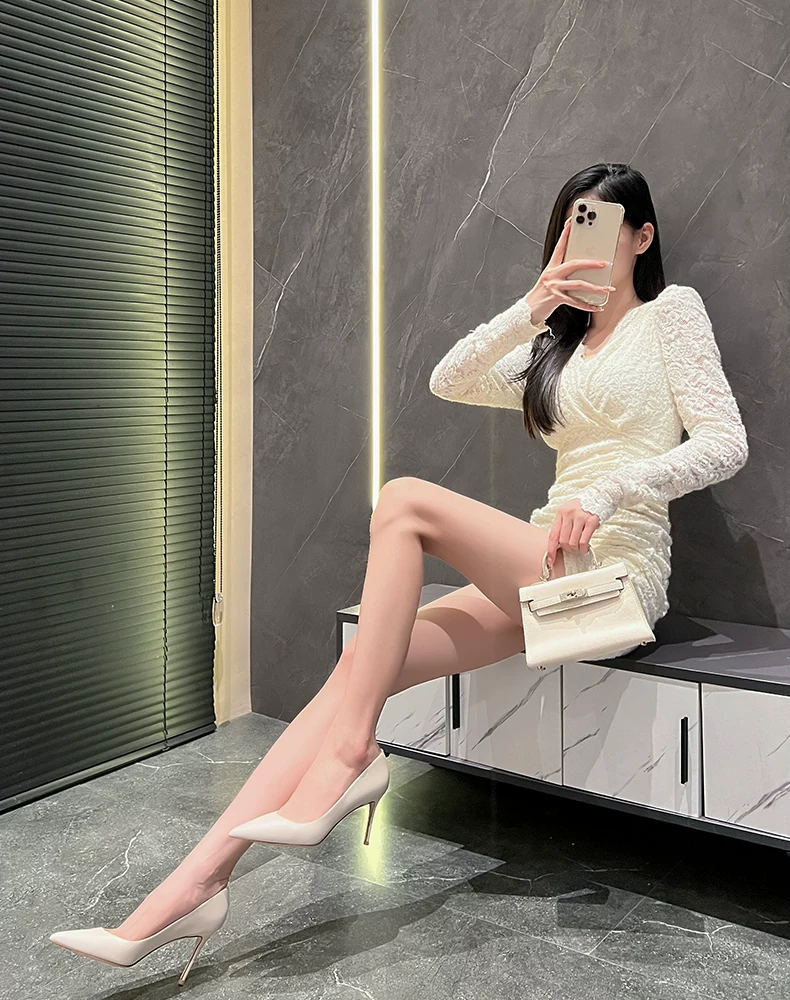
Grey is a range, and office light exposes it
Grey heels look like a safe neutral and behave like three different colours depending on the finish.
Cool grey with a blue undertone reads crisp under fluorescent light, which is what most offices have. Warm grey with a brown undertone goes muddy in the same light and looks noticeably better in daylight. Mid-grey is the safest, and it’s the one that photographs consistently.
Finish changes it again. Matte grey leather looks more expensive than grey patent, which tends to read slightly plastic under strip lighting. Grey suede is the most forgiving of creasing and the least forgiving of rain.
What to check before buying, in practical terms:
- Look at the shoe in daylight and under a warm bulb if you can. Two lights, two verdicts.
- Compare the grey to your trousers. Warm grey against cool charcoal looks like a mistake at 9am and fine at 6pm.
- Avoid grey with a green cast if you wear navy. It’s the one pairing that reliably reads off.
Grey also has a useful property that black doesn’t: it doesn’t dominate. A grey heel with black trousers reads as a quieter line than a black heel does, which is why it’s become the default in offices where black feels severe.
The test that settles most grey purchases: put the shoe next to the trousers you wear most, in daylight, at 9am. Warm grey against cool charcoal will look like a mistake at that hour and fine in the evening glow of a restaurant, which is the wrong way round for a work shoe. Cool grey against warm beige is the other combination that fights. Mid-grey against navy is the one that almost never fails, and it’s the reason mid-grey outsells the rest.
One drawback worth naming: grey shows scuffs less than black but more than taupe, and it shows rain spots badly. A pair worn to work on a wet Tuesday will have a tideline across the toe by the time you sit down. If you commute on foot in a rainy city, a matte finish survives that better than suede does.
The strap question: security or pressure
An ankle strap is sold as stability. Seated, it’s often the opposite.
A strap that sits directly over the ankle bone will press on it every time you cross your legs. A strap 2cm above the bone, on the narrowest part of the ankle, distributes pressure and stays put. The difference is 20mm and it decides whether you can wear the pair for a full day.
Elastic panels are worth knowing about too. A hidden elastic gusset makes a strap comfortable for the first month and slack by the fourth. If the strap has no elastic and no adjustable buckle, it will be the fit you bought forever, which is either good or bad depending on whether it was right on day one.
Slingbacks get a bad reputation for the same reason. The back strap either holds or it doesn’t, and when it doesn’t the shoe flaps with every step. A slingback with a small elastic insert and a buckle is the version that works; the slip-on kind is for sitting down in.
If you want to see how a well-built strap behaves across a working day, this piece on slingback kitten heels for office-to-dinner wear walks through the same mechanics at a lower heel height.
Why 70mm beats 90mm in a car, and it isn’t comfort
If your day involves driving between meetings, heel height stops being a comfort question and becomes a control question.
Above roughly 80mm, most drivers end up either slipping the shoe off or using the ball of the foot on the pedal instead of the whole foot. That changes pedal feel and reaction distance. It’s not a safety lecture, it’s just what happens when the ankle can’t hinge far enough.
A 70mm heel lets you keep the shoe on and still hinge the ankle. A 50 to 60mm heel is better again, and a block heel is better than a stiletto because the contact patch is wider on the pedal and on the floor mat.
The sitting part of the day has its own number. Anything over 80mm puts the knee higher than the hip in most office chairs, which pushes the foot forward and loads the strap. That’s the actual reason a pair feels fine at 10am and unbearable by 3pm, and it has nothing to do with the padding.
If you only remember one figure: 70mm is the height where a grey heel can do a desk day, a car journey and a walk to a meeting without a change of shoes. Above that, you’re choosing a look and paying for it in the afternoon.
Floor mats are the detail people forget. A deep rubber mat under the pedals adds resistance your ankle has to work against, and a thin heel tends to catch in the ridges. If your car has mats with a raised pattern, drive in a block heel or keep a flat pair in the passenger footwell. It sounds fussy until you’ve done a 40-minute drive in a 90mm stiletto and arrived with a cramped calf.
Two failures nobody checks for
Heel slip and counter collapse. Both are invisible in a shop and obvious by week three.
Heel slip happens when the shoe is a half size too long or the last is too wide at the back. In a chair, it shows up as your heel moving up and down inside the shoe every time you shift. That movement is what wears the lining through at the back and what makes the shoe feel loose even though the length is right.
The fix is a heel grip or a tongue pad, which buys you comfort but doesn’t fix the fit. If the slip is more than about 5mm when you walk, the shoe is the wrong shape and no insert will change that.
Counter collapse is the other one. Press the back of the shoe; if it folds flat, it will fold flat under your heel too. A collapsed counter is why some pairs feel like slippers after a month and why the back of the shoe starts to curl outward at the top edge.
Neither failure appears in product photos, and neither is mentioned in most reviews. They’re the two things worth physically checking in the shop, which is exactly why buying shoes entirely online is a gamble even when the size is right.
Lining wear is the slow version of the same story. The inside of the heel counter is the first place a shoe looks old, because that’s where friction happens every time you slip them on. A leather-lined counter takes a year to show it. A synthetic one can look polished and thin within three months, and once the lining is through, the shoe is finished no matter how good the outside looks.
The sequence test: drive, sit, walk, repeat
Here’s a test you can run at home in about 40 minutes, and it predicts a working day better than any review.
Put the shoes on at the time of day you’d normally leave the house. Sit in a chair for 30 minutes with your feet flat, then cross your legs for five. Get up, walk to another room and back, then sit again for 30 minutes. Then walk 200 metres outside on pavement.
What you’re looking for, in order:
- A red line across the instep after the first sit. That’s the strap sitting too low, and it won’t improve.
- Numbness or tingling in the toes after 30 minutes seated. The toe box is too shallow.
- Any heel movement on the walk. The counter or the size is wrong.
- Heat inside the shoe after the second sit. The lining isn’t breathing.
If the pair passes all four, you’ve got something you can wear to work. If it fails one, decide whether that one is tolerable, because it will be the thing you notice every single day.
Run the test twice if you can: once in the morning and once at 6pm. Feet change over the day, and a pair that passes at 9am can fail after eight hours of standing and heat. The evening run is the one that matters, since that’s when most people are deciding whether to keep a pair they’ve already worn outside.
There’s a cost argument here too. A 70 euro pair worn 150 times a year costs less per wear than a 40 euro pair worn 20 times, and the difference is almost always whether the pair survived the sequence test. The maths on that is set out in this cost-per-wear breakdown for women’s shoes, and it’s the argument for spending once rather than three times.
Before you order, in this order
Measure your instep and heel-to-ball length at the end of a day. Then decide the heel height by the worst hour of your week, not the best one.
Then pick the finish. Matte leather for a desk job, suede if you don’t commute in the rain, patent only if you’re not sitting for long stretches. If the listing mentions a tested lining, OEKO-TEX Standard 100 covers the dyestuffs and finishes most likely to irritate skin in a closed shoe, which matters more when you’re in them eight hours a day.
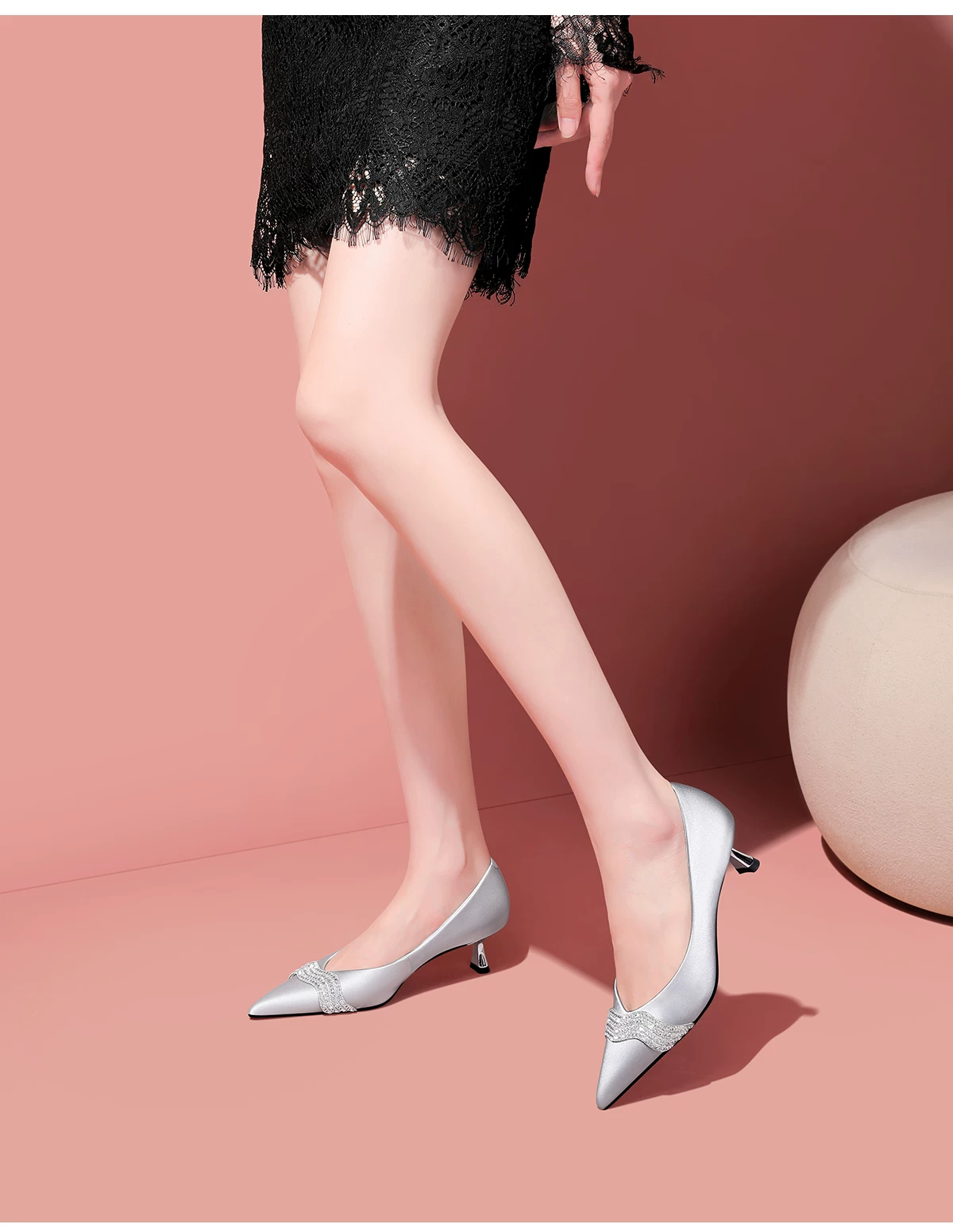
Then choose the shape. A pointed toe with a mid heel and a firm counter is the configuration that survives an office week. Something like these grey pointed heels with a slender heel and a closed toe is the right category: low vamp, adjustable fastening, counter that holds. For a softer, more forgiving shape in the same colour family, a shallow grey pair with a padded collar is the alternative if your instep runs high.
And if you’re still deciding between grey and black, the heels range sorted by colour is the faster way to compare both without opening twenty tabs. Style coverage of office dressing tends to treat grey as the safe middle; Who What Wear’s workwear edits are a reasonable sanity check on how it’s being worn this season.
One last thing worth saying, because it’s the pattern that repeats most often. Most people buy office heels one size too small, because a snug shoe feels supportive in the shop. Then they spend three months in a chair with their toes pressed against the front. Buy the size that lets you wiggle all five toes while seated, and let the strap do the holding.
If you’re ordering online and can’t decide between two sizes, order both and return one. Grey shoes in the womens heels category are rarely stocked in half sizes, so the choice is usually between a shoe that’s slightly long and one that’s slightly narrow. Try both seated, keep the one where your toes stay flat, and send the other back inside the window rather than hoping.
