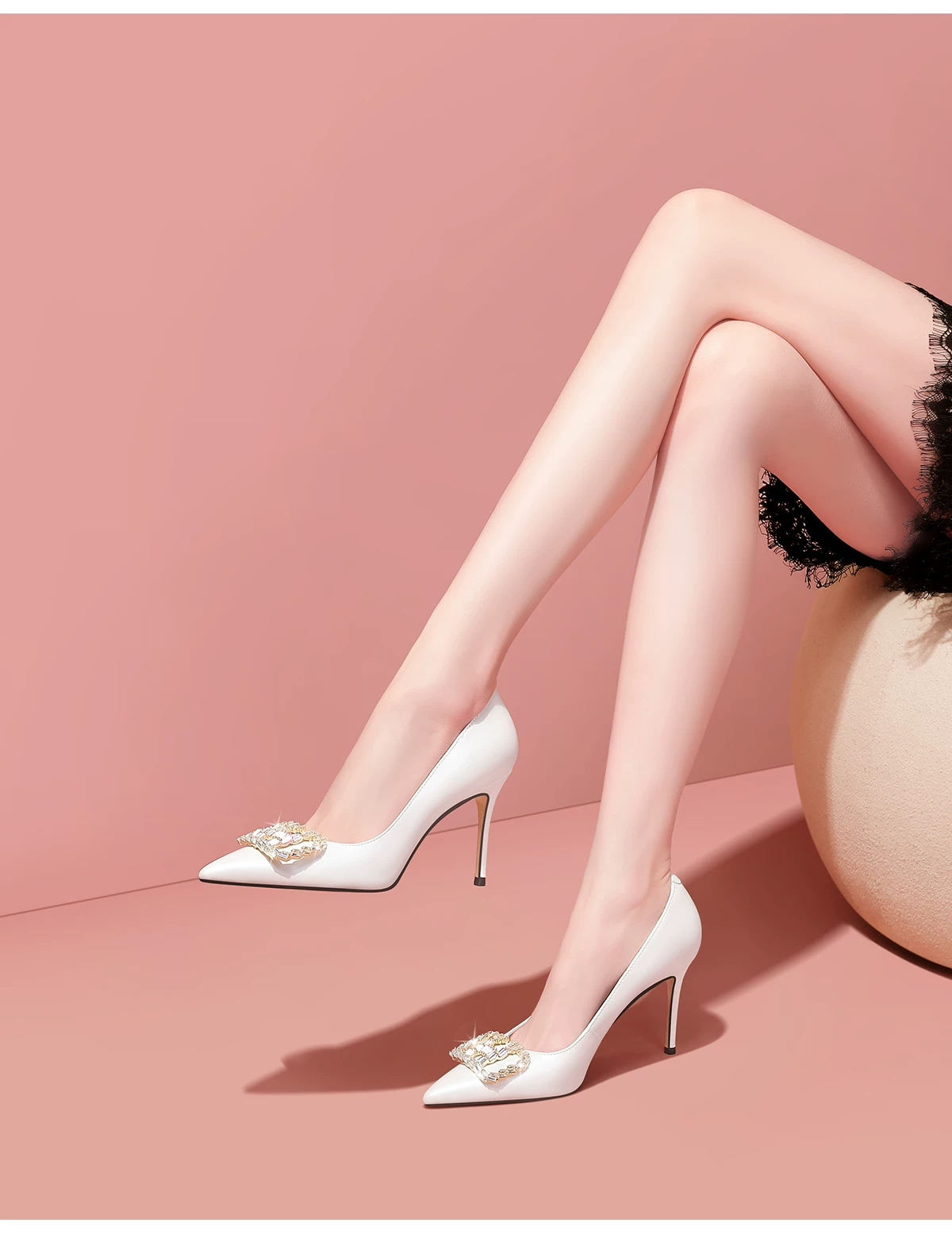
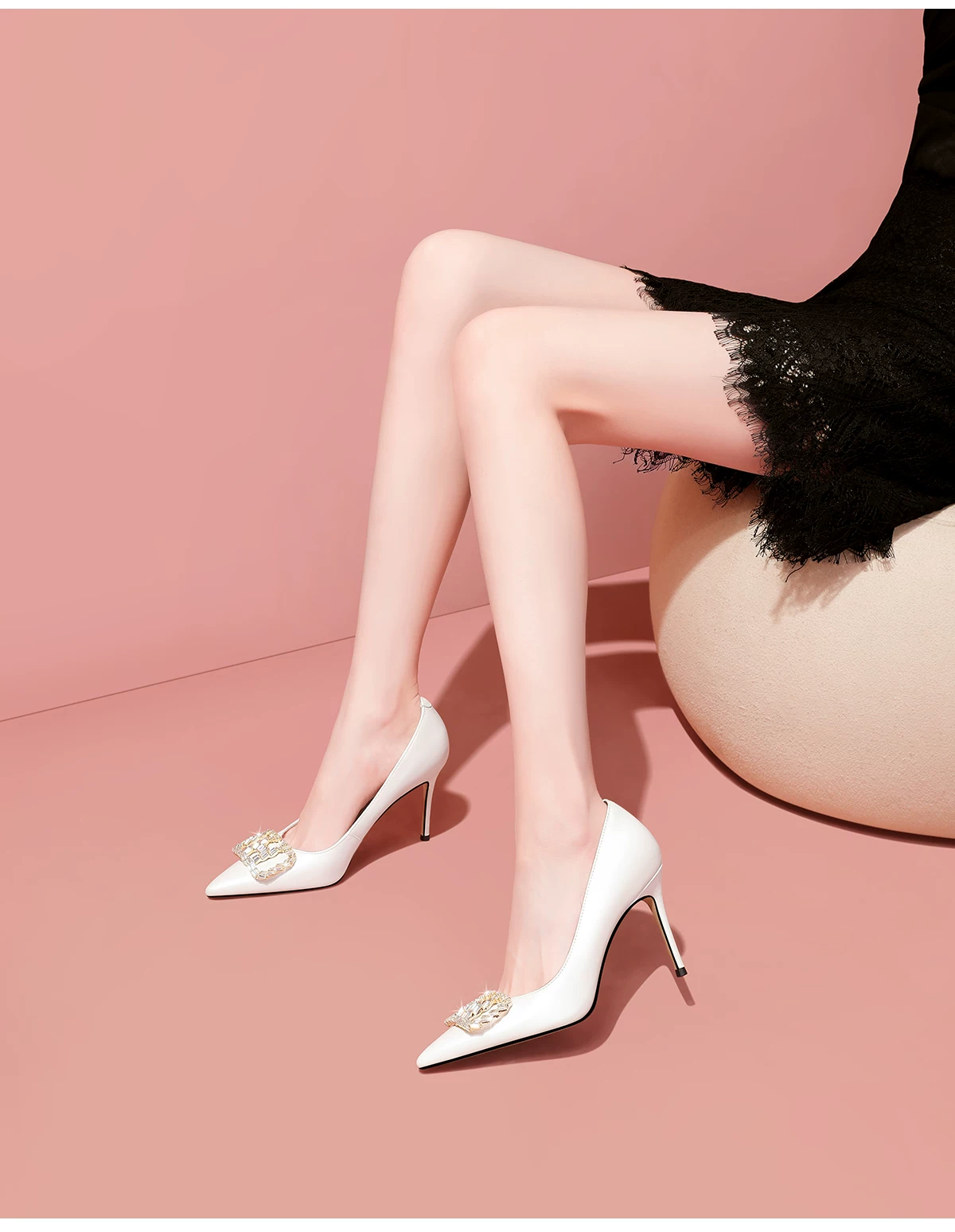
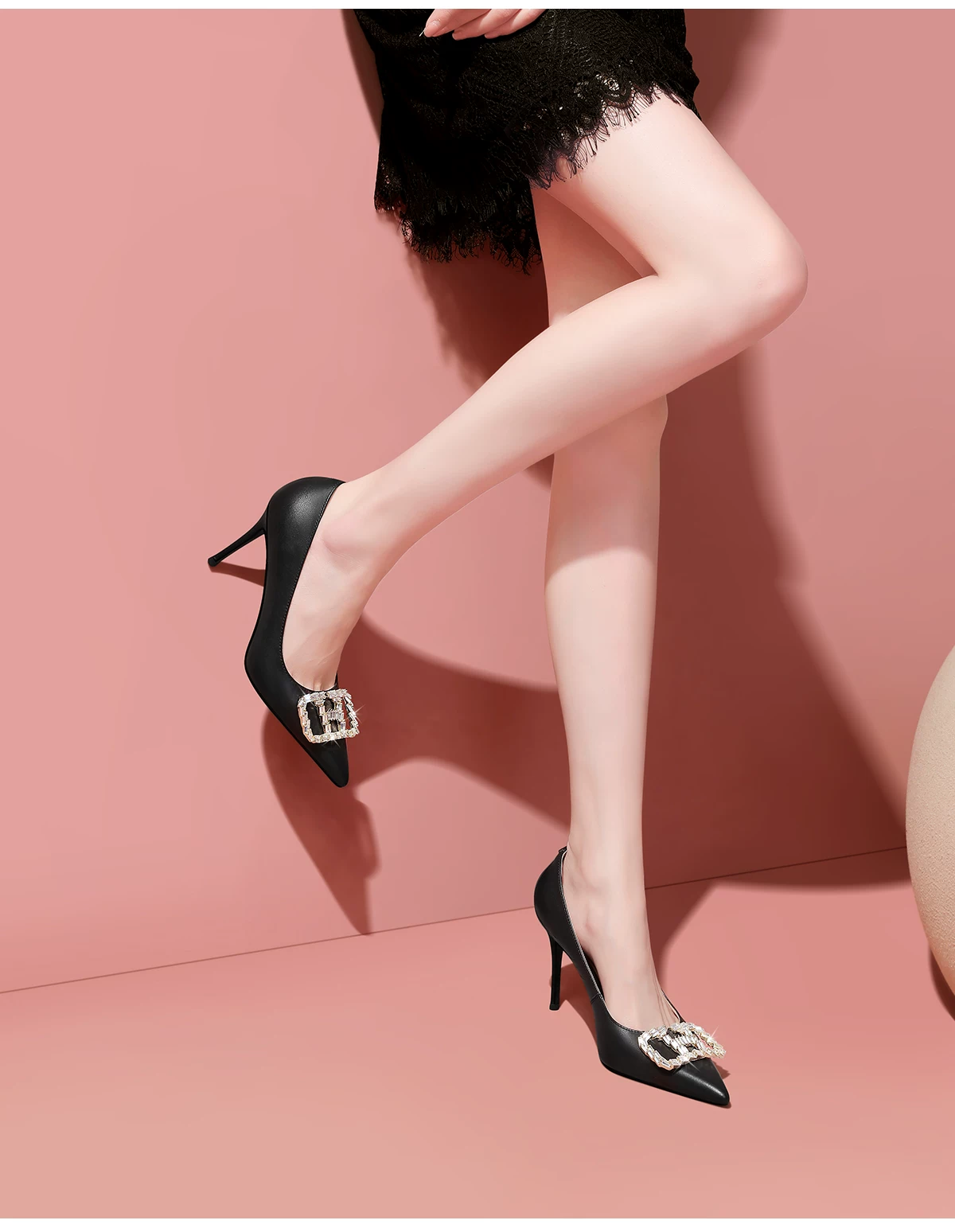
It’s 9:40 on a Saturday night, the wedding is in eleven days, and you’re on your fourth pair of white heels. The first two looked chalky in photos. The third pinched your little toe before you got halfway across the shop floor. So now you’re looking at a 9cm pointed pair with a crystal buckle, wondering whether $278 buys something you can stand in for six hours.
Fair question. I’ve worn these white pointed-toe heels for three weeks: two weddings, one long office day, a dinner that ran past midnight. Here’s what I’d want a friend to tell me before I paid.
What 9 cm does to your walk by hour three
The product page lists the heel at 9 centimetres, which is about 3.5 inches. That’s the height where a shoe stops being a heel and starts being a posture decision. Your weight moves onto the ball of your foot, your calf shortens slightly, and your steps get shorter without you noticing.
Hour one, nothing. You feel tall, the toe is sharp, and the crystals catch the light when you walk past a window. Hour two, you notice the ball of your foot. Hour three, you start scanning the room for a chair and doing that thing where you shift weight from one leg to the other while pretending to listen to someone’s speech.
In my own test I got close to six hours before I wanted to sit down properly. The page promises twelve. Six is generous enough for a wedding if you plan the sitting, and optimistic for a trade fair.
Walking is different too. A pointed toe compresses your toes slightly, so your stride lands shorter and your heel strike is softer. On carpet that’s fine. On cobblestone outside a church, you’ll want to hold someone’s arm, and not for romance.
Test this in the shop if you can. Walk fifteen steps on a hard floor, then come down a single step the way you would on a staircase. If your heel slides off the back edge, the shoe is too loose at the heel and no insole will fix it cleanly. Mine held, barely, and only because the sheepskin lining has grip.
Balance is the other thing to watch. A 9cm heel puts your ankle joint at an angle, and the narrow heel tip gives you a small base to stand on. On a moving train platform, or on wet stone steps, you’ll feel that base. Mine wobbled twice on gravel and once on a polished office floor, and I’m used to heels.
My rule for this height: keep a flat pair in the car or under the table. Nobody notices a swap at 9pm.
The size run ends at 39, so measure before you guess
Sizes go from 34 to 39 in whole numbers. No half sizes. That matters more with a pointed toe than with any other shape, because the tapered end eats the room your toes need.
My foot measures 23.5cm, and the 37 fits with a thin liner inside. I’d call the length true to size. The toe box, though, is the honest part of this review. Pointed shoes always run narrow at the front, and this pair is no exception.
- Average width foot: your usual EU size, maybe a liner if you wear them barefoot.
- Wide foot: go up one whole size. The taper will still press your little toe by late afternoon.
- High instep: the vamp is cut low across the top of the foot, so check that edge before you commit.
That’s the thing about white pointed toe heels in a shop: they either fit in the first minute or they never really will. The lining softens, the toe does not.
The sheepskin lining gives about 2mm after a week of wear, which loosens the heel but never the toe. That’s the shape of every pointed shoe, so size for the toe and accept a slightly roomy heel.
Measure at the end of the day, not in the morning. Feet swell by up to half a centimetre after a few hours of standing, which is exactly why a pair that fits at 9am can feel tight at 6pm. Stand on a sheet of paper, mark your longest toe and your heel, and use the centimetre number instead of the size you wore in your last pair.
If your foot is longer than 25cm, the 39 won’t do it, and no amount of stretching will help. I wrote about the half-size problem most size charts skip, and it’s the same trap here.
Calf upper, sheepskin lining, and a 31°C afternoon
The upper is calf leather, and both the lining and the insole are sheepskin. Out of the box it’s soft, with none of the stiffness that makes new leather pumps need a fortnight of plasters.
Soft has a cost. Sheepskin holds warmth. I wore these on a 31°C Saturday, roughly 8,000 steps, and by four in the afternoon my foot felt damp inside. Nothing dramatic, but you’ll want them off by six. In October, at an evening reception, they’re comfortable enough that you forget them.
If you care where the leather comes from, the OEKO-TEX Leather Standard is the certification to look for on finished leather goods, since it tests for harmful substances rather than just raw hides. This pair doesn’t advertise a certificate, and I’d rather say that than pretend otherwise.
What I’d actually do about the warmth: wear them with a thin no-show liner for long days. Cotton, not nylon, because nylon just slides and traps the same damp. It changes the fit by almost nothing and takes the worst of the afternoon off your foot.
Care is simple until it isn’t. A damp cloth handles dust. Skip silicone sprays on white leather, because they yellow over a season. And don’t soak the crystal buckle; a soft dry brush is enough.
The sole is a cow tendon bottom, which grips tile and dry pavement well and offers very little on a wet pavement. If your winter involves rain, this is a summer and indoor shoe.
The colour shifts under three lights
This is the part that nearly made me return them. White leather isn’t one colour, and the shop knows it.
Under the warm 3,000K spots in the store, they read cream, almost vanilla. Flattering, slightly expensive looking, easy to match with an ivory dress. Then I walked out into midday daylight and they went bone white, cooler and a shade closer to paper. Not worse. Just different enough that my “matching” ivory clutch suddenly looked beige.
At 9pm under a restaurant lamp, they turn white again, and this is where the crystals earn their keep. The square buckle throws small warm sparks every time you move your foot, which reads beautifully in photos and gets commented on. It’s the one detail nobody ignores.
The shade problem has a fix, and it’s the dress rather than the shoe. Put the heels next to anything you’re considering and look at the pair in the doorway, half in daylight and half in the shop. If the two whites fight, one of them is warm and one is cool, and no accessory will settle it.
Two practical notes. Your phone camera will shoot them one or two shades lighter than your eye sees, so check the photo, not the shoe. And if you’re pairing with ivory, try the two together in daylight before you buy anything else. Pointed pumps at this height have been back on every runway for years, and Vogue’s footwear coverage keeps circling the same shapes, so the styling risk isn’t the shoe. It’s the shade.
One more thing nobody warns you about: white leather shows every scuff. A car door, a curb, the metal edge of a bar stool. Mine has a grey smudge on the outer left heel already, and I’ve stopped caring.
How to wear them without looking like a bridal party
A white pointed heel is loud in a way black isn’t, so the rest of the outfit has to be flatter than you’d think. Here’s what actually worked for me.
- Cropped wide-leg raw denim, white T-shirt, no jewellery. The shoe does the work.
- Navy suit trousers and a grey knit. Reads office, not hen party.
- Black slip dress for evening. The contrast is what keeps it from looking bridal.
- Grey wool midi and an oversized white shirt. Same colour family, different texture.
The hem matters as much as the outfit. A trouser that ends right at the ankle bone shows the whole shoe and lengthens the leg. One that covers the heel makes a 9cm heel look like a mistake. If you’re between lengths, get them taken up 2cm.
Because the vamp is cut low, your toes and the top of your foot are on show. Keep nails short and neat, and skip dark polish with a white shoe unless you want that contrast on purpose.
And leave the all-white outfit alone. White shoe plus white dress plus white bag is a costume. One white piece per look, maximum.
Where they work, and where they don’t
Weddings are the obvious use. Stand, sit, stand, walk to the buffet, stand for photographs. Four to five hours with breaks is realistic at this height, and the pointed front photographs well in group shots because it reads sharp from a distance.
Office days are hit and miss. A desk job with a 700m walk from the station is fine. A day of site visits, stairs, and standing in a meeting room is not, and you’ll know by lunch.
Dinners and evenings out are the sweet spot. Two hours, seated, good lighting, and the buckle does exactly what you bought it for.
- Wedding guest: yes, with a flat backup pair in the car.
- Nine-hour workday: only if most of it is at a desk.
- Travel: they pack flat and weigh little, but don’t plan a walking day around them.
Cost per wear at $278, and two things I’d change
The listed price is $278. If you wear them to fourteen events in two years, that’s about $19.86 a wear, which is cheaper than the $35 pair you replace twice. Add heel tips every three or four months at roughly $10 a pair, and the number holds up.
What doesn’t hold up is the first fortnight. Mine needed two weeks of short wears before the right heel stopped rubbing, and I used a fabric heel grip for the first four outings. That’s normal for leather, but nobody puts it on a product page.
Second complaint: the toe. By hour five my little toe is pressed against the taper. It’s the price of the silhouette, and if you know that going in, it’s manageable. If you have wide feet, it may not be.
Third, and this is small but real: the crystals collect dust and lint from a carpeted floor. Halfway through a reception I looked down and the buckle had a grey fuzz on it. A wipe with a dry cloth fixed it in ten seconds, but someone should tell you.
If 9cm is more than you want, a brown pair built for commuting sits lower, or read nine hours in one pair of office shoes before you spend. The full selection lives under women’s shoes, and you can browse the whole shop page by price if $278 is a stretch.
Heel tips are the part that quietly decides whether you keep a pair. The plastic cap on a narrow heel wears down unevenly, and once you’re through to the pin, the shoe starts catching on carpet and tearing its own leather. Mine lasted about four months of regular wear. Check them once a season, because a cobbler replaces them for less than a takeaway.
One last cost nobody counts: storage. White leather picks up dye from dark shoe boxes and from the side of a leather bag. Keep them in the dust bag they arrive in, and don’t stack anything on top.
My honest summary: buy them for the buckle and the silhouette, size for your toes rather than your heel, and plan to sit down at some point. If you need a shoe that survives twelve hours standing, this isn’t it and no white heel is.
So, which matters more for the day you’re buying them: the photo at 9pm, or your feet at 11?