

A woman walks into a shoe shop with a wide forefoot and comes out with a pair that fits at the toe and gaps at the heel. That’s the normal outcome, not the exception. Heels are built on a last that assumes one proportion between length and width, and most feet don’t match it.
The frustrating part is what the box tells you. It gives a size. It rarely gives a width. Women’s shoes, unlike men’s, often carry no width marking at all, so the only way to know whether a pair is wide is to put it on.
What follows is how width behaves in a heel, where the extra room goes when a brand offers a wide fit, and which shapes give a wide foot space without looking like orthopedic stock.
The width letter that never makes it onto the box
Men’s shoes are usually sold with a width letter after the size: D, E, EE, EEE. Women’s shoes are usually sold with a number and nothing else. The result is that “wide” in a women’s range means whatever the brand decided it means that season.
Conventions exist, and they aren’t standardised across countries. In UK sizing a D is often the standard women’s width, E is wide, EE is extra wide. EU width is usually a letter grade from the last maker and may never appear on consumer packaging. US ranges vary enough that a wide in one house fits like a standard in another.
Shoe sizing systems have been harmonised on length for decades and left width informal, which is why the letter on the box is a weak promise.
The practical consequence: for extra wide heels for women, the only trustworthy information is a measurement in millimetres at the ball, or a fit note that names the last. Brands that publish ball width are usually the ones building a separate wide last rather than grading a standard one upward.
A wide fit isn’t one adjustment. It’s a decision about which part of the shoe grows, and the three common approaches produce three different fits.
Ball width only. The widest part of the shoe is extended, usually by 4mm to 8mm total, while the heel and waist stay the same. This is what most wide-footed people need, and it’s the version that keeps the shoe from slipping at the back.
Whole-shoe grading. The entire last scales up proportionally. Length, ball, waist and heel all grow together. It’s cheaper to produce because the pattern scales cleanly, and it fits badly: the heel becomes too wide and the shoe flaps.
Volume increase. The upper is made deeper rather than wider, which helps a high instep and does nothing for a wide forefoot. Plenty of comfort ranges do this and call it a wide fit.
That second option is the trade’s quiet failure. A graded-up standard last is what most mid-priced brands ship when they add a wide size, because a genuinely separate last costs tooling money and inventory. The shoe looks right on the shelf and swims at the heel.
In a heel specifically, ball width matters more than total volume. Your heel is narrow and bony, and the shoe has to hold it in place while the toe box stays generous. If you have to choose, choose the pair that fits your heel and gives room at the ball, not the pair that’s loose everywhere.
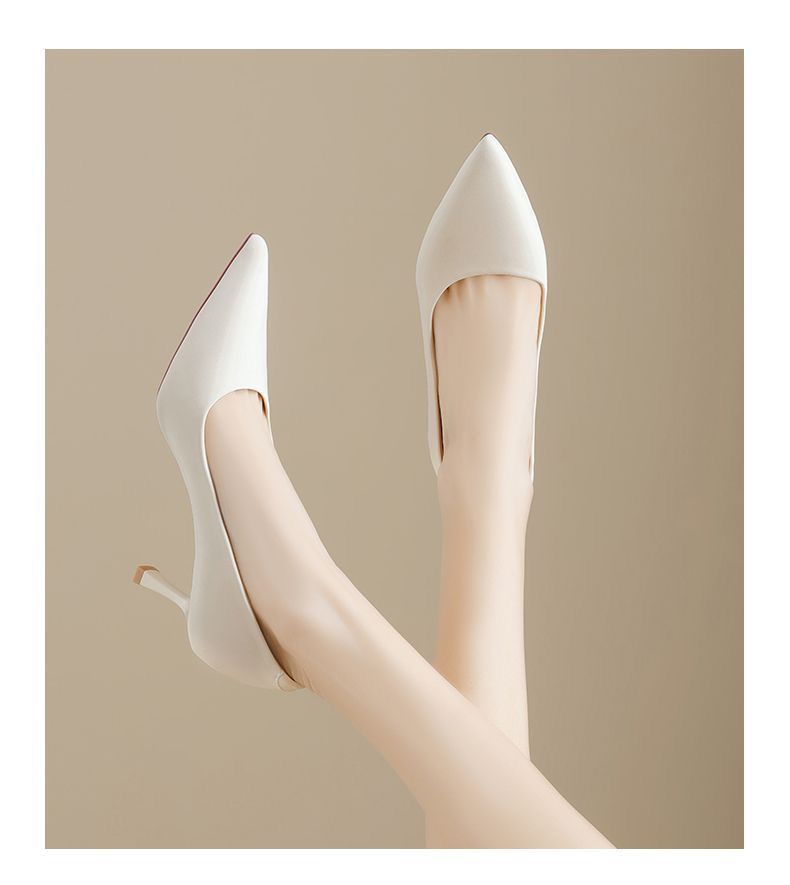
Why the grading breaks above a 41
In this trade you see the same pattern every season. A size 37 in a wide fit is usually well made. The same shoe in a 42 is often just longer.
When a last is graded up, ball width grows about 3mm to 4mm per size. Foot width in the population doesn’t grow at the same rate at the top of the range, and many brands stop developing their wide last at 41 because the stock volume doesn’t justify it. The largest sizes end up as stretched versions of a smaller pattern.
Three things go wrong up there:
- The toe box narrows in proportion even as the shoe lengthens, because the pattern tapers over a longer distance.
- The heel counter gets wider, so the shoe grips nothing.
- The vamp sits higher and cuts across the instep instead of clearing it.
If you’re a 42 or above with a wide foot, the honest advice is to stop hunting your size in standard ranges and start hunting shapes. A round-toe 43 in soft leather will fit better than a pointed wide-fit 42, and it often costs less because you’re not paying a wide-fit premium for a pattern that was never redesigned.
It helps to know what a shoe last actually is: a solid form shaped like a foot, from which the upper and sole patterns are cut. Every fit decision in a shoe traces back to that block, and no amount of finishing changes its proportions.
Pointed toes and wide feet are a bad contract
The pointed toe is the most common shape in heels and the least compatible with a wide forefoot. The geometry is simple. The shoe tapers from the ball forward, so usable width drops sharply over the last 40mm. A wide foot gets pushed into that taper, and the pressure lands on the joint at the base of the big toe.
What follows is predictable. The leather bulges over the sole edge within a week. The little toe presses against the side. After an hour the foot slides forward because of the heel, and now the toes are compressed against a narrowing wall.
A wide fit in a pointed shape doesn’t solve this. It moves the pinch point back by 5mm and leaves the taper intact. The shape is the problem, not the width.
What works, in order: square toe, round toe, almond toe, soft-point. A square toe gives the most room and reads modern in a low heel. A round toe is safest and looks dated only in a very high stiletto. Almond is the compromise that still photographs sharp. Soft-point, where the leather is thin enough to give, is the only pointed option worth trying, and only under 70mm.
One exception: an open toe. A peep-toe removes the wall your toes press against, which is why some wide-footed people find them easier than closed pumps. The trade-off is visible toes and a shoe that’s wrong for most offices.
When a heeled boot solves the problem
A wide foot often fits better in a heeled ankle boot than in a pump, and the reason has nothing to do with width grades. A boot fastens. A zip or a lace lets you tune the fit around the instep and the ankle, which is exactly where a pump gives you no adjustment at all.
Three details decide whether a wide-footed boot works. The shaft has to clear the ankle bone without pressing. The zip has to sit at the side rather than the back, because a centre-back zip pulls the counter tight across the heel. And the toe box has to be round or almond, since a pointed boot pinches at the same place a pointed pump does.
Height matters too. A 50mm to 60mm block heel in a boot gives you the same leg line as a higher pump with far less forward slide, which means the toes stay off the front wall. For anyone who has spent years being told to size up in pumps, that’s the practical fix.
The one thing boots can’t fix is the ball width in a narrow last. If the shoe is built on a standard last, a zip won’t widen it. It only stops the foot sliding forward. For the specifics of shaft height and ankle fit, the notes on heeled boots and the two measurements that matter go through the numbers.
Measure your foot in three minutes
Most people guess their width from how shoes feel. That’s unreliable, because feel changes with the shoe. Three measurements give you something to compare against a listing.
Stand on a sheet of paper in the evening, full weight on the foot, and trace the outline. Do both feet. They’re rarely identical.
Length: heel to longest toe in millimetres. Add 10mm for toe room and that’s the internal length you need.
Ball width: the widest point across the ball, straight across, in millimetres. This is the number that decides whether a shoe fits. A typical medium women’s foot runs about 90mm to 95mm at the ball in a EU38. A wide foot runs 100mm and up.
Heel width: across the back of the heel at its widest point. This decides whether the shoe stays on. Most people never measure it, and it’s the reason a wide-fit shoe can still flap.
Write the three numbers down and keep them on your phone. When a listing gives a ball width you can compare directly. When it doesn’t, ask. A brand that sells wide fits should answer in millimetres, and a vague answer tells you what you need to know.
For the same mechanics in a flat shoe, the notes on wide walking shoes and where the room is added are worth reading alongside this.
What a cobbler can widen, and what they can’t
There’s a persistent belief that any leather shoe can be stretched to fit. Half of that is true.
Smooth leather can be stretched about 2mm to 3mm at the ball, sometimes 4mm with heat and a proper last. That’s enough to turn a slightly tight pair into a comfortable one. It’s not enough to convert a standard width into a wide fit, and it won’t help at all if the shoe is short.
Patent doesn’t stretch. Neither does most corrected-grain leather with a heavy finish, nor any shoe with a cemented toe cap. Suede stretches more than smooth leather but recovers less, so a stretched suede pair tends to relax back within a month.
What a cobbler can genuinely fix: a heel that slips, by adding a pad inside the counter; a vamp that presses on the instep, by stretching locally; a shoe that rubs at one spot, by softening that panel. What they can’t fix: a toe box that’s too shallow, a last that’s the wrong shape, a sole that’s too narrow under the ball. Those are buying decisions.
One test before paying for a stretch: press your thumb into the upper at the widest point. If it gives 2mm easily, the leather will stretch. If it feels like a board, save your money.
Shapes that read wide without looking wide
People avoid round-toe wide shoes for appearance, not comfort. A wide shoe can look like a wide shoe, and nobody wants that. The good news is that most of the visual bulk comes from three details you can control.
Colour. Dark shades recede. A black or chocolate round-toe heel looks noticeably slimmer than the same shape in cream, because the eye loses the sole edge against the ground.
Sole edge. A slim sole that follows the upper tightly looks narrower than one with a visible welt or a chunky platform rim. Three millimetres of sole edge is the difference between neat and clumpy.
Vamp line. A higher vamp covers more of the foot and reads longer. A very low-cut vamp exposes the widest part of the forefoot and makes it the focal point, which is the opposite of what a wide foot needs.
Put those three together and a wide-fit heel in dark leather with a high vamp and a slim sole looks like a normal shoe. That’s the version worth buying, and it’s usually the one that sells out first.
Two more visual levers people miss. An ankle strap cutting across the narrowest part of the foot makes everything above it look wider, so a wide forefoot plus a strap is a double dose of width. And a heel that tapers to a thin tip draws the eye upward and away from the toe box, which is why the same shoe in a stiletto reads slimmer than in a block, even though the forefoot is identical.
What doesn’t help: platform soles. A 20mm platform lifts the shoe and adds visible bulk at the base, and bulk at the base is exactly what a wide foot doesn’t need. It makes a long day more bearable and the shoe look wider. If comfort is the priority, a lower heel beats a platform every time.
What to ask before you order
Four questions separate a real wide fit from a marketing label. Ask them in writing if you’re buying online, and ask them in the shop if you’re not.
What’s the ball width in millimetres for my size? Is the wide fit built on a separate last or graded from the standard? What’s the heel width at the counter? What’s the return policy if the pair has been tried on indoors?
If a brand answers the first two, it usually knows what it’s selling. If the reply is that the wide fit is very comfortable, assume a graded standard last and size accordingly.
Then plan for one return. Wide fits are inconsistent enough that most people need two attempts, and a shop with a 30-day window and free returns is worth a 20 premium over one with a 14-day window and paid postage.
Give the pair a proper test when it arrives: ten minutes indoors on hard floor, then two minutes standing still. Standing is where a wide shoe reveals whether the heel holds or the whole foot slides forward into the toe. If you can feel the front wall on your longest toe while standing, send them back. Browse the women’s shoe range with your three measurements written down and the choice narrows from a hundred listings to a handful of shapes.
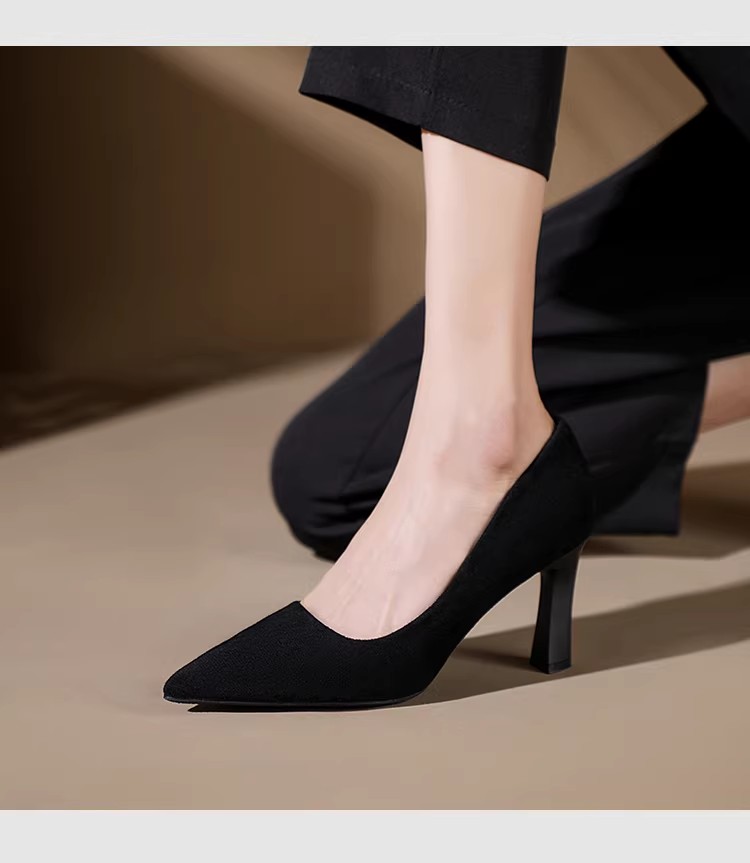
Two shapes worth trying first, both on the forgiving end of the spectrum. A soft leather shallow-mouth pair with a small heel gives at the vamp and keeps the pitch low, which is the combination that suits a wider forefoot best. And a suede commuter pump with a soft sole handles a high instep better than patent ever will, though the nap will relax after a month of wear.
None of this is quick. But a wide foot that finds the right last tends to buy the same shoe three times over the following years, which is more than most people can say about their heels.
Start with the paper trace tonight. Two numbers, ball and heel, written on your phone, will save you more money than any buying guide, including this one. Then shop the heel range by shape first and size second, because in a wide fit the shape is what decides whether the pair gets worn or returned.
