

At 5:40 on a Tuesday in late October, the light in my hallway turns the colour of weak tea. I had two pairs of shoes lined up against the skirting board, phone in hand, trying to answer a question a friend had texted me an hour earlier: which pair photographs better for the shop grid she’s rebuilding before the holiday rush. One was a sand-coloured Clarks Desert Boot I’ve worn since spring. The other was a pair of mesh walking shoes from our own shelf, the kind of shoe you buy because your feet hurt at four in the afternoon, not because it looks good on a shelf.
I took forty photos of each pair in the same spot, same phone, same 2x zoom, and then I sat on the floor and looked at them properly. The answer surprised me, and it wasn’t the one I expected. We’re not affiliated with Clarks. Brand names are used for identification only.
What follows is a purely personal read on how these two shoes behave in front of a camera in autumn, plus what happens to them on your feet after the photo is taken. Nothing here is a lab result. It’s one woman, one hallway, one window, and about ninety minutes of my life I won’t get back.
Two pairs, one hallway, one very ordinary question
The Clarks pair is the Desert Boot, the one the company has been making since 1950, when Nathan Clark adapted a crepe-soled chukka he’d seen in a Cairo bazaar, per the brand’s published history. Mine are sand suede, UK 5, and the label inside confirms it. They’re the shoe people photograph on cobblestones with a coffee cup just out of frame.
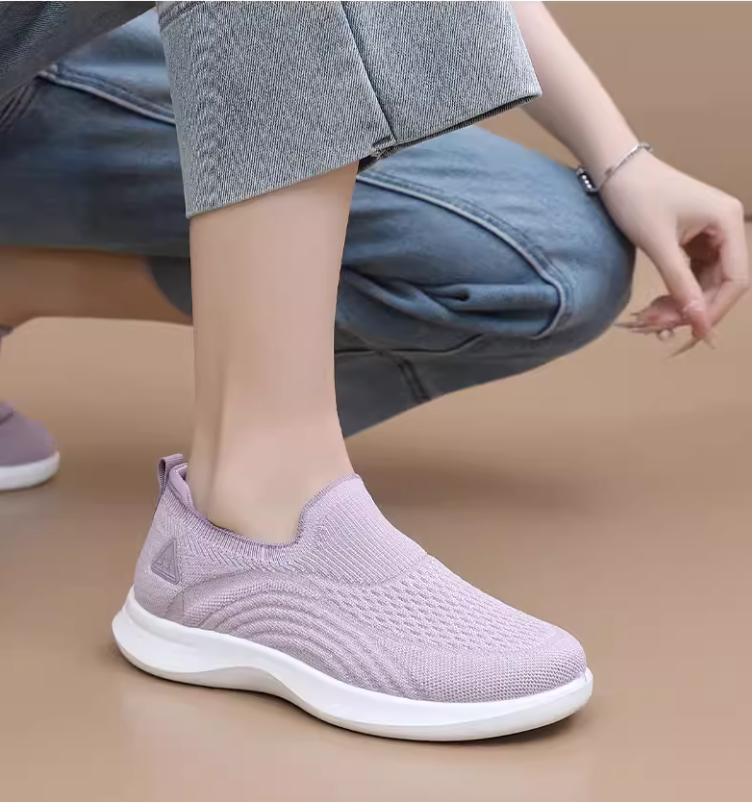
The other pair is the breathable mesh walking shoes we list at $49, in black, with EU sizes running 34 to 40 on the product page. They weigh almost nothing in the hand. They look, honestly, like a shoe designed by someone thinking about feet rather than about photographs.
That contrast is the whole story. Autumn light rewards texture and punishes flatness. Your phone camera, which is doing more work in this comparison than either shoe is, reads surface first and shape second. So the question “which photographs better” is really two questions wearing one coat: which one has a surface the light can describe, and which one has a silhouette that survives being shrunk to a thumbnail.
If you’ve been circling Clarks walking shoes and a mesh trainer for a week, here’s the short version before the long one. The Clarks pair wins on texture in low, warm light. The mesh pair wins on shape consistency, and it wins by a wider margin than I expected once the photos were scaled down to grid size. Neither wins everything, which is why this is worth writing down rather than settling with a one-line verdict.
What October light does to a matte mesh upper
Autumn light sits lower in the sky and travels through more atmosphere, which shifts it warmer and softer, a phenomenon usually described as the golden hour in photography circles. Practically, that means two things for a shoe photo. Highlights get gentler, and shadows get longer and softer at the edges.
Gentler highlights are kind to matte mesh. There’s no glare point for your phone’s metering to latch onto, so the whole upper stays inside the exposure range. In my hallway shots, the black mesh pair held its detail from the toe box all the way to the heel collar with no fiddling. I didn’t have to tap the screen to fix exposure once, which is unusual for a black shoe.
The price of that evenness is flatness. A matte surface with no sheen gives the camera very little gradient to describe, so the shoe reads as a dark shape with faint seam lines on it. At full size it looks clean. Drop it to 400 pixels wide in a grid and it starts to look like a silhouette of a shoe rather than a shoe. You can see the outline, you can’t see the material.
That matters if your photos are going anywhere small: a shop grid, a story thumbnail, a marketplace listing where the image renders at 300 pixels on a phone. In those places, matte mesh loses information every time it’s resized. The fix is close framing and a bright background, which is exactly what the product shots on our sneaker section do. Wide shots of a matte shoe in dim light are a waste of everyone’s afternoon.
One more thing I noticed, and it’s the sort of detail nobody puts in a buying guide. The mesh pair picks up colour from whatever it’s standing on. On my oak floor it went warm brown at the sole edge; on the grey pavement outside it went cool and slightly blue. Suede doesn’t do that. Suede holds its own colour and pushes back.
Suede, crepe, and the long shadow problem
Suede is the opposite animal. It has nap, meaning millions of tiny fibres standing at slightly different angles, and each one catches the low sun differently. That’s why a sand suede boot at 5:40 in October looks like it’s made of three or four shades at once. The light does the describing for you.
The crepe sole helps too, and this is where the Clarks pair earns its reputation in photos. Crepe rubber has a slightly irregular texture and a warm off-white tone that sits nicely against autumn colours. On a pavement of grey limestone, that sole reads as a deliberate detail rather than as a slab. In my shots you could see the sole without zooming, which is more than I can say for the black rubber on the mesh pair.
But here’s the catch, and it’s a real one. Suede in autumn means damp pavements, and damp pavements mean grit. By the third walk of the week, the crepe sole of my pair had picked up enough dark grit at the edges that it photographed as a dirty stripe rather than a clean line. That’s not a defect of the shoe. It’s what happens to a pale sole in a wet season, and if you’re photographing footwear in November you’ll spend more time cleaning than shooting.
Depth of field behaves differently too. The nap of suede gives the camera’s autofocus something to grab at any angle. The smooth mesh gives it less, and on a couple of my wider shots the phone hunted for a second before locking. Not a disaster. Just an extra half-second per frame, and forty frames adds up to a lot of half-seconds.
If you want a working rule out of all this: matte and black needs close, bright, simple frames. Nap and pale tones can carry a wider frame with more context in it. That rule held in every pair of shots I took, from the hallway to the bus stop.
Which shape survives a vertical phone crop
Most of the photos you’ll take this month will be vertical, because that’s the shape of the screen they’ll be seen on. A vertical crop is unforgiving to shoes. It cuts the sides and keeps the middle, so the toe box and the heel counter do most of the storytelling.
The mesh pair has a rounded, slightly bulbous toe and a low profile, and in a 3:4 crop it fills the frame evenly from bottom to about two-thirds up. That even distribution is why it looks tidy in a grid. There’s no awkward empty space, no part of the shoe begging to be cropped out.
The Desert Boot is taller and narrower, with a shape that wants horizontal space. Cropped vertically, the shaft eats the top third of the frame and the toe sits near the bottom edge, so you end up with a lot of ankle and not much shoe. The solution is to shoot it on a diagonal, toe pointing into the lower corner. I did that with six frames and all six looked better than the straight-on versions.
There’s a second shape question that has nothing to do with the camera: what the shoe does to your leg line. The mesh pair is low and visually quiet, so it disappears under a wide trouser and leaves your ankle as the focal point. The boot cuts the ankle at a specific height and creates a horizontal line that either works with your hem or fights it. In photos I took of both pairs with the same jeans, the boot made my legs look shorter, and the mesh pair didn’t. That’s a proportion observation, not a judgement about either shoe.
For a fuller look at how white and pale shoes behave under different light, there’s a piece on the site about white walking shoes in daylight and flash that covers the exposure side in more detail than I can here.
The flaw in each pair that no photo will show you
I want to be straight about the weak spots, because a comparison with no drawbacks is a sales pitch in disguise.
For the mesh pair, the honest problem is that it looks like what it is. In photos taken at midday, in flat overhead light, the black upper went completely featureless and the shoe read as a dark lozenge with a white sole. I took eight shots in that light and deleted seven. If you’re shooting for a shop and your only window faces the sun at noon, this shoe will fight you, and no amount of angle-hunting fixes a surface that has nothing for the light to catch.
For the Clarks pair, the honest problem is maintenance, and it shows up in photos before it shows up anywhere else. Suede marks. Mine has a faint darker patch near the outer toe from a wet morning in September, and in warm side light that patch is the first thing I see in every frame. I’ve stopped shooting that side. For my feet, the boot also runs a touch long, which means the crease across the vamp sits further forward than I’d like, and creases photograph as shadows.
Neither of those is a reason to avoid either shoe. They’re reasons to know what you’re pointing a camera at. A matte shoe in bad light and a suede shoe with a water mark will both disappoint you in the same way: the photo shows the condition of the shoe rather than the design of it.
What I’d wear with each one, and where
Photographs don’t happen in a vacuum. Half of whether a shoe looks right in a picture is what’s above it, so here’s what I actually reached for.
With the mesh pair, I wore wide-leg wool trousers in a mid grey and a cream knit. The shoe stayed quiet at the bottom of the frame and the photo read as a person rather than as a product. It also worked with dark straight jeans and a long coat, which is the outfit I’d wear to walk four kilometres into town on a Saturday. What it did not work with was a midi skirt, because the low, sporty shape and a hem at mid-calf left a gap of bare ankle that looked accidental rather than styled.
In my experience, Clarks walking shoes and a mesh trainer sort into two different wardrobes, and that’s a styling judgement rather than a verdict on either one. With the Desert Boot, the easy pairing was a straight-leg jean with a visible turn-up and a heavy overshirt. The boot wants weight above it. Put something light and floaty on top and the photo looks like two different outfits met in a doorway. In autumn colour terms, sand suede sits well with rust, olive and denim blue, and clashes gently with most cool greys, which is a preference rather than a rule.
If you’re shooting for a shop, the practical version of this is a styling note per shoe. Ours would read: low-profile mesh, shoot with wide trousers in neutral tones, keep the frame tight, avoid midday. A boot would read: shoot on a diagonal, give it weight above, keep the hem clear of the shaft. Two lines each, and it saves an hour of guesswork on the day.
For sizing context on the mesh pair, the product page lists EU 34 to 40 and four colourways, black, brown, pink and purple. Mine are a 38 and fit with a thin sock. If your feet run wide, there’s a useful piece on the two centimetres most size charts skip that explains why the number on the box is only half the information.
The hour-eight question behind the photo question
Here’s the thing I kept coming back to while editing ninety photos. A shoe that photographs beautifully and hurts by lunchtime is a prop, not a purchase. So let me answer the question my friend didn’t ask.
Clarks walking shoes and mesh trainers usually get compared on looks, and to me it misses the point. I wore the mesh pair through a nine-hour day that included a school run, two hours standing in a kitchen and a walk to the post office in drizzle. By hour eight my feet were tired in the ordinary way, not in the specific way that means something is wrong. The insole is soft enough that I forgot about it, which is the highest compliment I can pay a walking shoe.
The Desert Boot is a different day. It’s fine for three or four hours of walking on flat ground, and it’s genuinely pleasant in dry weather. On a long day with a lot of pavement, the flat crepe sole transmits more of the ground than I want after about five hours, and my arches notice. I still wear them constantly, because they go with everything I own. I just don’t plan a ten-kilometre day around them.
That’s the part photos can’t tell you, and it’s the part that should decide your purchase. If your week involves long stretches on your feet, the low, soft, slightly unglamorous shoe is the one that will still be on your feet at six in the evening. If your week involves sitting down and looking deliberate, the boot earns its place.
For anyone rebuilding a wardrobe around walking rather than driving, the broader women’s shoe range is a better starting point than any single pair, and the capsule logic in the 2026 sports and leisure styles holds up if you want one shoe to cover gym, errands and a casual Friday.
How I’d decide if the photos are for work
If you’re photographing shoes to sell them, the decision rules are different from the ones you’d use for your own grid, and they’re more boring than they look.
Start with where the image will be seen. A 1200-pixel product page rewards texture and detail, so a napped suede or a visible knit is an asset. A 300-pixel marketplace thumbnail rewards contrast and outline, so a pale sole against a dark upper beats a monochrome shoe every time. Same shoe, two judgements, both correct.
Then decide what the photo has to prove. If it has to prove the shoe is soft and light, you need a frame that shows the upper flexing, which means a slight angle and a foot inside it. If it has to prove the shape, shot flat, side-on, clean background. Trying to prove both in one frame is why so many product photos look like nothing at all.
Clarks walking shoes shots that I actually kept were nearly all taken between four and six in the afternoon; nearly all the mesh shots that worked came from before ten in the morning. So start by being honest about your light. Between 10am and 2pm in late autumn, most north-facing rooms give you flat, colour-accurate light that’s good for showing true colour and terrible for showing form. Early and late, you get shape and mood but the colour drifts warm. If your only shooting window is the flat one, shoot texture-led shoes close and don’t attempt moody wide shots. If you have the golden hour, use it on the suede and the knits and leave the black mesh for a bright overcast morning.
And if you only take one thing from all of this: the shoe that photographs well is usually the one whose surface has something for the light to land on. That’s it. That’s the whole trick, and it’s why my friend’s question had a real answer instead of a shrug.
I kept both pairs. The boot is by the door for dry days and the mesh pair lives in the car, which tells you what I actually reach for when I’m in a hurry. The photos are still on my phone. Put Clarks walking shoes and ours side by side on a grid and the mesh pair looks better small while the boot looks better big. If you’re picking one for a grid, that distinction is worth more than any spec sheet.
