

It’s 7:20 on a Tuesday, the pavement outside your building has that grey shine that means last night’s rain hasn’t dried, and you’re standing in the doorway deciding whether the boots you bought in September can take another 400 metres to the bus stop. Mine made it. Then I got to the office and took them off under the desk for twenty minutes.
That’s the whole story of boots with heels in one morning. You can like how they look and still end up counting steps.
I’ve worn four pairs of boots with heels over two winters in a city that rains sideways, walking in women’s shoes on wet stone, and I’ve returned one pair, resoled another, and given a third to my sister because the shaft cut into my calf at exactly the wrong height. Below is what I’d tell you over coffee: which numbers actually predict comfort, which ones are decoration, and where I still get it wrong.
The 7:20 platform test that sorts heeled boots into two groups
Before anything else, do this. Put the boots on at home, walk to your front door, step down one step, and turn around on the spot. Then walk fifteen steps on tile.
Two things happen. Either your heel lifts out of the back of the boot, or it doesn’t. If it lifts by more than a centimetre, the boot is too long in the back and no insole will fix it cleanly. If it doesn’t lift at all, you’ve found a boot that will either be comfortable or will ruin your ankle, and only the next hour tells you which.
I learned this the expensive way with a pair of chocolate-brown knee boots that fit perfectly standing still. Walking, my heel slid up and down about 1.5cm each step. By the time I reached the station my sock had bunched under my arch. Forty minutes of that and you get a blister in a place plasters won’t stay.
The second half of the test is the turn. Spin on the balls of your feet on a hard floor. A heeled boot with a small heel tip, say 8mm across, will wobble and you’ll feel your ankle working to stay upright. A block heel 25mm across won’t move at all. That difference is worth more than any description of leather quality on a product page.
Do it in the shop if you can, and do it on tile rather than carpet. Carpet hides everything. So does a shop mirror, which is why the boots always look better there.
One more check while you’re standing there: shift your weight onto one foot and lift the other heel off the floor by about 3cm, then hold it for five seconds. If the boot’s shaft digs into your shin or the top edge folds over, the shaft is too stiff or too tall for you. Soft leather folds. Stiff leather cuts. You want the first one.
And walk on a slight slope, if the shop has a step or a ramp. Most of the trouble with heeled boots shows up on a downslope, when your toes slide forward and the ball of your foot takes a load it wasn’t designed for. Ten steps down and back tells you more than an hour of standing still in front of a mirror.
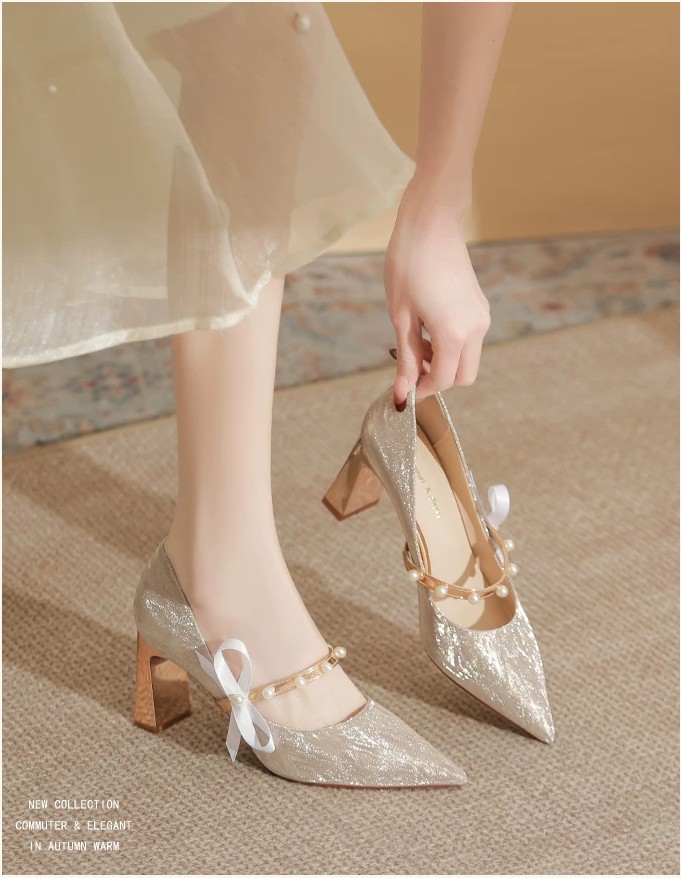
Heel height is the wrong number to shop by
Boots with heels live or die on this number, and product pages love a centimetre figure. 6cm, 8cm, 10cm. It reads like a specification, and it tells you almost nothing on its own, because the same 8cm heel can feel like a 5cm or like a 12cm depending on three other measurements.
First, where the heel sits under your foot. A heel placed directly under your heel bone transfers load straight down your leg. A heel set forward, under the middle of your heel, makes your arch do the work. Second, the platform or sole thickness at the front. Third, the toe shape, since a pointed toe shortens your effective foot length and pushes your weight forward.
My working rule: subtract the front platform from the heel height and treat the remainder as the real number. A boot listed at 9cm with a 2cm front sole behaves like a 7cm heel. That’s the number your calf cares about.
- Real height 4-5cm: you can walk an hour without thinking about it.
- Real height 6-7cm: fine for a commute with a desk at the end.
- Real height 8cm and up: a seated evening, not a shopping day.
Then there’s the question nobody asks in the shop: how long is your actual stride? Heeled boots shorten it. Mine went from about 68cm to 61cm, which sounds small until you multiply it by 6,000 steps and realise you’re covering 400 metres less ground per day at the same effort.
I’d rather have a 7cm block heel I can walk in than a 10cm stiletto I carry. The second pair photographs better and lives in the wardrobe. That’s a bad trade if you bought boots to wear.
One more thing about height. A taller heel changes your knee angle, and if you have any history of knee pain, a 9cm boot worn daily is a genuine risk rather than a style choice. I’m not a clinician and I won’t pretend to be. The biomechanics of high heels are well documented if you want the detail before you spend.
Where the shaft hits your calf decides the whole boot
This is the measurement almost nobody takes, and it’s the one that sent my third pair to my sister’s cupboard.
Boot shafts land in three zones on most adult women: below the calf muscle, across the widest part of it, and above it toward the knee. The middle zone is the risky one. If the top edge of the boot presses on the widest part of your calf, every step flexes the muscle into a hard seam. You’ll feel it as a band of pressure after about twenty minutes, and it doesn’t soften with wear the way leather does at the ankle.
Measure your calf circumference at its widest point, standing, and add 1.5cm. Then find the shaft circumference on the product page. If the boot’s number is smaller, it will not stretch enough. Leather gives maybe 5mm around a calf over a season. It will not give 3cm.
Height matters too, and it’s about proportions more than comfort. A shaft that stops just under the knee looks longer with a midi skirt and shorter with skinny jeans tucked in. I’m 163cm and a 38cm shaft is my limit before boots start eating my leg length.
The back of the knee is the other pressure point. Sit down in the boots before you buy. If the top edge digs into the fold behind your knee when you sit, you’ll be pulling them off under every restaurant table for the next two years. Mine did that. I wore them eleven times.
Leather, suede, and the puddle you can’t avoid
You will step in a puddle. Not today, maybe not this week, but if you wear heeled boots between October and March in a wet city, water finds them.
Smooth leather handles it. Wipe, dry away from heat, and it comes back. Suede doesn’t. One soaking and the nap mats down into a darker patch that no brush really lifts. I’ve tried the foam cleaners, the eraser, the vinegar trick from a forum. The patch stays, slightly smaller, and you learn to call it character.
That doesn’t mean skip suede. It means decide where you’ll wear it. Suede boots on a dry, cold, city day are lovely, and suede heels indoors are a different calculation entirely. If you want the suede look without the puddle risk, a soft-soled suede pair for the office makes more sense than a suede boot you’ll ruin in a car park.
For leather, look for a full-grain or top-grain surface rather than a heavy corrected finish, because the finish is what cracks first at the flex point above your toes. You’ll see it as a fine white network of lines after about eighteen months of daily wear. Not a defect, just the end of the coating.
If you care about what’s in the leather rather than how it looks, the OEKO-TEX Leather Standard tests finished leather for harmful substances, which matters more for a boot you wear against your skin for nine hours than for a bag. Most listings won’t mention it. Asking is still fair.
Waterproofing sprays help a bit. They don’t make a leather boot waterproof, and they do make it shinier than the photos. Reapply every six weeks or so, and skip it on patent finishes entirely.
Socks change the fit more than the size does
Here’s a thing I wish someone had told me at twenty-five: buying boots to fit your thickest winter sock is a mistake if you’ll wear them with tights nine days out of ten.
An ordinary cotton sock adds roughly 2mm of thickness around your foot. A wool hiking sock can add 5mm. Over a boot’s width that’s the difference between snug and pinching, and it’s the reason the same pair feels fine in January and unbearable in November.
My system, which took three bad purchases to settle on:
- Buy to fit the sock you’ll wear most, usually a thin one.
- Keep one pair of boots half a size up for the genuinely cold weeks.
- Never buy a boot that only fits with a liner, because the liner migrates.
If you’re between sizes, size up for a pointed toe and stay true for a round one. Pointed toes don’t stretch at the tip, ever. The taper is the least elastic part of the whole shoe.
Also test the boot with the tights you actually own. Fifteen denier and 80 denier are not the same fit, and 80 denier plus a leather lining can make a true-to-size boot feel a half size small by the end of an afternoon. Feet swell. Buy at 5pm if you can.
If you’re shopping online and can’t test anything, order two sizes when the shop allows returns, wear each pair indoors for twenty minutes on a hard floor, and send one back. It costs you a trip to the post office and saves you a season of pretending a boot fits. I’ve done this four times now. It works better than any size chart, including the ones with printable foot outlines.
One caveat on that trick: keep the soles clean and the box intact, because most returns policies are stricter than the shop assistant makes them sound.
What a full day of walking actually costs you
Last February I wore a pair of 7cm block-heel boots for a day that turned into 11,400 steps: a train, two meetings, a walk to a restaurant, and home. Here’s the honest log.
Hour one, nothing. Hour two, warmth, which is the whole point of boots. Hour three, a small hot spot on the outside of my right little toe, which I fixed at lunch by swapping to a thinner sock. Hour five, the ball of my foot started reporting in, the way it does in any shoe with a heel above 5cm. Hour eight, I wanted a different pair of shoes, and by hour nine I was walking slightly differently, shorter steps, weight on the outside edge.
Nothing catastrophic. But the recovery mattered more than the day. The next morning my calf was tight and my arch was sore in a way that took two days to settle. That’s the cost nobody puts on the product page.
Compare that to a 4cm block heel I wore for a similar day in October: no hot spot, no next-morning tightness, and I forgot I had them on by the afternoon. Four centimetres of height bought me a genuinely easier day.
My rule now: heeled boots for anything up to six hours, a flat or low pair in the bag for the seventh hour onward. Nobody at a work dinner notices a shoe swap under the table, and your calves will thank you on Wednesday.
If the boots you’re eyeing are only sold in one height and it’s 9cm, treat them as an evening boot and stop expecting them to be a commuting boot. That mismatch is where most of the regret lives, and I’ve written about three boot buys I regretted if you want the gory version.
The inside of the boot, which nobody photographs
Product photos show the outside, because the outside sells. The inside is where your day is decided.
Pull the insole up, or at least press it. A glued-in foam insole that depresses easily under your thumb will flatten in about three months of daily wear. A leather-covered insole over a stiffer board lasts longer and molds to your foot, though it’s harder underfoot for the first fortnight. Neither is wrong. They fail differently.
Check the lining at the heel. Synthetic lining plus a sliding heel equals a rub. Suede or leather lining grips the heel and is worth paying for if you’re prone to blisters. Mine are prone, so I now look at lining before colour.
Then look at the seam placement over the toes. A seam running across the top of the toe box, right where the shoe flexes, will press on your toes with every step. I’ve had boots where that seam left a red line for an hour after taking them off. Run your thumb along it and feel for a hard ridge.
Finally, the zip. A full-length back zip is easier to get into. A side zip with a short opening means you’ll be pulling the boot on by the pull tab for years, and pull tabs break. If the boot has no zip at all and a narrow shaft, try it on with the sock you’ll actually wear, because getting it on is half the battle and getting it off after a long day is the other half.
Then look at the sole under a light. A smooth sole with no tread pattern is an indoor sole, whatever the marketing says. You want a shallow zigzag or a few millimetres of rubber at the heel edge, because that’s the part that touches wet stone first when you step off a kerb. Resoling a heeled boot costs about a third of a new pair, and a good cobbler will add a rubber top piece that doubles the life of the heel tip. Cheap insurance if you like the pair.
The last thing I check is weight. Pick up one boot by the shaft and hold it at arm’s length. If your wrist drops, the boot is heavy, and heavy boots get left in the hall. Anything much over 500g per boot starts to show up in your step by the afternoon, and no amount of cushioning fixes that.
What I’d buy again, and what I’d skip
After four pairs, my shortlist is narrow and boring. A 6-7cm block heel, smooth leather, calf-height shaft measured against my own calf, leather lining at the heel, side zip, and a sole with actual tread. Not the most exciting list. It’s the one that survives a winter.
What I’d skip: stiletto-heeled boots with a small tip, because wet stone eats them. Anything with a decorative buckle on the outside of the ankle, because it catches on the other boot when you cross your legs. And very soft, unstructured leather boots with a high heel, because the two together mean your ankle does the stabilising and your foot slides inside.
The honest bit: if you walk more than 8,000 steps on a normal day, a heeled boot is a compromise, and the compromise is worth it only if you love how it looks. That’s allowed. Just go in knowing which hours are comfortable and which ones aren’t, so you’re not surprised on a Tuesday morning at 7:20.
For the indoor version of the same logic, a wide-based block heel at $115 does what a good heeled boot does at desk level, without the shaft problem. And if your feet are wider than the average last, filter by what actually fits before you look at the photo.
Buy the boot that matches your worst Wednesday, not your best Saturday. That’s the one you’ll still be wearing in March.
