

You’ve found a pair of platform chunky heels for £48. They look almost identical to a pair at £165 in the next tab. Same height, same shape, same photo angle.
Then you wear the cheap ones twice a week for a winter and find out where the £117 went. Usually it’s gone by February, in a way you can’t see in a product photo.
I’ve watched this pattern repeat across seasons and price bands, and it’s almost never about the label. It’s about four components and how they’re joined.
The cost-per-wear sum most people skip
Divide the price by the number of times you’ll actually wear the pair. Not the number of times you imagine wearing them. The honest number, which for most people is about 40 wears a year for a neutral pair and about 8 for something loud.
At 40 wears a year over two years, £165 works out at roughly £2 a wear. The £48 pair, if it survives one season of 40 wears, is £1.20 a wear. Cheaper on paper. The problem is what happens in year two, when the cheap pair is in a bin bag and the expensive pair is still going because you replaced a heel tip for £12.
That’s the whole argument in one line: a pair you can repair beats a pair you replace, and repairability is a design decision, not a price tag. Plenty of mid-price shoes are repairable. Plenty of expensive ones aren’t.
What breaks the maths is the trend pair. If you want the chrome platform that’s everywhere this season and will look dated by spring, buy the cheap one deliberately and wear it hard. Paying £200 for a two-month trend is the only genuinely bad deal in this category.
A second number worth tracking: cost per wear including repairs. A £48 pair plus a £15 cobbler visit is £63. If it lasts 60 wears, that is just over a pound a wear. The £165 pair that needs nothing until year three is £1.38 a wear at the same count. Suddenly the gap closes, and the cheap pair with a preventative cobbler visit looks like the smarter buy.
A platform chunky heel is four things stacked: the upper, the platform, the heel block, and the way all three are bonded to the sole. The visible part is the upper. The part that decides whether the pair is still on your feet in March is the bonding.
Cheap pairs bond the sole to the upper with adhesive only. Better pairs stitch through a welt, or use a moulded sole where the upper is lasted into a lip. You can usually see the difference at the edge: a stitched shoe has a visible line of thread where the sole meets the upper, and a glued one has a smooth seam that can be pulled apart with a fingernail at the toe.
The second cost is the sole material. A dense rubber or TPU sole weighs more and lasts longer. A blown, lightweight sole feels great in the shop and compresses under your heel within a season, which changes the angle of the whole shoe. Once the sole compresses unevenly, the platform stops being flat and your ankle starts compensating.
Third, the insole. Cheap insoles are foam, and foam has a lifespan measured in months. Under a heel strike at 70kg, a 4mm foam insole flattens to about 2mm in roughly 300 hours of wear. You can replace it, and you should, because a fresh insole buys most shoes another year.
None of this is visible when you’re deciding between two tabs. It is visible if you pick the shoe up and look at the edge, the weight, and the inside.
There is also the question of how the platform is filled. A hollow moulded platform is light and cheap and sounds hollow when you tap it. A solid or honeycombed core is heavier and keeps its shape for years. Tap the side of the platform with a knuckle in the shop: a dull thud is better than a hollow ring.
The 90-day failure points, in the order they show up
Week three is usually the first sign, and it’s the heel block. On a bonded construction, the plastic block starts to separate from the platform at the back edge, where the leverage is highest. It looks like a hairline gap. By week eight it’s a visible crack you can fit a coin into.
By week six to ten it’s the sole split at the flex point, just behind the toes. This happens because the platform resists bending and the upper doesn’t, so something has to give. On a stitched or moulded sole the failure point moves and the shoe survives longer. On a glued one, the two halves separate across the ball of your foot.
The third stage, around week twelve, is the insole collapse, and this one is subtle. The shoe still looks fine. What’s changed is the height of your heel inside it, which drops by 2 to 3mm, which tilts your foot forward, which is when the ache in your forefoot starts.
The order matters because people notice the third one and blame their feet. If your platform heels suddenly feel wrong after three months, check the insole before you book a podiatrist.
Heel tips run about £10 to £15 at a high street cobbler. A sole reglue at the flex point is £15 to £25 if the split is clean. A full resole is £45 to £70, which only makes sense on a pair you love or one with a genuinely good upper.
The economics are simple. If you paid £48 and the repair is £55, you’re done. If you paid £165 and the repair is £25, you’ve bought another 18 months for the price of one lunch.
The catch is that not everything can be repaired. A moulded platform sole with the upper vulcanised to it cannot be separated and reattached, so once it splits the shoe is finished. That’s a design choice made for cost, not for you, and it’s worth knowing before you spend on the expensive version of a shoe that can’t be fixed.
Who the shape suits, and who fights it
Platform chunky heels for women are usually sold on the height, but the shape changes your stance in ways that suit some bodies and fight others.
If you have a high arch, the low ankle angle is a gift. A stiletto puts your whole foot on a slope; a platform keeps the foot closer to level while the shoe does the lifting. That’s why people who can’t wear a 90mm pump often manage a 90mm total height with a 40mm platform.
Narrow feet have the opposite problem. A platform is a wide, stable base, and a narrow foot slides inside it. The heel lifts out at the back and the toes push forward until they hit the front. If that’s you, look for a strap across the instep, or laces, or an ankle strap, because the platform alone won’t hold you.
Wide feet generally do well, with one caveat: the toe box still has to be wide enough. A chunky sole doesn’t make the upper any roomier, and a pointed platform is still a pointed shoe inside.
Anyone with knee trouble should think twice. The extra weight at the end of your leg increases the load through the knee on every step, and stairs make it worse. It’s not a reason to avoid the shape entirely, but it’s a reason to keep the platform under 40mm and the weight under 800g.
Ask one question before you buy: can this be resoled? A shop assistant may not know. A cobbler will tell you in ten seconds if you bring the shoe in. That ten-second conversation is worth more than any review.
There’s a cheaper maintenance habit that extends life more than any repair: rotate. Two pairs worn on alternate days last considerably longer than one pair worn daily, because the insole gets 24 hours to recover instead of 12. It sounds trivial. It’s the difference between a foam insole lasting four months and lasting nine.
Weight is the number nobody lists
Platform chunky heels for women are heavy, and the product page almost never gives you the figure. A typical pair lands between 700g and 1,100g per shoe. That sounds abstract until you’ve worn a 1,050g shoe for six hours, at which point your hip flexor is doing work it wasn’t designed for.
As a rough guide, under 800g per shoe feels manageable for a full day. Over 950g and you’ll notice it on stairs by the afternoon. The weight comes mostly from the sole and the block, so a chunky look at a lower platform height will always be lighter than the same look at 60mm.
Weighing them isn’t practical in a shop. Lifting them with one hand is. If you can’t hold the shoe at arm’s length for ten seconds without your wrist complaining, imagine it on your foot for eight hours.
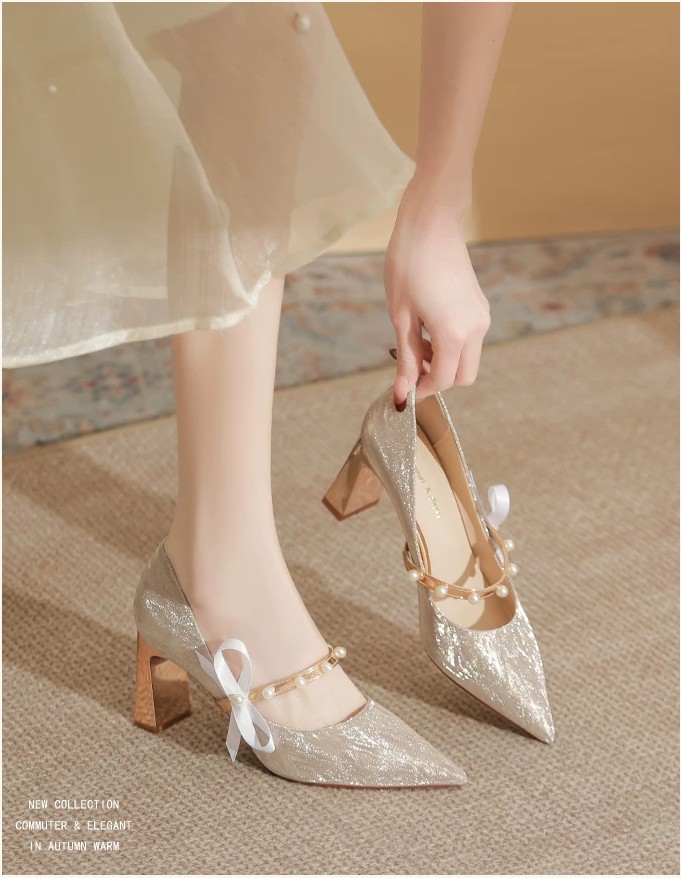
The champagne pair above is the sort of thing that works at 55mm with a lighter sole. The thick-heel platform with the padded footbed is built closer to that idea, and the non-tiring block pair sits at the cheaper end of the same shape, which is fine if you go in knowing it’s a season rather than a decade.
Total height is platform plus heel. A 40mm platform with a 50mm heel gives you 90mm of lift with a 50mm ankle angle. That’s why the shape feels easier than a straight 90mm stiletto: your foot is closer to flat inside the shoe even though you’re standing taller.
The limit is about 40mm of platform. Past that, the shoe stops flexing at the ball of your foot, and your foot rolls over the front edge instead of bending. That’s when you get the slap-walk, and it’s why very tall platforms look so awkward on stairs.
For anyone new to the shape, a 30mm platform with a 45mm heel is the sweet spot: real height, modest ankle angle, and enough flex to walk normally. If you’re going to a wedding and standing for six hours, that combination beats a 100mm stiletto every time.
Walking technique matters as much as the numbers. On a platform you land flat rather than heel-first, so you shorten your stride slightly and let the whole sole meet the ground. People who try to walk heel-toe in a tall platform slap the front down and sound like a horse, which is the noise everyone recognises and nobody enjoys.
Stairs are the real test. Going up, put the whole shoe on the step, not just the toe. Coming down, take the step sideways if the staircase is narrow, because a platform has no flex to catch you if you misjudge the edge. This is not elegant advice, but it’s the one that keeps you upright.
Where cheap genuinely wins

Two situations. The first is a colour you’ll wear four times. A bright platform in a shade that only works for one season doesn’t need to last; it needs to survive being photographed at two parties.
The second is a shape experiment. If you’ve never worn a platform and you’re not sure whether you’ll like the height, spending £45 to find out is sensible. Spending £200 to find out is a gamble with bad odds.
What I wouldn’t do is buy cheap in a neutral black or brown you plan to wear three times a week from October to March. That’s the pair where cost per wear rewards the better construction, and it’s the only category where I’d genuinely push you upward in price.
There’s a middle path too, and it’s the one I use most. Buy the cheaper pair, then spend £15 on a cobbler visit before you ever wear them: a rubber forefoot pad and a heel tip replacement. That one visit fixes the two things that fail first on cheap platforms, and it typically doubles the life of the shoe. Total spend, still under £70.
Pick the shoe up by the heel and press the platform against the edge of a table. It should resist, not flex. Then press the sole at the ball of the foot and check it bends there and only there.
Look at the join between sole and upper from the side, at eye level. A clean stitched line or a moulded lip is good. A visible glue line with slight squeeze-out is a warning.
Twist the shoe gently along its length. Some movement is normal. If the whole platform rotates like a tennis shoe, the sole is too soft for the height.
- Heel block: press it hard, listen for a hollow plastic sound.
- Insole: lift the edge with a thumb. If it comes up, it can be replaced, which is good.
- Weight: hold at arm’s length for ten seconds.
- Flex: bends at the ball, not in the middle of the arch.
Then walk. Twenty steps on a hard floor, up and down a step if there is one. Not to see if they’re comfortable in the shop, which they will be, but to hear whether the heel block is solid and whether your heel lifts out of the back.
If you can, take them off and put them back on twice. A platform that’s hard to get into is a platform you’ll stop wearing by week three, especially on a morning when you’re already late and the zip won’t cooperate.
What the price difference actually buys you
It buys about 12 extra months of use, on average, plus the option of a repair. That’s the honest summary. It doesn’t buy a better look, and it doesn’t buy comfort on day one, because a stiff expensive platform can be less comfortable than a soft cheap one until it’s broken in.
If you’re paying more, pay for construction you can see: a stitched or moulded sole, a dense block, a replaceable insole. If a £180 pair has none of those, you’re paying for a name and you’d be better off with the £48 pair and a spare £130.
The one thing price does reliably buy is consistency. Two pairs of the same expensive shoe will fit the same way; two pairs of the same cheap shoe often won’t, because the lasts get less attention. If you’ve found a cheap pair that fits perfectly, buy a second one in the same size while it exists. That’s not hoarding, it’s insurance.
And whatever you spend, keep the box for the first month. Platforms take a couple of weeks to reveal whether the heel block is going to hold, and a return is much easier with the original packaging than without it.
There’s a wider history to the shape if you’re curious about why it keeps returning: the entry on platform shoes covers the 1970s comeback and the earlier Venetian versions, both of which solved the same problem of adding height without adding ankle angle. The broader history of footwear is useful too, mostly for how long the sole-before-fashion order held.
And for a very different take on the same category, there’s a good piece on choosing gold platform heels in five minutes, which is the right timeframe if you already know your size and your limits.
Where I’d land: buy the cheap pair for the colour you’ll wear eight times, buy the better pair for the black you’ll wear forty times, and check the sole join before you check the price. The rest of the women’s shoes collection follows the same logic, whatever the heel shape.
