

You’ve got a 7:40 train, a desk you won’t leave until six, and a table booked at eight. The shoes that make the desk tolerable usually ruin the dinner, and the shoes that make the dinner worth photographing usually ruin the train.
Slingback kitten heels solve that specific problem better than anything else in my experience, but only if you pick them with three measurements in mind. Get those wrong and you’ll spend the whole evening hitching the strap back onto your heel.
Here’s the standard I’d use, then how the same pair carries you through a working day and a dinner without a trip home.
Three checks before you look at colour
Start with heel height. A kitten heel runs from about 35mm to 55mm. Below 40mm you get comfort but the leg line flattens; above 55mm it stops being a kitten heel and becomes a pump with a strap. The 45 to 50mm band is where most people can stand for four hours and still walk home.
Second, check where the slingback strap sits. It should cross your heel just above the widest point, roughly a finger’s width below the ankle bone. If it sits lower, it’ll slide off every time you take a step. If it sits higher, it’ll rub the Achilles tendon raw by the second hour.
Third, the toe. Slingbacks expose the heel, so the toe has to do all the containment work. A pointed toe looks sharpest but needs about 8mm of clearance in front of your longest toe. Squeeze that and you’ll feel it at the nail, not at the tip, which is why people blame the wrong part of the shoe.
- Heel: 45-50mm for a full day, 35-40mm if you’re on your feet more than sitting.
- Strap: a finger’s width under the ankle bone, with light tension, not tight.
- Toe: 8mm of clearance, measured standing, in the afternoon.
None of this requires a specialist. It requires trying the pair on at 4pm rather than 10am and walking twenty steps before you decide.
There’s a fourth check I’d add if you’re buying online: ask for the heel width, not just the height. A 45mm heel that’s 8mm wide at the tip feels much less stable than the same height at 15mm. The narrow version looks better in a photograph and wobbles on a cobbled street.
Colour comes last for a reason. A bone slingback and a black one fit the same foot, so fit is the variable you can’t fix later. Once the fit is right, black covers work and evening, bone covers summer and daytime, and anything metallic is a third pair you buy when you already own the first two.
9am to 6pm: the hard floor test
Offices are the worst environment for a heel because most of them have hard floors, and hard floors don’t absorb anything. Every step sends the impact straight up through the heel. On carpet you can wear almost anything for eight hours. On polished concrete you’ll know by lunchtime.
The kitten heel helps here because the height is low enough that your calf isn’t permanently shortened. At 45mm, your ankle still has most of its range, which means your stride stays close to normal and your lower back doesn’t take the load. At 90mm the calf stays contracted all day and the ache moves upward by about 3pm.
What I’d watch instead is the sole. A thin leather sole on a hard floor is a genuinely bad combination, and a lot of slingbacks are made exactly that way because it looks more refined. A rubber insert at the forefoot, even a 2mm one, changes the feel completely. If the pair you like has no grip, a cobbler can add it for very little.
One more thing about offices: heating. A closed pump traps heat; a slingback doesn’t, because the back is open. That’s why the same 45mm heel feels cooler under a desk radiator than a comparable court shoe. It’s a small thing that matters on a long day.
The commute is the other half of the working day, and it’s where slingbacks get unfairly blamed. Twenty minutes of walking to a station is not the same as eight hours at a desk, and no shoe does both perfectly. If your walk is longer than fifteen minutes, put the slingbacks in a bag and commute in trainers. Nobody at the office will know, and your feet will thank you by Thursday.
I’d also count the standing time, not just the walking time. Standing still in any heel is harder than walking in it, because your calf stays contracted without the pump action that helps blood move. A day with three standing meetings is more demanding than a day with a 20-minute walk and a lot of sitting.
8pm: the swap that actually changes the outfit
You don’t need different shoes for dinner. You need a different bag and, if the office is casual, a jacket that reads less like work.
The reason the shoes survive the transition is that a slingback kitten heel sits in an unusual spot: it’s formal enough for a restaurant with linen napkins and quiet enough for a Tuesday desk. Swap a tote for something small and the same pair reads as evening. That’s a two-minute change in a bathroom, not a trip home.
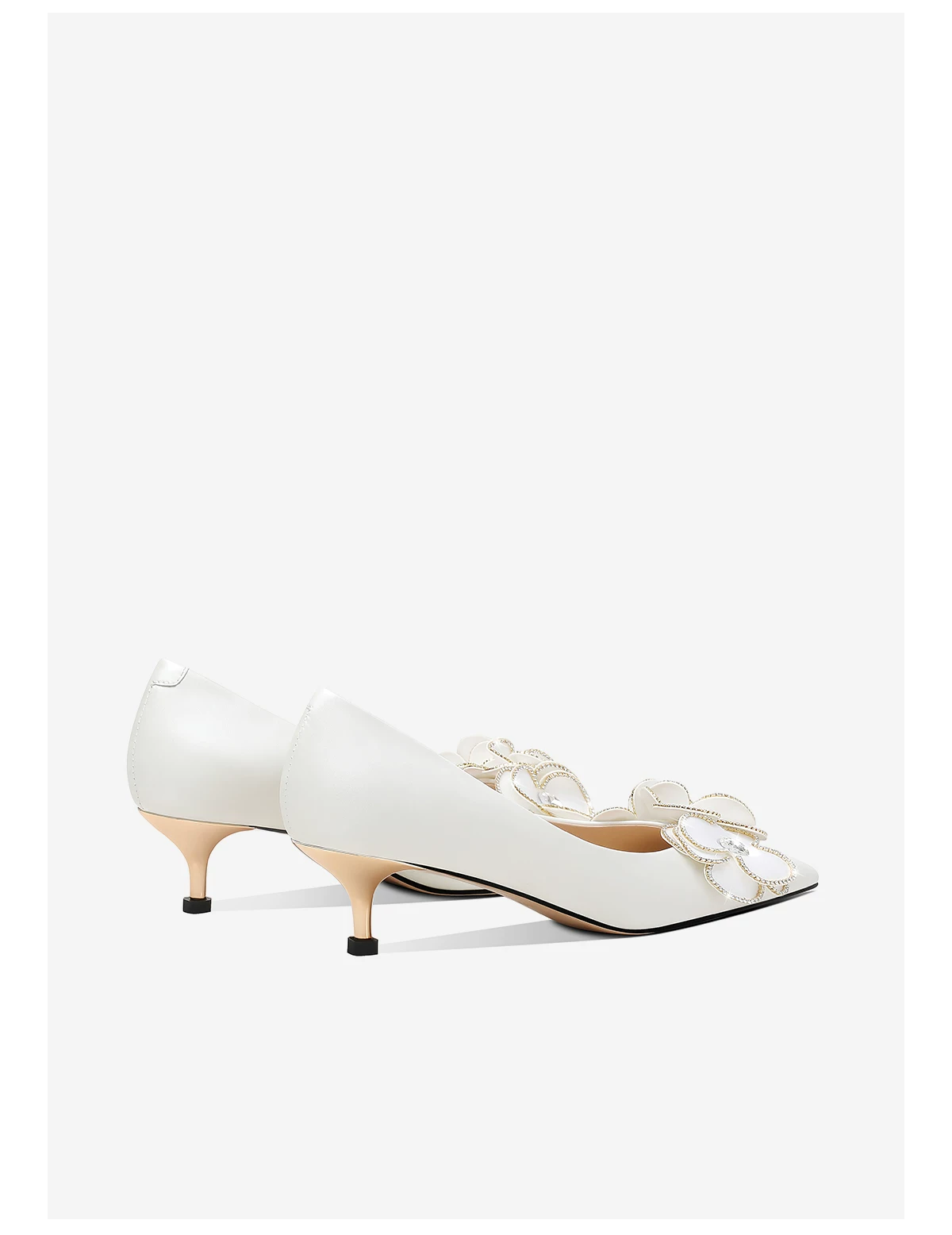
What I’d avoid is trying to make one pair do both jobs with accessories that fight each other. A metallic slingback with a heavy work tote looks like two outfits stapled together. Pick the shoe first, then let the bag follow it, not the other way round.
For a longer version of this idea with a different colour and four swaps instead of two, there’s a solid breakdown in one pair of beige heels across three occasions.
Restaurant floors are worth thinking about before you go. Polished wood and stone are slippery under a leather sole, and a slingback has less contact with the ground than a closed shoe. If the place has a steep staircase to the toilets, which most of them do, a rubber forefoot insert is the difference between a confident descent and holding the handrail like a pensioner.
Carry time is also real. You’ll stand for twenty minutes waiting for a table, then sit for two hours, then stand again. That pattern is easier on a 45mm heel than a 90mm one, because the seated part lets your calf recover and the standing part doesn’t undo it. Higher heels lose that recovery.
If the evening runs long and you’re walking home, that’s the point where a slingback stops being the right shoe. A taxi is cheaper than a pair of shoes you ruin. I’ve made that calculation wrong more than once.
Saturday: where the kitten heel quietly wins
This is the part people don’t expect. A 45mm slingback is a better errand shoe than a flat, in one specific way: it keeps your heel slightly lifted, which most people find easier on a hard supermarket floor than a completely flat sole with no cushioning.
I wouldn’t do a full food shop in them. I would do a coffee, a browse, and a walk to the car. The open back means no rubbing at the Achilles, which is the usual failure point on a new pair of flats, and the strap holds everything in place without a break-in period.
The limit is distance. Beyond about 3,000 steps on pavement, a kitten heel starts to feel like a heel. That’s not a design flaw, it’s just what a raised heel does. If your Saturday involves a market and a park, wear something else and save these for the part of the day that involves a table.
Weather is the other limit. Slingbacks and rain don’t mix, and a wet leather sole becomes genuinely dangerous on smooth tile. In a wet October, mine stay in the cupboard from Monday to Friday and come out for indoor events only.
There’s a seasonal angle too. A slingback in bare feet works from April to October in most of Europe, and from November it needs a thin tight underneath, which changes the fit slightly and makes the strap dig in at the back. If you plan to wear them through winter, buy half a size up or accept a snugger feel.
The one place a kitten heel beats a flat outright: a long indoor event where you’re standing and talking. Flats put your heel flat on a hard floor and after two hours the heel bone aches. A 45mm lift shifts the load forward and most people find they can stand for longer. It’s counterintuitive, and it’s the reason wedding guests wear them.
Fit details that decide whether you’ll still wear them in March
Most slingbacks fail at the elastic. The strap at the back is usually a band of elastic covered in leather, and that elastic is what keeps the shoe on your foot. Cheap elastic stretches out within a couple of months and the shoe starts flapping. You can feel the difference in the shop: good elastic snaps back flat when you pull it, bad elastic stays slightly wavy.
The second detail is the heel counter, the stiff part at the back of the shoe under the strap. It should be firm enough to hold its shape when you press it with your thumb. If it folds, the shoe will collapse sideways when you walk and the strap will do all the work, which it isn’t designed for.
Third, the vamp, meaning the part across the top of your foot. A shallow vamp shows more toe cleavage and holds the foot less securely. A deeper vamp holds better but can press on a high instep. If you have a high instep, look for a vamp that curves rather than cuts straight across.
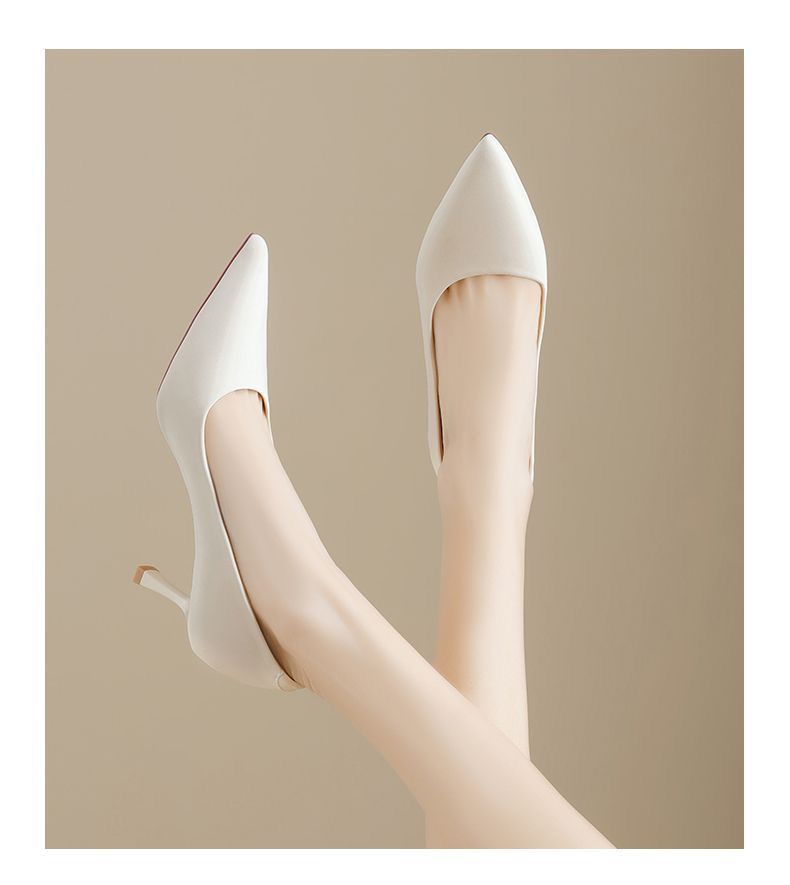
For a first pair, the white pointed kitten heels are a reasonable starting point because the vamp is cut generously and the heel is on the lower end. If you want something that handles a full working day, the soft leather pair with the shallow mouth flexes more across the ball of the foot, which is where a stiff shoe hurts first.
One caveat I’d give anyone: white and bone-coloured slingbacks show scuffs at the toe within about three wears. They’re lovely and they need wiping down after every outing. If that sounds like admin you won’t do, buy black or tan.
Also check the strap for stitching rather than glue at the join. A glued strap separates at the exact point where the elastic pulls hardest, usually around month four. Stitched joins survive the same tension for years.
The 4pm swell, and why sizing up usually fails
Your feet get bigger during the day. Not dramatically, but enough that a shoe bought at 10am can feel tight by six. The usual advice is to size up, and that advice is only half right.
Sizing up fixes the width and the length. It doesn’t fix the strap. A slingback one size too big will slide off your heel with every step, and no amount of elastic tension will hold it, because the extra length moves your heel forward of where the strap was designed to sit. So you end up with a shoe that’s loose in the back and still tight across the toes, which is the worst possible combination.
The better approach is to buy your true size and address the pressure point directly. If the toe box is tight, a shoe stretcher will buy you 2 to 3mm in the right place. If the vamp presses on a high instep, a thinner insole at the heel only, not the whole foot, lowers your foot in the shoe without shortening it.
When sizing up genuinely helps: wide feet with a narrow heel, or anyone planning to wear them with tights all winter. When it makes things worse: a narrow foot, which will swim in the extra volume and slip at the strap regardless of size.
If you can only try one pair on, try them at the end of the day, after you’ve been walking. That’s the foot you’ll actually be wearing them with at dinner.
And if the strap leaves a red mark after twenty minutes in the shop, it will leave a deeper one after two hours at a table. Elastic relaxes slightly with wear, but not enough to fix a strap that’s already too tight.
There’s also a timing point most people miss: your foot is widest in the late afternoon and narrowest first thing. Buying at lunchtime is the closest thing to average, and it’s the least likely to produce a pair that fits only in the morning.
Heel height versus toe shape: what changes the leg line
People assume heel height does all the work of making legs look longer. Toe shape does about as much, and it’s cheaper to get right.
A pointed toe extends the visual line of the foot by roughly 15 to 20mm compared with a rounded toe at the same heel height. On a bare leg, that reads as a longer leg. On a wide foot, it also reads as a tighter fit, so the trade is real. An almond toe gives you most of the visual extension with more room, which is why it’s the safer recommendation for anyone who isn’t sure.
Heel height changes the ankle angle rather than the length. At 45mm, the ankle is slightly lifted and the calf looks subtly longer. At 35mm, the effect is almost gone. At 60mm and above, the ankle lifts enough to change how you stand, which reads as more formal but also shortens your stride.
What I’d avoid is a very pointed toe on a very low heel. The combination looks elongated in a photo and slightly odd in person, and it puts all the pressure on the toes with none of the lift that would justify it.
If your day involves more than 8,000 steps, a kitten heel is the wrong tool. It’s not a walking shoe and pretending otherwise leads to a sore forefoot by mid-afternoon.
If you have a narrow heel that slips out of everything, slingbacks will slip too, and the strap will only partly help. Look for a style with an adjustable buckle rather than a fixed elastic band, so you can take up the slack.
And if you need arch support, most slingbacks have none. You can add a thin insole, but it will push your heel back against the strap and change the fit. Try that combination in the shop before you commit, not at home after the tags are off.
Bunions are the last honest caveat. A pointed slingback will press exactly where you don’t want pressure, and no amount of stretching fixes a shape problem. Look for a square or almond toe with a soft upper, and don’t let a shop assistant talk you into a point because it’s the current shape.
The rest of it is simple. Buy in the afternoon, walk twenty steps on a hard floor, check the elastic snaps back, and accept that one pair can cover a desk and a dinner but not a desk, a dinner, and a two-mile walk. The women’s shoes range has enough options to pick by height rather than by photograph, which is the order I’d do it in.
A final number worth remembering: if a pair costs £90 and you wear it twice a week for a year, that’s under a pound a wear. If it hurts, you’ll wear it four times and it costs £22 a wear. Comfort is the cheap option.
For the wider history of the shape, if that’s your sort of thing, the entry on the kitten heel explains where the name came from, and the broader article on high-heeled footwear covers why heel heights keep cycling back to the 40 to 50mm range every couple of decades. It’s a shape that keeps returning because it works, not because a designer decided it should.
