

You’ve got a wedding in three weeks, a dress that hits just below the knee, and a pair of 90mm heels you already know you can’t stand in for eight hours. So you’re looking at something lower. Something with a bit of shine so it doesn’t read as office footwear.
That’s usually where silver kitten heels for women come in. They’re the obvious answer on paper: low enough to walk in, bright enough to look like an occasion shoe. The catch is that silver is the least forgiving metallic on the shelf. Two pairs at the same price can look like heirloom jewellery and cheap tinsel, and the difference is mostly in the finish and the heel shape.
Short version before the detail: aim for 45mm to 50mm, pick a brushed or satin finish over mirror-shine, and check that the toe shape matches the width of your forefoot. Do those three things and you’ll wear them more than once.
50mm is the height where kitten heels stop being a compromise
A true kitten heel sits between 35mm and 50mm. Under 35mm you’re in low-heel territory, where the shoe starts looking like something from a school uniform list. Over 55mm and you’ve lost the whole point, because you’re back to the calf tension that makes long standing unpleasant.
At 45mm to 50mm, your heel lifts just enough that your calf doesn’t have to stretch. That sounds like a small thing until you’ve spent four hours at a reception. The angle also keeps your weight slightly forward, which means the ball of your foot takes less load than it would in a flat. Heel height has been used to signal formality for centuries, and the history of the high-heeled shoe is a decent reminder that the shape keeps coming back for reasons that have nothing to do with comfort.
Here’s the part shops don’t tell you: a kitten heel with a very thin post feels higher than a 50mm block, even though the tape measure says otherwise. Thin heels put more pressure per square centimetre on the floor, so your ankle works harder to stay balanced. If you want to stand for hours, pick the thicker post. If you want the delicate look for photographs, accept that you’ll be sitting more.
And don’t trust the label. Heel heights are quoted generously. Take a ruler to the shop, or measure your own pair at home from the back edge of the heel to the floor. I’ve measured 50mm heels that were actually 42mm, which is fine, and 60mm heels sold as 50mm, which is not.
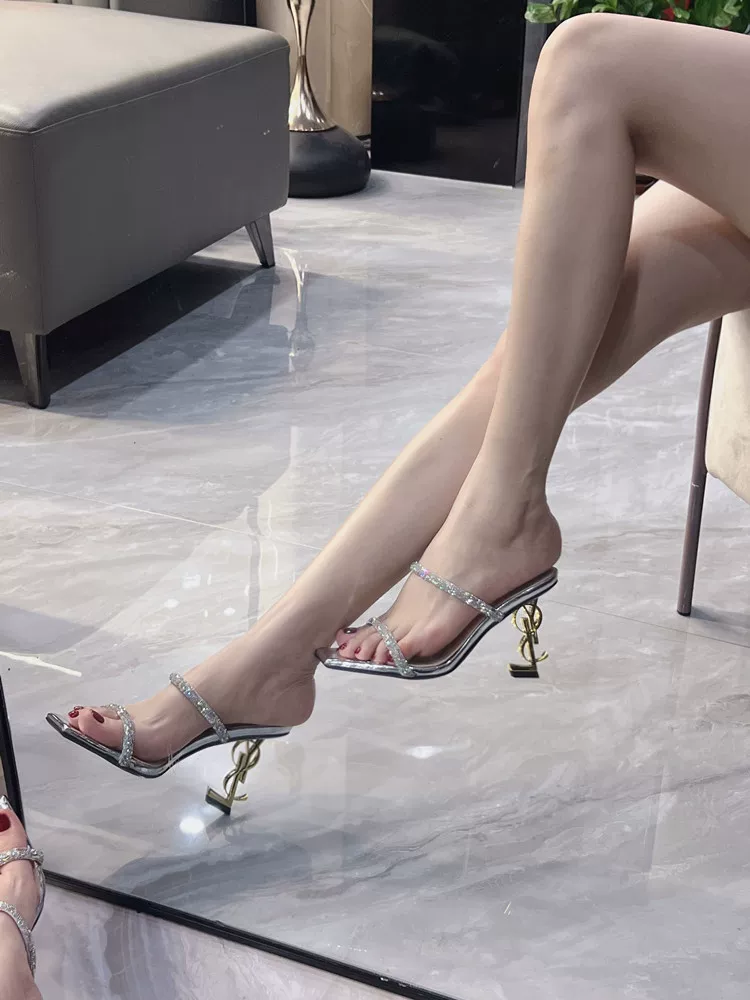
Silver is the hardest metallic to get right, and here’s how to spot the good ones
Gold forgives. Silver doesn’t. A gold shoe can be slightly dull and still read as warm. A silver shoe with the wrong finish reads as foil, and once you see it you can’t unsee it.
The finish you want is satin metallic or a fine brushed texture. Those scatter light instead of bouncing it back at the camera, so the shoe looks like leather with a sheen. The finish to avoid is the mirror-glaze on synthetic uppers, usually on pairs under about £40, which creases into sharp white lines at the toe after two wears.
Silver is a real material term and a real colour term, and they’re not the same thing. The metal itself is the most reflective element on the periodic table, which is why silver reflects almost all visible light, and why a poorly finished imitation looks so obviously flat next to it. Pigment can imitate the colour. It can’t imitate the way light behaves.
Put two pairs side by side under the shop lights and look at the darkest part of the curve, near the heel counter. A good metallic keeps depth there. A cheap one goes grey and slightly plastic. That grey patch is the tell.
Also check the edge finishing around the topline, the rim where your foot goes in. On good pairs it’s folded and stitched. On bad ones it’s raw and sealed with a painted edge that will crack. That’s a two-second check that saves you a return.
Where silver works and where it looks like a costume
The failure mode with metallic shoes isn’t the shoe. It’s the outfit around it. Silver reflects whatever is next to it, so it picks up the colour of your hem, your tights, and the floor.
Reliable combinations:
- Navy or charcoal tailoring, with silver showing at the toe only. This is the safest way to wear them to work.
- A black dress with no other hardware, so the shoes are the single bright element.
- Pale grey or soft blue, which keeps the whole thing cool-toned and calm.
- Denim, honestly. A dark straight-leg jean and a silver kitten heel is a genuinely good Saturday outfit.
Combinations that fight: silver shoes with a gold bag. Silver shoes with a warm cream dress. Silver shoes with a red lip and red nails, unless you’re deliberately going for a very specific look. Metallics are neutral in theory and fussy in practice.
Sequins are the other trap. Silver heels under a sequinned skirt gives you two competing light sources, and the photograph will look like a hen party. Matte fabrics let the shoes do the work.
For a wedding where you’re a guest rather than the bride, silver kitten heels for women are close to ideal, because they’re dressy without competing with the couple. If you’re the one in white, go for a warmer metallic and let the dress carry the shine.
The fit question: kitten heels slip at the heel more than any other style
Because the heel is low, your foot doesn’t get pushed forward into the toe box the way it does in a high heel. That sounds good. In practice it means there’s nothing holding your heel down, so the shoe pops off with every step.
The fix is usually a strap. An ankle strap, a slingback, or a Mary Jane style all solve it, because they anchor the shoe to your foot rather than relying on gravity and friction. If you want a plain pump with no strap, buy it half a size down and expect a week of discomfort while it molds.
Wide feet have the opposite problem. A narrow kitten heel silhouette pinches across the ball of the foot, and because the heel is low you can’t shift weight back to relieve it. Look for a square or rounded toe. The square toe shape that forgives wide feet appears in this height too, and it’s worth searching for specifically.
One more thing about the front. Kitten heels often have a shallow vamp, meaning the top edge sits low on your foot. That’s flattering in photos and terrible for grip. If you can see the tops of your toes when you look down, the shoe is holding you at the heel and the strap only. Expect to walk slowly.
Most silver kitten heels for women fail in the shop, not on the street. The pair that slips at the heel gets bought anyway because it looked so good under the lights, and then it sits in a box for a year.
Test it in the shop: put both shoes on, stand up, and rise onto your toes. If the heel drops off your foot before your heel lifts, size down or find a strap.
Here’s the version of that test I actually use, because shop floors are smooth and the real world isn’t. Take them to the doorway, where the floor changes from tile to a mat. Walk over the edge four times. If the shoe slips at the heel going over that small step, it’ll slip on stairs, on gravel, and on the walk from the car to the venue. Smooth floors flatter bad fits and that step doesn’t.
Narrow heels will also tell you something about your ankle. Stand still for a full minute and look down. If your ankle rolls inward even slightly, the heel is too narrow for the way you stand, and no amount of practice will fix that. Wider posts exist in silver, and they’re not less attractive, just harder to find.
What to wear them with, month by month
Silver kitten heels for women get filed under “evening” by most people, which is why they sit in boxes for 11 months. That’s a waste. The low heel makes them one of the few metallics that work in daylight.
Spring and summer: bare legs, a cotton midi dress, no jewellery. The shoe is the accessory. Add a canvas tote and nobody looks twice, which is the goal.
Autumn: dark tights and a wool skirt. Silver over opaque black is a strong look, and unlike a peep toe it doesn’t create the toes-in-jail problem because the shoe is closed at the front. This is the one season where a closed silver kitten heel genuinely outperforms every other metallic style.
Winter: the same, plus a longer coat. Watch the salt. Road salt is the fastest way to destroy a metallic finish, and it attacks the sole edge first. If you live somewhere that grits the pavements from November, keep a cloth by the door and wipe the salt off before it dries.
Work: navy trousers, silver toe. That’s it. If your office is conservative, this is the maximum amount of shine that reads as intentional rather than showy.
If you want a comparison before committing, the silver block heel version that survives a nine-hour wedding is the same colour story with more stability, and what 50mm does to a long day in black kitten heels covers the height question without the metallic variable.
The tarnishing problem nobody mentions
Metallic finishes on shoes are a coating, not a material. That coating sits on top of leather or synthetic and it wears off at the flex points. On a kitten heel the main flex point is right across the top of the toes, which is also the most visible part.
Expect visible dulling after about 30 wears. Not flaking, usually, just a gradual loss of shine in one patch. You can slow it down but you can’t stop it. That’s the honest downside of the category and it’s why I wouldn’t spend a lot on a silver pair unless you plan to wear them weekly.
Care is simple: wipe with a dry microfibre cloth after each wear, keep them out of direct sun, and never use leather polish on a metallic surface. Polish contains waxes that dull the coating. If the finish has scuffed, a tiny amount of clear nail polish on the scuff will stop it spreading, though it won’t be invisible.
Store them in a cotton bag rather than a plastic box. Plastic traps moisture, and moisture under a metallic coating is how you get bubbling along the sole line.
The 90-second shop test
You don’t need to guess. Do this in the shop and you’ll know whether a pair is worth the money.
First, look at the heel from behind. It should be centred under your heel bone, not offset to one side. Offset heels are the single most common cause of the ankle rolling that people blame on the height.
Second, press the heel post sideways with your thumb. It should flex a little and return. A post that’s rigid with no give transmits every impact straight up your leg.
Third, walk 20 steps on a hard floor, not carpet. Carpet hides everything. Listen for the sound: a hollow click means a plastic heel with a thin cap, which will be noisy and slippery on wet stone.
Fourth, check that the shoe doesn’t pinch when you stand still. If it pinches at rest, it’ll be unbearable after an hour, and a kitten heel has no extra material to stretch into.
If a pair passes all four, buy it in your normal size and stop second-guessing. If it fails one, walk away. There are hundreds of silver kitten heels for women on the market and the difference between a pair you wear 40 times and a pair you wear twice is almost entirely in these four checks.
Browse a few shapes side by side in the women’s shoes category before you commit to a toe shape. Two minutes of comparison online saves a return, and returns on shoes are a faff nobody needs in December.
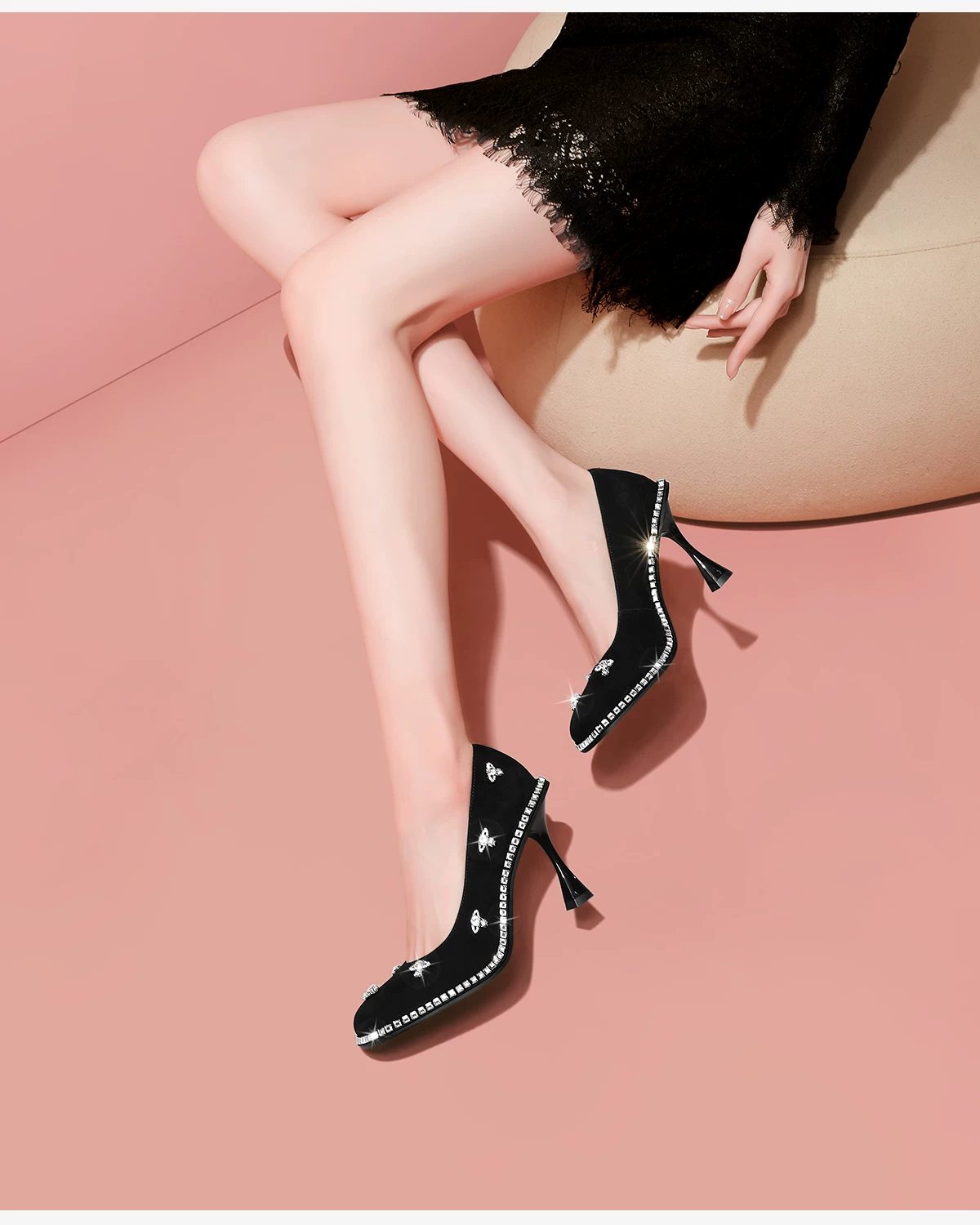
My own pick, if you want a starting point: this one-piece rhinestone pair with the low heel for evenings, or the square toe rhinestone version if your forefoot is wider than average.
Wear them to the wedding, then wear them to the supermarket the following Saturday. That second outing is the real test, and it’s the one most pairs fail.
