

You’ve got one shoe on and one shoe off in the shop, and something at the front feels wrong. The heel fits. The width across the ball of your foot is fine. But your second toe is pressed against the edge of that little opening like it’s trying to leave the building.
That’s what nobody tells you about women’s peep toe heels. The hole at the front isn’t decoration. It decides where the shoe grips your foot, how your toes spread when you walk, and if you’ll still be happy at 9pm. Put the opening in the right spot and they behave like any other pump. Move it 5mm too far back and you’ll spend the whole evening sliding your foot forward.
So here’s the short version before the details: the opening should sit 15mm to 25mm in front of the hole, the shoe should grip you across the instep rather than the toes, and you should buy them when your feet are at their biggest, which for most people is late afternoon.
Now the parts that actually take thinking about.
Look at where the opening sits before you look at anything else
Turn the shoe over in your hand and look straight down at it. The front rim of the opening should land between the base of your big toenail and the joint behind it. On a well-made pair that leaves a strip of material roughly the width of your little fingernail across the front. That strip is doing real work: it stops your foot from sliding forward every time you take a step.
Cheaper pairs often cut that strip too narrow, because narrow looks daintier on the shelf. Try walking ten steps in the shop and you’ll feel your toes creep toward the edge. That’s not a break-in issue. It’s geometry, and it won’t fix itself.
Two fingers, one rule. If you can slide your pinky finger into the opening without pushing, it’s too big for walking and fine only for sitting at a wedding.
You should also check the height of the vamp, which is the top edge of the shoe over your instep. Peep toe styles often drop that edge low to show more foot, and a low vamp means less material holding you in. If the shoe only touches you at the heel and the toe rim, your arch is doing all the gripping. That’s the pair you kick off under the table.
One more check that takes two seconds: press your thumb down on the toe box from above. There should be a small amount of give. Rock-hard toe boxes on women’s peep toe heels are usually glued over a plastic stiffener, and plastic doesn’t mold to your foot. It just rubs.
How much toe should show? Two centimetres is the usual answer
Roughly 20mm of toe visible at the front is the sweet spot for most feet. Less than 10mm and the opening is basically cosmetic, so you get the discomfort of a cutaway shoe with none of the breathing room. More than 30mm and you’ve drifted into open-toe territory, where the shoe stops covering the joints that need covering.
Your toe length changes that number. If your second toe is longer than your big toe, which is common enough that it has its own name, you’ll want the opening further forward than the standard cut allows. Otherwise the longest toe takes the full impact of every step against that front rim.
Wide feet need a different adjustment. On women’s peep toe heels the opening should be wider, not deeper. A deep narrow opening squeezes the toes together at the front; a shallow wide one lets them spread. If you’ve got a bunion starting on the outer side of your big toe joint, this matters more than heel height does.
Here’s the number most people get wrong: heel height and toe opening are independent. You can wear a 90mm peep toe comfortably if the opening is cut well, and you can be miserable in a 45mm pair with a badly placed rim. Height gets blamed for problems that come from the front of the shoe.
Try this at home with a pair you already own. Stand barefoot on a piece of paper, trace your foot, then put the shoe on top of the outline. You’ll see instantly whether your toes are sitting where the shoe expects them to be.

Peep toe, open toe, slingback: pick the shape that matches your day
These four styles get used interchangeably in shops, and they shouldn’t be. Each one fails in a different way, which means each one suits a different kind of day.
- Peep toe: small opening, toes covered at the sides, good for offices and long dinners. Fails when the front rim is too narrow and your toes slide.
- Open toe: the whole front is cut away. Cooler in July, useless in rain, and no protection for the toe joints.
- Slingback: closed front, strap at the heel. The most secure of the four for walking, though the strap can rub if it’s elastic.
- Closed pump: no opening at all. Warmest, most formal, and the one that traps heat on a 30°C commute.
For a normal Tuesday, the peep toe wins because it covers enough to look intentional at a desk and breathes enough to survive a stuffy meeting room. For a black-tie evening where you’ll mostly be sitting, the open toe looks better in photographs.
Worth knowing: a peep toe with a strap across the instep is a genuinely different shoe from one without. The strap takes over the job of holding your foot back, which means the front rim stops doing structural work. If you’ve had bad luck with this style before, start there. You can browse a whole wall of options in the women’s shoes section of the shop and compare vamps side by side, which is far more useful than reading descriptions.
And if the shape itself is the problem rather than the opening, a pair of round toe heels for women with wide forefeet will solve the same fit complaint without any cutaway at all. It’s a boring answer that works.
Why your second toe aches after two hours
Toes aren’t a row of identical little levers. Each one has a joint at the base, and those joints sit at different distances from the end of your foot. When the front rim of the opening presses on the longest toe, you’re loading one joint over and over, roughly 1,200 times in an hour of walking. That’s how a dull ache starts.
The medical term for the bony bump that forms at the base of the big toe is hallux valgus, and narrow toe boxes are one of the recognised contributors. The Wikipedia entry on bunions covers the mechanics in plain enough language, and it’s worth ten minutes if you’ve already got a bump forming. Toe anatomy matters here too, especially the difference between the joint and the tip, which is explained on the page on toes.
What this means in practice: any pair where you can feel a hard edge under a toe joint is a pair to leave on the shelf. Not because it’s badly made, necessarily. Because it’s made for a different foot shape.
Broken skin is the other common outcome. The top of the toe rubs against the front rim on every step, and by hour three there’s a red mark. A blister plaster applied before you leave the house works better than one applied at the party, when the damage is already done.
What to wear them with, including the outfits that don’t work
Peep toe heels look dated when the rest of the outfit is doing too much. That’s the pattern I keep seeing: the shoe gets blamed, but the real issue is a peep toe paired with a fussy hem, a busy print and a statement bag. Strip the outfit back by two elements and the same shoe reads modern.
Things that work, reliably:
- Cropped straight jeans that stop above the ankle, so the opening is visible rather than covered.
- A plain midi skirt in a matte fabric, with the hem hitting mid-calf.
- Tailored trousers with a wide leg, worn with a heel that shows only at the toe.
Things that mostly don’t: opaque black tights with a peep toe. Your toes will look like they’re in jail, and the tights will bunch at the rim. If the weather forces tights, wear a closed pump. It’s not a rule anyone will explain to you, but you’ll feel it the moment you catch a shop window.
Bare feet are the intended state. That means the state of your toenails becomes part of the outfit in a way it isn’t with closed shoes. Two coats of a colour close to your skin tone hides a lot. Dark colours draw the eye straight to the opening, which is fine if the nails are neat and annoying if they’re not.
If your feet swell in summer, which most do by a few millimetres, size up rather than tough it out. This style has no give at the front rim. A pair that fits at 9am will be pressing by 6pm.
Sizing: the half-size decision that fixes most of these problems
Go up half a size if the front rim touches a toe. That’s the whole trick, and it costs you nothing in the shop because you can try both. Going up a half size buys you about 4mm of length, which is usually enough to move your longest toe off the rim without making the heel slip.
If the heel then slips, add a heel grip rather than sizing back down. Heel grips cost a few pounds and solve the problem the half size created. Sizing back down puts you straight back into the toe problem, which is the worse of the two.
Buy in the late afternoon. Feet are at their largest after a day of standing, and this style has no tolerance for swelling. Shoes bought at 10am are the ones that end up in the back of the wardrobe.
One honest drawback before you commit. The front rim of a peep toe is the first part to show wear, because it takes the most friction. On softer leathers you’ll see the edge darken and soften within a season. That’s not a defect. It’s also the reason a very pale pair looks tired faster than a black one. If you want a pair to last three winters, buy the darker colour and accept that it’s less photogenic.
Most women’s peep toe heels that fail do it at the front rim, and that’s the part to inspect before anything else. A close alternative if the whole shape keeps disappointing you is square toe heels, which forgive wide feet at the exact point where this style punishes them. Different look, much easier fit.
Keeping them wearable past week four
Most people break in a pair for two days and then wear them for a year without touching them again. That’s when the problems start: the rim dries out, the leather stiffens, and the shoe that was fine in October is a instrument of torture by February.
A five-minute routine once a month keeps them usable. Wipe the inside of the front rim with a damp cloth, let it dry fully, then work a small amount of leather cream into the edge with your thumb. You’re not polishing anything. You’re keeping the part that touches your toes supple.
Store them with the opening facing out and nothing stacked on top. A shoe pressed flat against another shoe in a box will crease exactly where the front rim is, and that crease is permanent.
If the rim has already hardened, a hairdryer on low heat for 20 seconds followed by ten seconds of flexing with your hands will soften it enough to wear. Do it twice, not five times. Leather has a limit and heat is how you find it.
Rain is the other thing to plan for. Suede peep toes and wet pavements don’t mix, and the opening means water gets in from the top as well as the bottom. Check the forecast before you build an outfit around them. That’s not cautious advice, it’s the difference between a good night and walking home in wet socks.
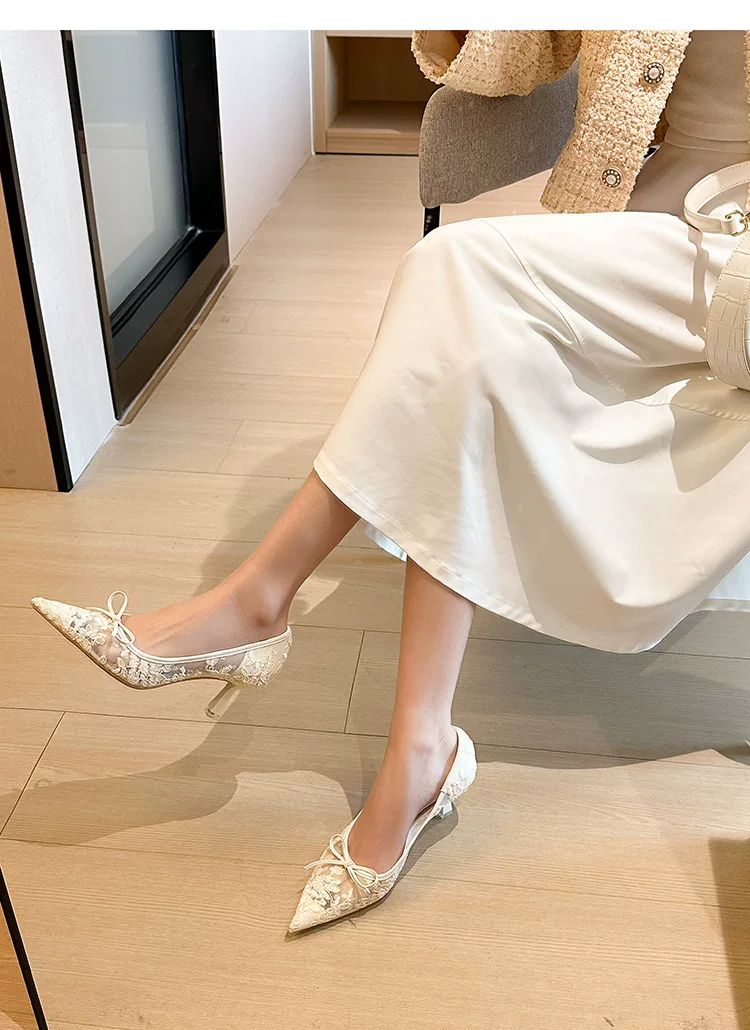
If you want the version of this shape that’s easiest to live with, look for a pair with a rounded front rim, a strap somewhere above the instep, and a heel under 70mm. That combination covers nearly every complaint covered here. This satin pair with the shallow vamp shows what a well-placed rim looks like from above, and these pointed sandals work the same trick for warmer months.
One last thing worth trying before you buy anything new: take the pair you already own, put a thin foam toe pad under the ball of your foot, and walk to the end of the street. Half the women’s peep toe heels people give up on were only ever missing 3mm of padding.
And if that doesn’t fix it, the shoe is the wrong shape for your foot, not the other way round. There’s no break-in period long enough to change geometry.
