The dress was fine. The shoes were the problem. Every pair in the wardrobe either looked like a work shoe or demanded a taxi. That’s the gap black kitten heels fill, and it’s why they keep coming back every few seasons no matter how often someone declares them dated.
If you’re comparing two pairs of black kitten heels for women and can’t say why one feels better, it’s usually this: a kitten heel is roughly 30 to 50mm, set slightly forward under the heel rather than right at the back edge. That one detail changes how the shoe walks, and it’s the reason some pairs feel effortless and others flip off your foot at the supermarket. If you’re shopping for black kitten heels for women, the heel position matters more than the height.
What actually counts as a kitten heel
The name gets used loosely. A 40mm block and a 50mm stiletto with a rounded toe are both sold as kitten heels, and they behave nothing alike.
- Height: 30 to 50mm. Above 55mm it’s a mid heel with a marketing problem.
- Heel shape: usually a slim “kitten” taper, sometimes a small block. Slim looks dressier, block walks better.
- Set-back: the heel sits a few millimetres forward of the rear edge, which softens the landing.
- Toe: pointed for evening, round or almond for daytime, square for something current.
That set-back detail is the whole point of the shape. On a stiletto, the heel lands almost behind your heel bone, so your ankle has to stabilise a lever. On a kitten heel the load lands closer to under your heel, which is why you can walk in them for hours without thinking about it.
The proportions matter too. A kitten heel on a very long, pointed toe looks elegant. The same heel on a short round toe looks like a child’s party shoe, and this is where most of the “dated” reputation comes from. It isn’t the height. It’s the toe-to-heel ratio.
According to the history of the kitten heel, the shape was popularised in the 1950s as a shoe for women who wanted height without the stance of a stiletto. Sixty-odd years later, the reasoning hasn’t changed. Neither has the physics.
So when you’re looking at a pair online, measure the toe. If the toe box is longer than about 40% of the shoe’s total length, it will read dressy. Shorter than that and it reads casual, which is fine if that’s what you want.
Why 40mm changes an outfit more than 90mm does
Here’s something that surprises people. A 90mm stiletto makes an outfit look dressed up. A 40mm kitten heel makes an outfit look finished. Those are different jobs, and the second one is more useful on a Tuesday.
With jeans, a kitten heel is the difference between “running errands” and “going somewhere after.” It works because the shoe is quiet enough not to compete with denim and refined enough to lift it. Cropped straight-leg jeans are the easiest pairing, with a sliver of ankle showing.
Tailored trousers get something a flat can’t give them. A flat under a wide leg can make the whole outfit look like it’s melting into the floor. A small heel gives the hem somewhere to land.
With tailored trousers, it does something a flat can’t. A flat under a wide-leg trouser can make the whole outfit look like it’s melting into the floor. A small heel gives the hem somewhere to land.
With midi skirts, this is the shoe. A stiletto under a midi reads formal, a flat reads casual, a kitten heel reads correct. That middle position is why the shape keeps returning.
At weddings, kitten heels are the practical choice for anyone who has to stand through a ceremony and then work a room. You get the polished line without the four-hour countdown. Buying for the fourth hour rather than the photo is the right way to think about it, and it’s why so many bridesmaids end up in this height.
One thing they won’t do: make short legs look longer. A kitten heel adds almost nothing to leg line compared with a stiletto, and if that’s your goal you need height or a pointed toe in a nude tone. Buy these for comfort and polish, not for optical illusion.
Heel slip is the number one problem, and it’s fixable
If you’ve owned kitten heels and hated them, the reason is probably that your heel kept sliding out. This shape is notorious for it, because the low heel gives your foot less to lock against.
Three fixes, in order of how well they work:
- An ankle strap. The most reliable fix by a wide margin. If you have narrow heels, only buy strapped styles.
- A heel grip. Cheap, effective, ugly if it shows. Works for a half-size gap.
- Size down half a size. Only if the toe box still fits. Never squeeze the front to fix the back.
There’s a fourth option people forget: a lace-up or a Mary Jane. Lace-up heels solve the slipping problem at the source, because the lacing holds the whole foot rather than just the heel.
Worth knowing why this shape slips in the first place. A stiletto loads your heel against the back of the shoe and holds it there. A kitten heel barely loads it, so nothing pins your foot down. The biomechanics of heeled shoes explain the same thing in more formal terms.
Test it in the shop properly. Walk ten steps, then turn. Turns are where slip shows up, because your heel lifts laterally. If the shoe shifts more than a few millimetres, it will be worse at home on a smooth floor.
Also check the topline at the back. A soft, unpadded collar feels nice for ten minutes and then rubs. You want a collar with a little structure and a smooth seam, not a raw edge.
Toe shape and material: where the money goes
Black kitten heels live or die on two details that have nothing to do with the heel.
The toe. Pointed reads sharper and slightly formal, and it flatters a wider foot because the taper hides width. Round reads softer and more casual, and it’s kinder to a bunion. Square is current and sits between the two, though it can look heavy in a very small size.
The material. Smooth leather holds shape and takes a polish. Patent looks dressier and shows every crease under office lighting. Suede is the softest-looking and the least forgiving in rain. In black, all three work, but they age differently: leather softens, patent cracks, suede scuffs into a lighter patch.
Check the lining next. A leather lining makes a 40mm shoe feel like a slipper within two weeks. A synthetic lining stays stiff and is the usual cause of blisters on the back of the heel, which is a strange problem to have in a shoe this low.
Then look at the sole. A thin leather sole looks refined and is slippery on wet pavement. A thin rubber sole is less elegant and much safer. For a shoe you’ll wear to work, choose the rubber and stop worrying about the millimetre of visible sole.
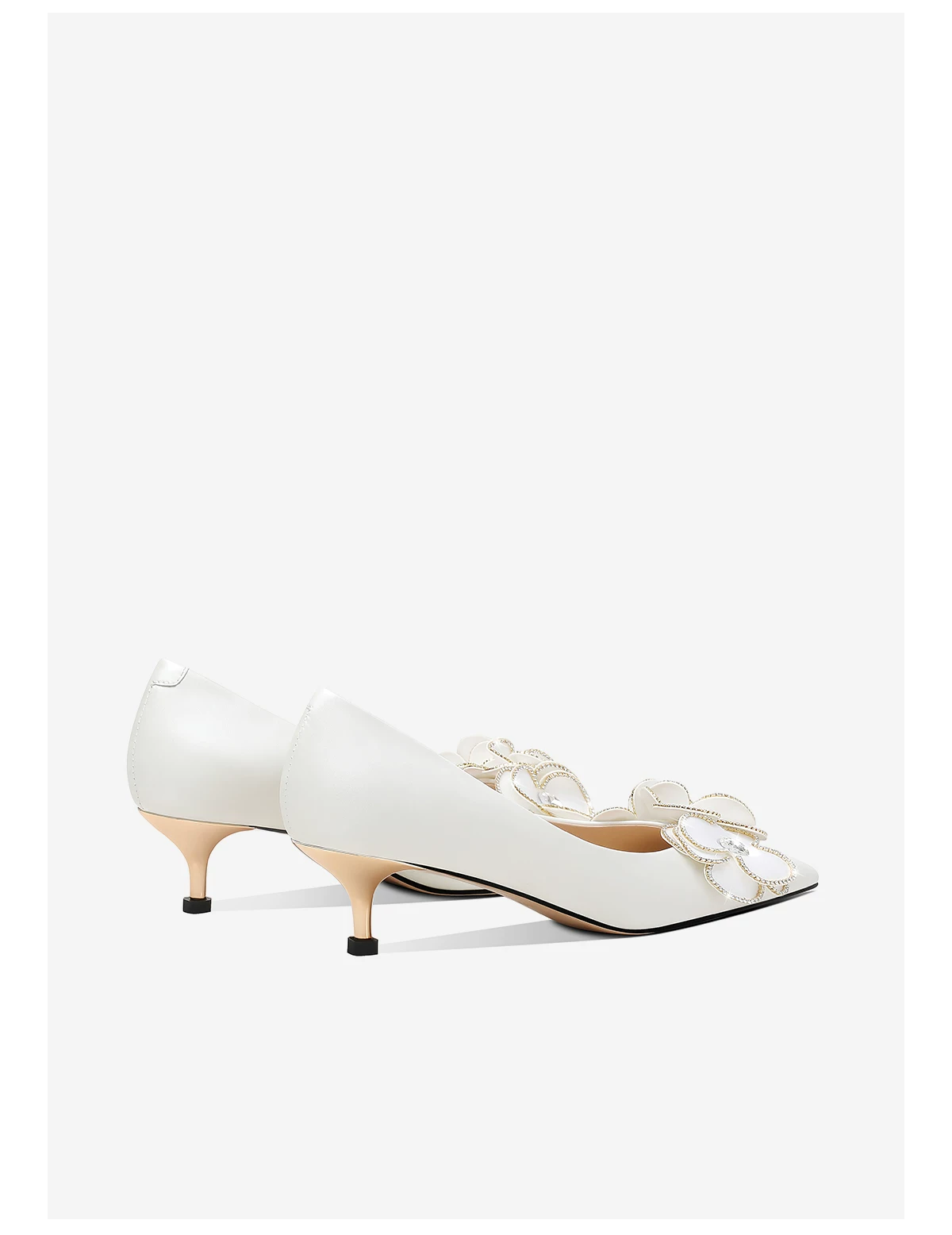
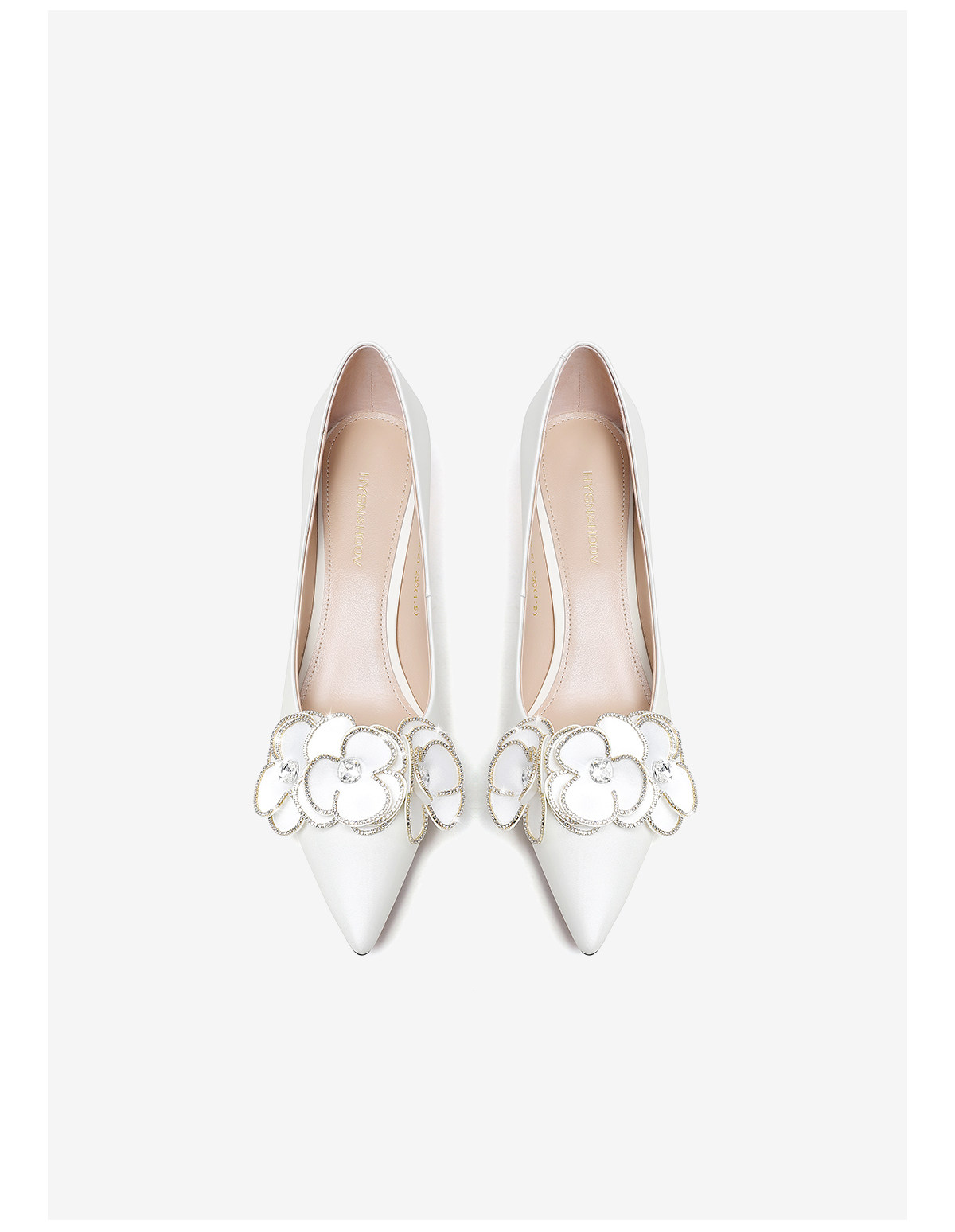
For a pointed pair that leans dressy without tipping into evening, the pointed black pair with a rhinestone detail keeps the toe sharp, and if you prefer the round-toe daytime version, the kitten heel in a soft white finish shows how much the toe shape changes the mood.
Winter is where people get kitten heels wrong
Black kitten heels for women get a bad name in winter, and the usual culprit is a knee-length skirt with opaque black tights. That combination that earned this shoe its fussy reputation. It’s not the shoe’s fault. It’s the contrast.
Three ways to wear them after October without looking like a period costume:
- Go longer with the hem. A midi or a long wide-leg trouser with a tiny heel reads modern, because the eye follows the line rather than stopping at the ankle.
- Go sheer with the tights. 20 denier keeps the leg line soft and stops the shoe from looking like a hard full stop.
- Go tonal. Black tights, black skirt, black shoe, one lighter layer on top. No contrast at the ankle, no visual cut.
The worst version is a short skirt, heavy opaque tights, and a pointed black kitten heel. That combination is doing three different things at once, and the eye can’t settle.
Cold weather also exposes the construction. A thin leather sole transmits cold straight through, and a low heel gives you no insulation from the pavement. If you plan to wear these through winter, look for a rubber sole and a lined footbed, and accept that you’ll wear them for the walk from the car rather than the walk to the station.
Boots do the winter job better. Kitten heels do the indoor job better. Trying to make one shoe do both is how people end up with wet feet and a bad mood by 9am.
What they’re genuinely bad at
Kitten heels are not a solution for long walks, and pretending otherwise is how people end up with sore feet and a bad opinion of the shape.
They have almost no arch support. The heel is too low to hold your arch and the footbed is usually flat, so a 40-minute walk on concrete will leave your arches complaining. Clinical guidance on plantar fasciitis points to support and cushioning rather than heel height, and this shoe offers little of either. If your arches complain, it’s the wrong shoe unless you can fit an insole, and most pointed kitten heels have no room for one.
They’re also bad on cobblestones and grass. The narrow heel sinks into soft ground, and the low height gives you no leverage to pull it out gracefully. Weddings in a field are a bad match.
And they can look dated in the wrong combination. Black kitten heels with a short skirt and opaque tights can read like a costume from a period drama. The fix is proportion: longer hem, sheer tights, or bare legs.
One more honest point. They’re not as comfortable as a flat, and anyone who tells you otherwise is comparing them to a stiletto. They’re comfortable relative to heels, which is a different claim.
If you want one pair that covers work, travel, and events, a kitten heel is a reasonable compromise. If you want one pair for a 12,000-step city day, buy a flat and stop negotiating with yourself.
Which black kitten heels to buy, and how to keep them
Buying only one pair? Get the plainest version you can find. Smooth black leather, pointed toe, 40mm, with a strap if your heel is narrow. No bows, no rhinestones, no contrast trim. That pair will work with more outfits than any other shoe in the wardrobe.
The second pair is where you can have some fun: suede, a square toe, a slight metallic trim. The first pair is a tool. The second is a choice.
Most black kitten heels for women fail at the toe before anywhere else, so care is mostly about the front of the shoe. Black leather kitten heels scuff at the tip before anywhere else, because a pointed toe takes the impact when you misjudge a step. A cream polish and a soft cloth every couple of weeks keeps them looking new, and a cobbler can fit toe taps for a few pounds if you’re rough on shoes.
Store them with the toes stuffed. A pointed toe collapses in a bag and creases across the vamp, and that crease is permanent in patent.
One last thing worth knowing, and it’s the reason so many black kitten heels for women get returned. They photograph darker and flatter than they look in real life, especially in indoor light, so don’t judge a pair by a phone photo at a wedding. Judge them by the toe shape and the heel position, which are the two things you can actually see clearly.
And if you’re replacing a pair that never felt right, check the heel position before you buy again. The height was never the problem. Neither was the colour, and it’s never the colour.