

You’re holding two pairs in a shop, both black leather heels, one at $85 and one at $210. They look the same. One will still be wearable in five years and the other will have cracked across the toe box by next spring.
The difference isn’t brand. It’s what the word leather is hiding, and most listings don’t tell you which version you’re buying.
Here’s how to work it out before you pay, and what to do once you own a pair worth keeping.
Real leather, bonded leather, and coated split: three different shoes
The word leather on a shoe label covers at least three materials, and only one of them behaves the way you expect.
Full grain or top grain. The actual outer surface of the hide. Fibres run through the whole thickness, so it flexes, breathes and holds shape. Creases form in soft lines. This is what people mean when they say leather.
Coated split or corrected grain. A lower layer of the hide with a sprayed finish on top. Cheaper, more uniform, and the surface is essentially plastic paint over suede. It looks great for a season and then cracks at the flex point, because the coating doesn’t stretch with the fibres underneath.
Bonded leather. Leather scraps ground up and glued back together with a binder. Often labelled “genuine leather”, which is technically true and practically meaningless. It delaminates. Once it starts, no cobbler can save it.
The price bands tell you a lot. Most leather heels women buy between $80 and $150 are coated split, and they’re fine for two seasons of light wear. Above $200 you should be getting top grain, and if you aren’t, you’re paying for a name.
- Look at the cut edge near the sole. Fuzzy fibres means a hide. A clean plastic-looking line means a coating.
- Press a thumbnail into the surface. Real leather creases outward in a small fan. Coated split shows a hard dent or nothing.
- Check the inside. A rough suede back is a good sign. A fabric backing glued to the underside usually means bonded.
The label wording is the giveaway, once you know it. “Genuine leather” is the weakest claim on the list. “Full grain” and “top grain” are the strong ones. Anything that says “leather upper” without a qualifier is probably coated split, and the brand knows it.
None of this makes cheap shoes immoral. A bonded pair you wear thirty times and bin is a reasonable purchase if the price reflects it. The problem is paying top-grain money for a coated shoe, and that happens constantly.
The crease test is the only test that matters
Bend the shoe. Not gently. Take the toe and the heel and fold it so the vamp creases the way it will when you walk, then look at what happened.
Real leather creases in a soft, rounded fold and springs back with a slight memory of the line. Coated split creases sharply, like folded card, and leaves a white line along the ridge. Bonded leather creases and doesn’t come back at all, or worse, separates.
Do this in the shop, on the floor, before you hand over money. Staff sometimes wince. They also know why you’re doing it.
The crease point is where the shoe will eventually fail, so it’s worth understanding where it lands. On a court shoe it’s about 30mm behind the toe, right where your foot bends. On a pointed shoe it’s further forward and the fold is tighter, which is why pointed coated-split shoes crack first and worst.
Second test, and it takes ten seconds: smell it. Real leather smells like leather. Coated split smells like a new plastic wallet. Bonded smells like glue, because it is glue.
Third test if you’re buying online and can’t do either. Read the reviews and search them for the word cracked. It’ll be there if the shoe is coated, usually around the four-month mark, and it’s the single most reliable signal in the whole listing.
There’s a variant of the bend test for shoes you already own and suspect. Crease them and hold the fold for ten seconds, then let go. Real leather recovers most of the way within a minute, leaving a soft line. Coated split keeps the sharp ridge and the white line underneath it, and once that line appears you’ll see it in every photograph from then on.
Crease width is informative too. A wide, soft fold across the vamp suggests fibres running in multiple directions, which is what top grain does. A single hard crease running straight across suggests a coating doing all the work, with nothing underneath it that wants to bend.
Buy them snug, but not for the reason you’ve been told
Leather heels women buy a size up because they’re worried about tightness end up with a shoe that slips at the heel and rubs at the back. It’s the more common mistake, and it’s harder to fix than a snug shoe.
Leather does give. Top grain will stretch about 2mm across the width over the first month, and it moulds to the shape of your foot in a way coated split never will. So a shoe that feels slightly firm across the ball on day one is usually right.
What shouldn’t be tight is the length. If your longest toe touches the front, size up. No amount of stretching adds length, and a toe pressing against the front of a pointed shoe will make you miserable by lunchtime.
The heel is the third variable. Leather uppers stretch, heel counters don’t. A shoe that slips at the back on day one will still slip in June, because the stiffener behind your heel keeps its shape. Fit the heel first, then check the width.
There’s a shortcut if you’re between sizes: buy the larger and add a thin leather insole. It takes up half a size, it’s removable, and unlike a heel grip it doesn’t move around. Mine have been in the same pair since 2023.
Wide feet need a different approach. Top grain stretches across the width but not much, maybe 3mm at the ball over a month. If the shoe is pressing on your little toe in the shop, that pressure will still be there in August, just spread over a slightly larger area. Look for a wider last instead of hoping the leather will do the work.
The break-in period is real but short. Expect five to seven wears before a good leather heel stops feeling like a new shoe, and expect them to feel best around wear twenty. After that the shape is set, and a pair that still hurts at wear thirty is never going to stop.
Two products, and nothing else
Leather care has been sold as a hobby. It doesn’t need to be. A cream conditioner and a horsehair brush will handle nearly everything a pair of heels will ever face.
Condition twice a year, or whenever the leather looks dry and slightly matte. Work a small amount in with a cloth, wait twenty minutes, brush off the excess. That’s it. Over-conditioning is a real problem and it makes leather floppy, which on a heel means the upper stops holding your foot.
Skip the silicone sprays and the miracle protectors. A good cream does the same job and doesn’t leave a residue that attracts dust. If you live somewhere with salt on the roads in winter, wipe the shoes with a damp cloth the same day and condition a bit more often.
Store them with shoe trees if you can. Cedar ones cost about the same as a decent lunch and they hold the shape of the vamp, which is exactly the part that creases. Crumpled newspaper works in a pinch. Leaving heels in a hot car does more damage in an afternoon than a year of normal wear.
For scuffs, match the colour with cream polish rather than a marker pen. A marker looks right for a day and then goes purple in sunlight, which I learned on a pair of brown courts I liked a lot.
The one thing worth paying a professional for is a heel tip. Replacing the plastic cap costs very little and takes ten minutes, and delaying it is how a $200 shoe becomes a $40 shoe, because once the tip wears through, the heel block starts grinding away.
Conditioner choice matters less than frequency. A $12 tin and a $40 jar do broadly the same job, and the expensive one isn’t four times better. What actually damages leather is neglect followed by panic, where somebody discovers a dry shoe and applies half a tin at once. Little and often beats a rescue mission.
Where the money actually goes: sole, lining, heel
A leather upper on a plastic sole is a compromise, and it’s the most common one in the mid-market. It’s not fatal. It does tell you the shoe was built for a price.
Look at three components, in this order:
- The sole. Leather soles breathe and can be replaced. Rubber grips and lasts. Bonded leather soles wear through in months and often can’t be repaired.
- The lining. Leather lining moulds to your foot and doesn’t smell. Synthetic lining is cheaper and gets hot fast, which matters if you wear them without socks.
- The heel. A stacked leather heel can be rebuilt by any cobbler. A moulded plastic heel is disposable, and if it snaps, the shoe goes with it.
The lining is the one people ignore and it’s the one your foot notices. A leather-lined shoe at 70mm feels different after four hours than a synthetic-lined one at the same height. It’s not subtle, either.
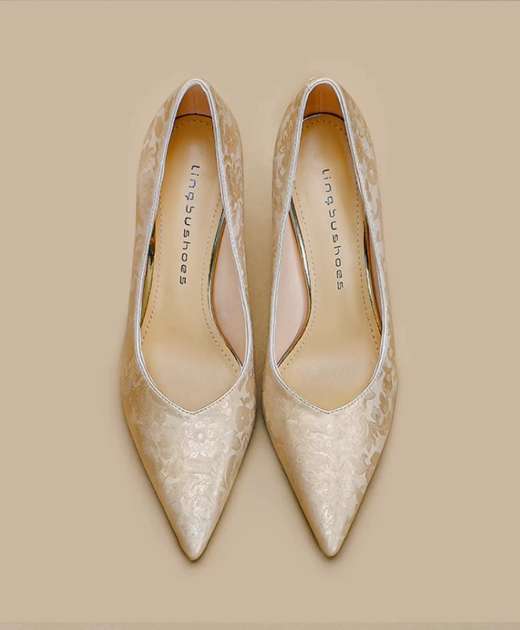
You can see the difference in how a shoe is finished at the edges. these genuine leather pointed courts show a clean cut edge rather than a folded and stitched seam, and woven leather uppers in white are a useful comparison for how much material quality shows once the surface is cut into strips.
The resoling question is worth doing the arithmetic on. A cobbler charges somewhere between $45 and $80 to replace a leather sole, depending on where you live. On a $250 shoe with a good upper, that’s obviously worth it. On an $85 shoe, you’re paying most of the purchase price to extend the life of something that will crack at the vamp before the new sole wears out.
So the rule is simple. Resole when the upper is worth more than the repair. Skip it when it isn’t, and put the money toward a pair whose upper will still be intact in five years.
The listing words that mean nothing, and the ones that mean something
Online shopping turns this into a reading exercise. Most product pages are written to avoid committing to anything, so you have to look for the specific phrases that do.
Words that carry no information: premium, luxurious, high quality, soft feel, fashion leather, man-made leather. That last one is plastic, and at least it’s honest.
Words that carry real information: full grain, top grain, vegetable tanned, leather lining, stacked heel, Goodyear welted, resolable. If a listing mentions any of these, the brand is usually proud of the construction and will tell you more if you ask.
Response time to a question is a decent test as well. Ask what kind of leather it is and whether the lining is leather. A brand that answers in a sentence with a specific term is a brand that knows its product. A brand that replies with “high quality leather material” has told you what you needed to know.
Photos help more than copy. Zoom into the edge of the upper near the sole, then into the inside of the heel. Look for a stitched sole rather than a glued one, and a lining that looks like suede rather than woven fabric. If the only photos are three-quarter views on a white background, that’s a choice.
One more: check whether the same shoe comes in multiple colours with identical creasing in the photos. If every colourway uses the same base image with a hue shift, nobody photographed the actual product.
Return policy is part of the construction story, weirdly. Brands confident in their leather usually offer free returns for thirty days, because they know the shoe survives trying on. Brands selling coated split often charge for return shipping, which is a quiet admission about what happens to the surface after one wear.
Sizing charts are worth a second look before you decide a listing is useless. A chart with foot length in millimetres and a note about width is a brand that has measured something. A chart that just maps S to 36 and M to 37 is a template, and templates are usually pasted onto shoes from three different factories.
Buying secondhand, which is where the value is
Well-made leather heels are one of the few things that genuinely improve secondhand, because the previous owner has already done the breaking in. A pair of top-grain courts from a good maker, worn twenty times, sells for a third of new and has thirty years left in it.
Check four things before you buy. Creasing at the vamp, which should be soft lines rather than a hard fold. Wear at the heel tip, which tells you how much walking they’ve done. Stretching across the instep, which you can spot as a bulge in the side profile. And the lining, which should still be intact at the heel, not rubbed through.
Skip anything with a crack in the coating. That’s the end of the road for coated split, and no cobbler will touch it. Skip anything that smells of mildew, too. That smell doesn’t come out.
Size is the thing people get wrong. Secondhand shoes have already moulded to somebody else’s foot, so they fit slightly differently than a new pair in the same size. If you’re a half size, buy your true size rather than sizing down, because the previous owner’s shape has taken up some of the volume.
For shade matching, the shade test in this red heels guide works just as well on used shoes, and what a woven upper costs you in fit is worth a read before you buy anything with a cut surface. If you’d rather start from new, the women’s shoes range is the place to compare like for like.

If you want the technical side of how hides become uppers, the entry on leather and tanning explains why vegetable-tanned hides behave differently from chrome-tanned ones, and OEKO-TEX publishes the limits on the chemicals used in the finishing processes, which is the part most people never think about.
So do the bend test, smell the shoe, and read the label for a word that actually means something. Three minutes in a shop answers the question that four hundred reviews can’t.
And if the crease goes white in the fold, put it back on the shelf. There’s a pair two steps along that won’t do that.
