

The afternoon a pair of olive green heels gets judged is rarely a mild one. It’s 32°C, the pavement outside a venue reads closer to 43°C on a phone thermometer, and the shoes have been on since 11am. By 3pm the strap has left a line across the ankle, the suede has a darker patch where the toe flexed, and the inside of the heel has started to feel like a small heated room.
Green is the colour people buy for spring and then wear in July, which is where most of the trouble starts. Suede and patent behave differently in heat, dye moves at different rates, and the fitting that felt perfect in an air-conditioned shop at 10am can be half a size wrong by late afternoon.
What follows is what tends to happen to olive green heels across a hot day, in the order it happens, plus the checks that separate a pair that survives summer from one that ends up at the back of the wardrobe by August.
Why 31°C is the number that matters, not 25°C
Below about 28°C, most shoes behave. Leather stays firm, feet stay close to their morning size, and a snug fit reads as supportive rather than tight. Above 31°C, three things shift at once.
Feet swell. Not dramatically, but enough: studies of foot volume during sustained heat and standing put the change at roughly 3 to 5% over a long day, which on an average foot is close to half a UK size. A shoe fitted at 10am has to accommodate that by 4pm.
Moisture climbs. A closed heel in summer holds sweat against the lining for hours, and every material reacts differently. Leather lining absorbs and dries. Synthetic lining doesn’t absorb anything, so the moisture sits there.
Surfaces get hotter than the air. Dark asphalt in direct sun runs 10 to 20°C above air temperature, and a thin sole passes that heat upward. A 4mm sole on a 43°C pavement is not insulation, it’s a hot plate.
Olive green makes all three problems more visible. It’s a mid-tone with a lot of grey in it, so it shows water marks and dust more clearly than black and less forgivingly than tan. A pair of olive suede heels that looks sharp at noon can look tired by five, and the change is mostly moisture, not wear.
If you’re buying for a specific date outdoors, check the forecast for the hour you’ll actually be standing rather than the daily high. A 29°C day that peaks at 1pm and drops to 24°C by the time the ceremony starts is a different shoe decision from a flat 31°C afternoon, and your feet will notice the difference within an hour.
Suede and patent fail in opposite directions
Most olive green heels on the market are one of these two finishes, and neither likes heat for the same reason.
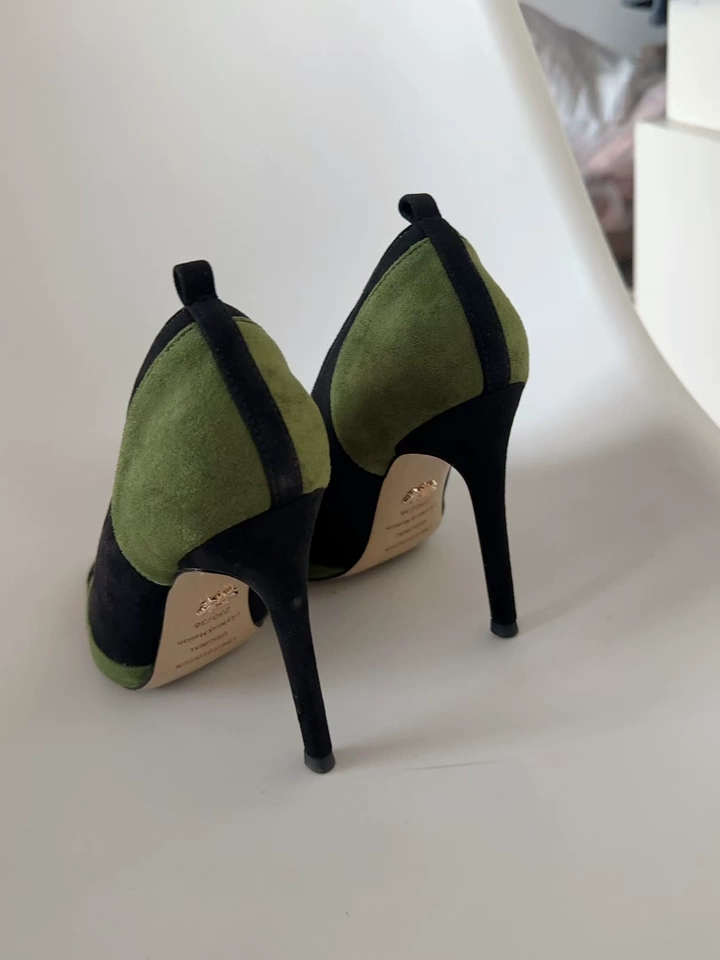
Suede is a brushed surface. Heat softens the nap, sweat mats it down, and any pressure point polishes into a shiny patch that doesn’t brush back out. The toe box crease is the usual casualty, along with the inner side of the heel where the strap rubs. Suede also darkens when damp, so a sweaty afternoon leaves a tideline that only shows once it dries.
Patent does the opposite. It doesn’t absorb, so moisture stays on the surface and the foot slides. On a hot day a patent olive heel can feel a half size bigger by 2pm simply because the foot is moving inside it. Patent also traps heat against the skin, and the sole edge tends to yellow under sustained UV.
Neither is a dealbreaker. Suede is more comfortable in dry heat, patent is easier to wipe down. The mistake is buying suede for an outdoor July event and expecting it to look new at 6pm, or buying patent for a long standing day and expecting no slip.
There’s a third option worth knowing about: coated leather with a matte finish. It holds colour like patent but behaves like leather, and it’s the finish that ages most gracefully in olive, because the tone deepens rather than going patchy.
You can tell which one you’re looking at in about ten seconds. Run your thumb across the toe. Suede drags and changes shade as the nap moves. Patent squeaks and shows a fingerprint that you then have to wipe off. Coated leather does neither: it’s smooth, slightly waxy, and the mark fades on its own. Ask which finish it is if the listing only says “green” and shows a soft-focus photo, because the care routine and the summer behaviour are completely different.
The dye question nobody asks before August
Green dye on a light lining is a summer problem, and it shows up on the back of the heel first. Sweat plus friction plus a low-grade dye equals transfer, and once it’s on skin it takes a few washes to fade.
Two things raise the risk. A dark, saturated green on a pale leather lining is the classic combination, because the dye has further to travel. And a shoe worn barefoot in heat transfers more than one worn with a thin sock, simply because there’s no barrier.
The test is cheap. Dampen a white tissue, rub it firmly on the inside of the heel counter for ten seconds, and look. A faint tint is normal on new leather. A strong transfer means the dye will find a foot.
Darker linings hide the problem and don’t solve it, though they do keep the shoe looking better from the outside. If a listing mentions tested lining, the OEKO-TEX Standard 100 limits for dyestuffs are the reference point, since that standard covers the substances most likely to irritate skin.
For anyone who plans to wear olive green heels without tights from June to September, a pair with a tan or beige calf lining is the safer buy. It hides transfer, it doesn’t show sweat salts, and it doesn’t discolour at the flex point.
One habit worth building before you wear a new pair anywhere that matters: put them on at home with a thin white sock and walk around for twenty minutes on a warm afternoon. If the sock picks up green at the heel, you’ve found the transfer before it reached your skin. Wash the sock, not your ankle, and decide whether that’s acceptable. Most people find a faint tint is, a strong one isn’t.
Lining decides whether they smell by week three
This is the least photogenic part of shoe buying and the one that decides whether a pair lasts a season or three.
Leather lining breathes, absorbs, and dries out overnight. It also costs more, which is why a lot of mid-price olive heels use a synthetic lining and describe it as “breathable” without saying what it’s made of.
PU lining is the one to check for. It doesn’t absorb, so moisture stays between foot and shoe, and in sustained heat that produces the smell that no spray fixes. A pair with PU lining worn barefoot through a hot summer will usually be unwearable by the following June.
Fabric lining sits in the middle. Cotton twill is decent, polyester mesh is not, and both are cooler than leather in heat but worse at managing moisture over six hours. Trade coverage in the footwear trade press tends to focus on uppers, and it’s worth reading how Footwear News covers material and comfort claims when a brand leans hard on “breathable” as a selling point, because the word has no fixed definition.
A practical middle path for summer: leather lining in the heel counter, where friction is worst, and a lighter lining in the forefoot. Many better mid-price pairs are built this way, and it’s the combination that holds up best in 30°C-plus conditions.
If you can’t inspect the lining before buying, read the weight instead. A pair that lists 380 grams per shoe in a size 38 has more structure than one that lists 250 grams, and the heavier pair usually has a real lining and a thicker sole. Lightness is sold as comfort, and it is comfortable for the first hour. After four hours on a hot pavement, you’ll want the grams back.
Buy at 4pm, not at 10am
Nearly every fitting problem with summer heels traces back to the hour the shoe was tried on. Feet are smallest in the morning and largest after a day of standing and heat, and the difference is enough to change a size.
So fit late. Go to the shop at 4pm, or try an online order on after a normal day rather than first thing in the morning. The pair that feels right at that hour will still be right at noon; the reverse isn’t true.
Three measurements are worth taking before ordering, because they explain most fit failures:
- Foot length standing, heel against a wall, at the end of the day rather than the start.
- Width at the ball of the foot, measured across the widest point while standing.
- Instep height, taken as a rough loop around the top of the foot at its highest point.
Olive green pointed heels are usually cut narrow, and a high instep is the most common reason a pair that fits lengthwise still pinches across the top. That pinch gets worse in heat, not better, because the foot rises slightly when it swells.
For anyone ordering online, the sensible move is to order two sizes, try both at the end of a hot day, and return one inside the window. Pointless pride about being a consistent size is how people end up with shoes they wear twice.
When you try them, do it on a hard floor rather than carpet, and do it standing. Carpet hides a heel that slips and softens a sole that’s too stiff. Stand for five minutes, then walk twenty steps, then turn sharply twice. If you feel the shoe move independently of your foot on the turn, the fit is wrong and the strap won’t save it.
What olive pairs with, in actual daylight
Olive is a mid-tone with yellow and grey in it, which makes it unusually flexible and unusually easy to get wrong under artificial light.
It works with cream, camel, rust, chocolate and denim. It works with navy, though the combination reads slightly autumnal in bright sun. It fights with most blues that lean cool, and it looks muddy next to lilac and pale pink.
Against black it’s a subtler pairing than people expect. An olive heel with black trousers reads almost neutral at a distance, which is why it’s a useful office shoe for anyone who finds black heels severe and tan heels too soft.
The light problem is real. Olive shifts toward brown under warm interior lighting and toward grey in overcast daylight, and phone cameras exaggerate both. A pair photographed at a restaurant at 8pm can look like a completely different shoe from the same pair at a bus stop at 8am. Buying online, it’s worth looking for a photo taken outdoors and unfiltered, or accepting that the delivered colour will read a shade deeper than the grid image.
Green also had a long run in seasonal colour reporting; the Pantone Color of the Year archive is a decent way to see how olive and moss tones get positioned against the rest of a season’s palette.
The footwear half of the outfit matters less than people think. Olive heels with a cream linen dress and no jewellery look intentional. The same shoes with a busy print, a tan bag and gold earrings look like three separate decisions. If you’re unsure, take one accessory off before you leave the house.
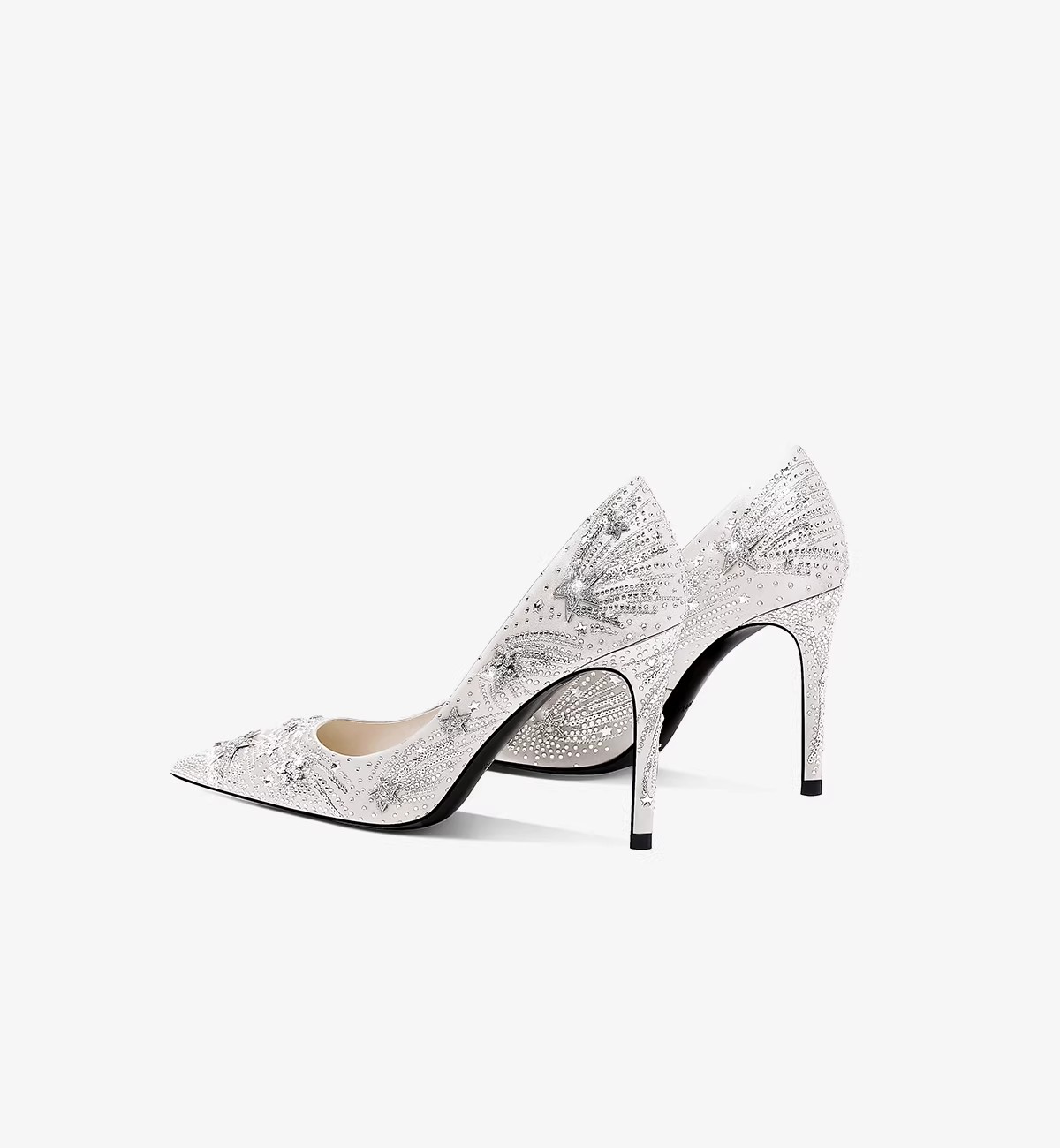
Where the colour gets harder is evening. Olive in artificial light looks brown, and brown plus a black dress can read flat. A pair with some sheen handles that better, which is the argument for embroidered champagne and green heels with a closed toe over a matte pair if you need the shoes to work after dark.
Six hours outdoors: the checks that matter
An outdoor event in July is the hardest test an olive green heel will face all year. Heat, grass, gravel and a long gap between sitting down.
Before leaving the house:
- Heel tips: press a thumbnail into the tip. If it dents easily, it will wear through on gravel.
- Strap length: fasten it on the loosest hole, then walk ten steps. If the heel lifts, the strap is decoration.
- Sole flex: bend the shoe at the ball. It should give, not fold.
- Spare: a flat pair in the car or bag. Not romantic, extremely practical.
On grass, a stiletto sinks. A block or a 60 to 70mm heel with a wider footprint stays on the surface, which is the single most useful thing to know before buying a heel for a garden wedding. Gravel is worse for thin heels than grass is, because the tip catches between stones rather than sinking in.
The other thing worth planning is the sitting gap. Six hours with two short sits is different from six hours with eight. A shoe with a padded insole and a slightly thicker sole handles the standing version; a paper-thin sole does not, regardless of heel height.
Something like these slim-heel green rhinestone heels in a mid height is built for the shorter version of that day: evening, indoors, a couple of hours on your feet. For a full outdoor afternoon, the thicker heel and closed shape of the green commuting heels with a wider heel base are the more honest choice.
The end of a hot day, in five minutes
What happens in the twenty minutes after the shoes come off decides how they look in September.
Let them dry at room temperature, away from radiators and out of direct sun, and stuff them with newspaper or a shoe tree while they’re still slightly damp so the shape sets as they dry. Never put suede in a plastic bag damp; that’s how mildew starts, and mildew on olive suede leaves a permanent grey bloom.
Brush suede once it’s fully dry, in one direction, with a soft brass brush. For patent, wipe with a damp cloth and dry with a soft one, then check the sole edge for that yellowing line. For coated leather, a neutral cream once a month is enough.
Then the honest part. If a pair of olive green heels has left a red line across the ankle, a matte patch at the toe crease, and a smell that survived the night, that’s not a care problem. That’s a fit and lining problem, and no amount of brushing will undo it. Better to know that in week two, while the return window is open, than in September when it’s just a pair of shoes taking up shelf space.
September arrives and the same pair has to work again
By mid-September the olive pair that spent July on a hot pavement gets worn with tights, and this is where a summer purchase usually turns into a year-round one, or into a mistake.
The change is mostly inside the shoe. A 40-denier tight adds maybe a millimetre of thickness, which is enough to turn a snug heel into a pinching one and a loose one into something that finally grips. If your olive heels were tight in bare feet in July, they’ll be right in October. If they were comfortable barefoot, try them with tights before you commit to a long day in them.
Colour shifts too. Olive against black opaque tights reads deeper and slightly more formal. Against sheer nude tights it stays close to the summer version. Against grey tights the whole outfit goes quiet, in a good way. The combination that surprises people is olive with burgundy tights, which either looks considered or looks like a mistake, and there’s not much middle ground.
Two practical notes for the shoulder season. Suede that got damp in July will have a slightly raised nap by September, and a brass brush fixes most of it. And if the pair has a slingback or an ankle strap, check the elastic: summer heat degrades thin elastic faster than anything else on the shoe, and a stretched strap is the reason a pair that fit in June slips in October.
If you’re building a rotation rather than buying one pair, the smarter order is a closed heel in September and a sandal in May, since the closed pair carries more of the year. There’s a fuller version of that logic in how slingback kitten heels cover office and dinner without a change, which is the same argument at a lower heel height.
And if you’d rather compare finishes side by side before deciding, the women’s shoes section sorted by colour and heel shape is faster than scrolling a search page. Look at the green options in two or three heights, then pick the one that matches the number of hours you’ll actually spend standing.
