

The pair looks perfect for eleven days. Then the first rain hits, or the first puddle on a station platform, and the nap at the toe flattens into a dark patch that doesn’t brush out. By week three there’s a shadow where your foot flexes and a water line around the heel. Nothing has failed. That’s just suede, doing what suede does, on a schedule nobody mentions at the till.
I’ve watched this pattern repeat often enough that I can usually predict which customers will come back unhappy from the shoe they’re holding. It’s rarely about quality. It’s about buying a material for its look and then treating it like the material it isn’t. Suede sneakers for women are a genuinely good category, and they come with a maintenance contract most people never read.
Suede is sold as a texture and bought as a risk
Walk into any shop and the suede pair is the one on the display table, angled toward the window. That’s not an accident. Suede photographs beautifully, absorbs light instead of reflecting it, and reads more expensive than it is. Under shop lighting it looks like velvet. In a hallway at 7am it looks like the reason you’re late.
The gap between those two impressions is the entire story of the category. Suede has a nap, which means a direction, which means it behaves differently depending on which way you brush it, which way the light hits it, and which way you walked through a door. A single pass with a wet hand leaves a mark that lasts until it dries, and sometimes after.
Here’s what buyers consistently underestimate: suede is not fragile, but it is directional. It handles dry cold, dry heat, and daily wear fine. What it doesn’t handle is water, salt, and friction at the flex point. Two of those are weather. One is you, and it happens on every step.
There’s a commercial reason the shop steers you toward the suede pair, and it’s not conspiracy. Suede sneakers for women carry a higher margin than mesh or leather in most ranges, because the material is cheaper than full-grain leather and the perceived value is higher. That’s fine as long as you know it. It means the assistant’s enthusiasm is a signal about the range, not about your feet.
So the honest framing isn’t “is this pair good”. It’s “can I give this pair the conditions it needs”. If you commute on foot through a wet city, the answer is probably no for four months of the year, and yes for the other eight. That’s a useful answer, and it’s the one you rarely get in a shop.
What the word suede actually covers
In the trade, “suede” is a family of materials with very different behaviours, and the price gap between them is bigger than the price gap between brands.
Split suede is the real thing: the inner surface of a hide, sanded to raise a nap. It’s soft, it breathes, and it scuffs into a patina that some people love. It’s also the most water-sensitive version and the hardest to clean, because the nap traps fine dirt and holds it.
Nubuck is the outer surface of the hide, sanded lightly. The fibres are shorter and tighter, so it takes a scuff better and cleans up more easily than split suede. If you want the look with less anxiety, this is the version to look for. The difference between nubuck and suede is worth understanding before you spend 90 euros on the wrong one.
Microfibre suede is synthetic and gets sold under a dozen invented names. It’s water-resistant, uniform, and cleans with a damp cloth. What it doesn’t do is age. It stays exactly as it was for a year and then starts looking tired in a way that’s hard to describe and easy to spot next to real suede.
One more variant worth knowing: bonded suede, where a thin layer of split hide is glued to a textile backing. It’s cheaper, it holds its shape well, and it’s the version most often used in mid-price suede sneakers for women. The tell is the edge. On a bonded panel you can see a straight, slightly fuzzy cut line where the backing shows. On a full hide the edge is thicker and more irregular. Neither is wrong, but bonded panels are the ones that delaminate in year two if they get wet repeatedly.
Price tracks this ladder almost perfectly. Under 60 euros you’re almost always looking at microfibre or bonded. Between 70 and 110 euros, real split suede becomes realistic, usually with a synthetic lining. Above that you start seeing full-grain nubuck and leather linings, which is where the material stops being the weak point and the sole becomes the limiting factor instead.
None of these is a scam. They’re different products at different prices, and the problem is that the label rarely tells you which one you’re holding. Ask. If the answer is vague, assume microfibre and price accordingly.
The nap test: twenty seconds, no tools
You can identify what you’re dealing with before you try anything on, and you don’t need equipment.
Brush the surface with the flat of your hand in one direction, then the other. Real suede changes shade noticeably between directions. Nubuck changes less. Microfibre changes almost not at all, and feels slightly cooler and slicker under the fingers.
Then pinch a small fold at the side and look at the crease. Real suede creases softly and springs back. Microfibre creases sharply and holds the line. That single test has saved me from more bad purchases than any amount of reading labels.
Finally, press a dry thumb into the nap at the toe. If the mark stays visible for more than a few seconds, the nap is long, and long nap means visible footprints on the shoe within a week. That’s not a defect, it’s a characteristic, but you should know it before you pay.
- Short, tight nap: better for daily wear, cleans up with a brush, less visual drama.
- Long, loose nap: gorgeous in photos, marks easily, needs a brush after most wears.
- Uneven nap across the two shoes: a manufacturing inconsistency, and it will look like a colour difference within a month.
The last point is the one people miss in the shop, because they only handle one shoe. Compare both. Suede sneakers for women are often cut from different parts of a hide, and two panels that looked identical under shop light can look like different colours by a window.
Why black and sand suede age differently
Colour changes the maintenance story more than most guides admit, and it’s not only about stains.
Black suede hides dirt and shows damage. Water marks sit on the surface as a lighter ring, and because the base is dark, those rings are the only thing you see. The upside is that scuffs disappear. The downside is that one wet walk in November makes the pair look old in a way that a brush won’t fully fix.
Sand, taupe, and grey suede hide water marks and show dirt. Every scuff shows as a dark smudge, and the toe box collects a grey shadow from pavement within two weeks. These pairs are more forgiving of rain and much less forgiving of a bus floor.
Dark colours also fade unevenly. Black suede that’s been in sun loses saturation on the upper surfaces and stays dark in the folds, which produces a mottled look that reads as age rather than character. Pale suede tends to fade evenly, so it just gets lighter.
There’s a second colour effect that only shows up over months. Suede takes dye unevenly across panels, because different parts of a hide absorb differently. On a sand pair this reads as subtle variation and looks expensive. On a black pair it reads as patchiness, because the eye is tuned to notice any deviation from flat black. That’s why black suede is the hardest colourway to buy online and the easiest to buy in person, where you can hold both shoes side by side in daylight.
If you’re choosing between colourways and you can only own one pair, think about your worst commuting day rather than your best. The pair has to survive that day, not the wedding.
My advice, and it’s a bias rather than a rule: if this is your only pair and you walk to work, buy sand or taupe. If it’s a second pair for dry days and dinners, buy black. The colour that looks best on day one is usually the colour that looks worst on day ninety.
Weatherproofing: what works and what is being sold to you
Almost every suede care product promises to make the material waterproof. None of them do. What a protector does is slow absorption and make marks easier to lift, which is worth the ten euros and worth doing before the first wear rather than after the first accident.
Spray outdoors, two thin coats, twenty minutes apart, on a dry shoe. One heavy coat is worse than two thin ones because it darkens the nap unevenly and can leave a visible tide line. Let it cure overnight before wearing.
Reapply every four to six weeks if you wear the pair often, and always after cleaning. That’s the honest schedule. Anything promising a single annual application is marketing.
One more thing worth checking if your feet react to synthetics: the lining and the adhesive in a bonded shoe are the two components most likely to cause irritation, and the OEKO-TEX Standard 100 limits for skin-contact textiles are the benchmark a decent brand should be able to meet. Ask. A brand that can’t answer probably hasn’t tested.
For wet shoes, the recovery matters more than the prevention. Stuff with newspaper, change it after two hours, and dry at room temperature away from any heat source. A radiator will shrink and stiffen the nap permanently. If salt lines appear in winter, a 50/50 mix of white vinegar and water on a cloth, blotted rather than rubbed, lifts them before they set.
One trade note worth passing on: the protector you buy in a shoe shop is usually the same chemistry as the one in a hardware store at half the price. What you’re paying for in the shop is the brush and the confidence.
One more piece of the schedule that nobody warns you about: the lining. Suede uppers breathe well, but the synthetic lining most pairs use does not, and a foot that sweats inside a suede shoe produces moisture from the inside at the same time as rain arrives from the outside. That’s how you get a pair that smells faintly of damp by week three even though it’s never been out in the rain. Cedar shoe trees, five euros each, fix this better than any spray.
If the pair does get soaked, resist the urge to wear it dry. Walking a wet suede shoe flexes the nap while it’s soft, and the crease that forms then never fully recovers. Take the shoes off, stuff them, and give them a full day. That single decision separates a pair that lasts two winters from one that lasts one.
The two-week window
Here’s what actually happens in the first fourteen wears, based on watching a lot of these pairs come back through the door for cleaning.
- Days one to three. Nothing. The pair looks exactly as it did in the shop, and you conclude that suede is easier than people say. This is the trap.
- Days four to seven. The crease at the flex point appears, and the nap there flattens. It’s now slightly darker than the rest of the shoe. Nobody else notices. You do.
- Days eight to eleven. The toe box picks up a dust shadow, and the heel counter shows the first abrasion where your other foot brushes it when you walk. This is normal for any suede shoe and it’s the moment most people start brushing.
- Days twelve to fourteen. Either the pair has been protected and brushed and looks like a slightly lived-in version of itself, or it’s been caught in one rain shower and has a water line it will keep. That’s the window. Two weeks decides which pair you own for the next year.
If you want a comparison point for how much treatment matters, the notes on how a leather pair handles the same fortnight are useful, because leather forgives what suede records.
Repair, rotation, and when to walk away
Suede is repairable at the edges and not in the middle. A scuff on the heel counter can be brushed out, or hidden with a suede eraser and a little steam. A water line across the vamp can often be lifted by wetting the whole panel evenly and letting it dry flat, which sounds wrong and usually works.
What can’t be fixed is a flattened nap over the whole toe box, or a sole that’s started to separate at the flex point. Once the nap is gone in a patch the size of a coin, no brush brings it back, and dye won’t take evenly.
There’s also a structural repair most people don’t know about. If the sole is stitched rather than glued along the edge, a cobbler can resole a suede sneaker for around 35 euros, which is worth it when the upper is still good. Glued soles can be replaced too, but the bond line rarely survives the process cleanly on a soft upper. Check for visible stitching at the welt before you buy if you intend to keep the pair for years rather than seasons.
And keep the box. Suede sneakers for women that live in a box between wears hold their shape and stay cleaner than pairs left by the door, and the box costs nothing. It sounds fussy. It’s also the difference between a pair that looks new in month eight and one that looks like it’s been through a winter, which, technically, it has.
Rotation is the cheapest repair there is. Two days on, one day off gives the nap time to recover and the lining time to dry, and it roughly doubles the life of the pair. A suede sneaker worn daily will look two years old at eight months. The same shoe in a three-pair rotation looks a year old at eighteen months.
When to walk away in the shop: if the two shoes have visibly different nap, if the suede feels plasticky and cool, or if the price suggests real suede and the nap test says otherwise. All three are visible in under a minute, and all three are permanent.
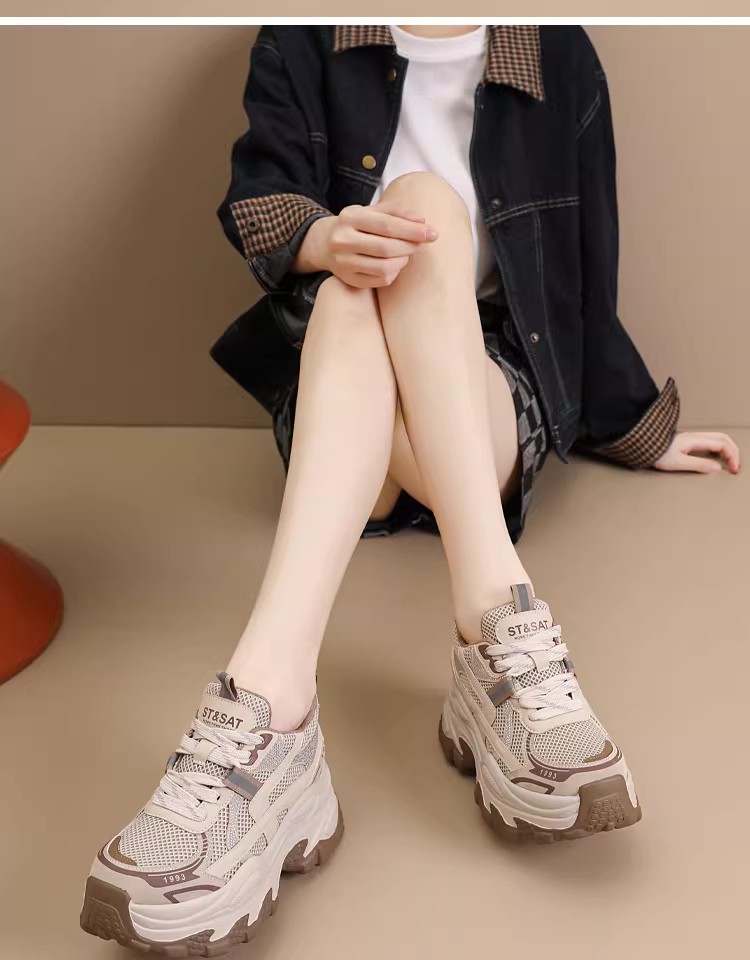
If you want to see how the shape compares with other materials, the sneakers range is sorted by style, and the thick-soled dad shoe is the closest silhouette we stock to the suede pairs people bring in for cleaning. The mesh soft-sole pair is the wet-weather alternative if you want the shape without the maintenance contract, and the wider women’s shoes collection is where I’d start if you’re building a rotation rather than replacing one pair.
Suede sneakers for women are worth owning. They’re just not worth owning as your only pair in a rainy city, and the two-week window is real whether or not anyone mentions it at the till. Protect them before day one, brush them twice a week, rotate them, and the pair you bought for the look will still look like the pair you bought. Skip those three things and you’ll be back in the shop by spring, buying the same shoe in mesh.
