

It’s 7:40 on a Monday, you’re standing in the hallway with one shoe on, and the pair you meant to wear is the pair that rubbed your heel raw on Friday. So you reach for the black sneakers again. That’s the whole reason this category exists: a black pair is the default answer to a rushed morning, and most of us own at least one that has quietly become the only thing we wear between October and March.
The problem is that “black sneaker” covers everything from a 12-euro canvas slip-on to a leather trainer with a 35mm sole, and the difference between a pair that survives five workdays a week and one that looks tired by Wednesday has almost nothing to do with the colour. You can judge most of it before you put them on. Below is the order I’d check things in, plus what actually happens to a single pair over a full working week.
Start with the last, not the black
The last is the foot-shaped mould a shoe is built around, and it decides whether the shoe looks sleek or clumpy long before colour enters the conversation. A narrow last with a tapered toe reads sharp under tailored trousers. A wide, rounded last reads sporty and pairs better with denim. Neither is better, but if you buy the wrong one for your wardrobe you’ll end up treating an expensive pair as gardening shoes.
Stand in front of a mirror with the shoe in your hand and look at it from directly above. Draw an imaginary line from the middle of the heel to the tip of the toe. On a good black sneaker that line sits roughly in the centre of the shoe or slightly toward the inside. When the line bends outward toward the pinky toe, the shoe will look wider on your foot than it does on the shelf, which is the single most common reason people say a pair “looks cheap” in person.
Then look at the heel counter from behind. Firm, with a slight inward curve at the top, means the shoe will hold your heel instead of letting it slide. Soft and floppy means you’ll be tightening the laces to compensate, and tightening laces over the instep all day is how you get a numb spot across the top of the foot by four in the afternoon.
One more thing worth knowing: black hides shape. A shoe with three visible panels and a chunky bumper looks like a solid dark mass from two metres away, so the silhouette has to do all the work. If you want the pair to look intentional rather than accidental, pick a last with a clean vamp and skip anything with a contrasting logo on the side.
Monday to Friday in one pair
Here’s how a week actually plays out, based on the schedule most office workers keep. It’s a more useful test than five minutes in a shop.
- Monday, meeting day. Trousers, a blazer, a room with bad lighting. This is the day a black sneaker either passes as smart casual or doesn’t. A leather upper with a slim sole passes. A mesh runner with a 40mm foam stack does not, and no amount of styling will fix it in that particular room.
- Tuesday, desk day. Six hours seated, two hours standing, one walk to get lunch. What matters here is the collar: a padded collar that sits above the ankle bone is comfortable for the first hour and irritating by the fifth. Lower-cut pairs win on desk days.
- Wednesday, the long walk. You park four blocks away, or you take the walk-and-transit route. This is where sole stiffness shows up. A shoe with a stiff, non-flexing forefoot makes your calf do extra work on every push-off, and you’ll feel it that evening rather than during the walk.
- Thursday, rain. Black leather handles a wet pavement better than suede or mesh, but only if the sole has a real tread pattern. Smooth rubber soles on wet tile are genuinely unsafe, and office lobbies are full of wet tile.
- Friday, the relaxed one. Jeans, maybe a skirt. This is the day you notice whether the pair scuffs. Matte finishes hide scuffs. Patent and high-gloss finishes show every one of them.
If a pair can cover Monday and Wednesday without complaint, it will cover the other three days easily. Those two are the filter.
Something worth stealing from people who walk a lot: treat the first week as a test, not a commitment. Wear the new pair for two hours on day one, four on day two, and a full day on day three. If a hot spot appears on day one, it will still be there in week three. The World Health Organization puts the weekly target for adults at 150 to 300 minutes of moderate activity, and for a lot of women most of that arrives as walking in ordinary shoes rather than as a workout. The shoe you wear for those minutes matters more than the one you keep for the gym.
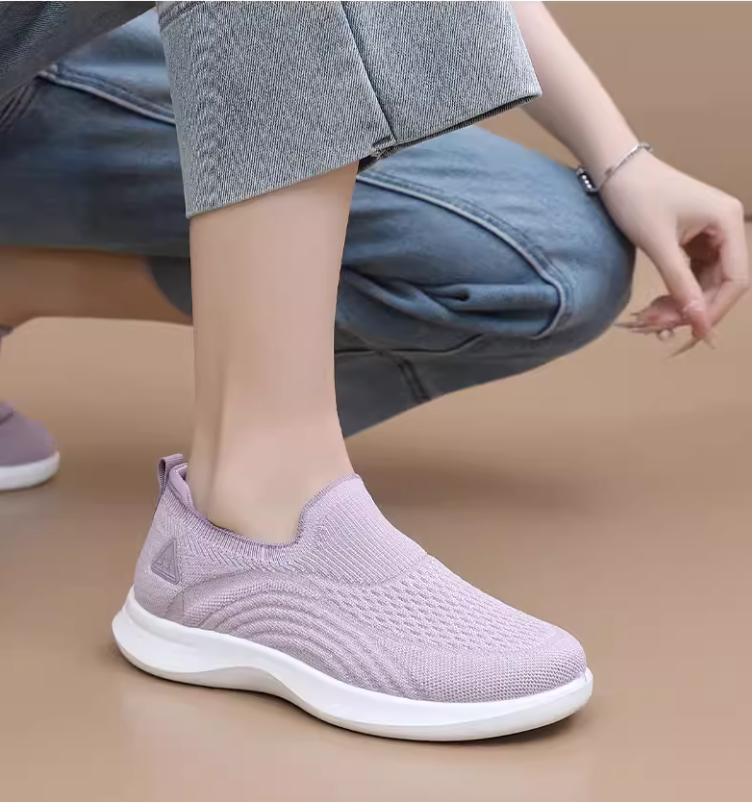
The breathable black mesh pair in our own range is a decent example of the Wednesday-friendly side of this: soft forefoot, low collar, four colourways including a true black. It won’t pass a Monday meeting, and I’d rather say that up front than pretend otherwise.
The toe box test you can do in ten seconds
Take the insole out if it comes out. Stand on it with your full weight and look at where your longest toe lands. You want roughly 8 to 10mm of insole left in front of it. Less than that and your toes will press the upper on every step, which is how black leather develops a pale crease line across the toe box within a month.
Then check width at the ball of the foot. Your foot spreads when you stand, typically by 3 to 5mm, and a shoe that fits perfectly while seated can be tight after an hour of walking. Press your thumb into the upper at the widest point while standing. If you can’t make a small dent, the shoe is too narrow for a full workday, whatever the size label says.
This is also the moment to notice whether the toe box is lined. Unlined black leather will stretch a little and mould to your foot over two weeks, which is good. Lined leather with a stiffener holds its shape, which looks better and forgives less. If you have a bunion or a wide forefoot, that distinction decides whether the pair is wearable or a two-week mistake.
High insteps deserve a mention, because they get ignored in most fitting advice. If the laces leave a V-shaped gap wider than about 15mm when the shoe is tied, the tongue isn’t long enough for your foot and the pressure will land right on the highest point of your arch. Try the next half size up, or a different lacing pattern that skips the middle two eyelets.
Sole height and what it does to a trouser hem
Sole thickness isn’t only a comfort question. A 20mm sole and a 32mm sole change where your hem sits, and that changes the whole line of an outfit.
With a 20mm sole, a straight-leg trouser breaks exactly where it would over a flat shoe, so the hem skims the ground and the leg looks long. With a 32mm sole, the same trouser now sits 12mm higher, which is enough to show a sliver of ankle in a way that reads deliberate on some people and slightly short on others. If you own trousers you love and don’t want to alter them, stay near 20 to 24mm.
Chunky soles also add weight, and weight is what you notice at hour six. A 32mm rubber platform can add 150 to 200g per shoe compared with a slim cupsole. That doesn’t sound like a lot until you’ve lifted it 9,000 times in a day. Thick soles photograph well and feel supportive for the first two hours. After that, the extra mass is just extra mass.
For what it’s worth, the relationship between platform height and apparent leg length is weaker than most people assume. The 4cm collar height changes how the ankle looks far more than 10mm of extra foam under the heel does.
Fourteen shades of black
Black is a finish as much as a colour, and the finish is what decides whether the pair survives a winter. The finishing stage in leather production is what separates a matte upper from a gloss one, and it happens after the tanning, which is why two pairs can feel identical in the hand and behave completely differently in the rain.
Matte full-grain leather is the workhorse. It takes a scuff, hides it reasonably, and can be brought back with a cream polish every couple of months. It also creases in a way that looks like it’s been worn, which some people like and others hate.
Nubuck and suede look softer and more expensive in the box and are the worst choice for wet weather. One Thursday of rain and the nap darkens unevenly at the toe, and no brush fully fixes it. If you want suede in a city with real weather, keep it for dry days only.
Patent and gloss photograph beautifully and show fingerprints, dust, and every crease. They also squeak against each other when you walk, which is a small thing until you’re in a quiet office corridor.
Knit and mesh are the lightest and most breathable, and they hold odour more than leather does. If you’re wearing the same pair five days a week, that matters. Rotate in a second pair, or accept that the shoes will need a wash every three weeks.
There’s a real cost angle here too. A pair worn 200 days a year at 60 euros works out to 30 cents a wear. The same pair worn 40 days because it only suits dry weather costs 1.50 per wear. That arithmetic is the argument for a matte leather upper over a prettier suede one, and it’s the same logic behind our cost-per-wear breakdown on gum soles.
The sock variable nobody prices in
You can do everything right with the shoe and still get a bad fit because of what’s on your foot. A black sneaker worn with a 2mm no-show sock behaves like a different shoe from the same pair worn with a 6mm cotton crew sock, and the difference shows up at the heel and the instep long before it shows up anywhere else.
Thin socks let the heel sit deeper in the shoe, which is usually good, but they also let the foot slide forward on downhill steps. Cushioned crew socks take up roughly half a size of volume, which is enough to turn a comfortable 38 into a tight 38 by mid-afternoon. If you plan to wear the pair mostly with thicker socks through winter, try them on with those socks. It sounds obvious. Almost nobody does it, and then the shoes get blamed.
There’s a seasonal wrinkle as well. Feet swell during the day, by as much as 5% in warm weather and after long periods of standing. A pair that fits at 8am in November can feel tight at 6pm in May. If you’re between sizes and you walk a lot, take the larger one and use a thin insole to take up the slack. If you’re between sizes and you mostly sit, take the smaller one, because a shoe that’s too long will crease across the wrong part of the toe and never stop.
And on the subject of black: dark socks with a low-cut black sneaker create an unbroken line at the ankle that makes the leg look longer. Pale socks break it. If you’ve ever wondered why the same pair looks better on someone else in a photograph, that’s usually the reason, not the shoe.
Where a black sneaker fails
Three situations where I’d steer you elsewhere, honestly.
A formal interview or a client pitch in a conservative industry. A sneaker can be styled into business casual, but it can’t be styled into a suit-and-tie room without looking like a statement. Wear the loafers.
A wedding where you’re not the guest of honour’s closest friend. Black sneakers read casual no matter the price tag, and in photographs next to heeled guests they pull the eye downward.
Any job where you’re on your feet for ten hours on hard floors. Fashion sneakers aren’t work shoes. A pair with a 20mm sole and no arch support will leave your feet aching by hour eight, and no amount of gel insert fixes a sole that wasn’t built for that load. Nurses, baristas and retail staff need a different category of shoe entirely.
One more caveat, less obvious: black rubber scuffs white floors. If your office or your home has pale tile, a black cupsole will leave marks, and the cleaning staff will notice before you do.
How a good pair ages over six months
Wear patterns are predictable, and knowing them helps you decide whether a pair is wearing out or just settling in.
Week one to four is the settling phase. Leather softens at the flex point and takes the shape of your forefoot. The heel counter moulds slightly. If the pair feels better at week four than at week one, the materials are doing what they should. If it feels worse, something is wrong with the fit rather than the break-in, and the return window is the answer.
Somewhere around week eight, the sole tells you what it’s made of. Cheap EVA compresses visibly, and you’ll notice the forefoot feels thinner than it did. Better foam holds its height longer. You can check by pressing a fingernail into the midsole at the ball of the foot: if it leaves a mark that stays for a minute, the foam is soft and will pack down quickly.
Four months in is the stitching test. Look at the inner side of both shoes, where the upper meets the sole. This is where a glued-and-stitched construction separates first, and where a purely glued one starts to lift. A 2mm gap is fixable with shoe glue. A 10mm gap means the pair is done.
At the half-year mark comes the honest assessment. If the upper still holds shape, the sole hasn’t gone slick at the heel, and the insole isn’t compressed into a footprint, you bought well. If two of those three have failed, the pair cost you more per wear than the price suggested, and next time the checklist at the end of this piece is worth ten minutes.
One maintenance note that costs nothing: let the pair dry out for 24 hours between wears, and stuff newspaper in them if they get wet. Leather that dries slowly keeps its shape. Leather dried on a radiator goes hard at the flex point and cracks in month five.
What to check before you pay
A short list, in the order that saves the most money.
- Flex the shoe at the ball of the foot with both hands. It should bend where your toes bend, not in the middle of the arch.
- Twist it lengthwise. Some resistance is good; a shoe that twists like a wet sock has no midfoot support.
- Check the insole is removable. If it isn’t, you can’t add your own and you can’t air the shoe out properly.
- Look at the stitching at the flex point. Single stitching on a thin upper will fail there first, usually within four months of daily wear.
- Squeeze the heel counter. If it collapses completely, the shoe will too.
Then wear them indoors for an hour before you commit, ideally on carpet so you can still return them. Every pair I’ve regretted, I could have caught in that hour.
The short version: pick the last for your wardrobe, check the toe box while standing, keep the sole near 20mm if you want your trousers to hang properly, and choose matte leather unless you live somewhere dry. Five workdays a week is a hard life for any shoe. Buy the one that’s built for it, and the black becomes a decision you stop making every morning.
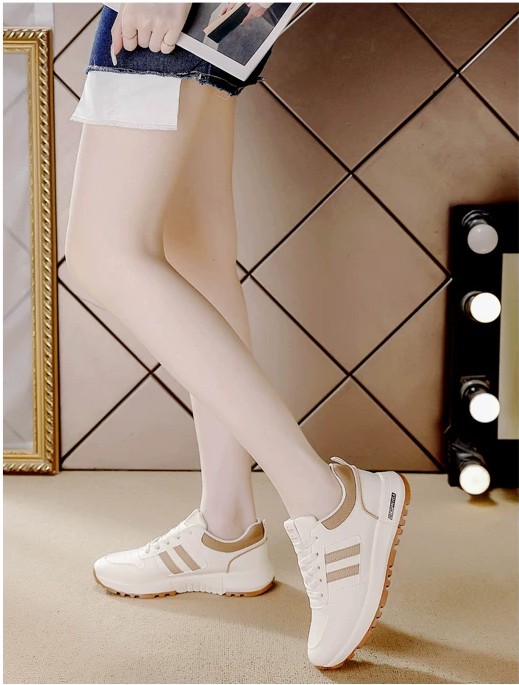
If you want to compare shapes side by side rather than one at a time, the sneakers category is sorted by style, and the flat-soled board shoes are the closest thing we stock to a true 20mm cupsole. See also the wider women’s shoes range if you’re building a small rotation rather than replacing one pair.
