

I bought a pair of pink and white sneakers in March because they looked clean and slightly retro under the shop lights. I wore them outside the next morning and spent the whole walk to the bus stop convinced I’d been sold a different shoe. The pink had gone from soft rose to a chalky salmon. The white looked blue.
Nothing was wrong with the shoes. The lighting was wrong when I chose them, and I hadn’t thought about what a pink and white pair does in daylight, on a pavement, next to whatever I’m wearing.
Three pairs later, I’ve got a system. It’s mostly about testing the colour where you’ll actually wear it, then deciding how much maintenance you’re willing to do. Here’s what I learned, including the wash cycle that turned one pair’s white panel a faint pink.
Why the pink looked right in the shop and wrong at the bus stop
Shop lighting runs warm, usually around 3000 to 3500 kelvin, with a high proportion of yellow-red light. Daylight sits closer to 5600 kelvin and is much bluer. A pink with any orange in it reads warm and flattering under shop light, then turns dusty and flat outside.
This is a known effect in colour science, where two colours that match under one light source stop matching under another. There’s a decent explanation of the mechanism in the entry on metamerism in colour matching, and it explains why so many people return shoes they loved in the store.
My fix is blunt. Take the shoe to a window. If the shop has one, walk over and hold both shoes side by side in daylight for 30 seconds. If you’re buying online, look for a photo shot outdoors and ignore the studio shots entirely. Thirty seconds of embarrassment in a shop beats a return slip.
The other half of the problem is the white. Very few sneakers are actually white. Most are a cool white with a blue tint, which makes pink look warmer by contrast, or an off-white with a cream tint, which makes pink look cleaner. Put a cool-white shoe next to a cream-white shoe and you’ll see it immediately.
Your phone camera makes this worse, not better. Auto white balance corrects for the shop’s warm light, so the photo you take in the store looks bluer than the shoe actually is. Then you look at the picture two days later, order the pair, and wonder why it arrived peachy. Turn off auto white balance, or take the shot with a piece of plain white paper in frame so you have a reference.
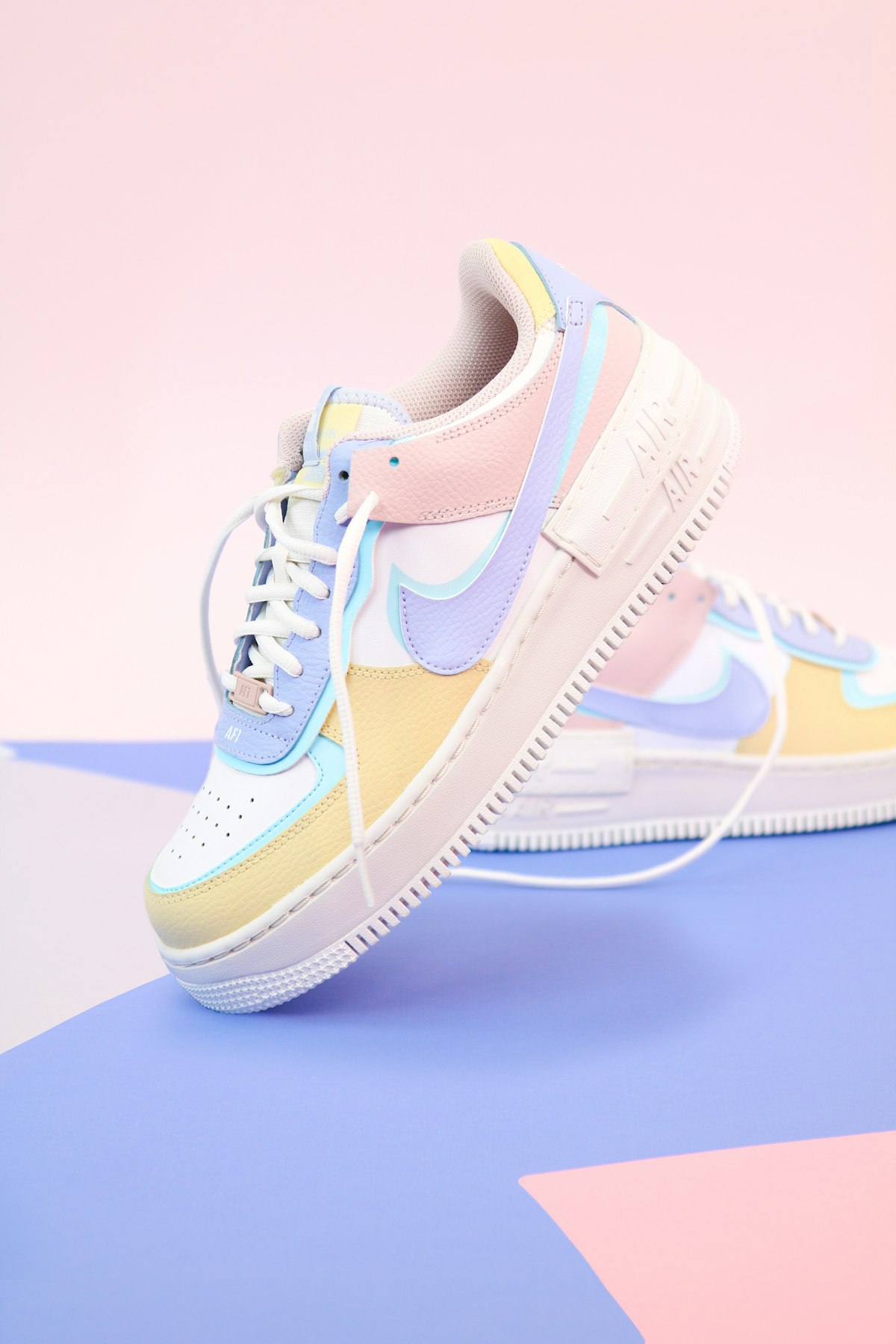
Three pinks, three different jobs
Pink is not one colour, and the shade you pick decides what the shoe can do. I’ve owned three, and they behaved nothing alike.
Baby pink is the one that photographs best and dresses worst. It’s chalky, low in saturation, and it makes legs look washed out in anything shorter than a midi. It’s lovely with dark denim and terrible with beige. Mine lasted one summer, mostly indoors.
Rose pink, the slightly deeper one with a bit of red in it, is the most wearable. It’s close enough to a neutral that it works with navy, grey, black, and olive. It also hides small scuffs better than baby pink, because the contrast between the scuff and the leather is lower.
Coral and salmon lean orange, which is where the bus-stop problem started for me. In daylight they go bright and slightly cheap-looking on smooth leather, and they clash with red lipstick in a way that’s hard to explain until you see it in a photo. Swap the lipstick and they settle down, which tells you the problem was never the shoe on its own.
If you only buy one pair, buy rose. If you want the pair that makes an outfit look deliberate, baby pink works, but only with dark denim or a full white look.
Skin tone shifts all three shades, and it shifts them differently than most style advice admits. Pale pink against pale skin reads soft and low contrast, almost like a neutral. The same shoe on deeper skin goes high contrast and pops, which is a completely different effect and usually a better one. Coral behaves the opposite way: it flatters warm mid-tones and goes loud on very pale legs. Try the pair on bare-legged before you decide, not with the socks you came in wearing.
White sole or pink sole changes the whole shoe
The sole is roughly a third of the visible shoe and most people ignore it when ordering. It changes the shoe more than the upper does.
A white sole makes a pink upper look sporty and young. It also draws the eye downward, which is fine if you’re wearing cropped trousers and less fine with a long skirt. A pink or tonal sole makes the whole shoe read as one shape, which looks more expensive and less like gym kit.
Gum soles are the third option, and they’re the ones I keep coming back to. A gum sole under pale pink doesn’t compete, doesn’t yellow, and doesn’t show pavement dirt the way white rubber does. There’s something about the slightly translucent amber that makes pale uppers look intentional.
Then there’s the midsole height. A 25mm platform with a pink upper reads as a fashion shoe. The same upper on a 12mm flat sole reads as a tennis shoe. Neither is better, but they don’t go with the same clothes, and it’s much easier to judge that before you pay than after. If you wear long, wide trousers, the platform version tends to look more balanced, since a flat sole disappears under the hem.
Check the sole edge too, not just the side. A white sole with a raw, unfinished edge collects dirt in a line and looks grubby within two weeks. A painted or sealed edge wipes clean.
Stack height also decides whether the shoe shortens or lengthens your leg line. A 30mm sole with a low-cut upper adds height but cuts the ankle visually, which is fine with wide trousers and awkward with a straight midi skirt. A 20mm sole with a slightly higher cut keeps the line continuous. This is the sort of thing you only notice in a full-length photo, so take one in the shop if you can.
The 20-metre test, and how far white can go before it looks grey
White panels on a sneaker have a short window where they look crisp. After that they look tired, and no amount of cleaning gets them all the way back.
Here’s the test I use. Stand 20 metres from a mirror, or get someone to hold the shoe up at the end of a corridor. If the white still reads as white from there, the shoe will look fine in photos and on the street. If it reads grey, the pair is already on its way out, and it’ll look worse with every wear.
Two things age white fastest. The first is the toe bumper, which takes the brunt of kerbs, escalators, and other people’s shoes. The second is the heel counter, where your trousers or tights rub.
Cleaning helps for a while. A paste of bicarbonate of soda and a little washing-up liquid, worked in with an old toothbrush, lifts surface grey. It does not lift the grey that’s inside the coating. Once that happens, the white panel has maybe two months left before it looks permanently dingy.
This is why I’d rather pay for a pink and white pair with a leather toe cap than a mesh one. Leather can be wiped. Mesh holds the dirt in the weave, and once it’s in there, it stays.
There’s a point where cleaning stops being worth it. If the toe bumper has gone beyond light grey, or if the sole has worn through at the outer heel, you’re maintaining a shoe that has maybe three months left. That’s the moment to stop buying cleaner and start looking at the wider range of women’s sneakers instead. A cobbler can replace a sole on a leather shoe, but on a moulded rubber one it’s usually not economic.
Washing a pink and white pair without turning the white pink
I ruined a pair this way, so this section is from experience rather than theory. Pink dye on cheap leather and on canvas bleeds in warm water. The white panel next to it absorbs that dye, and the result is a pale pink shadow that no amount of washing removes.
If you’re going to wash them, use cold water, no soaking, and keep the wash under 10 minutes. Wash one shoe at a time so the dye has less chance to sit against the white. Don’t put them in a machine unless the care label explicitly says so, and never put them in a dryer.
Dry them stuffed with white paper towel, not newspaper. Newspaper ink transfers, and it transfers more readily onto damp white panels than onto anything else.
For the white parts, a dedicated sneaker cleaner with a soft brush is safer than household bleach, which yellows synthetic whites. If the white is already yellowing, a diluted oxygen-based cleaner is the only thing that reliably helps, and it works slowly.
One more thing I learned: white laces are the cheapest fix in the world. A new pair costs a couple of pounds and makes a two-year-old shoe look a year younger. If your pink and white pair is looking sad, change the laces before you consider replacing the shoes.
Drying takes longer than you expect, and patience matters more than technique. Stuffed with paper in a warm room, a canvas pair dries in about 12 hours. Leather takes a full day, sometimes two if the lining got soaked. Don’t rush it with a hairdryer. Heat sets the dye and shrinks the lining, and a shrunken lining is the one repair you can’t undo. Pink pigment itself is a long-standing problem in textiles, which is roughly why cheap pink dyes are the least stable ones in the shop, as the background on the colour pink makes clear.
What I’d buy again, and what I’d skip
The pair I still wear is a rose pink leather low-top with a gum sole, white laces, and a leather toe cap. It’s not the prettiest shoe I own. It is the one I reach for when I want to look put together without thinking about it.
I’d skip the all-canvas version, the salmon shade, and anything with a white mesh toe. All three looked great for six weeks. If you want a cleaner white option for the days when pink feels like too much, these white dad shoes with a 6cm sole do the same job and take a wipe better than canvas.
For a budget second pair, a flat-soled pair works fine for short days. These breathable flat-soled board shoes in a plain colourway are the sort of thing I’d wear to the shop and not worry about. Pink is for days when you want the shoe to be the point.
If you’re building around pastel shoes, the broader white sneakers section is a better starting point than the pink listings, because white is the base colour everything else sits on. There’s also a useful companion read on how a black pair earns its place in the same wardrobe, since most people end up with one of each.
Outfit-wise, the rose pair does more work than I expected. It’s fine with straight-leg jeans and a grey jumper, better with navy trousers and a white tee, and genuinely good with an all-cream outfit where a white shoe would look clinical. What it doesn’t do is sit next to red. Pink and red can work when the red is deep and the pink is pale, but at the same saturation they fight, and the photo will show it even if the mirror doesn’t.
Pink shoes are a mood purchase, and that’s fine. Just check the shade by a window before you commit, keep the wash cold, and buy the pair with the leather toe cap. Mine have survived two summers and one very nervous washing. If you’re standing in a shop right now holding two pairs, take them both to the door and look at them outside. That’s the whole test.
