

It’s 7:42 on a Tuesday. One shoe is on, the other is still in the box, and the car is coming at 8:05. You have two pairs on the floor: a plain black pump you’ve worn forty times, and a white and black pair you bought in March and have worn twice. You reach for the plain pair. Again.
That’s the honest test for two-tone shoes, and most people fail it for a reason that has nothing to do with taste. The pair is fine. The decision about when to wear it was never made.
So here’s the standard I’d give a friend. A white and black pair earns its space in your closet when the white sits exactly where your outfit needs a second colour, and when the black part absorbs the damage a pale shoe can’t hide. Get those two things right and the shoes work for years. Get them wrong and you own a costume.
Three decisions follow from that. Where the contrast sits, what the surface is made of, and how much shoe you actually need under your foot. Each one takes about ninety seconds. Total: five minutes, then you’re out the door.
Decide where the white sits before you decide anything else
People shop two-tone pairs by photograph. That’s the wrong order. The photograph shows you a shape; what you actually live with is where the light patch lands on your leg.
Put the shoe on and look at it from two metres away, full length, in the clothes you plan to wear. Then answer one question: does the white part end at a place that makes sense on your body, or does it cut across it?
Here’s how the common layouts behave.
- White toe cap only. Draws the eye forward and makes a pointed shoe look shorter and friendlier. Works with cropped trousers and midi skirts. Can look dated with very round toes.
- White heel and counter. Reads sportier and slightly casual. Good with denim, bad with a formal suit.
- White ankle strap. The riskiest one. A pale band across the ankle visually ends the leg at that line, which is why it flatters a long shin and punishes a short one.
- White sole edge or welt. The most forgiving version. You get the contrast without a hard horizontal line anywhere near your ankle.
If you’re 160cm and wearing a hem that stops 3cm above the ankle bone, a white ankle strap adds a second horizontal line in the same zone. That’s the pair that stays in the box. If your hems are longer, or your legs are long relative to your torso, the same shoe looks deliberate.
Notice I’m not telling you which is better. I’m telling you the measurement to check. Contrast position plus hem position equals the whole decision, and both numbers are things you can see in a mirror in under a minute.
The five-minute routine, in order
Assuming the shoes are already bought, the morning version of this is short. It has to be, or you’ll default to the black pumps every time.
Step one: put on the outfit, not the shoes. Step two: put the shoes on standing up, because feet spread when you stand and a shoe that fits sitting will pinch by the time you’re on the pavement. Step three: walk to the furthest wall and back. Step four: look at your reflection in a window, not a mirror, since daylight is the light you’ll be seen in.
That’s it. Four moves, no deliberation.
What kills the routine is trying to match a bag. Skip that. Let the shoes be the only two-tone thing you’re wearing and the outfit will read as intentional. Match the bag and you look like you bought a set, which is a different and much worse look.
One more thing about the clock. The reason the plain pair wins at 7:42 is that it’s already been decided, dozens of times. If you want the white and black heels for women in your closet to get wear, they need a standing appointment. Mine is anything with a white shirt. Yours might be Sunday lunch, or the Thursday client meeting. Pick one and stop evaluating.

What the black half should be doing for you
Two-tone pairs put the pale part where the damage happens. That’s backwards, and it’s why so many of them look tired after one season. The black section should be the part that touches the ground, the kerb, the car door, and the back of your other shoe.
Check three places on any pair you’re considering.
The toe comes first. A black toe cap on a white shoe is functional, not decorative. It takes scuffs that would otherwise leave a grey smear on white leather, and grey smears on white leather do not come out with polish. They fade, and then they come back.
Next, the heel block. A black ABS one hides chips. A white one shows every one of them, and once the paint lifts at the corner you can’t fix it at home.
Then there’s the inner edge of the strap. This is the part nobody photographs and everybody ruins. Pale straps go dark where they rub, and that mark sits right at eye level when you cross your legs.
Materials matter more than the pattern here. Full-grain leather holds a colour through the surface; corrected-grain leather with a sprayed finish chips at the fold. You can check the certification side of this if you care about how the hide was processed: OEKO-TEX sets the leather testing standard most European tanneries work to. If the product page says nothing about the leather at all, assume a coated split and treat the shoe as a one-season item.
For a dressier take, satin black heels with a pointed toe solve the opposite problem: they take dye well and hide scuffs, but satin marks with water, so they’re an evening shoe and nothing else. Don’t buy satin for a commute. It never ends well.
Three outfits that genuinely need a two-tone pair
Two-tone shoes aren’t a neutral. They’re a decision the outfit has to be able to carry. These are the combinations where I’ve seen them work consistently.
The navy suit and white shirt. The white of the shoe repeats the shirt, the black ties to the trousers. Nothing else in the outfit needs to compete. This is the safest possible entry point and it’s the one I’d recommend for a first pair.
An all-black evening outfit with one pale detail. A black dress, black tights, and a two-tone shoe with a white toe gives the eye one place to stop. Without the pale detail the whole look flattens into a silhouette.
A summer wedding with a pale dress. Here the shoe echoes the dress instead of contrasting with it, and the black section keeps the pair from disappearing against a light floor. It’s also the one occasion where people look at your feet on purpose.
And the combinations that don’t work, in my experience, are just as predictable. Heavy knitwear and a two-tone shoe fight each other. Brown or tan accessories clash with the cool white. Anything with three other colours in it makes the shoe look like a mistake rather than a choice.
If you want to see the difference lighting makes before you commit, this piece on what store lighting hides applies to pale shoes in general, not just metallic ones.
What the product photo hides, and what to check in the box
The single biggest gap between the picture and the pair in your hands is the white. Product photography pushes highlights, so an off-white or cream shoe photographs as clean white. Under a window at 9am it may read ivory, and ivory next to a white shirt looks like a laundry accident.
When the box arrives, do this before you take the tags off.
- Hold both shoes next to a sheet of white printer paper in daylight. If the difference is obvious, plan the outfit around a warmer white or return them.
- Bend the toe area gently with your thumb. Leather creases and springs back. Coated synthetic creases and stays creased.
- Look at the seam where the pale upper meets the dark heel. On a cheap pair this is glued and uneven, and it’s the first place it splits.
- Check the insole edge. If the white insole lining is exposed at the side, it will go grey within a month.
Now the part I’d rather not say, because it costs a sale: a white and black pair is not a daily shoe. The pale surfaces pick up dye from dark trousers, and if you drive or cycle, the top of the toe box will mark. Two to three wears a week is realistic. Five is not.
If you need one pair that survives 8,000 steps a day on concrete, buy it in a single dark colour and put the two-tone money somewhere else. That’s a fair trade, not a compromise.
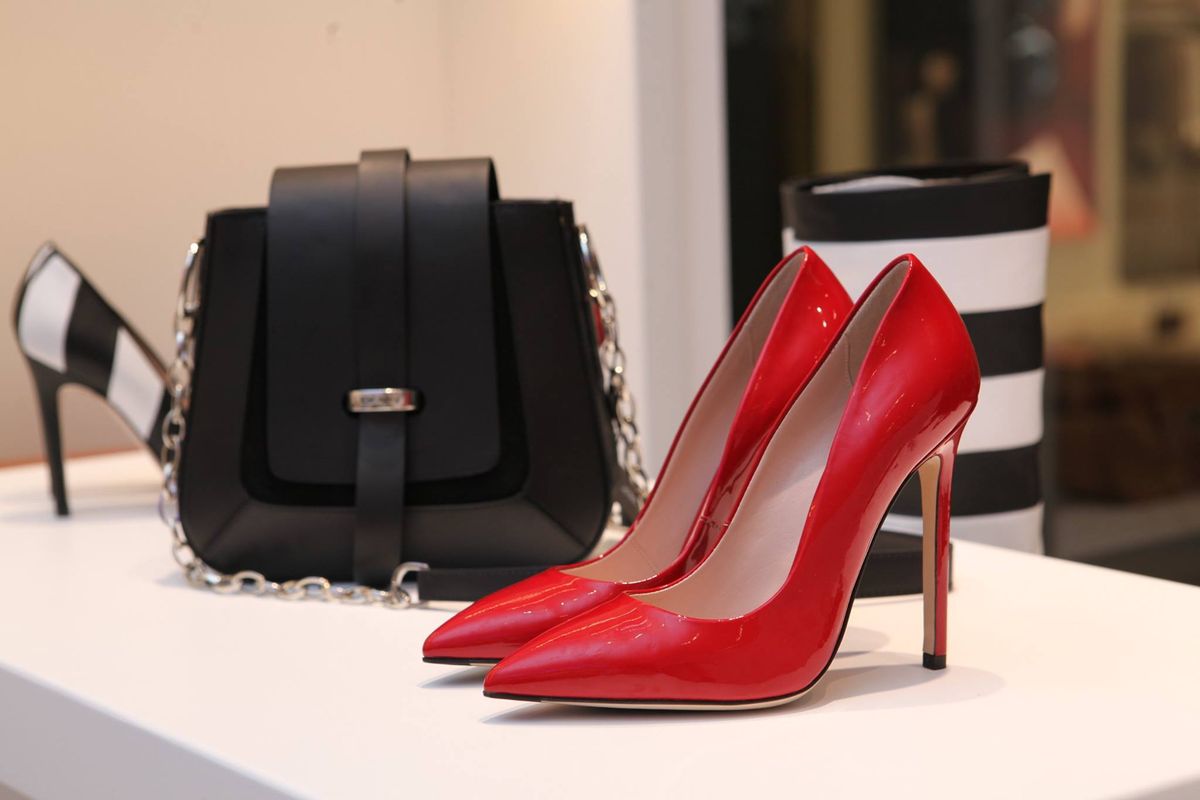
One more thing that never survives the photograph: the smell and stiffness of a new coated upper. Real leather softens over the first ten wears and moulds to the shape of your foot. Coated synthetic keeps its shape and keeps its stiffness, which is comfortable for about ninety minutes. If you can’t tell which one you’ve bought, wear them indoors for an afternoon before you commit to an outdoor day in them.
This is the reason I’d rather see someone spend the money on a well-made black and white pair and cheap out on the plain black one. The plain pair gets worn regardless. The white and black heels for women only pay you back if the material holds up long enough to be worn forty times.
Fit questions that matter more than the colour
Colour gets you to the door. Fit decides whether you take the shoes off in the car at 6pm.
Start with the toe box. A pointed two-tone shoe needs about a centimetre of space past your longest toe when you’re standing, not sitting. Feet swell through the day, and the swelling shows up in the toe first. If you can feel the end of the shoe with your toe when you stand, you’ll feel it much more at four in the afternoon.
Then the heel. Seventy millimetres is where most people stop noticing the height. Ninety is a different shoe with different posture, and above that you’re making a decision about how long you plan to stand. The history of that trade-off is well documented, and it hasn’t changed: the high heel has always been a compromise between silhouette and gait.
Then width. Two-tone styles are often cut narrow because they’re styled as occasion shoes. If you have a wide forefoot, size up half a size rather than accepting a pinch, and add a heel grip if the back then slips. A shoe that’s slightly too long is fixable. One that’s too narrow is not.
There’s a cheaper version of this test that works in the shop. Stand on a hard floor, not carpet. Hard floors expose the two things that hurt later: a heel that tilts outward under your weight, and a sole that’s too stiff to flex at the ball of the foot. If the shoe doesn’t bend where your foot bends, it never will, and no insole fixes it.
Most white and black heels for women are built on a last that’s narrow through the waist, which is fine for a wedding and wrong for a trade show. Try the pair on at the end of the day if you can. Feet are at their largest then, and a shoe that fits at 6pm fits at 9am with room to spare.
Weight is the number nobody lists. Put a pair on a kitchen scale if you can. Anything over 320g per shoe starts to feel heavy by the end of an eight-hour day, and that’s before you add a bag strap on the same shoulder.
Spend on the pale part, save on the dark part
Price is where two-tone shoes get confusing, because the two halves aren’t worth the same amount. The white section is the one that decides how long the pair lasts, since it’s the part that shows wear, dirt and any weakness in the finish. The black section can be almost anything and still look fine for a year.
That gives you a rule. Buy up on the pale leather and down on the heel. A pair with a properly finished white upper and a plain stacked heel will outlast a pair with a glossy black patent body and a plastic heel every time.
If the pale part is woven, look closely at the edges of the weave. Woven leather is more forgiving of creasing than a smooth surface, and it hides the small grey marks that plain white picks up in a car park. A pair like these woven white leather heels with a rounded toe will show less damage over two seasons than a smooth white pump at the same price, simply because there’s no continuous surface to scuff.
What you shouldn’t pay extra for: a designer name on the insole, a dust bag, or a box that photographs well. None of those survive contact with a pavement.
Also worth knowing: two-tone pairs go out of style on a cycle of roughly three years, so buying at the top of a trend means you’ll wear them for one season and store them for two. Buying a classic layout, which usually means a black toe, a white body and a black heel, means the pair looks current whenever you pull it out.
The fallback combination that never fails
Back to 7:42. If you own white and black heels for women and can’t decide, the answer is almost always the same: black trousers, white shirt, and the shoes. Nothing else. No jacket with a pattern, no coloured bag, no statement earrings.
It works because the outfit has exactly two colours and the shoes repeat both. You’re not styling anything at that point, you’re just not making a mistake. On a morning when you have four minutes, that’s the goal.
The combination that fails is the one people try when they’re in a hurry and want the shoes to do more work. Floral dress plus two-tone shoes plus a bright coat. Three ideas in one outfit, and the eye has nowhere to settle.
One practical note on storage. Keep the pair out of the shoe rack, in the box, with the two shoes facing opposite directions so the toe caps don’t press against each other. White leather marks where it’s pressed for weeks, and a dark mark transferred from a black toe is nearly impossible to lift.
And if you’re still deciding whether a two-tone pair is worth the shelf space at all, walk into the room where you keep your shoes and count how many times you’ve worn the boldest pair you own in the last three months. If the answer is once, the problem isn’t the shoes. It’s that nothing in your week gives them a job.
Give them a job first. Then buy them.
The rest of the colour range behaves differently, and it’s worth skimming the women’s heels section with a specific outfit in mind rather than a general idea of what you like. Shoes bought against an outfit get worn. Shoes bought against a mood sit in a box.
