

You have probably bought a black sneaker that looked right on the shelf and wrong on your foot by Thursday. It isn’t bad luck. Black is the hardest colour in the category to buy well, because it hides the three features that decide whether a pair works: the shape of the last, the height of the sole, and the firmness of the heel counter. All three disappear into a dark mass in photos and under shop lighting.
So treat this as a checklist rather than a recommendation. Five checks, in the order that saves the most money, with the numbers that make each one pass or fail. If a pair clears all five, the brand barely matters.
White sneakers are honest. Every seam, every bulge over the little toe, every crooked sole edge is visible from across a room. Black sneakers are not honest. They read as a silhouette, and a silhouette can look sharp while the shoe underneath is doing damage to your feet.
That creates a specific failure mode. You try a pair on in a shop, look down, see a sleek dark shape, and buy it. Nothing in that thirty seconds tells you whether the forefoot flexes, whether the collar sits on your ankle bone, or whether the counter will hold your heel after twenty minutes of walking. All three of those are what you’ll actually feel.
There’s a second problem, which is that black sneakers photograph badly in a different way than they look in person. A shoe with three panels and a chunky bumper looks like a solid block from two metres, so the details you paid for vanish. The reverse is also true: a cheap pair with a clean vamp looks expensive until you stand next to someone wearing a better one.
Practical consequence: judge the shoe in your hand rather than on your foot, and judge it in daylight rather than under a shop’s warm spotlights. Take it to the window. If the staff won’t let you, that tells you something too.
Check one: the last, seen from above
The last is the mould the shoe is built around, and it decides the silhouette before colour or material get a vote. You can read it in about ten seconds by holding the shoe at eye level and looking straight down at it.
Draw an imaginary line from the centre of the heel to the tip of the toe. On a well-balanced last, that line runs through the middle of the shoe or slightly toward the inside edge. When it bends outward toward the pinky toe, the shoe will look wider on your foot than it does on the shelf, which is the most common reason a black pair suddenly looks cheap once it’s on.
Then check the toe shape against your wardrobe, not against your mood. A tapered toe with a slim profile reads sharp under tailored trousers and slightly formal with a midi skirt. A rounded, roomier toe reads sporty and works with denim. Both are legitimate. The mistake is buying the tapered one for a wardrobe that’s all wide-leg trousers, because the proportions fight and you’ll stop wearing the pair without quite knowing why.
One number worth remembering: the difference between a slim and a roomy last at the ball of the foot is usually 6 to 10mm. That’s enough to change your size in one direction. If you’re between sizes, buy the last that matches your foot shape rather than forcing your foot into the last that matches the outfit you had in mind.
Wide forefoot and a tapered last is the combination that fails most often, and black hides the bulge that would have warned you in white. If that’s your foot, look for a last described as rounded or wide-fit, and check the insole width while standing. The measurements in this guide to black sneakers across a full workweek apply to any colourway of the same shape.
Check two: sole height and the trouser break
Sole stack changes how long your leg looks, and it changes which trousers work. This is the check most people skip, and it’s the one that decides whether a pair looks deliberate.
Under 20mm at the heel, a black sneaker behaves like a plimsoll. It’s the right call for cropped trousers, ankle-length jeans, and anything that shows the ankle. It looks wrong under a full-length wide-leg trouser, where the hem will drag and the shoe will look like an afterthought.
Between 20mm and 28mm is the useful middle. Trousers hang properly, the shoe has enough visual weight to balance a coat, and you can walk four kilometres without thinking about your feet. If you’re buying one pair for everything, buy here.
Above 30mm you’re in platform territory, which is a styling decision rather than a comfort one. It adds height. It also adds weight, usually 60 to 120g per shoe, and that’s the part nobody mentions. A heavy sole makes your calf work harder on every step, and you’ll notice it on stairs before you notice it anywhere else.
Test the flex while you’re standing there. Bend the shoe at the ball with both hands. It should fold where your toes bend, roughly a third of the way back from the tip. If it folds in the middle of the arch, the shoe will feel like it’s fighting you on every push-off. If it doesn’t fold at all, it’s a stiff board with a nice upper.
Also turn it over and look at the tread. Smooth rubber on wet office tile is genuinely unsafe, and lobbies are full of wet tile between October and March. A shallow herringbone or a scattering of pods is enough. A completely flat sole is a fair-weather shoe pretending to be an everyday one.
Check three: what the upper does in rain
Black leather, black mesh, and black suede all look identical in a photograph and behave nothing alike in November. This is a climate question before it’s a taste question.
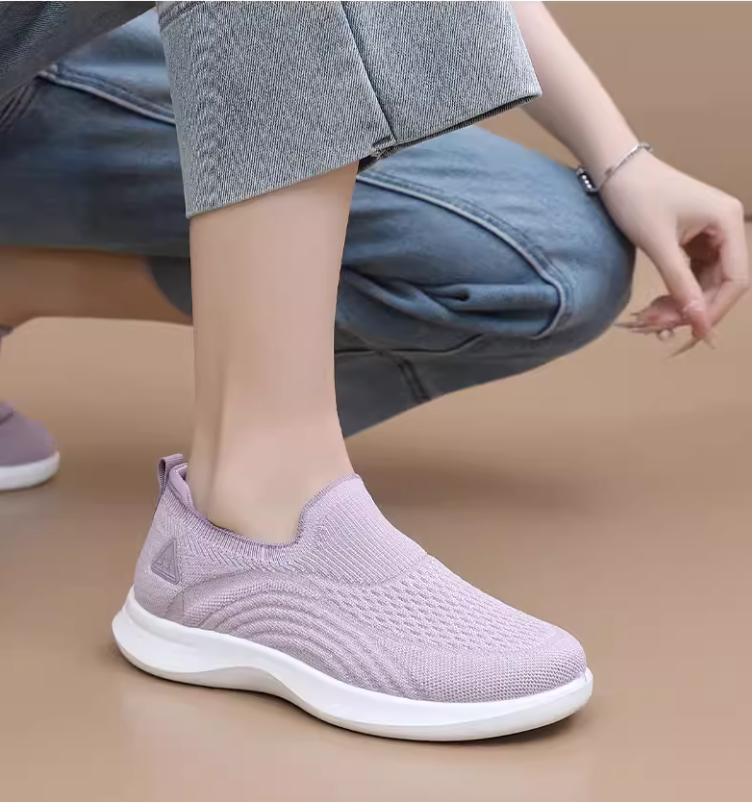
Coated leather or a synthetic leather upper handles a wet pavement and wipes clean with a damp cloth. It also traps heat, which is fine below 15°C and unpleasant above 22°C. Mesh breathes far better and dries fast, but it drinks water and holds dirt in the weave, and black mesh that has dried badly goes a dusty grey that no brush fully fixes.
Suede is the one I’d talk you out of for daily wear unless you live somewhere dry. It looks the best of the three for about six weeks. After that, water marks, salt lines, and the flattened nap at the flex point make it look older than it is. If you want suede, treat it before the first wear and accept that it’s a second pair, not the pair.
There’s a skin-contact angle too, and it’s more than marketing. Textile and leather goods that sit against your foot all day are covered by standards for restricted substances, and the OEKO-TEX Standard 100 criteria explain what’s tested on materials intended for skin contact. Ask for the certificate if a synthetic upper makes your feet itch. In my experience the pairs that cause reactions are the cheapest unlined ones.
Lining is the detail that separates the two price tiers more reliably than the upper. A textile lining that’s glued in with visible folds will create hot spots. Run your fingers around the inside of the heel and feel for ridges before you commit.
Check four: collar, tongue, and the first hour
Most black sneakers that “feel tired” by the end of the day are not badly cushioned. They’re loose at the heel, and you’ve spent six hours curling your toes to keep them on without realizing it.
Squeeze the heel counter from both sides. It should be firm, with a slight inward curve at the top. If it collapses completely, the shoe will too. If it’s soft and floppy, you’ll be tightening the laces to compensate, and laces tightened over the instep all day produce a numb spot across the top of the foot.
Then check the collar against your ankle bone, standing up. The collar should sit clearly above the bone or clearly below it. Anything that lands exactly on the bone will rub, and the rub will show up in hour three rather than hour one, which is why shop fittings miss it.
- Walk ten steps on hard floor. A squeak at the heel means a loose counter or a sliding insole, and it doesn’t settle down.
- Press a thumb into the upper at the widest point of the ball while standing. No give at all means too narrow, regardless of the size label.
- Check the tongue doesn’t slide sideways when you lace up. Off-centre tongues press on the instep and are unfixable without stitching.
- Take the insole out. If it’s glued in, you can’t add your own and you can’t air the shoe out properly.
If the tongue presses down on the top of your foot, skip the second-from-top eyelet instead of loosening the whole lace. It’s a thirty-second change that rescues a lot of high-instep pairs.
Check five: price bands and what actually changes
Price is a rough proxy for construction, and it’s worth knowing where the money goes so you don’t overpay for the wrong thing.
Around 45 to 60 euros you get a synthetic upper, a moulded EVA sole, and a glued-in insole. That’s a perfectly usable shoe. What you don’t get is a firm heel counter or consistent glue lines, and those are the two failure points. Expect 8 to 14 months of three-day-a-week wear.
Around 70 to 100 euros the counter gets sturdier, the lining stops being an afterthought, and the sole unit is usually a proper cupsole rather than a slab. This is the band where the shoe starts being repairable at the edges: you can replace laces and insoles and get another season.
Above 120 euros you’re paying for leather quality, stitching consistency, and brand. Some of that is real. The leather does crease better and the shape holds longer. But the comfort difference between a good 90-euro pair and a 160-euro pair is smaller than the price gap suggests, and I’d rather you spend the difference on a second pair to rotate.
The tradeoff that matters most: a cheaper pair worn in rotation outlasts an expensive pair worn daily. Two pairs at 80 euros, alternating, will give you more total wear than one pair at 160 euros worn every day. Moisture is what kills shoes, and 24 hours of drying between wears does more for longevity than any construction upgrade.
Sizing, half sizes, and the sock variable
Black sneakers are usually bought in the wrong size for a boring reason: you tried them on with the socks you happened to be wearing. Thin no-show socks and a 4mm wool sock are roughly half an EU size apart, and that’s exactly the margin where a pair goes from comfortable to cramped.
Bring the socks you’ll actually wear. If you split your year between bare ankles and wool, buy for the thicker option and add an insole for summer. Insoles are cheaper than a second pair, and a 3mm flat insole takes up the slack without changing the fit at the heel.
The size label is also less standard than it looks. An EU 38 is a foot length of about 240mm in theory, and brands deviate by up to 5mm in practice, which is why the standards behind shoe sizing are worth a glance before you order online. Measure your foot on paper at the end of the day, standing, heel against a wall. Use that number rather than the size you wear in another brand.
Two specific notes for black pairs. First, dark uppers show creasing more than light ones, so a shoe that’s slightly too long will look worn at the toe within a month even if it’s comfortable. Second, mesh stretches about 2mm across the ball over the first six weeks, and leather doesn’t stretch at all in the width. If you’re between sizes in a leather pair, go up. In a mesh pair, stay put.
And if the pair arrives and the heel slips, don’t assume it’s the wrong size. Try a heel grip and a different lacing pattern first. A heel that lifts 4mm is a lacing problem. A heel that lifts 10mm is the wrong shoe.
Where black sneakers stop working
You can wear black sneakers to more places than most dress codes admit, but there are three situations where they read as a mistake regardless of how much you paid.
A formal interview in a conservative industry. Not because sneakers are wrong in 2026, but because the room is reading for signals and a sneaker is a signal. Wear the loafer, keep the sneakers for the second interview.
A wedding where the invitation says cocktail. A black sneaker under a midi dress can look intentional with the right sole height, and it can look like you forgot your shoes with the wrong one. If you’re unsure, the safe version is a low-profile leather sneaker in the 15 to 20mm range, not a chunky one.
Any outfit where the trouser hem is meant to break cleanly on the shoe. A wide-leg wool trouser with a 35mm platform sneaker creates a shape that only works if the whole outfit commits to it. Half-committed is the look that fails.
The general rule: black sneakers work when the rest of the outfit is casual or deliberately mixed. They stop working when the outfit is formal and the shoes are the only casual element. If you want a benchmark for what passes in an office, the box test in this piece on the eight-point check for black sneakers is the version I’d use.
What to expect at twelve months
Assuming three days a week and about 4km a day, here’s the realistic timeline for a pair in the 70 to 100 euro band. Month three: the insole compresses about 2mm under the heel and the pair feels slightly flatter. Month five: the glue line at the outer heel collects dirt and a hairline seam appears. Month eight: the flex point creases visibly and the laces have been replaced once. Month twelve: the tread at the outer heel is down to about half its original depth.
None of that is a defect. It’s the normal life of a shoe, and knowing it in advance stops you from blaming the pair for being ordinary.
Two maintenance habits extend the timeline more than anything you can buy. Let the pair dry 24 hours between wears, with newspaper inside if they got wet. And clean the sole edge monthly with a dry brush, because dirt left on the bond line accelerates the seam you’ll otherwise get at month five.
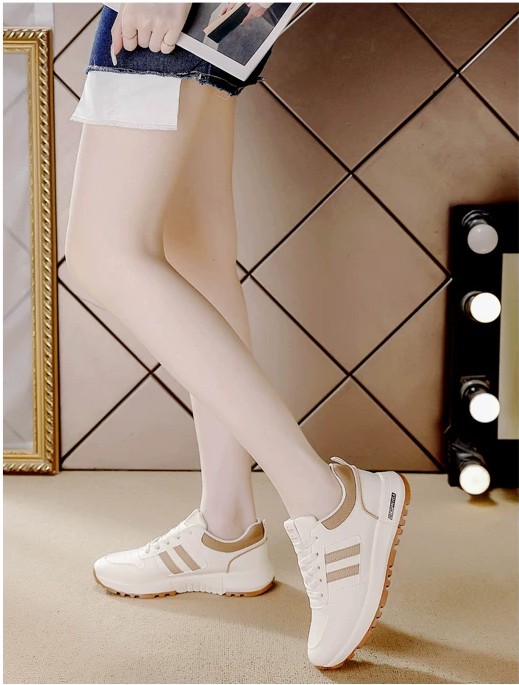
If you want to see the checks in practice, the flat-soled women’s board shoe is the closest thing we stock to a true 20mm cupsole, and it passes the flex test. The breathable mesh walking pair is the wet-weather compromise: lighter, faster drying, less structure at the counter. Neither is the right answer for everyone, which is the point of the checklist.
Run the five checks in the shop, in this order, and you’ll eliminate most of the pairs that would have disappointed you by Thursday. The ones that survive all five tend to be the pairs you still wear in year two, and that’s a better test of value than anything on the price tag.
Browse the full sneakers category if you want to compare shapes side by side, or start from the wider women’s shoes range if this is part of a bigger wardrobe reset.
