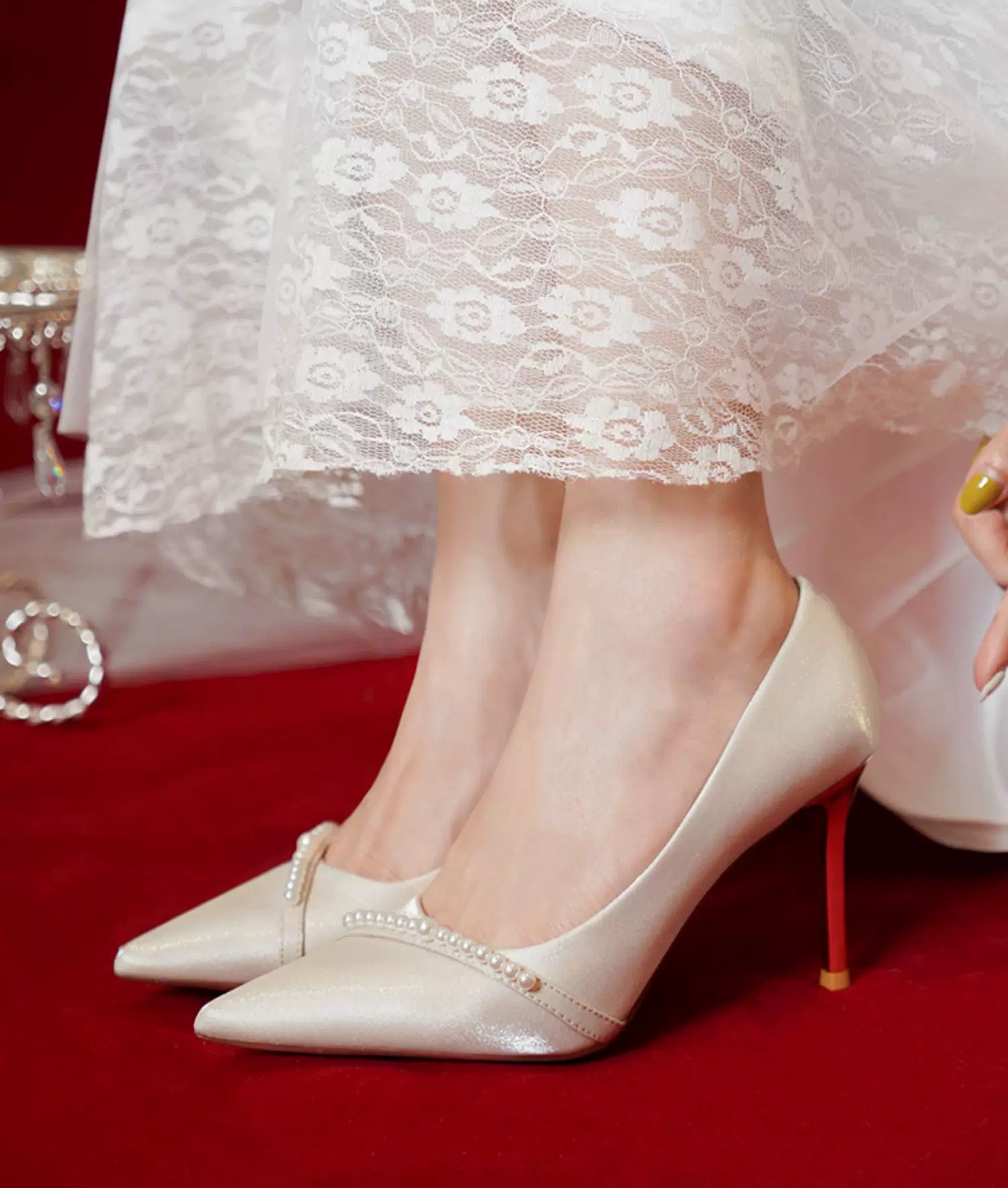
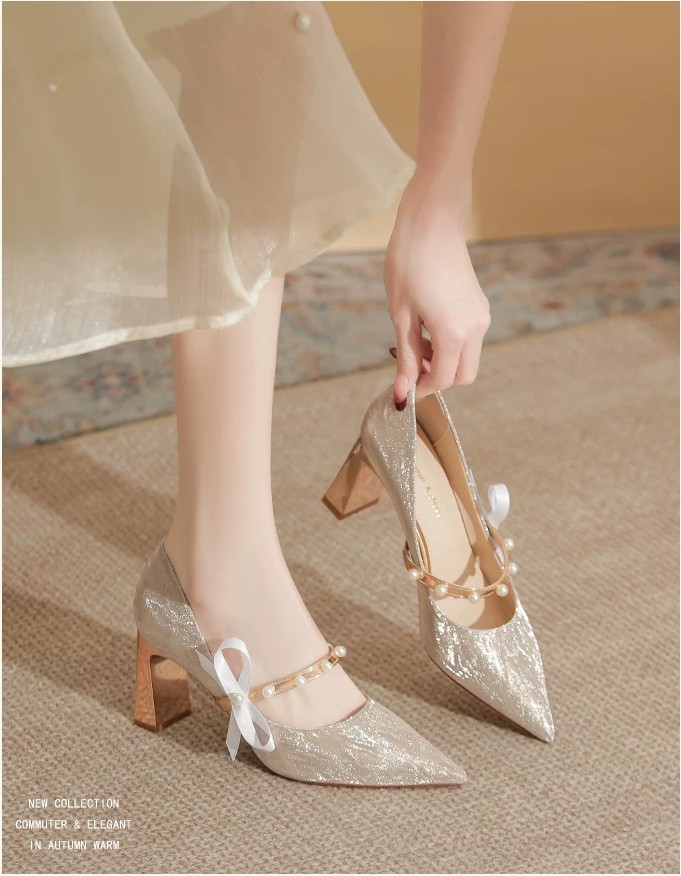
The return note says “too tight across the toes”. The shoe was the right length. The strap was adjusted correctly. What went wrong is that the opening at the front was cut in a shape that didn’t match the foot inside it, and sizing up doesn’t fix that. It just moves the problem half a centimetre forward.
Ladies open toe heels get bought on how the opening looks and returned on how it feels. The gap between those two things is almost entirely toe shape. In shops, the same three complaints come back week after week: the big toe rides over the edge, the little toe escapes out the side, and the upper cuts across the top of the foot at the point where the skin is thinnest. Three complaints, one cause, and it’s a cutting decision made on a last, months before you saw the photo.
Here’s how the four common shapes behave on a real foot, and which one to pick depending on what yours does.
What the opening is doing, mechanically
An open toe isn’t a decorative cut. It removes the most rigid part of the shoe, the toe cap, and replaces it with an edge that has to hold your foot in place by itself. That edge sits just behind the toes, on the metatarsals, and every step pushes the foot forward against it.
So the opening has two jobs at once. Let the toes out, and stop the foot sliding through. The wider the opening, the better it does the first and the worse it does the second. That’s the trade, and it’s why a peep toe with a 15mm opening feels nothing like a D’Orsay cut with a 60mm one.
There’s a structural consequence that almost nobody mentions at the till. Removing the toe cap takes stiffness out of the shoe, so the sole under the ball of the foot has to work harder. On a good pair that section is reinforced. On a cheap pair it isn’t, and the sole bends through the middle of the foot instead of at the toe joint. That’s the pair that feels fine in the shop and vicious after twenty minutes.
Load moves toward the ball of the foot as heel height rises, and an open toe puts the edge of the shoe directly on the part of the foot carrying that load. The whole design problem fits in one sentence.
Peep toe, D’Orsay, slingback, and what each one suits
Four shapes cover most of what’s on sale. They behave differently enough that the choice should follow your foot rather than the outfit you had in mind.
- Peep toe, small round opening. Shows two toes at most and holds the foot well. Good for narrow feet. Bad if your second toe is longer than your big toe, because it hits the edge on every step.
- Square cut across the toes. The most forgiving shape. A straight edge spreads pressure instead of concentrating it on one point, which matters if your forefoot is wide.
- D’Orsay, cut away at the sides. The most flattering and the least secure. Suits a high instep and a narrower foot. On a wide foot the sides spill over the cut, which is as visible as it is uncomfortable.
- Open toe slingback. Takes pressure off the heel and loads the strap across the toes instead. Fine in summer, risky in a shoe that runs short, because nothing at the back stops the foot sliding forward.
The return pattern is consistent. People buy the D’Orsay because it looks lighter, and they needed the square cut. The square cut is the least photogenic of the four and the one that gets worn most.
There’s a fifth variant worth knowing, the crossover or knot-front opening, where the upper folds over itself above the toes. It looks structured and holds the forefoot firmly, which helps on a narrow foot in a shoe that would otherwise slip. The catch is that the fold adds bulk right where a tight toe box is already tight.
Where it cuts across your foot decides the comfort
Take a pencil and mark the edge of the opening on your own foot. That line is where every bit of pressure lands. If it sits over a bone, you’ll feel it within an hour. If it sits in the soft gap between the big toe joint and the next metatarsal, you’ll forget it’s there.
On most feet, the safe line runs about 8-12mm behind the web of the toes, angled very slightly outward. Shoes cut on that line work on almost everyone. Shoes cut 5mm further back, toward the instep, look more open and press on the tendons that lift the toes, and those tendons are not designed to take body weight.
Then there’s the strap. A thin strap across an open toe is the single most common source of “these rub” in the whole category, because a 6mm strap concentrates force on a strip of skin. A 12mm strap on the same shoe distributes it, and looks nearly identical from a metre away.
Three checks you can do in thirty seconds:
- Stand, then lift your toes. If the strap lifts off your foot, the shoe is holding nothing, and your toes will grip to compensate.
- Press on the edge of the opening with a thumb. It should give slightly. A hard edge is a blister waiting for a warm day.
- Look down. If you can see the seam where the lining meets the upper, it’s cut too far back, and that seam will find your skin.
Wide forefeet need the square cut, and they need it in a shoe that’s genuinely wider rather than just longer. A pair marketed as wide but built on a standard last is the worst of both: extra length, no extra width. The pointed shapes that dominate the range are usually generous through the vamp and tight at the toe, which suits a narrow foot and punishes a wide one. If you already know you need room across the ball, the slimmer heeled styles cut with a wider vamp are worth trying before you give up on the shape.
Heel height, and the reason 75mm keeps coming back
In this trade, 75mm is the number that returns least. Not because it’s flattering, though it is, but because it’s the point where the foot still has enough range to roll through a step without the toes taking the whole load. Above 90mm, the ankle can’t dorsiflex far enough, so the heel lifts early and the toes grip to keep the shoe on.
You can see it in how people walk. A 100mm open toe produces a short, flat step with the knee slightly bent. A 75mm produces a normal stride. The shoe looks similar on the shelf. The gait is completely different, and the gait is what your knees and lower back get to live with.
Open toe designs also make heel height less forgiving than a closed pump does. With no toe cap, there’s nothing stopping the foot sliding forward when the heel is high, so the toes end up jammed against the front edge. Two things mitigate it: a heel placed further back under the arch, and a slightly deeper vamp so the instep is held.
If you love the look of a high open toe and know you’ll be standing, there’s a workable compromise. Buy the height you want in a pair with a wider heel tip, and treat the shoe as a two-hour shoe rather than an all-day one. That’s not defeat. It’s just honest planning, and it’s cheaper than the physio appointment.
One more note on the pitch, the angle of the sole from heel to toe. Two pairs can both measure 80mm and feel different because one has a 12mm platform under the toe and the other has 3mm. The platform reduces the effective pitch, which is why a 100mm heel with a 20mm platform walks like an 80mm. If your feet complain about height, look at the platform before you look at the heel.
When to skip the open toe entirely
Some feet should not be in this category, and it’s worth saying so before anyone spends money. If you have a bunion that sits on the joint behind the big toe, the edge of an open toe lands on it directly, and no strap width fixes that geometry. A closed round toe with a soft upper is the better answer.
If your second toe is markedly longer than your big toe, peep toes are out, though a square or fully open cut can still work because there’s no edge for that toe to hit. If you have very narrow feet and a low instep, the D’Orsay will slide off your heel within a month, and a slingback with an adjustable buckle is the only shape that stays put.
And if you’re on your feet for ten hours, none of the four shapes is ideal. Open toes look cool and distribute load poorly. That’s not a moral failing of the design, it’s just what happens when you remove the part of the shoe that spreads pressure. Knowing that in advance saves you from buying a beautiful pair for a job that needs a different shoe.
None of which means ladies open toe heels are a bad buy. It means they’re a specific tool, and the tool works best when the edge sits in the soft part of your forefoot and the strap is wide enough to spread the load.
The useful rule: open toe for two to four hours, closed toe for anything longer. Most people discover this after one bad wedding. It’s cheaper to read it here.
Buying them without trying them on
Online buying works if you ask for the right three measurements. Internal length in millimetres. Internal width across the ball in millimetres. Height of the opening at the centre, measured from the insole. With those numbers, a pair of ladies open toe heels becomes predictable, and without them you’re guessing from a photo taken at a flattering angle.
Compare the width to a pair you already own. Put your current shoes on a piece of paper, trace the insole, and measure across the widest point. That trace is more reliable than any size chart, and it takes two minutes. If you want to know why the numbers on the box vary so much between makers, the history of shoe sizing standards explains more than a size guide ever will.
Photographs hide the two things that matter most. Product shots are taken with the shoe empty, so the opening looks wider than it will on a foot. And the vamp depth is usually cropped out, which is exactly the dimension that decides whether the shoe holds you. Ask for a photo from directly above, looking down into the shoe. Most sellers will send one, and it tells you more than six studio shots.
Returns are the safety net, so check the window before ordering. Try them on carpet, in the evening when your feet are largest, and walk for two full minutes. If the edge of the opening presses on a bone, send them back the same day. That pressure doesn’t soften, whatever the leather is.
If the shape is right and the edge is comfortable, the rest is maintenance. Wipe the inside of the opening after wear, because that edge collects sweat and grit and then rubs. A soft pencil eraser takes the shine off a scuff on the edge without touching the leather around it. And keep the shoe on a shoe tree between wears so the opening doesn’t collapse inward, which is what makes a good pair start pinching in month four.
That last point applies to every pair of ladies open toe heels you own, not just the expensive ones. An opening that sags inward after two seasons is the most common reason a shoe that used to fit starts rubbing, and a wooden tree costs less than one pair of insoles.
For a closer look at how much the opening changes the fit on a specific pair, there’s a longer piece on how the toe opening decides whether a peep toe works. If you’re shopping by shape rather than by colour, browsing the heels section and comparing vamps side by side beats scrolling a single product page.
The short version: match the cut to your forefoot, not to the outfit. A lace pair with a slightly deeper vamp will hold a narrow foot all evening, and a square-cut shoe will do the same for a wide one. Get that one decision right and the rest of the shoe is easy.