

You bought them online at 11pm. The listing photo showed a deep, almost wine-coloured red, and you pictured them with a black slip dress for a wedding in three weeks. Then the box arrived, you opened it under the kitchen light, and the shoes looked orange. Not orange-red. Orange. You stood there in your socks holding one shoe, wondering whether you’d ordered the wrong colourway or whether your kitchen was lying to you.
It’s usually the kitchen. Red is the colour that changes most between one light source and the next, and in shoe retail that fact gets used, sometimes on purpose, mostly by accident. In shops you see the same pattern every season: a customer tries on a red pair under warm halogen, loves it, wears it outdoors once, and brings it back saying the colour is wrong. The shoe didn’t change. The light did.
So before you decide that red women’s heels suit you or don’t, put them through three light sources. That single test settles more returns than any size chart.
Red is the colour your eye reads differently in every room
Red sits at the long end of the visible spectrum, roughly 620 to 750 nanometres, and your retina handles it with cone cells that respond very differently depending on how bright the room is. In dim conditions your eyes shift toward relying on rod cells, which peak in the blue-green range and barely register red at all. That’s why a red shoe looks black in a dark bar and vivid at a window. Same object. Different physiology.
Then there’s the light itself. A halogen bulb at 2700K pushes a lot of orange and yellow into the scene, and red surfaces reflect that warmth back at you, so the shoe reads richer and deeper than it is. A cool LED at 5000K does the opposite. It flattens the warm end and pulls any blue undertone forward. Offices, fitting rooms and phone screens all lean cool now. Homes are a mix.
The technical name for the mismatch is metamerism: two colour samples that match under one light and diverge under another. It happens because a red shoe isn’t one wavelength, it’s a curve, and different light sources feed that curve different amounts of energy at different points. Dyers fight this constantly. The dyeing industry has spent a century building lightfastness scales partly because of it.
Practical version: never judge a red shoe in the room where you tried it on. Walk it to a window. That’s it. That’s the whole trick, and almost nobody does it.
The three-light test, and what each one tells you
You need about four minutes and three locations. Do it in the shop if you’re buying in person, or in your own hallway if the pair arrived by post. Keep the same shoe on your foot the whole time so the only variable is the light.
- Shop light: usually 3000K to 3500K, slightly warm. This is the most flattering condition red will ever get. If the shoe looks borderline here, it will disappoint you outside.
- Daylight at a window: the honest test. North-facing windows give you the coolest, flattest read. If the red goes brick or rust in daylight, that is its true colour.
- Evening lamp: a warm table lamp in a living room, roughly 2700K. Red deepens here. If it turns maroon or brown, you own a pair that only works after dark.
Write down what you see in each, or photograph the shoe in all three. Your memory will smooth over the differences within an hour, which is exactly how people end up keeping shoes they’ll never wear.
One more condition worth adding if the pair is for an event: check them under the venue’s likely lighting. Hotel ballrooms run warm. Museums and galleries run cool and dim. A red that sings in a warm ballroom can look muddy under gallery spots, and the reverse is just as common.
If you only have your phone, there’s a shortcut. Take one photo of the shoe next to a sheet of white paper, then a second photo with the paper held in front of the lens for two seconds before the shot. The first frame gives you the shop’s version, the second gives you something closer to true colour. It’s crude, and it beats trusting your eye after forty minutes of staring.
Red heels split into two families, and most people buy the wrong one
Forget brightness for a second. Undertone decides whether a red works on you and with your clothes, and there are really only two directions to choose between.
Blue-reds (carmine, cherry, crimson, wine) carry a cool base. They read formal, they photograph cleanly, and they sit well next to black, navy, grey and pure white. On most skin tones they look slightly more expensive than they cost, for reasons that have nothing to do with price.
Orange-reds (tomato, vermilion, poppy, coral-leaning red) carry warmth. They look casual, sunny and a bit retro. They’re the better choice with denim, cream, tan leather and anything linen. They’re the worse choice with black, where they can go loud and cheap-looking fast.
| If your wardrobe is mostly | Pick | Avoid |
|---|---|---|
| Black, navy, charcoal, grey | Blue-red, crimson, wine | Tomato, poppy |
| Denim, cream, tan, olive | Orange-red, brick, rust | Cold cherry, magenta-leaning red |
| White and pastels | True red, mid-saturation | Very dark wine (reads brown) |
| Prints and patterns | Repeat a red already in the print | Any red not in the print |
The pair I’d point most people toward first is a mid-height pointed pair in a blue-leaning red, because it covers offices and evenings without arguing with anything. Our pointed high heels for women sit in that shape, and the reason the shape matters more than the shade is covered further down.
Your outfit changes the red more than the shoe does
Colour is judged in context, always. A red heel against bare skin looks warmer than the same heel against black tights, because your eye compares it to the surrounding field. Put the shoe next to what you’ll actually wear and the shade shifts by a visible amount.
Three pairings that reliably work: red with a white shirt and straight-leg jeans, red with an all-black outfit where the shoe is the only colour, red with a camel coat and no other warm tone in sight. Three that fail more often than people expect: red shoes with a red bag in a different red, red shoes with a busy floral print, red shoes with a nude that’s half a shade off your skin.
Two reds in one outfit is the mistake I see most. Wine shoes with a cherry lip is fine, since lips aren’t fabric. Wine shoes with a cherry dress reads as a near-miss, and near-misses are more noticeable than outright clashes. If you want two reds, separate them with a solid neutral at the waist or ankle.
The nude problem is worth spelling out because it’s subtle. A beige that’s slightly pinker or slightly greyer than your leg breaks the line at the ankle, and suddenly the red shoes look like they were added rather than worn. Bare legs or black tights solve it. Half-tone nudes rarely do.
Then there’s the photograph, which is not the shoe
Almost every red heel you’ve admired online was shot under controlled light, on a white sweep, with a camera profile tuned to push saturation. Phone cameras make it worse. Auto white balance sees a large red area and compensates by cooling the whole frame, so the red comes out deeper and more uniform than reality. Grain, creases and the slight unevenness of real leather disappear.
This is why the returns rate on red footwear runs higher than on black. Black is forgiving across every light source and every camera. Red is the colour most sensitive to both, and red heels are the version of that problem people notice most, because the shoe is the whole statement.
Two habits that help. First, look for listing photos taken on skin or on a floor, not only on white. Second, search the product name plus the word “video” before you buy. A five-second clip shot on a phone in a warehouse will tell you more about the true shade than twenty retouched stills.
Fit decides whether red works, and 70mm is the number to start with
Here’s the part that gets ignored while everyone argues about shade. A red heel that fits badly looks worse than a plain one that fits, because red draws the eye straight to the problem. Gapping at the heel, a bulging toe box, an ankle strap cutting in: all of it is more visible in a bright colour.
Three measurements worth taking before you commit:
- Heel height. 70mm covers most people for a full workday. 90mm and up is a two-hour shoe unless you already live in heels. 50mm reads almost flat in a photo and won’t give you the lift you wanted.
- Heel-to-ball length. Measure from the back of your heel to the ball of your foot while standing. If it’s longer than the shoe’s shank, your weight lands forward and the toes take the load.
- Toe box width at the widest point. Compare it to your foot at the end of the day, not the morning. Feet swell 3 to 5mm over a working day, more in heat.
Try shoes at 4pm or later for that reason. A pair that fits at 8am can pinch by dinner.
Two smaller fit signals are worth checking before you walk out. First, the heel tip: stand on a hard floor and shift your weight back. If the tip wobbles or clicks, the heel column is loose, and a loose heel on a 90mm shoe is a fall waiting to happen. Second, the ankle strap. It should sit above the ankle bone, not across it. A strap that crosses the bone rubs the same square centimetre all day and leaves a mark you’ll still see on Friday.
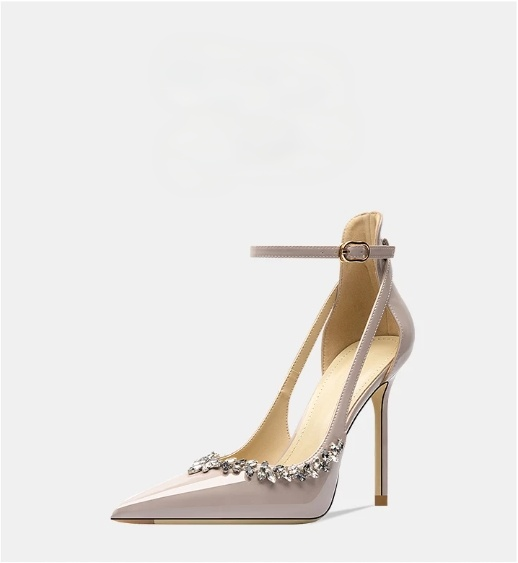
Pointed toes extend the visual line and flatter short legs, but they also crowd the toes. If you have a wide forefoot, a slightly square or almond toe in the same red will be kinder, and nobody will notice the difference from a metre away. Our pointed heels with a higher vamp are a decent middle path: the point is there, but the vamp covers more of the foot, which keeps the toes from sliding forward.
One thing I’d steer you away from: buying red heels a half size down because the shop’s pair felt loose. Red patent and red satin both stretch less than people assume, and what felt loose at 11am will feel correct by evening. Sizing down is a gamble you don’t need to take.
The materials behave differently, and red shows all of it
Suede, patent and satin are three different colour experiences in the same shade name.
Suede absorbs light, so red suede reads softer and a shade darker than the swatch. It also scuffs into a lighter mark, and on red those marks show up as pale streaks. A suede brush fixes most of it. Rain does not, and once suede gets soaked the nap can dry patchy, so a red suede pair is a dry-weather shoe.
Patent reflects. Red patent is the most saturated version of the colour you’ll ever own, which is either the point or the problem. It creases at the toe within a few wears and the crease line catches light. Patent also can’t be stretched or conditioned, so fit has to be right on day one.
Satin and silk finishes are the ones that fade. Light exposure breaks down dyestuff, and reds are among the less stable families on the colour fastness scales used in textile testing. A red satin heel left by a sunny window for a summer will go pink at the toe. Store them in a dust bag, in the box, away from the window, and they’ll hold for years.
If you want the same silhouette in a shade that survives bad lighting and bad weather, black is the safe version. Our black satin heels are the pair people buy after the red experiment, and there’s no shame in that order.
What the EU size number actually tells you
Red makes sizing errors more obvious, so this bit matters. EU sizing is a length measurement, not a fit measurement. A 38 is meant to be 240mm of last length, give or take, and every brand interprets the last differently. Two 38s can differ by 5mm in the toe box and 3mm in the heel width and both still be labelled honestly.
What that means in practice: your EU size is a starting point, and the model notes are the actual information. Three things to look for on any product page:
- Last width. If the listing says standard or narrow, assume your usual size. If it says nothing, look at the photos on a foot and check whether the shoe looks pinched at the widest point.
- Model foot length. Many listings now state the foot length in millimetres that a given size suits. That number is more useful than the EU label, especially if you’ve measured your own foot at the end of a day.
- Heel counter height. A higher counter holds the heel in place on a slingback or a d’Orsay cut. A low one lets the foot slide forward with every step, which pushes the toes into the point.
Measure your foot properly once, on paper, standing, with your weight on it. Write the millimetres on a note in your phone. Then ignore the EU number whenever a listing gives you real measurements, because 240mm is 240mm in any language.
Half sizes are the other trap. Plenty of brands skip them entirely, which means the difference between a 37 and a 38 can be 5mm of length and a visible gap at the heel. If you’re between sizes in a pointed red heel, take the larger one and add a thin heel grip. Taking the smaller one to avoid a gap is how people end up with red shoes they can wear for forty minutes.
Where red heels stop working, honestly
Not every wardrobe needs them, and a few genuinely don’t.
If your work dress code runs conservative and you’re on your feet in front of clients all day, red is a conversation starter you may not want. If you own three pairs of black heels and wear them constantly, adding red changes your outfit count by a small amount, maybe once a fortnight. That’s a real cost per wear: a $150 pair worn eight times a year is nearly $19 a wear, which is more than a $300 pair worn forty times.
Red also punishes cheap construction more visibly than any other colour. Glue lines at the sole edge, uneven dye at the welt, a heel tip that’s a slightly different red: all hidden in black, all on display in red. So the same budget buys you a better-looking shoe in a dark colour.
And if you’re buying for one specific dress, buy for that dress. Red heels bought as a “versatile” purchase usually become the pair you keep moving to the back of the shelf. If you’ve read our notes on how two colours in one shoe change the buying decision, the logic is the same: start from what you’ll actually wear them with, not from the colour itself.
The wider women’s shoe range is worth a slow browse before you commit to a shade, mainly because seeing ten reds side by side recalibrates your eye faster than reading about undertones ever will.
How to test a pair you already own
If the shoes are already in your closet and you’re unsure, do this. Wear them with the outfit you bought them for, stand in front of a window at 10am, then again at 8pm under a lamp. If you like them in both, keep them. If you only like them at night, they’re an evening shoe, and that’s a legitimate thing to own as long as you know it. Red women’s heels get judged exactly this way, and the verdict changes with the hour you ask.
Then check the toes. Red shows creasing within the first ten wears, and where the crease falls tells you whether the shoe is too long. A crease right at the toe cap means the shoe is a half size big. A crease across the ball means it’s flexing where your foot flexes, which is correct.
Last thing. Keep the box for a month. Red is the colour most likely to send you back to the returns desk, and having the box makes that decision cheap instead of annoying.
