

It’s 8:10 on a Tuesday and you’re standing in your bedroom holding one shoe. Black satin pump, 70mm heel, and a bow sitting on the toe like a small, well-behaved animal. You bought it in September. You’ve worn it twice. Both times you felt slightly ridiculous, and you can’t work out whether that’s the bow, the heel, or the fact that you’re 36 and still second-guessing a piece of ribbon.
So let’s deal with it properly. A bow on a pump isn’t automatically sweet or automatically childish. It depends on four things you can actually measure: the size of the bow, where it sits, the height of the heel under it, and what the bow is made of. Change any one of those and the same shoe reads completely differently.
I’ve put a lot of bows on and taken most of them off again. Here’s the version of this I wish someone had handed me before I spent £140 on a pair that made me look like a flower girl at a wedding where I wasn’t even invited.
A bow is a scale problem, not a style problem
Look down at a bow pump and the first thing your eye does is measure the bow against the toe box. That ratio decides everything. A bow that spans more than roughly half the width of the toe box starts pulling the shoe toward costume. A bow under about a third reads as a detail you notice on the second look.
This is why the same ribbon can look expensive on one shoe and cheap on another. It isn’t the ribbon. It’s the surface area it covers.
For a pointed toe, you want a narrow bow, no wider than 25mm across, sitting just behind the point. Anything bigger and you’re fighting the shape of the shoe, because the point already gives the eye a strong direction. Add a wide bow to a sharp toe and the two ideas cancel out. That’s the pair that ends up in the back of the cupboard.
Round toes are more forgiving. They have dead space in front of the toe joint, and a bow fills it. A 40mm bow on a round toe looks intentional rather than stuck on. If you’re buying your first bow shoe and you’re nervous about it, start round.
Square toes sit in the middle. The straight edge gives you a clean line to park the bow against, and the effect is more architectural than cute. It’s the least risky option for anyone who wears tailoring three days a week.
Then there’s the question nobody mentions: how the bow is tied. A flat, symmetrical bow with short, stiff loops looks disciplined. A floppy bow with long tails that hang over the vamp looks softer and moves when you walk, which is lovely until the tails start picking up dirt from the pavement. Long tails on a light-coloured shoe are a two-wear item. I learned that with a cream satin pair and a very wet October.
One more thing worth checking in the shop, and it takes four seconds. Pinch the bow between thumb and finger. If it collapses completely flat, it will look sad by week three. You want a little structure in the loops, either from interfacing or from a stiffer weave.
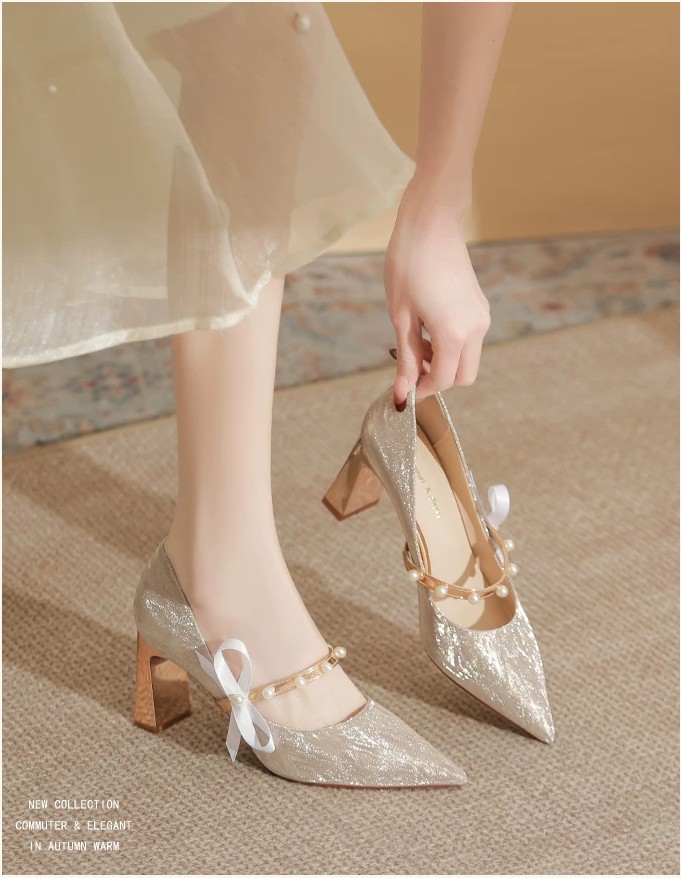
Where the bow sits changes the whole shoe
Position does more work than size. The same 30mm bow will flatter you on the vamp and fight you on the ankle strap, and it’s worth understanding why before you buy.
On the toe or just behind it. The classic spot, and the safest. It draws the eye forward, which lengthens the foot visually. Good on pointed and almond toes, good with cropped trousers, good with anything that shows the top of your foot.
On the vamp, across the instep. This is the grown-up version. A flat bow laid across the instep, especially in leather or grosgrain rather than satin, reads as a tuxedo detail. It works on a slingback. It works on a mule. It’s the placement I’d point you toward if you want one bow shoe that doesn’t feel like a costume.
Ankle strap. Riskiest, and the one most likely to look twee. A small bow at the side of an ankle strap can be charming on a 50mm kitten heel. The same bow at the front of the strap cuts your leg line at the most unhelpful point. If you’re short, skip it.
At the back of the heel. Underrated. A bow on the counter is only visible when you turn, which means it stays a private joke rather than a statement. On a plain black pump it’s the only thing that makes the pair different from the eleven other black pumps in the shop.
- Toe bow: longer foot, safer, better with trousers
- Instep bow: most adult, best on slingbacks and mules
- Ankle bow: highest risk, needs a low heel to survive
- Heel-counter bow: quietest option, works on plain leather
If you’re choosing between two pairs in a shop and can’t say why one is better, nine times out of ten it’s placement. Move the bow 20mm and the shoe changes decade.
60 to 75mm is where a bow still reads as adult
Heel height and bow size have to balance. A 100mm stiletto with a big floppy bow is a lot of information at once, and most people can’t carry it without it looking like a themed outfit. A 100mm stiletto with a small, flat, leather bow looks like expensive evening wear.
My rule, after too many pairs: keep the total bow footprint small as the heel gets taller. At 75mm and below you can afford a fuller bow, because the shoe itself is telling a calmer story.
Sixty to seventy-five millimetres is also the range where you can actually walk. Not “walk to the car” walk. Walk from the Tube to a restaurant, stand for an hour with a glass in your hand, and still be fine at 11pm. If you want the physics of it, the history and biomechanics of the high heel are well documented, and the short version is that every 10mm you add shifts load onto the ball of your foot.
That matters more with a bow, because a toe bow sits right where your toes flex. A stiff bow with a hard backing, on a 90mm heel, will press on the top of your toes every time you push off. You’ll feel it after about 1,500 steps. I’ve had a pair that left a red mark shaped exactly like a ribbon loop.
Wedges are the exception worth knowing about. A 60mm wedge with a bow on the toe is one of the few genuinely comfortable dress shoes you can buy, because the wedge spreads load across the whole sole. If your feet are the reason you avoid heels, start there. If you want to compare shapes before committing, this breakdown of the main types of women’s heels and what each one does to your feet is a decent five-minute read.
And if you already know that anything over 50mm is a non-starter for your commute, don’t let a bow talk you into 85mm. There’s a whole case for staying low, and why 45mm keeps turning out to be the number that works covers it better than I can here.
Satin, grosgrain, or leather: what survives ten wears
Material decides whether your bow shoe looks new in December or looks tired in November. This is the part the shop assistant never brings up.
Satin is what most bow pumps are made of, and it’s the most fragile. It shows water marks. A splash of rain on the toe leaves a ring you can’t brush out. It scuffs into a permanent dull patch where your other foot brushes against it. Satin bows also crush, and a crushed satin bow never comes back, no matter what the internet tells you about steam.
Grosgrain is the ribbed ribbon, and it’s the one I’d buy. It holds its shape, it doesn’t show fingerprints, and it survives being shoved into a tote bag. It looks slightly more formal than satin in photographs and slightly more expensive in person, which is the right way round.
Leather or suede bows are the most durable and the least likely to read as costume. They’re also harder to find, because a leather bow has to be cut and folded rather than tied, so it costs more to make. If you find a pair with a folded leather bow on the instep, that’s usually a well-made shoe underneath as well.
Whatever the ribbon, check what’s behind it. Cheap bow shoes glue the bow to the upper, and glue fails at the edges first. You’ll see a small lifting corner after a few months and then the whole thing peels. Stitched-down bows last. Turn the shoe over in your hand and look for a thread line at the bow’s base, or a small anchor stitch through each loop.
One legitimate note on materials: if you’re buying a lot of synthetic satin, the OEKO-TEX standards for textile safety are the ones worth looking for on the label, because they cover the dyes and finishes next to your skin rather than the fibre itself.
If your feet are wide or your instep is high
Bow shoes are, structurally, not your friend. Here’s why, and here’s what to do about it.
A toe bow adds a layer of fabric and a layer of stiffness right over the widest part of your foot. On a normal-width foot that’s fine. On a wide foot it becomes a pressure point, and you’ll feel it as a hot spot on the top of your big toe joint after about 20 minutes of walking.
The fix isn’t to size up blindly. Sizing up gives you length you don’t need, and the heel starts slipping, which is a worse problem because a slipping heel gives you blisters at the back. Size up half a size at most, and only if the widest part of the shoe actually pinches when you stand.
- Try the shoe at 4pm, not 10am, when your feet are at their largest
- Stand up and press where the bow meets the upper. If you feel a hard edge, walk away
- Check the toe box width against your own foot, not the size on the box
- Look for a bow mounted on a soft backing, not a stiff board
High insteps are the other group that struggles. A bow on the vamp sits exactly where a high instep pushes up, so the bow ends up tilted and slightly lifted, and the shoe cuts across the top of your foot. If you have a high instep, look for a bow placed forward on the toe, or a slingback where the vamp sits lower.
Wide feet and pointy toes are a known bad combination in general, and if that’s your situation there’s a specific fix worth reading: round toe heels and why they stop toe pain. A round toe with a small bow is genuinely one of the most comfortable dressy shoes you can put on a wide foot.
If the shoe fits but the bow still presses, there’s a cheap trick. Take it to a cobbler and ask them to re-stitch the bow 5mm higher on the upper. It costs almost nothing and moves the pressure point off the joint. I’ve done this twice and both pairs went from “can’t wear” to “wear weekly”.
What to wear them with, and what fights them
Bow pumps are easier to style than their reputation suggests. The problem is almost always the other half of the outfit, not the shoe.
Trousers. Cropped, straight, ending just above the ankle. This is the best pairing there is, because the bow becomes the only soft thing in a hard-lined outfit. A black bow pump with grey wool trousers and a plain knit is about as good as this shoe gets. Full-length trousers that break over the instep will hide the bow entirely, which defeats the point, and they’ll also crease the ribbon.
Midi skirts. Works if the skirt is plain and the hem sits below the knee. Works less well if the skirt has its own bow, ruffle, or tie waist, because then you have two competing soft details and the outfit starts to look like a gift shop.
Jeans. Straight-leg, dark, cropped at the ankle. A satin bow pump with blue jeans is a genuinely good look and one of the few ways to wear a dressy shoe on a normal day without looking like you’re on your way to a christening. Skip it with skinny jeans, which make the bow look like an afterthought.
What fights them. Anything with a bow of its own. A pussy-bow blouse. A ribbon tie at the neck. A bag with a scarf knotted on the handle. One bow per outfit, and the shoe should usually be the one that wins, because it’s the smallest.
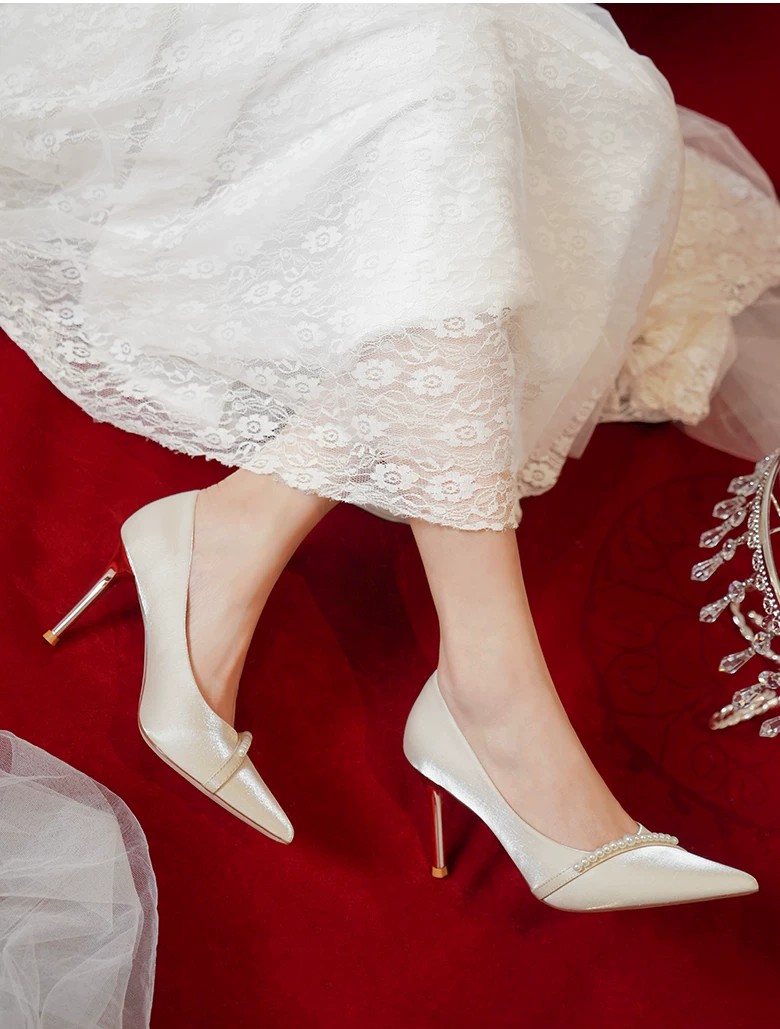
Colour is simpler than people make it. Black satin with a black bow is the easiest thing you can own and it goes with everything except brown. If you’re starting from nothing, the plainest pairs in a women’s shoes collection are usually the ones you’ll reach for on a normal Wednesday. A champagne or ivory pair does the same job on lighter outfits and is much better for weddings, where black satin photographs heavy. If you want a pair that reads as evening without being black, there’s a solid argument for champagne embroidered heels with a covered toe, which handle the colour problem and the toe-box problem at once.
For anything with a lace or fabric upper, the pointed shape is what stops it drifting into bridal. A pair like these lace pointed pumps in a French cut keep the detail tight to the toe, which is the whole trick.
When to skip the bow entirely
Here’s the honest part. There are situations where a bow shoe is the wrong choice and no amount of styling fixes it.
Skip it for a job interview in a conservative industry. Not because it’s unprofessional, but because you’ll be thinking about your shoes while you should be thinking about the answer to the second question. Anything you’re conscious of is a bad choice for a room where you need to be sharp.
Walking more than about 6,000 steps on a normal day is another good reason to leave them at home. Ribbon doesn’t breathe and the bow traps heat against the top of your foot. On a hot day you’ll feel it by lunchtime.
Skip it for anything outdoors between November and March in a wet climate. Satin and rain don’t negotiate. One walk across a wet car park and the toe is marked for good.
And skip it if you’re buying it to solve a different problem. A bow doesn’t make a plain outfit interesting. It makes an outfit that’s already working slightly better. If you’re buying the shoe because you’re bored of everything you own, buy a colour instead. Same effect, half the maintenance.
The one place a bow always earns its keep is a wedding where you’re a guest, in a solid-colour dress, in a venue with a lot of photographs. There, a small satin bow on the toe does more than jewellery, and nobody will think you look like a child. They’ll think you found something interesting.
Buy the 70mm, the small bow, the round or pointed toe, in grosgrain if you can find it. Wear it with cropped trousers first, before you try it with a dress. That’s the order that convinces you the shoe works, and it’s the order that stops a good pair from becoming another one worn twice.
