

You bought a pair of pink heels for one specific thing. A hen do, a birthday, a wedding where the dress code said “colour encouraged.” Then the event ended, the shoes went in the box, and you haven’t touched them since.
That’s how most pink heels live. Not because pink is hard to wear, but because most pairs are bought for one night and built for one night. Thin heel, satin upper, a size that only works with bare feet.
The version that survives is duller than the one you’d pick in a shop: a dusty pink, a heel around 70mm, matte leather rather than satin, and a shape you’d wear with jeans on a Saturday. Get those four things right and you’ll wear them a dozen times a year instead of once. The whole heel range on the site is worth browsing with that filter in mind rather than chasing the brightest pair.
Pink heels work in daylight, if the pink is quiet
Pink stopped being an evening colour at least a decade ago. What changed isn’t the shade, it’s the finish. Bright pink in satin still reads as a party. Dusty pink in matte leather reads as a neutral, and you can wear it to lunch without feeling overdressed.
The useful split:
- Dusty rose, blush, pale mauve: daytime. Pairs with denim, navy, grey, cream. Wear them to work if your office allows heels at all.
- Bubblegum and fuchsia: evening, or one very specific outfit. Looks cheap fast if the material isn’t good.
- Peach and coral pinks: summer only, and only against white or tan. Wrong against black, which makes them look orange.
The quiet shades also hide wear. A scuff on dusty rose disappears at two paces. The same scuff on hot pink patent is visible from across a room, because the surface is uniform and any interruption in it catches the light.
If you’re only buying one pair, buy the one that already looks slightly grey in the box. It will look the same in two years. The one that pops under shop lighting will look washed out by November, and you’ll blame the shoes rather than the lighting. Part of that is pigment chemistry: the dyes behind bright pink are the least light-stable of the common colourants, which is why the loudest version ages fastest.
Shape matters as much as colour here. A pearlescent finish that softens the colour reads warmer in daylight than flat pink, and it’s more forgiving of small marks than a smooth patent surface.
Match the pink to your trousers, not your skin
You’ve read the advice about undertones. Warm skin, warm pink. Cool skin, cool pink. It’s not wrong, but it isn’t the thing that decides whether you wear the shoes.
Here’s what actually happens. You buy a pink matched to your forearm, get it home, put it next to your clothes, and it clashes with everything you own. Skin tone doesn’t sit next to the shoe. Your trousers do.
So do this instead. Before you buy, hold the shoe (or the product photo on your phone) against the three things you wear most:
- Blue denim. Almost every pink works. The blue-grey of indigo flatters warm pinks and cools down the bright ones.
- Black. Only cool pinks work. Warm pinks against black look like a mistake under fluorescent light.
- Navy or grey. Safe with everything. This is why navy trousers plus pink heels is the most reliable combination in the list.
If the pink works with at least two of those, you’ll wear the shoes. If it only works with the dress you bought it for, you’ve bought a costume, not a shoe.
Fair warning on one popular combination: pink heels with an all-black outfit. It photographs beautifully and looks slightly off in real daylight, because the shoe becomes the only colour in a very dark picture and reads as an accessory rather than part of the outfit. Cream trousers with the same shoe look far more intentional.
Satin, patent, matte: 20 wears each
The upper decides the lifespan, and pink is the least forgiving colour to age in. Same shade, three materials, three completely different outcomes after a season.
Satin looks the most expensive for the first three wears and the worst by the tenth. It creases at the flex point, water leaves a ring, and any scuff lifts the weave. Satin pink heels are an event shoe. Buy them knowing that.
Patent wipes clean and holds colour, which makes it the practical choice for pink. The catch is that patent scuffs show as white marks, and on pale pink that’s less obvious than on black, so you get away with more than you’d expect. It also doesn’t breathe, so bare feet get sweaty by hour three.
Matte leather is the one I’d buy. It takes a cream, it buffers out small marks, and it looks better after a year than it did on day one. How patent leather gets its coating explains why the shiny version can’t be repaired the same way: the finish is a separate layer, so once it’s damaged you’re touching up plastic, not leather.
Suede sits outside this list. Gorgeous in dusty pink, ruined by one shower, and hard to clean without changing the nap. Own it if you like the risk.
Check the lining while you’re at it. A leather lining keeps the colour from transferring onto your feet, which synthetic linings do in heat. Pink dye on bare feet is not the look, and it’s the kind of thing you only notice once you’ve taken the shoes off at a friend’s house.
70mm is the height that keeps them in rotation
Pink heels tend to get bought at 100mm, because that’s what the photos show. That height is also why they stay in the box.
At 100mm you need a reason to wear them: an event, a dinner, a night out. At 70mm you can wear them to a work lunch, a gallery, a Sunday afternoon, and that’s what makes a pair earn its space. The pitch maths behind platform height applies here too: what your foot feels is the angle, not the number in the listing.
Two shapes work best at that height:
- A block or thick heel. Stable, wearable on pavement, and the extra visual weight suits a matte leather upper. See how block heels handle real ground if you’re unsure about the width.
- A pointed toe with a slim 70mm heel. Sharper and more formal, still walkable. Pointed toes run narrow, so size up if your feet are wide.
Skip the 100mm stiletto in bright pink unless you specifically want a photo shoe. It’s the least worn combination in most wardrobes: too high for daytime, too colourful for evening formality.
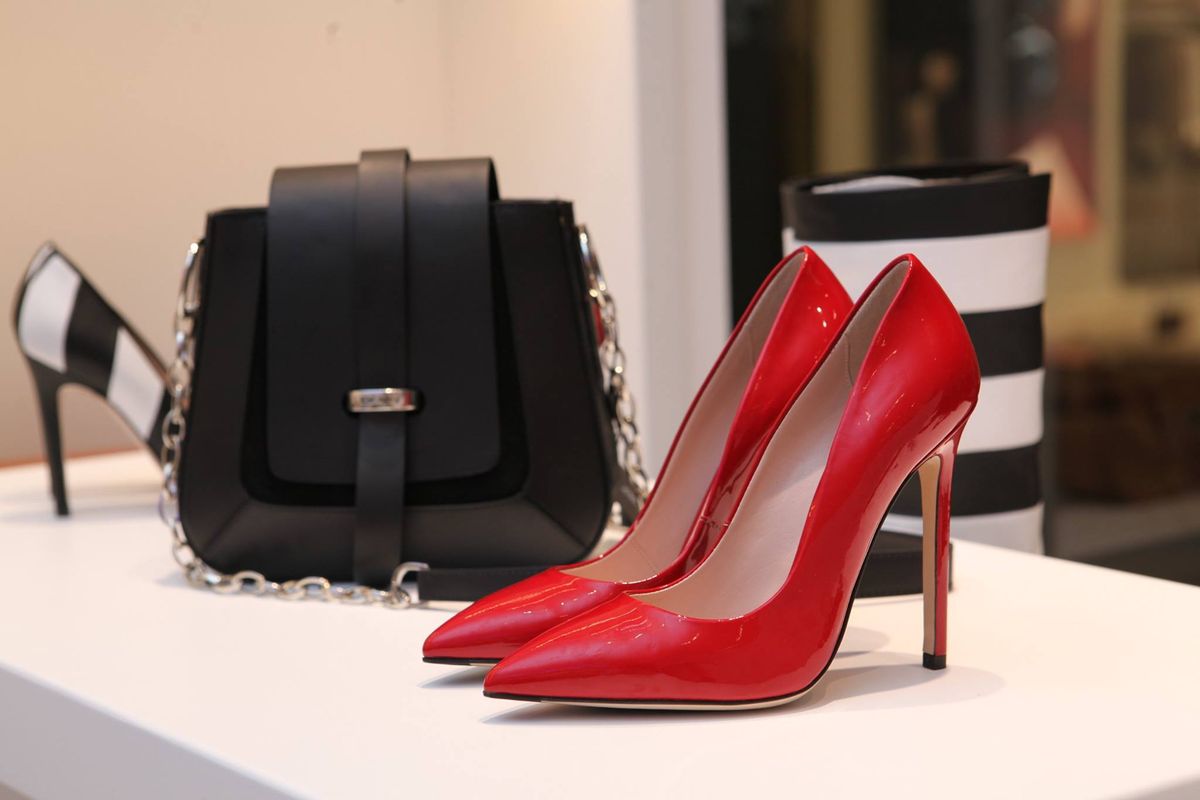
If you’re set on something higher, look for a pointed shape in a matte finish rather than a rounded toe in satin. The first reads sharp, the second reads costume. A lace pointed toe done in a quiet tone is the version that survives past one season.
Three outfits that actually work
Concrete combinations, because “pink goes with neutrals” isn’t much help on a Tuesday morning.
Straight-leg blue jeans, white shirt, dusty pink heels. The safest entry point. Roll the hem once so the ankle shows, otherwise the shoe disappears and the outfit looks bottom-heavy.
Navy wide-leg trousers, cream knit, blush pink pointed heels. Works in an office that allows heels, works at dinner, works on a plane if you’re the kind of person who does that. Keep the toe visible below the hem.
Black midi dress, pink heels, no other colour. The one black-plus-pink combination I’d defend, because a midi shows enough leg that the shoe reads as deliberate. It falls apart with a maxi, which hides the shoes and makes them look like an afterthought.
What doesn’t work: pink heels with a floral print that contains a different pink. Two pinks that are close but not identical look like a mistake, and nobody can tell you why the outfit feels off. If you want print, pick one with no pink in it at all.
Also skip pink heels with a red bag or a red lip unless you know exactly what you’re doing. Pink and red can work, but the pairing needs a third element to hold it together, and most mornings you don’t have one.
One styling detail worth the thirty seconds: check the hem length in a mirror while sitting down. A trouser that shows the whole shoe standing up can swallow it entirely when you sit, which is why the pink heel disappears in every photo taken at a table.
A fourth combination that works better than people expect: a camel trench, straight jeans, and a warm pink heel. Three warm tones in a row, no black to break them up, and it reads like you planned it. Swap the jeans for cream tailored trousers if the office is formal, and keep the heel under 75mm so the whole thing stays on the daytime side of the line.
Where pink heels go wrong
Three specific failures, and they’re all predictable.
Cheap pink looks cheaper than cheap black. Black hides poor material because you can’t see the surface. Pink shows everything: the grain, the glue line, the plastic sheen. If your budget is tight, buy black and put the money into the fit.
Scuffs read as dirt. On a pale pink shoe, a grey scuff looks like a mark rather than wear, and people notice it the way they notice a stain on a white shirt. Keep a suede block in your bag and deal with marks the same day.
The office problem. In a conservative workplace, pink heels are the brightest thing in the room and they will be commented on. That’s not a reason to avoid them, but it is a reason to pick the muted end of the spectrum rather than fuchsia. I’d wear dusty pink to a meeting. I wouldn’t wear hot pink to an interview.
The fourth failure is sizing. Pink is a colour people buy online in a hurry, and a heel half a size too big will slip at the back with every step. If you’re between sizes, take the smaller one in a pointed toe and the larger one in a rounded toe.
Keeping them from going patchy
Pink fades in a specific way: unevenly. The toe goes first because it catches the light, the heel counter goes last, and after a summer the shoe looks like two different pinks sewn together.
What slows it down:
- Keep them out of sunlight. A windowsill does more damage in a month than a year of wearing them.
- Wipe after every wear. Dust bonds to leather and abrades the finish from the inside.
- Condition matte leather every couple of months. Dry leather fades faster than conditioned leather.
- Store them stuffed, in a dust bag. Not stacked, and not against anything that can transfer dye.
Suede needs a brush and a protector spray, applied before the first wear and reapplied every few months. Patent needs nothing but a damp cloth, and absolutely no leather cream, which will cloud the finish permanently.
For the toe scuff that eventually happens, a cream matched to the shade works better than coloured polish on matte leather. On patent, nothing works except a professional, so treat the scuff as character and move on. A pair of 60mm heels in a softer finish will also take knocks with more grace than a stiff, high-shine pair, which is worth remembering if you’re clumsy with your feet the way I am.
One last thing. If the pair you own already looks tired, don’t retire it. A dusty pink heel with a bit of wear reads better with jeans than a brand new one does, and the whole point of buying a quieter shade was that it could take a few knocks.
Wear them on a normal Wednesday, not just the day you bought them for. That’s the test that matters.
