

You’ve got a 9am meeting, a 20-minute walk from the station, and two options in the hall: the flats that leave your arches aching by four o’clock, and the 90mm pair you love and can’t wear past lunch. There’s a third category sitting between them, and most people walk straight past it on the shelf.
Low heels get ignored because they don’t look exciting. That’s the whole reason they work. A 45mm heel changes how your foot loads without changing how your day goes, and it still reads as a proper shoe rather than a slipper.
Here’s what separates a good low heel from a bad one, and why the height number matters less than the shape underneath it.
Low heel isn’t the same as flat
A flat shoe puts your heel level with the ball of your foot. That sounds neutral, and for a lot of feet it isn’t. Your Achilles tendon sits at a stretched angle all day, your arch has nothing to push against, and by evening the underside of your heel is sore in a way that’s hard to explain to anyone who hasn’t felt it.
Add 4cm and the geometry shifts. Your calf shortens slightly, which takes tension off the tendon, and your weight moves forward onto the part of the foot designed to carry it. That’s why a 40mm heel often feels better after eight hours than a flat does. Sounds backwards until you’ve tried both on a concrete floor.
The catch is that women low heels shoes vary wildly in what sits under the heel. A 45mm wedge spreads load across the whole sole. A 45mm stiletto concentrates it into a patch the size of a coin. Same height on paper, completely different day. The sole is the other half of the story: a single layer of hard leather transmits every pavement crack straight up through your heel, and a rubber or crepe layer absorbs most of it.
Watch how you stand in flats for a minute. Most people lock their knees and lean back a little, which pushes the arch down and puts the load on the heel. A small heel stops you doing that, because the ankle can’t hyperextend as far. That postural change is the quiet benefit nobody advertises.
There’s a persistent idea that flat equals healthy. The truth is more boring: there’s no universal best height, only a height your particular foot tolerates. Someone with a tight calf and a high arch usually does better at 30 to 50mm than in a ballet flat. Someone with a loose, flexible foot does better close to the ground. The number on the box tells you nothing until you know which foot you have.
The 45 to 55mm band is the useful one
Below 30mm you’re basically in a flat with a decorative lift, and you keep all of the flat’s arch problems. Above 65mm the ball of your foot starts taking load it can’t sustain for hours. The window from 45 to 55mm is where those two problems balance out.
What that feels like in practice: you can stand through a 40-minute presentation without shifting your weight, take stairs without watching your feet, and drive home afterwards. That’s a low bar, and a surprising number of shoes fail it.
There’s a second number people miss, and it’s the one that actually decides comfort. Look at the platform under the toe. A 50mm heel with a 10mm front platform gives you an effective 40mm drop. A 50mm heel with no platform gives you the full 50mm. Two shoes labelled the same height, a noticeable difference at hour six.
Measure it with a ruler if the listing doesn’t say. Most listings won’t.
Walking cadence is the other half of the calculation. A 50mm heel shortens your stride by roughly 10%, which is why low heels feel calmer than stilettos and why they don’t leave you with calf cramps at the end of the day. Your body takes more, smaller steps and the impact per step drops.
There’s a useful sanity check here. If you can’t stand in a shop for five minutes without shifting from foot to foot, the shoe is wrong for a nine-hour day, whatever the label says. Women low heels shoes that pass that test on tile tend to pass it on a Tuesday too.
None of this is an argument for going higher. It’s an argument for measuring what you already own. Put a ruler against the inside of the heel, floor to the top of the block, and see what the number actually is. Most people guess 15 to 20mm too high.
Who gets the most out of them
If you’re on your feet for a living, this is probably your shoe. Teachers, nurses on clinic days, retail staff, anyone doing site visits in a building with no lift.
If you’ve had that morning heel pain, the kind that’s worst with your first steps out of bed and eases after ten minutes, a cushioned low heel is worth trying before you spend money on orthotics. The NHS guidance on plantar fasciitis is blunt about it: supportive footwear and calf stretches do most of the work, and a hard flat shoe is often the worst thing you can wear. Mayo Clinic’s overview of the same condition adds the detail that matters for shoe shopping: the pain is load-related, so what you stand on changes the outcome more than most treatments do.
Coming back from a foot injury, or new to heels entirely, a 40 to 50mm block is a sensible first pair. You get used to the posture change without adding balance problems on top, which is how most people should start.
And if you’re tall and have spent years avoiding heels for that reason alone, 45mm is worth revisiting. It reads as a shoe, not as a statement about your height.
Two groups get overlooked. Women in the third trimester of pregnancy, whose centre of gravity has moved forward and whose feet have widened by roughly half a size, do better in a low block than in anything with a slim heel or an open back. And women past 50, whose heel pads have thinned with age, often need more cushioning at 40mm than they ever did at 25.
Wide feet have a separate problem. Most low heels are cut on the same last as the high version, so a wide forefoot gets squeezed at exactly the same point. Look for a rounded or square toe rather than a pointed one, and expect to go up half a size. Cheap women low heels shoes almost never come in a wide fit, which is the main reason they get returned.
Block, cone, kitten, or Cuban
The heel shape matters more than the height, and it’s the part most shoppers never think about.
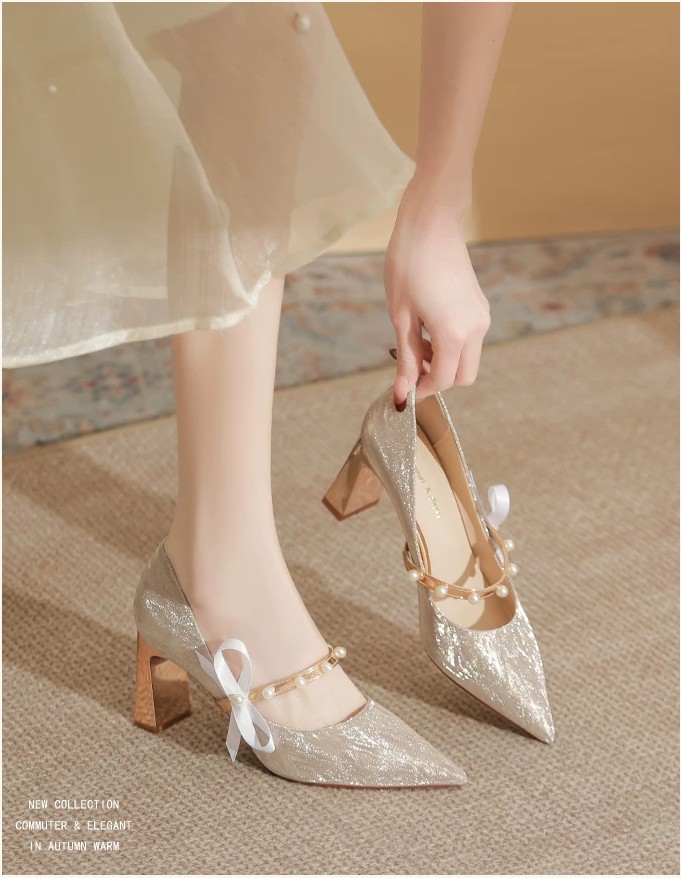
- Block: the widest contact patch, the most stable, the least elegant. Best for long days and uneven pavements.
- Cone: narrow at the top, wide at the base. More flattering than a block and nearly as stable, as long as the base is at least 25mm across.
- Kitten: a slim 40 to 50mm heel, often with a pointed toe. The dressiest low option and the least forgiving on cobblestones. The history of the kitten heel explains why it keeps returning in exactly this form.
- Cuban: a straight, chunky heel with a slight taper. Reads vintage, wears like a block.
For anything over an hour of standing, pick a block or a well-made cone. Kitten heels are a desk shoe, and pretending otherwise is how people end up carrying their shoes home.
The block heel styles on the site cover most of what’s described above. If you want the full range of heights in one place, the main heels collection is the faster way to browse.
One measurement worth taking before you commit: the width of the heel base. Under 15mm and you’re on a stiletto in all but name, whatever the height claims. Over 30mm and you’re in block territory. The 20 to 25mm range is the compromise most people end up happy with.
Material changes the feel as much as the profile. Wood and ABS heels are loud and unforgiving. Stacked leather and rubber are quieter and absorb vibration, which is why cobblers can rebuild a worn leather stack for years. Resin sits in the middle and is what most mid-price pairs use.
The last variable is the top piece, the little cap at the bottom of the heel. Cheap plastic caps wear through in about forty wears and start clicking on tile. A rubber cap costs almost nothing to replace and doubles the life of the heel.
What to check before you pay
Four things, in this order.
Sole flex. Hold the shoe at the toe and the heel and bend it. It should flex at the ball of the foot, where your foot flexes. If it bends in the middle like a cheap trainer, the shoe will fold under your arch and rub. If it doesn’t bend at all, it’ll fight every step.
Heel cup. Press your thumb into the inside of the heel. You want something firm with a thin layer of padding on top. A heel cup that’s pure foam collapses in a month and takes the support with it.
Toe box width. Stand up in the shoe and wiggle your toes. If you can’t, the shoe is too narrow regardless of what the size says. Leather gives about 2mm across the width, and that’s the ceiling.
Heel counter. Pinch the back of the shoe between finger and thumb. It should hold its shape. If it folds flat, it’ll collapse under your heel and you’ll be walking on the side of the sole within weeks.
Buy late in the day when your feet are at their largest, and try them on with the tights you’ll actually wear. Then walk on a hard surface rather than the shop carpet, because carpet hides a slipping heel better than any material invented.
Unsure between two sizes? Size up and add a thin leather insole. Filling space is easier than creating it.
Then run the five-minute test in the shop. Walk to the door, turn around, walk back, and stand still for two minutes while you pretend to read your phone. Standing still is where most shoes fail, and almost nobody tests it.
One last thing worth doing: check the insole is removable. If it lifts out, you can swap it for an orthotic or a padded insert without changing the fit. If it’s glued down, your options end at the shop door.
Where low heels still disappoint
They’re not a magic fix, and three complaints come up again and again.
The first is arch support. A low heel improves the angle of your foot but does nothing for a fallen arch, and most women low heels shoes arrive with a flat, unpadded footbed. If you have high arches, budget for an insole from day one instead of hoping.
Styling comes second. A low heel reads sensible. With a cocktail dress it can look like you gave up halfway, and under wide-leg trousers it disappears entirely, which defeats the point of buying a nice pair.
Third is quality at the low end. Cheap low heels fill the discount bins, and most of them use a bonded sole, a foam heel cup, and a synthetic lining that traps heat. They last a season. The shape-by-shape guide to women’s heels is a decent reference for what a well-built pair looks like inside.
Noise is the fourth one, and it’s small but real. A hard sole on a hard floor announces you. In an open-plan office that’s a genuine annoyance, and a thin rubber insert under the heel silences it for the price of a coffee. It’s the one flaw that shows up on women low heels shoes costing three figures as often as on a budget pair.
Spending more helps with exactly two of these: sole construction and lining. It doesn’t fix arch support and it doesn’t fix styling. So if a pair already fits and the shape works, a mid-price shoe will serve you as well as a designer one.
How to wear them without looking like you gave up
The trick is proportion, not decoration.

A pointed toe adds length that the low heel takes away. That one detail does more for a 45mm shoe than any amount of hardware or contrast stitching.
Show some ankle. A hem that stops above the ankle bone keeps the leg line visible. A low heel under a full-length trouser just looks like a flat from across the room.
Keep the colour close to your skin tone or your tights. Nude and taupe low heels read as an extension of the leg. A bright white or red low heel draws a hard line at the ankle and makes the shoe look smaller than it is.
Skip the ankle strap unless the shoe is otherwise plain. A strap, a low heel and a round toe is a lot of horizontal lines in a small space.
For work, a pair like these commuting heels on a low, stable heel handle the office-to-dinner stretch without a second pair in your bag. If you want a wider base for genuinely long days, thick-heeled shoes built for standing are the more practical buy.
For a wedding where you’ll stand for six hours, the honest answer is a 50mm block with a padded insole and a spare pair in the car. If you want the field report on how a 50mm heel holds up across a full day, this breakdown of a 50mm heel over a long day covers it. And if you’re pairing them with a two-tone outfit, the notes on where black and white panels sit on the foot apply to low heels just as much as high ones.
Start with one neutral pair at 45mm. Wear them for a fortnight before buying a second, and let your feet decide whether the shape suits you. That’s a cheaper education than most people get, and you’ll know within two weeks whether low heels are your answer or just another compromise.
