

You bought the beige pair everyone calls a neutral, put them on with a bare leg in July, and something went wrong. Your feet looked pale and slightly grey. The shoes looked dusty. Nothing was broken, the colour just didn’t belong to you.
That’s the trap with beige. It’s treated as a single colour when it’s really a family of about forty, and only a few of them match the skin on your foot. Get the undertone right and the shoe disappears into your leg, which is the effect everyone is chasing. Get it wrong and you’ve paid for a pair that makes your ankles look ashy.
Here’s how to work out which one you need before you spend anything, and what to do with the pair you already own.
Beige is not one colour
Open any shoe site and you’ll see the same word covering shades from pale oat to deep cognac. Manufacturers use it loosely because it sells, and because a photograph on a white background can’t tell you whether a shoe will work on your foot. Beige womens heels are the clearest example of a category where the name on the listing tells you almost nothing.
The shades split into three rough groups. Warm beiges lean yellow, gold or peach, and they read rich on the foot. Cool beiges lean pink, mauve or grey, and they look quieter. True neutrals sit between the two with no obvious cast. Most people can wear one of these convincingly and one of them badly, which is why two friends buy the same pair and only one of them loves it.
Pantone’s colour finder is useful here if you want to name what you’re looking at. Search beige and you’ll get dozens of entries that look similar on screen and behave completely differently against skin. The definition of beige as a colour range makes the same point in less commercial terms: it’s a family, not a single value.
And skin isn’t the only variable. Beige heels have to sit next to whatever hem you’re wearing, and a cool beige shoe under a warm cream dress looks like a near miss rather than a match. That’s the failure people notice but can’t articulate.
Light changes everything too. The same pair reads warm at noon and grey at 5pm, and grey under office fluorescents. If you mostly wear them indoors, check them under indoor light. If you’re buying beige womens heels for a summer wedding, check them outside, because that’s where the photographs will be taken and that’s where a bad undertone shows.
Price doesn’t rescue a bad shade. A designer beige with the wrong undertone looks worse on your foot than a cheap one that matches, because better leather holds colour more evenly and the mismatch becomes more obvious rather than less. That’s an inconvenient fact if you’ve just spent a lot of money, and it’s true anyway.
Match the undertone, not the shade
Forget the word nude. Ignore the shade names on the box. The only test that matters takes about twenty seconds in daylight.
Hold the shoe next to the inside of your wrist, then next to the top of your foot. The wrist is a decent proxy for the tone of your leg, and the top of your foot shows you the real thing. If the shoe looks slightly the wrong temperature, it is. If it blends so well you have to look twice to find the edge, buy it.
Daylight matters. Shop lighting is warm and flattering, and it will make almost any beige look like it belongs to you. Walk to a window, or step outside the door if the shop has one.

Three rules cover most cases.
Before you use them, know that the biggest mistake with beige womens heels is buying for the skin tone you had in February. Feet are the palest part of most bodies in winter and the tannest in August, and a shoe bought in one season can look wrong in the other.
- Olive or golden skin: warm beige, camel, champagne. Avoid anything grey-based, which reads dirty against warm skin.
- Pink or cool skin: taupe, mushroom, pale blush beige. Yellow-based beige will look orange next to you.
- Deep skin: beige is often the wrong tool. A rich caramel or chocolate brown does the same leg-lengthening job with better contrast, and it’s the shade most often missing from the nude ranges.
That last point is worth sitting with. The nude shoe trend was built around light skin for decades, and plenty of women have been told a colour is neutral when it’s neutral for somebody else.
One shortcut if you’re shopping online: photograph your bare foot next to the product image on the same screen, in the same lighting. Phone cameras lie, but they lie consistently, so the comparison holds up better than either image on its own. It’s crude and it works more often than the shade names do.
Buying beige womens heels online without that check is a coin toss, and return postage is the real cost of getting it wrong.
Why the leg-lengthening trick works
The idea is simple mechanics. When the shoe matches your skin, the eye can’t find where your foot ends. The leg line runs from hem to floor without a break, and you read as taller than you are.
It fails in three situations.
First, when there’s a strap across the ankle. A strap draws a hard line at the narrowest point and cancels the effect, no matter how perfect the colour match. Second, when the shoe has a contrast sole or a dark heel, both of which break the line from a distance. Third, when you’re wearing dark tights. A beige shoe over black opaque tights looks like two unrelated decisions.
If you want the effect to work with tights, match the shoe to the tights instead of to your skin. A taupe shoe over taupe tights does the same job, and it’s the version that works from October to March.
Also worth knowing: the trick works best at a mid height. At 30mm the gain is small and nobody notices. At 70 to 90mm it’s visible, and it’s the reason so many wedding outfits use a champagne or blush shoe rather than a white one.
The reverse is also true, which is the part nobody says out loud. A shoe that’s noticeably darker than your leg cuts you off at the ankle, and the shorter the skirt, the more obvious it is. That’s why black heels with a bare leg look deliberate and a mid-brown heel with a bare leg often looks like an accident: the contrast sits in an awkward middle.
If you already own a mismatched beige pair, you have three options. Wear them with tights close to the shoe colour, which makes the mismatch disappear. Wear them with trousers that cover the ankle, which does the same job. Or take them to a cobbler for a re-dye, which runs less than a new pair and works well on smooth leather, badly on suede, and not at all on patent.
Beige for work, weddings, and winter
This colour earns its place differently depending on the occasion.
For an office, a beige pump at 50 to 70mm is the least confrontational shoe you can wear. It doesn’t compete with a patterned dress, it doesn’t read as evening, and it works with navy, grey, olive and black. Most wardrobes could replace three pairs with one good beige pump and nobody would notice. If your office is carpeted and your commute is a bus, this is the pair that survives both.
For a wedding, champagne and blush are the safe choices, and they photograph better than stark white, which blows out under flash and goes blue in shade. This pair of champagne wedding heels with crystal detailing shows the shade at the dressier end of the range.
Winter is where beige struggles. The colour reads summery next to heavy wool, and pale suede picks up salt marks that never fully come out. If you want beige in December, go darker than you think: cognac, camel, toasted almond. They sit next to winter fabrics without looking like a mistake.
A darker beige also solves the scuff problem. Light beige shows every mark, and a scuff on the toe of a pale shoe is visible from across a room. Camel hides most of it.
Three pairings that work without thinking about it:
- Navy suit, camel pump. Warm against cool, and it reads more expensive than a black shoe does.
- White shirt, wide trousers, taupe block heel. Neutral on neutral, with the shoe as the quietest thing in the outfit.
- Dark denim, champagne slingback. The pale shoe keeps the whole look from going heavy.
What doesn’t work is beige on beige. A beige shoe under a beige dress almost always fails, because the two beiges are never the same beige and the eye finds the difference immediately. Break it with a contrast somewhere else, or pick a darker shoe. If you’re set on the tonal look, buy the shoes in person with the dress in hand, and accept that a perfect match is rare enough to be worth the detour.
What to check before you pay
Five things, and the first one is unique to this colour.
Dye transfer. Rub the inside of the shoe with a white tissue. If colour comes off on dry leather, it’ll come off on your feet and on light tights. Cheap beige dye is notorious for this, and there’s no fix once it starts.
Finish. Patent beige looks glossy and slightly plastic in daylight, and it shows fingerprints. Matte leather, suede and satin all look softer and age better. If you want shine, keep it to the heel rather than the whole shoe.
Lining. A pale leather lining is a fair indicator of a better-made shoe. Synthetic linings in beige shoes go grey at the heel within a month, and that’s the part people see when you sit down.
Sole edge. Look at the side of the sole where it meets the upper. A neat, painted edge holds up. A raw, unfinished edge on a beige shoe looks cheap within weeks and can’t be disguised.
Heel tip. Check the little cap at the bottom. On a pale shoe it’s often the only dark element, and a worn tip makes the whole pair look neglected. Replacements cost almost nothing.
If the shoe passes all five and the colour disappears against your foot in daylight, you’ve found your pair. Beige womens heels are one of the few categories where the right one is genuinely hard to find and then lasts for years. Expect to try four or five pairs before one works, and don’t let a shop assistant talk you into the second one because it’s the last in your size.
Two of those five checks are worth paying more for. Dye transfer and lining quality both scale with price in a fairly reliable way, and both are the things you can’t fix afterwards. Finish and sole edge you can live with. The heel tip costs a few pounds to replace whenever you like.
What you shouldn’t pay extra for is a brand name on a shade that doesn’t match. That’s the one purchase nobody can help you with after the fact.
Keeping beige clean without ruining it
Beige shows dirt in a way black never will, and it also shows cleaning mistakes. Two rules save most pairs.
Never scrub. Scrubbing drives dirt into the grain and leaves a lighter patch around the stain. Dab with a damp cloth and a drop of mild soap, work from the outside of the mark inward, and let it dry away from direct heat.
Never use a coloured cloth. Dye from a red or blue rag transfers onto pale leather and sets permanently. White cotton or microfibre only.
For suede, a brush and a gum eraser handle most marks. Do it dry, do it gently, and don’t wet the nap. A protector spray applied before the first wear keeps coffee and rain from becoming permanent, and it needs reapplying every few weeks.
Store them away from dark leather. Beige picks up dye from black shoes in a warm wardrobe, and the transfer shows as a soft grey haze rather than a mark, so people don’t notice until it’s set.
One last habit worth building: wipe the toe and the heel after every wear, before you take them off. It takes eight seconds, and it’s the difference between a pair that looks new after two summers and one that looks tired after one.
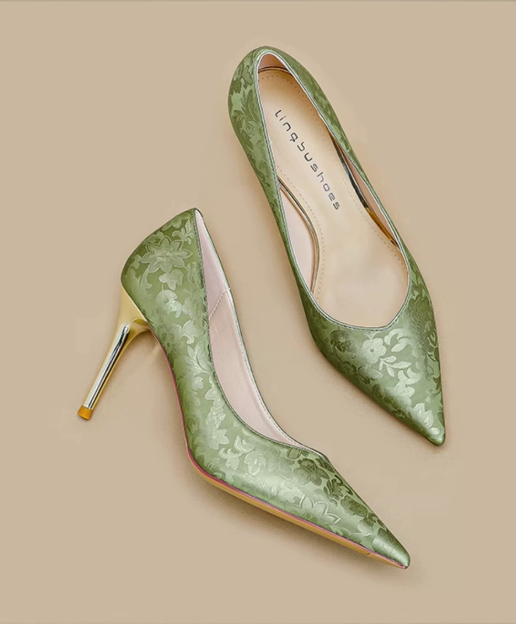
For the rotation, a soft embroidered champagne pair covers occasions, and a plainer slim-heeled champagne pump handles office days. Both sit in the wider heels collection alongside the darker camel shades that work in winter.
If the colour match is the part you keep getting wrong, the notes on choosing a metallic that still works at a wedding follow the same undertone logic, and the guide to round toe shapes for wider feet is worth reading before you commit to a toe box in a colour this unforgiving.
Take one pair into daylight before you decide. If the shoe blends into your foot and you have to look twice to find the edge, that’s the one. If you can see the boundary immediately, put it back and try the next shade along.
