

There’s a specific noise a suede slip-on makes when your heel lifts out of it. A soft, slightly damp sort of flap, once every step, all the way down the road. You can hear it and so can everyone behind you.
If that’s already your life, you’re in the right place. Suede slip-ons are the most comfortable-looking shoe in the shop and the most likely to betray you at the back, because suede has no structure and a slip-on has nothing holding your foot in. Get the fit right and you’ll wear them four days a week. Get it slightly wrong and you’ll be buying heel grips by the pack.
The good news is that fit is predictable. Suede behaves in fairly reliable ways, and once you know the three places to check, you can tell in about 40 seconds whether a pair will work or whether it will end up in the bag by the door.
Why suede slip-ons fail at the heel
Suede is leather with the outer grain sanded off, which leaves a surface of tiny fibres. It feels soft because it is soft, and it stretches because those fibres slide against each other. Over the first month, a suede slip-on will give by roughly 3 to 5mm at the widest point and about 2mm at the heel counter.
Two millimetres doesn’t sound like much. But a slip-on has no laces, no strap, and no buckle, so those 2mm are the entire difference between gripping your heel and letting it rise. There’s nothing to tighten.
The heel counter is the stiffened part at the back of the shoe, and on cheap suede shoes it’s usually soft. Soft counters feel lovely for the first week and then collapse. Once it’s collapsed, the shoe is finished as a walking shoe, though it still works as a “sitting in a café” shoe, which is not what you bought it for.
So the counter is the thing to check first. Pinch it between your fingers, right at the top centre of the back. You want resistance, a defined edge, and a slight inward curve at the very top. If it folds flat with no pressure at all, walk away. That pair will be a slipper by February.
Forty seconds in the shop, three checks
If you only do three things before buying a pair, do these. They catch about nine out of ten bad fits.
Check the counter. Pinch the back. It should hold its shape and it should sit snug against your Achilles tendon without pressing on it. If it digs in at the top edge, the pair is cut too high for you, and no amount of breaking in fixes that, because suede doesn’t shrink.
Check the topline. That’s the edge around the opening where your foot goes in. On a good slip-on it’s slightly elasticated, or there’s a hidden elastic gusset on the inner side. Run your thumb along it. If it’s a hard, unlined leather edge, it will cut into the top of your foot within a week. If it’s soft and sprung, the shoe will hug the instep instead of gaping.
Walk 30 steps on a hard floor. Not carpet. Carpet absorbs the heel lift and makes every shoe feel secure. On a hard floor you’ll hear the flap if there is one, and you’ll feel whether your foot slides forward and jams your toes against the front.
- Heel lifts more than 5mm: too long or too wide at the back, don’t buy
- Gaping at the sides when you walk: the topline is too straight for your instep
- Toes hitting the front on push-off: too short, and suede won’t stretch lengthwise
- Slight lift at the heel with a firm counter: fixable with a 2mm insert
That last one is the only failure mode worth buying through. A firm counter plus 2mm of lift means the shoe fits well and just needs a little volume taken up. A soft counter plus 2mm of lift means the shoe is badly made.
For reference on how a suede shoe should be put together, the short entry on what suede actually is and how it’s finished explains why the nap direction changes how the shoe feels under your hand.

Not all suede is the same, whatever the label says
“Suede” on a label covers a wide range of things, and the difference shows up after three weeks of wear.
Full-grain suede comes from the outer layer of the hide, has the longest fibres, and is the most durable. It feels dense and slightly heavy in the hand. It costs more and it lasts. If you’re buying one pair to wear for three winters, this is the one.
Split suede comes from the inner layer. Shorter fibres, softer hand, less durable. It’s the standard for most mid-priced suede shoes, and it’s perfectly fine, as long as you accept that the nap will flatten at the flex point across your toes within a season. That’s normal, not a defect.
Bonded or faux suede is a synthetic microfibre. It looks convincing in photographs, and it behaves badly in real life. It doesn’t breathe, so your foot gets warm and damp, and it pills at the flex point instead of flattening. It also doesn’t stretch, which means the shoe that felt tight in the shop stays tight.
You can usually tell by touch. Real suede has a directional nap that changes the shade when you brush it one way. Faux suede has a uniform surface that looks the same from every angle and feels slightly plasticky when warm.
If the pair is going to sit against your bare foot all summer, it’s also worth looking for a lining that’s been tested for the chemicals used in dyeing. The OEKO-TEX testing standards for textiles worn next to skin are the ones to look for on the tag, and they cover the finish rather than the fibre.
Rain, salt, and the two-week window
Suede’s reputation for being fragile is a bit overstated. It doesn’t dissolve. What actually ruins suede is salt, and what actually saves it is doing something in the first two weeks rather than the first year.
Water alone marks suede, but the mark usually dries out if you leave the shoe alone and don’t rub it. Rubbing is what sets the stain, because it pushes the fibres in different directions and the nap never lines up again.
Salt is different. Winter gritting leaves a white tide line around the bottom of the shoe, and that line is crystalline, so it abrades the fibres every time you brush against it. It also wicks moisture, which stiffens the leather.
So: spray them before you wear them, not after. A fluoropolymer protector, two light coats, 20 minutes apart, outdoors. Let them dry overnight before the first wear. Reapply every six to eight weeks through autumn and winter. That’s it. That’s the whole maintenance routine, and it takes about four minutes a month.
If they do get soaked, stuff them with newspaper, leave them away from radiators, and don’t touch them for 24 hours. A radiator will shrink the suede and crack the sole bond. I’ve done this to a pair of grey boots and they never recovered their shape.
For marks, a suede brush and a suede eraser, in that order. Brush with the nap, not against it. If the mark is oil-based, cornflour overnight draws some of it out. If it’s mud, let it dry completely and brush it off, because wet mud pushes into the fibres and dry mud sits on top.
Breaking them in without wrecking the shape
Here’s the counterintuitive part. Suede slip-ons don’t need breaking in the way leather boots do, and treating them like boots is how people ruin them.
You’re not trying to soften the leather. You’re trying to let the shoe take the shape of your foot at three points: the instep, the widest part of the forefoot, and the top of the heel. That happens through warmth and flexion, not through force.
- Wear them for two hours the first day, indoors, with thin socks
- Add an hour a day for the first week, and don’t wear them two days running
- Use a shoe tree or rolled newspaper between wears to hold the shape
- Skip the hairdryer trick, which shrinks suede and hardens the counter
Thin socks matter more than people think. A cotton pop sock gives you 1mm of slide, which lets the suede settle against your foot instead of grabbing it. Wear them that way for the first week, then try bare feet.
If a specific spot rubs, don’t push through it. Find the spot from the inside, and soften it by working the suede between your fingers for a minute. Then cover the area on your foot with a plaster for two or three wears. That combination fixes most pressure points without stretching the shoe out of shape.
What you shouldn’t do is stretch them with a spray and a shoe stretcher in the first week. Suede slip-ons already give; adding mechanical stretch on top means they’ll be too big by month two and you’ll be back to the heel-flap problem you started with.
What to wear with them
Suede slip-ons are the least fussy shoe in a wardrobe, with one exception that catches everybody.
Trousers. Straight or wide-leg, hemmed to just above the ankle bone. This is the pairing that makes them look intentional. A taupe suede slip-on with navy wool trousers and a plain jumper is about as good as casual gets. Full-length trousers that break on the shoe will ruin the suede at the heel within a month, because the hem rubs exactly where the nap is weakest.
Jeans. Cropped straight-leg, dark wash. Works. Skinny jeans with a suede slip-on looks dated in a way that’s hard to explain, but you know it when you see it.
Dresses and skirts. A suede slip-on with a midi dress is a nice contrast, because suede reads as slightly utilitarian against something soft. Keep the dress plain. A print plus suede plus a suede bag is too much texture in one outfit.
The exception. Anything with a raw or frayed hem. Frayed denim against suede is a two-week death sentence for the shoe, because the loose threads catch the nap and pull it up into little balls along the side. If you love frayed jeans, wear leather.
Colour is straightforward. Sand, taupe, and grey go with nearly everything and show marks least. Black suede looks sharp for about a month and then shows every scuff as a lighter grey patch, which is why I’d take dark brown over black if you only buy one pair. Pale suede is beautiful and needs spraying every three weeks, and honestly, most people don’t keep up with it.
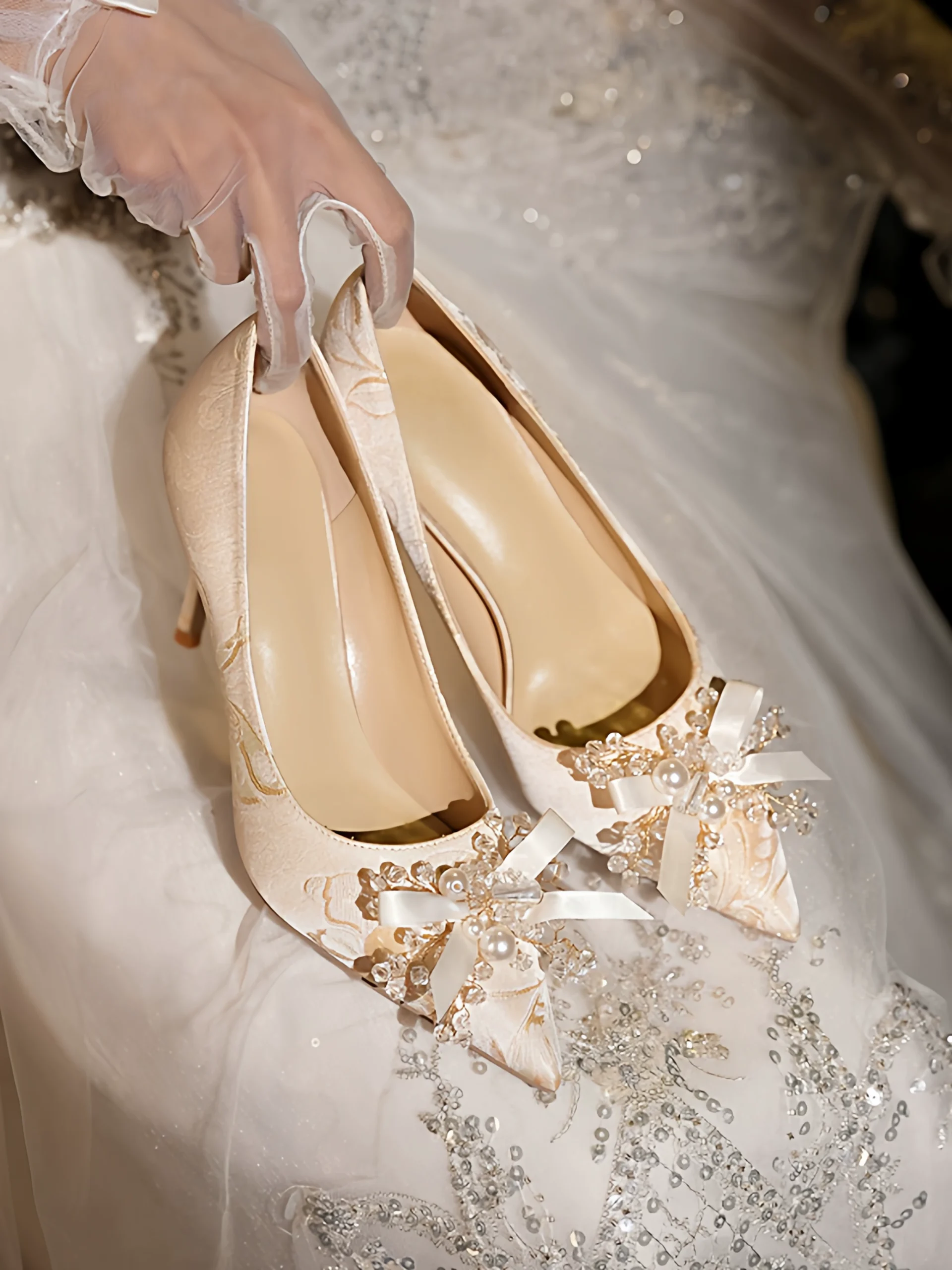
If you want a dressier version of the same idea, a suede shoe with a shaped heel does the job without the fit problems, and this pair of soft-soled suede heels for office days is cut for exactly that. The retro suede single shoes with a rounded toe sit in the same family, with a bit more shape at the front.
When to pick leather or knit instead
Suede slip-ons are not the right shoe for everyone, and it’s worth saying so before you spend money.
If you walk more than 8,000 steps a day, buy leather. Suede’s nap compresses at the flex point and the shoe starts to look tired by month three, no matter how well you care for it. Leather creases instead of flattening, and a creased leather shoe still looks like a leather shoe.
If you live somewhere with heavy rain from October to March, buy knit or leather. Protecting suede works, but it’s another job, and you’ll skip it. There’s no shame in choosing the shoe that survives your actual weather.
Wide feet and slip-ons are a harder match, because there’s no adjustment anywhere on the shoe. A wide forefoot in a slip-on means the shoe gapes at the sides while still pressing at the widest point, which is the worst of both. For that group, a square toe shape that forgives a wide forefoot is a much better starting point than a slip-on.
And if you want a low shoe that holds your foot properly, look at what a 50mm kitten heel does across a long day before you settle on a flat. The strap does the work that suede can’t.
Otherwise, buy the pair with the firm counter, spray it before the first wear, and keep a shoe tree by the door. Do that and a decent suede slip-on will be the pair you reach for without thinking, which is the highest compliment a shoe can get.
