

A polished black pump and a restaurant kitchen floor are a genuinely bad combination, and thousands of women find that out the hard way every year. The spill near the service station, the polished marble in a hotel lobby, the wet tile by the entrance on a rainy Monday morning — none of these surfaces forgive a smooth leather sole. That is why slip resistant dress shoes for women have quietly moved from niche occupational gear into a mainstream request. Nurses, teachers, restaurant managers, retail supervisors, flight attendants, and anyone who spends a working day on hard flooring now ask for the same thing: a shoe that looks like a dress shoe and behaves like a work boot underneath.
The trouble is that the label is close to meaningless. Walk through the women’s section of any department store and you will find boxes stamped with “non-slip,” “slip-resistant,” “anti-slip,” and “safety grip,” usually with no test data, no standard number, and no explanation of what surface the claim refers to. Some of those shoes are genuinely well engineered. Others have a slightly textured rubber pad glued to the bottom of an otherwise slick sole and a marketing team with a good graphic designer. Learning to tell them apart takes about twenty minutes of knowledge, and it will save you from a fall that can cost far more than a pair of shoes.
This guide covers what actually creates traction on a dress shoe, how the real testing standards work, why heel shape matters as much as sole compound, which materials hold grip and which degrade, and how to test a pair on the shop floor before you spend money. It applies whether you are shopping for a pair of women’s shoes for a hospital shift, a service job, or simply a long commute that ends on a polished lobby floor.
Why “Slip Resistant” on a Dress Shoe Label Is Vague
Shoe labeling in most countries is regulated for composition and origin, not for traction. A manufacturer can call a shoe slip resistant because it passed their own internal test on their own chosen surface, at their own chosen speed, with their own chosen contaminant. There is no universal legal definition that forces them to disclose any of it. That is not a conspiracy; it is simply a gap. Safety footwear standards exist and are strict, but they apply to protective footwear certified for industrial use, and a fashion pump almost never enters that category.
So the phrase survives because it is useful marketing. What you want instead is a number. A shoe that has been tested under a recognized method will usually say so on the box, on a hangtag, or on the product page — ASTM F2913, SATRA TM144, EN ISO 13287, or a certificate reference. In the food service and healthcare supply world, buyers routinely ask suppliers for the test report itself, and good suppliers send it. In fashion retail, you will almost never see one, which tells you something about how seriously the claim is being made.
There is a second reason the label misleads. Traction is not a property of a shoe in isolation; it is a relationship between a sole, a floor, and whatever is on that floor. The coefficient of friction that determines whether you stay upright changes dramatically with water, oil, dust, sugar syrup, or a thin film of floor polish. A shoe with excellent dry grip can be genuinely dangerous on a wet tile. A shoe rated highly for wet ceramic may be mediocre on dry concrete. Any claim that does not name the surface is only half a claim, and usually the flattering half.
What this means practically is that you should stop reading the front of the box and start reading the sole. The rest of this guide is mostly about that.
The Outsole Is Where the Answer Actually Lives
Flip a dress shoe over. What you see there determines almost everything. Three things matter: the rubber compound, the tread pattern, and how much of the sole the outsole actually covers.
Compound first. Natural rubber blends give the best combination of grip and durability on dry and slightly damp surfaces, and they stay flexible in cold weather. Soft rubber grips better than hard rubber but wears faster, which is why work shoes often use a softer heel strike zone and a harder mid-sole. Thermoplastic rubber, common on inexpensive fashion shoes, is cheap and molds crisply, but it hardens with age and offers modest wet grip. Polyurethane is light and durable but can be genuinely treacherous when wet unless it is specifically formulated for it. If the sole is described only as “rubber” with no further detail and it feels hard and slightly waxy under a fingernail, treat the slip claim with suspicion.
Tread pattern second. A dress shoe does not need an aggressive hiking lug, and you would not want one — it looks wrong with a skirt suit and it traps grit. What it needs is a network of shallow channels that let water escape sideways as your foot loads. A completely flat sole has nowhere to push the water film, so it hydroplanes on wet tile at walking speed. A pattern of thin grooves, small chevrons, or a fine honeycomb does the same job discreetly. Look for grooves that run to the edge of the sole rather than stopping in the middle, because water has to have an exit route.
Coverage third. Many women’s dress shoes have a sole that ends before the toe and heel edges, leaving thin leather or a hard heel tip in contact with the floor. Those are the areas that slip first, especially the heel edge on stairs. A good pair of slip resistant dress shoes for women wraps rubber around the heel breast and the toe spring, so the parts that touch down first are the parts with grip. If you can see a hard plastic heel tip at the back, that shoe will skate on a wet lobby floor regardless of what the midsole is made of.
Heel Geometry, Sole Thickness, and the Balance Problem
Heel shape is the most under-discussed safety feature in women’s footwear. A three-inch stiletto concentrates your entire body weight onto a contact patch smaller than a fingernail. On a hard, smooth surface that patch behaves like a pivot. It does not need to slide to cause a fall; it only needs to twist. A block heel of two inches spreads the same load over perhaps ten times the area, which is why hospitality and healthcare workers who want a dressier look almost always land on block heels and low wedges rather than thin spikes.
Height interacts with traction in a way that is easy to miss. As heel height increases, your ankle sits in plantarflexion, which reduces the range of motion available to correct a small slip. The muscles that would normally catch you are already near the end of their travel. That is why a one-inch slip in flat shoes becomes a full fall in four-inch heels. If you need a dress shoe for long shifts on hard floors, a heel between half an inch and one and a half inches is the practical sweet spot, and the difference in how your calves feel at hour eight is considerable.
Sole thickness matters too, but not in the direction people assume. A very thin sole transmits every pebble and every change in surface texture directly to your foot, which sounds uncomfortable but actually improves proprioception — your sense of where the ground is. Extremely thick platform soles do the opposite: they damp feedback, raise your center of gravity, and reduce the ankle’s ability to roll with a surface change. For a shoe meant to prevent falls, moderate is better than maximal. A sole in the four to eight millimeter range under the ball of the foot, with a distinct heel lift, gives you both ground feel and cushioning.
One more geometric detail: the toe spring. That upward curve at the front of the sole is what lets you roll through a step. Too much spring and the shoe rocks forward on its own, which is unsettling on stairs. Too little and the toe catches on carpet edges and thresholds. Press the toe of the shoe down on the floor and let go; a well-made dress shoe should return to its curve without slapping down flat.
What the Real Testing Standards Measure
If you want to verify a claim rather than trust it, these are the standards worth knowing. They are all real, all published, and all referenced in the safety footwear industry.
ASTM F2913 is the standard test method for measuring the coefficient of friction of footwear and flooring under controlled conditions. It runs a shoe or a sole sample across a test surface at a defined speed and load, with a defined contaminant, and reports a number. Many slip-resistant work shoes state their ASTM F2913 result explicitly, along with the surface used — typically quarry tile with water, or stainless steel with glycerin, which is the classic restaurant scenario.
SATRA TM144 is the equivalent method used widely in Europe and by manufacturers producing for international markets. SATRA, the research and technology organization based in the United Kingdom, also runs a certification program that allows a shoe to carry a verified slip resistance mark. EN ISO 13287 is the European standard for slip resistance of personal protective equipment, and the marking system you will see on certified work footwear — SRA for ceramic tile with dilute soap, SRB for stainless steel with glycerol, SRC for both — comes from it. A shoe marked SRC has passed both wet ceramic and wet steel testing, which is the strictest common benchmark in the category.
Here is the honest caveat: a fashion dress shoe will essentially never carry SRC certification, because certification is expensive and the category does not demand it. What you can reasonably look for is a manufacturer that names a method and a result, or a line built specifically for hospitality and medical use where the buyers do demand it. If you see “slip resistant” with no standard, no surface, and no number, you are looking at a mood, not a measurement.
The Occupational Safety and Health Administration treats slips, trips, and falls as one of the leading categories of workplace injury in the United States, and its guidance on walking-working surfaces emphasizes both floor condition and footwear as controls. That framing is useful even at home: the shoe is half the system, and the floor is the other half.
Materials, Uppers, and How Construction Affects Grip
Upper material does not touch the floor, so it has no direct effect on friction. It has a large indirect effect, because the upper determines how well the shoe stays attached to your foot, and a shoe that shifts under load is a shoe that slips.
Full-grain leather is the most forgiving choice for a dress shoe that has to work hard. It molds to the foot over a few weeks, holds its shape, and does not stretch out of position the way softer materials do. Patent leather looks sharper but is stiff and unforgiving; it does not adapt, so any fit error stays a fit error for the life of the shoe. Satin and fabric uppers, popular for occasion shoes, offer almost no lateral support, which is fine for a two-hour event and poor for an eight-hour shift. Suede sits somewhere in the middle and needs weather protection to survive a wet commute.
Construction matters as much as material. A cemented sole, where the outsole is glued to the upper, is standard in fashion footwear and perfectly serviceable, but the bond can fail at the toe where flexing is constant. A stitched or Blake-stitched construction costs more and holds up far better, and it can be resoled — which matters, because the outsole on a slip resistant shoe is the part that wears out first. Goodyear welting is rare in women’s dress shoes but appears in heritage styles and is worth knowing about if you want a pair that lasts a decade.
Linings deserve a mention. A leather-lined shoe manages moisture far better than a synthetic one, and dry feet grip the inside of a shoe more securely than damp ones. Sweat is a real slip mechanism inside the shoe, not just outside it. If you are choosing between two similar pairs and one is leather-lined, that is a meaningful difference for anyone standing all day.
Match the Shoe to the Surface You Actually Walk On
Generic slip resistance advice is close to useless because surfaces vary so much. Here is what actually matters in the places women most often need a dress shoe with grip.
Polished tile and marble lobbies are the classic hazard. They are hard, smooth, and often slightly damp from foot traffic on a rainy day. Soft rubber with fine, edge-to-edge grooves is the answer here, and smooth leather soles are the worst possible choice — they behave like ice skates on the first wet footprint.
Commercial kitchen floors, if your work takes you near one, are usually quarry tile or epoxy with a film of oil and water. This is where the SRC marking earns its keep and where a decorative fashion sole will fail outright. Shoes built for this environment typically have a slightly softer compound and a denser pattern of small blocks that squeegee the surface as you walk.
Carpet and matting create a different problem: the risk is catching rather than sliding. A toe that is too springy or a sole edge that protrudes catches on the transition strip between carpet and hard floor, and that is a leading cause of trips in offices. Lower toe spring and a sole that follows the shape of the shoe reduce the risk.
Wet pavement and outdoor steps combine water with grit and irregular surfaces. Here you want a slightly deeper tread than a purely indoor shoe, and a compound that stays soft in cold weather. Winter is worth a specific note: rubber hardens as temperature drops, and a cheap TPR sole that grips acceptably at twenty degrees Celsius can become genuinely slick at zero. If you commute on foot in winter, that is the single strongest argument for paying more for a proper rubber outsole.
There is also a transition problem that almost nobody plans for. Most women do not walk on one surface; they walk across five or six in a single journey — pavement, a bus step, a marble lobby, an elevator with a metal threshold, then carpet. The risky moment is never the middle of a surface, it is the seam between two of them, especially when the first is wet and the second is polished. Shoes with a continuous rubber outsole and rounded edges handle transitions far better than shoes with a hard toe tip and a thin leather sole, because there is no hard edge to catch and no smooth patch to skid on. If your day involves that kind of mixed terrain, judge a candidate pair by its worst-case contact point rather than its average one.
Fit, Break-In, and the Slipping That Happens Inside the Shoe
Most people think of slipping as a sole problem. A large share of it is a fit problem. If your heel lifts a centimeter with every step, you are not walking in the shoe; you are walking on top of it, and each step is a small controlled skid. That is why slip resistant dress shoes for women that fit properly feel dramatically more secure than the same model half a size too large.
Get measured properly, and do it late in the day when your feet are at their largest. Feet swell through the day, and a shoe that fits at eight in the morning will be tight by six in the evening, or worse, loose if you compensated by sizing up. Measure both feet; most people have a difference of a few millimeters between them, and the larger foot should set the size.
Pay attention to heel lock. With the shoe laced or strapped, your heel should sit deep in the heel counter and stay there when you walk. A heel that rises more than about six millimeters is a shoe you will fight all day. If the rest of the fit is right and only the heel lifts, a heel grip insert can solve it; if the shoe is simply too long, no insert will fix it properly.
Break-in should be gradual and short. Wear new dress shoes for an hour indoors, then two hours, then a half day. Leather needs time to crease where your foot flexes, and rubber outsoles need a light scuffing to reach peak grip — a brand-new sole is often slightly glossy from the mold, which is exactly the wrong surface for traction. Walking a few minutes on dry pavement before you wear them into a wet lobby is a small habit that genuinely helps.
Care That Keeps the Grip Alive
Traction degrades quietly. The outsole that felt secure in the shop becomes marginal after eight months of daily wear, and you rarely notice the change because it happens gradually. There are a few habits that slow it down and one or two that reverse it.
Clean the sole regularly. Fine grit embeds in tread grooves and effectively polishes the rubber, reducing grip and filling the channels that are supposed to move water. A stiff brush and warm water once a week is enough. Avoid silicone or oil-based polishes on the outsole; they leave a film that is actively slippery.
Watch the heel tips. The small plastic or rubber cap at the back of a heel is a wear part, and once it wears through, the heel becomes a hard, slick edge that also damages floors. Replacing heel tips costs very little at a cobbler and should be done before the wear reaches the heel block itself. On block heels, check the corners, which wear first.
Consider a professional resole before the sole is gone. A cobbler can add a thin rubber grip layer to a leather-soled dress shoe for a modest price, and that single change converts a beautiful but dangerous shoe into one you can wear in rain. This is the highest-value modification available to anyone who owns good dress shoes and lives in a wet climate. Ask for a thin sole guard rather than a thick lug, so the profile of the shoe stays intact.
Store shoes dry and away from direct heat. Radiators harden rubber and crack leather. If shoes get soaked, stuff them with newspaper and let them dry at room temperature, never on a heater. Rotating between two pairs is the cheapest durability trick there is: each pair gets a full day to dry out, the leather recovers its shape, and the outsole compound is not asked to flex while saturated, which is when it degrades fastest.
Finally, keep an eye on the calendar rather than the shoe. If a pair has done a full year of daily wear, the outsole has probably lost a meaningful share of its grip even if it looks intact. Hold the shoe at eye level under a bright light and compare the depth of the grooves at the ball of the foot with the depth at the arch, where almost no wear happens. When the difference is obvious, it is time for a resole or a replacement, and it is far cheaper than the alternative.
A Five-Minute Test You Can Run in the Store
Practical checks beat specifications when you are standing in a shop with a box in your hand.
First, turn the shoe over and look at the heel edge. Rubber that wraps around the back, with visible grooves running off the edge, is a good sign. A hard plastic tip or bare leather is a bad one.
Second, press a thumbnail into the outsole. It should leave a slight dent and recover. If it feels like a bottle cap, the compound is hard and wet grip will be poor.
Third, put the shoe on a smooth tile floor in the shop — most stores have one — and try to twist your forefoot while standing. You want resistance, not a smooth swivel. Do the same with the heel. Staff rarely object, and it is a far better test than reading the tag.
Fourth, walk ten steps and check the heel lift. If your heel rises noticeably, size down or try a different last before you try a different shoe.
Fifth, ask directly whether the model has been tested and to what standard. A good salesperson will know or will find out; the answer itself tells you how seriously the brand treats the claim.
Sixth, and this one is easy to forget, try the shoe on a hard surface rather than the carpeted area staff usually point you toward. Carpet hides everything. A shoe that feels planted on carpet can feel alarmingly loose on vinyl, and the difference only shows up when you actually stand on the surface you will be walking on all day. Most stores will not mind you stepping a few feet onto the tile by the mirror, and that short walk is the closest thing to a real test you will get before purchase.
If you are shopping online, you lose all of that, so substitute inspection for testing. Read the product description for the words rubber, outsole, tread, or grip, and treat their absence as an answer. Look closely at the photographs from below if the listing includes them — many do not, which is itself informative. Check the return policy before you order, and plan to walk around indoors on a hard floor for twenty minutes the day the box arrives. A pair that fails the twist test at home will fail it on a wet lobby floor too, and returning unworn shoes is straightforward.
Where to Spend Your Money
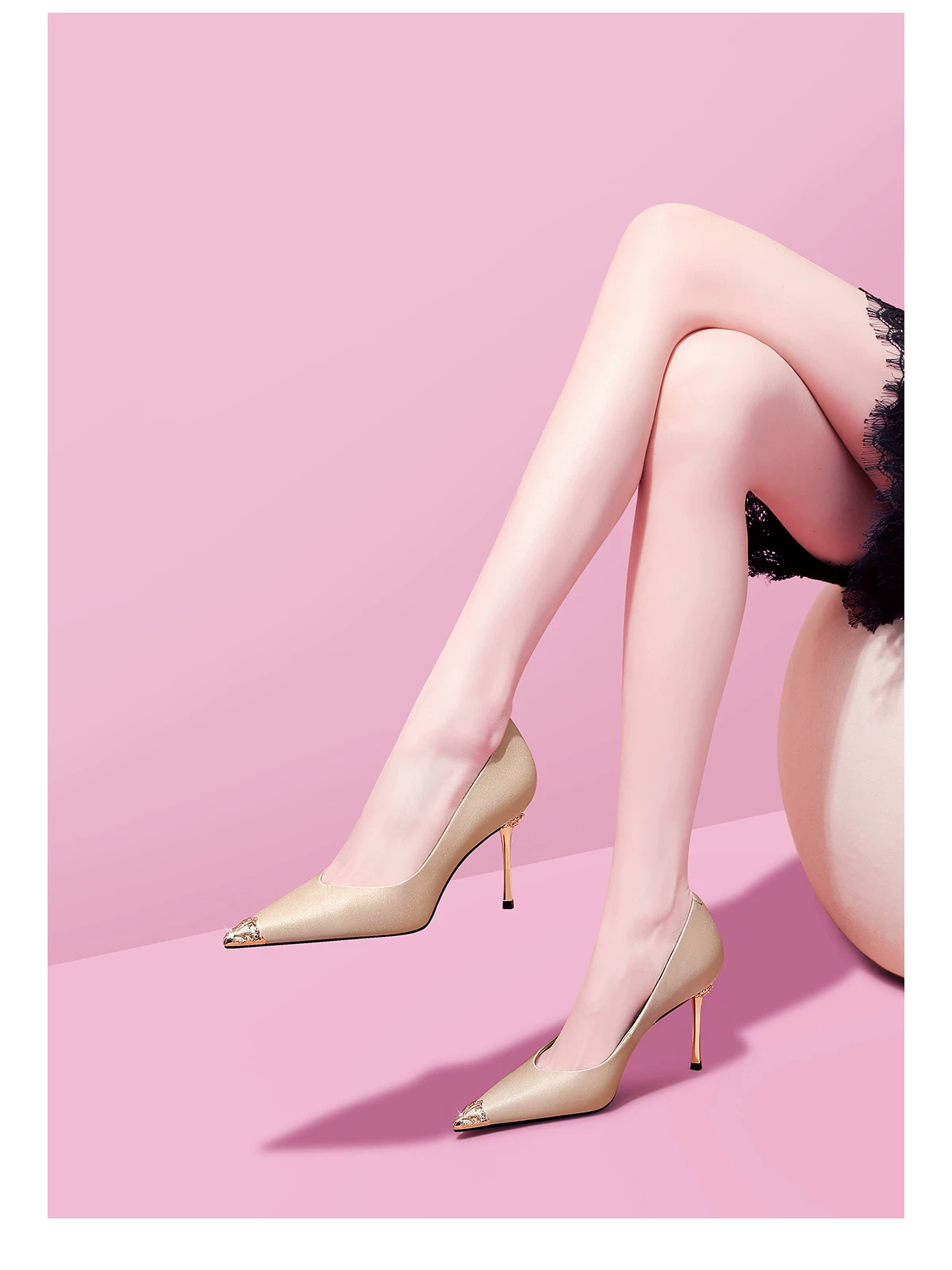
If you need slip resistant dress shoes for women for actual work — healthcare, hospitality, retail, teaching — buy from a line that serves those industries and states its test results. You will pay slightly more and get a shoe that is honest about what it does. Look at pointed-toe dress pumps with a stable heel as a starting shape, then verify the sole construction before committing.
If you need grip mainly for a commute that ends indoors, a good pair of leather heels or flats with a rubber sole guard added by a cobbler is the more sensible spend. You keep the look you want and solve the actual problem for a fraction of the cost of a specialist shoe.
What you should not do is buy a smooth-soled fashion shoe and hope. Floors do not negotiate, and the difference between a shoe with real traction and one without is a number you can measure, a sole you can inspect, and a five-minute test you can run before you hand over your card.

One last piece of context that reframes the whole purchase. The best slip resistant dress shoes for women are not the ones with the most aggressive tread or the highest claimed friction number. They are the ones you actually wear. A pair of certified work shoes that sit in the closet because they look wrong with everything you own protects nobody. A well-fitted, reasonably grippy dress shoe that you put on every morning does far more for your safety than a specialist pair worn twice a year. Buy for the life you actually live, add a sole guard if the weather demands it, and replace the heel tips before they wear through. That combination handles almost every floor you will meet, and it costs a great deal less than a single emergency room visit.
