

There is a particular kind of frustration that only shows up when you slide your foot into a beautiful pair of heels and feel it swimming around inside. The length is right, the toe box looks fine from the outside, and yet every step makes your heel lift, your arch slide forward, and your toes curl up trying to grip the insole like a bird on a wire. That is not a sizing mistake in the usual sense. It is a width problem, and it is far more common than most shoppers realize. Standard retail racks are stocked overwhelmingly in one width — a medium — while feet come in everything from extra narrow to extra wide. If your foot runs slim, you have probably spent years buying half a size down just to stop the slipping, then paying for it with pinched toes.
This guide is written for that exact situation. Nothing here requires a custom order or a specialist last. It is about learning the handful of details that separate a heel that merely fits from one that holds your foot, the way a fitted glove holds a hand. You will learn how width is actually measured, which materials give and which ones refuse to, which fastenings do real work and which are purely decorative, and how to test a pair in the store in under five minutes. We will also cover the small corrections — grips, pads, a good cobbler — that can rescue a pair that is almost perfect. By the end you should be able to walk into any store, or shop online with confidence, and know within moments whether a pair of heels is going to work for your foot or quietly ruin an evening.
Why Standard Widths Miss So Many Feet
Walk into most shoe stores and ask for a narrow width and you will often get a polite shrug. Retail buyers keep inventory lean, and medium width sells in the highest volume, so that is what gets ordered. The result is a market where a huge share of women are wearing a shoe built for somebody else’s foot. The logic behind it is not sinister, just economic: stocking five widths across every style multiplies the units a store has to carry, and most customers never ask for anything else. They simply size up or size down until something feels tolerable, then live with the compromise.
The measuring tool you will see in a good shoe shop is the Brannock device, a metal slider that reads three numbers instead of one: heel-to-toe length, arch length, and the width across the ball of the foot. That third measurement is the one that decides whether a shoe will hold you. On a Brannock, women’s widths run from AAAA (very narrow) through AAA, AA, A, B, C, D, E, EE, EEE and beyond. B is the medium most shelves carry. AA and AAA are the true narrows, and A sits in between — a width many fitters call “slim medium.” Two women can both wear a size 38 and need completely different widths, which is why copying a friend’s size rarely works out.
It also helps to know that length and width do not scale together neatly. Going down half a size shortens the shoe and narrows it slightly, but it also pulls the arch back and can crush the toes. Going up half a size does the opposite: more room at the front, more slip at the heel. If your real issue is width, chasing it through length is a losing game, and it is the single most common reason people end up with a closet full of heels they never wear. Once you know your actual width, half the guessing disappears.
Reading a Size Chart the Way a Fitter Does
Size charts online are usually a single column of numbers, which is exactly the wrong format for anyone shopping narrow womens heels. What you want is the grid version, with widths across the top and lengths down the side, so you can find a specific cell. If a retailer only lists lengths, that is a signal the shoe comes in one width and you should read the product description carefully for words like “runs wide” or “snug through the instep.” Reviews are genuinely useful here. Search the review text for “narrow,” “slippery heel,” or “too much room” and you will often find three or four women describing your exact foot.
Conversions are the other trap. A US women’s 8 is roughly a UK 6 and an EU 39, but those are conventions rather than fixed laws, and shoe sizing systems have never been fully standardized across countries. European sizes are built on the Paris point, two-thirds of a centimetre, which is why an EU 39 from one brand can feel tighter than an EU 39 from another. Asian lasts frequently run narrower and shorter than European ones, which can actually work in your favor if your foot is slim — but it can also mean a 39 arrives feeling like a 38. Always check the centimetre length in the chart if it is offered, and measure your own foot against a wall with a sheet of paper rather than trusting a size you wore a decade ago.
One more thing fitters do that shoppers rarely copy: they measure both feet, and they fit to the larger one. Almost everyone has a slight asymmetry, often a half size, sometimes more. Buying to the smaller foot guarantees a shoe that pinches on one side. If the difference is significant, look for styles with an adjustable strap that lets you take up slack on the smaller foot rather than compromising the fit of the larger.
Materials That Hold a Narrow Foot in Place
Fabric decides fit as much as numbers do. Soft full-grain leather is the friendliest material for a slim foot because it conforms without collapsing, and it can be gently stretched at the ball if a pair is a touch tight. Suede behaves similarly and gives a little more, which is helpful in the toe box but less helpful at the heel, where you actually want grip. Patent leather and highly polished finishes are the problem children: they look sharp, but they barely move, and a patent heel that slips on day one will usually still slip on day thirty.
Lining matters just as much and gets almost no attention in product listings. A leather lining breathes and creates friction against a sock or bare skin, which keeps the foot from sliding forward. Synthetic linings, especially the smooth polyester kind, act like a slide. If you are browsing descriptions, look for “leather lining,” “padded collar,” or “suede-lined heel counter.” A suede-lined heel counter is the quiet hero of narrow womens heels, because it grips the back of the foot and stops the vertical slip that makes a heel feel like it is about to come off with every stride.
Padding is a third variable. A lightly padded footbed is comfortable, but a heavily cushioned one can lift your foot up and out of the shoe’s shape, giving your heel room to rise. Very soft, squishy insoles feel wonderful in the store and become a liability after an hour. The ideal is a firm base with a thin layer of cushioning, so the shoe keeps its geometry while your foot stays supported. When a pair’s materials are doing the holding, you need fewer straps and less grip tape to make it work, and the shoe keeps its shape season after season instead of slowly flattening into a slipper. Read the material list before the photos — it tells you more about fit than any styling shot can.
The Fastening Details That Actually Matter
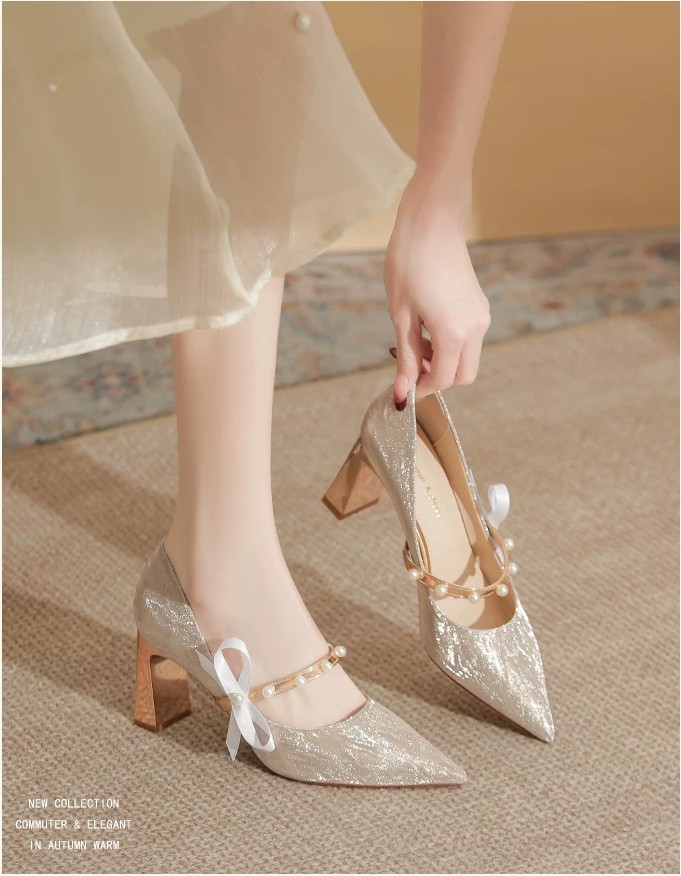
If you only take one thing from this article, take this: on a narrow foot, closure is everything. A slip-on pump with no strap relies entirely on the last and the lining to hold you, and if either is slightly generous, your foot will migrate. An ankle strap changes the mechanics completely. Fastened snugly just above the ankle bone, it turns the shoe into something your foot has to stay inside rather than balance on top of. For narrow womens heels, a strap is not decoration — it is the difference between walking and clenching.
Slingbacks are the second-best option, provided the back strap has an elastic gusset or a buckle with several holes. A rigid slingback with a single fixed hole will either cut in or hang loose, with no middle ground. Mary Jane styles offer the same security with a strap across the instep, which also stops the foot from sliding forward — useful if your arch is high and your foot tends to ramp toward the toe. Lace-up heels, including heeled oxfords and derbies, give the finest control of all, because you can tighten the vamp independently of everything else.
Buckles deserve a mention because so many are purely ornamental, stitched on with no functional holes. Check before you buy: if the strap cannot be tightened by at least two holes, treat it as fixed. Hidden elastic panels on the inner side of a strap are a good sign, since they let the shoe flex with your foot while keeping tension. And avoid straps that sit too high on the ankle — they rub the tendon and, oddly, allow more heel lift than a strap placed low and snug. If a style only comes with a decorative strap, treat it as a slip-on and fit it accordingly, which usually means choosing a slightly shorter length than you would with a functional fastening.
Shapes and Toe Boxes That Flatter a Slim Foot
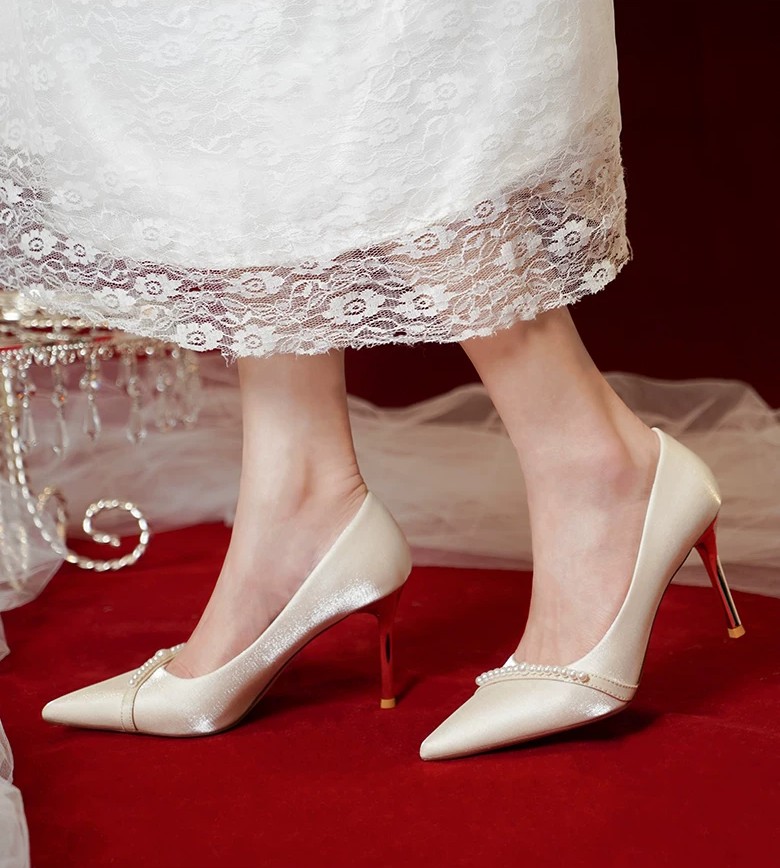
Toe shape does more for a narrow foot than most people expect, and it does it in two directions at once. A pointed toe visually lengthens the leg and continues the line of the foot, which reads as elegant on a slim ankle. It also narrows progressively toward the tip, so a foot that is slim through the ball sits in it more naturally than a foot that is wide. An almond toe gives most of that effect with more room, and it is often the safer choice if your toes are long. Square toes are the least forgiving for narrow feet, because the boxy front gives the toes room to spread sideways with nothing to hold them.
Depth matters as much as width. Many narrow-footed women find that shoes are not too wide across the ball but too deep over the instep — there is empty space above the foot, and the whole shoe feels like a loose slipper. Look for a lower vamp, meaning the front of the shoe comes up higher over the toes and closer to the ankle, which takes up that vertical volume. D’Orsay styles, cut away at the sides, look delicate and suit a slim foot well, though they offer less structure, so pair them with a strap if you plan to walk more than a block.
Heel geometry is worth a thought too. A stiletto places all your weight on a small point under the heel bone, and on a narrow foot that concentrates pressure exactly where slipping begins. A wrapped block heel or a cone heel spreads the load and stabilizes the ankle, and a kitten heel at four to five centimetres keeps the foot at a gentler angle, which reduces the forward slide that pushes toes into the front of the shoe. None of this is a rule about what you are allowed to wear — it is simply information about which shapes cooperate with a slim foot on a long day.
Fit Tests You Can Run in the Store in Five Minutes
Try shoes on at the end of the day, not the morning. Feet swell through the day, sometimes by half a size, so an afternoon fitting tells you what the shoe will feel like at the hour you are most likely to be wearing it. Wear the socks or tights you plan to pair with the style — a thin nylon versus a bare foot changes the fit noticeably. Then run through a short sequence that tells you almost everything you need to know.
First, the heel slip test. Fasten everything as you would wear it, then walk ten steps on a hard floor, not carpet. Your heel should lift no more than about a centimetre. If it rises higher, the shoe is either too long or too wide at the back, and no amount of breaking in will fix it. Second, the thumb test at the toe: you want roughly a thumb’s width of space in front of your longest toe, measured standing, because the foot lengthens when you stand. Third, press your thumb against the side of the shoe at the widest part of your foot. On a proper fit there should be very little give — the upper should feel taut, not baggy.
Finally, walk away from the mirror and pay attention to your toes. If they are curling or gripping, the shoe is forcing you to hold it on, and that is the classic signature of narrow womens heels cut for a wider foot. A good pair lets your toes lie flat and relaxed while the shoe stays on by itself. If the pair is comfortable only when you consciously clench, put it back. That clench is what turns into a cramp at hour three.
Care, Break-In, and the Fixes When They Are Almost Right
Some pairs are genuinely one small adjustment away from working, and knowing which fixes are real saves a lot of returns. Heel grips — the suede or foam pads that stick inside the heel counter — are the most effective and least invasive. A suede grip adds friction, a foam one adds volume, and together they can take up the slack that causes slipping. Tongue pads, placed under the laces or behind the instep on a slip-on, push the foot back into the heel and stop the forward slide. Ball-of-foot cushions add a little width and take pressure off the metatarsals at the same time.
A decent cobbler can do more than most people ask for. They can stitch in an extra hole on a strap, shorten a slingback’s elastic, add a thin leather insole to lift the foot into the shoe, or fit a heel liner under the existing lining so nothing shows. What they cannot do is make an over-wide shoe narrow without visible seams, so judge the starting point honestly. If the gap at the sides is more than a finger’s width, the shoe is the wrong last and no insert will disguise it.
Breaking in should be gentle and short. Wear new leather heels around the house for twenty minutes at a time, over a thin sock at first, and let the leather warm and flex. Never force a stiff shoe through a full workday to “teach it a lesson” — that is how blisters and long-term foot problems start, and the pressure from a poorly fitted toe box is a well-documented contributor to bunions and hammer toes. Rotate your heels rather than wearing the same pair daily, and give leather a day to dry out between wears.
Where to Shop and What to Ask
Online shopping for narrow womens heels is far more workable than it used to be, provided you use the tools the retailer gives you. Filter by width where the option exists, then read the product description for last shape, lining, and heel counter details. Check the returns window before you order, and if you are between widths, order both and send one back — the cost of a return is almost always lower than the cost of a pair you never wear. Independent brands that specialize in extended widths are worth the search, and so are dance and bridal suppliers, who routinely stock slim fittings because their customers need them.
In person, ask specific questions. “Does this come in a narrow?” is a good start, but “what last is this built on, and is the heel counter lined in suede?” gets you much further. A knowledgeable salesperson will also tell you whether a style runs true to width or narrow, which is information no size chart carries. If you find a pair that works, consider a second colorway in the same last — the fit will be identical, and you will have solved the problem twice. It also helps to note the brand and last name in your phone, because the next time you shop narrow womens heels, that note will save you an afternoon of trial and error.
For a good starting point, our black satin heels for women show the features worth looking for: a shaped heel counter, a vamp that sits close to the instep, and a finish that holds its shape rather than stretching out. Pair details like that with your own measurements and a five-minute in-store test, and the guessing game finally ends. A narrow foot is not a difficult foot to fit — it just needs a shoe that was built with a little more attention, and a shopper who knows exactly what to check.
