

Last Tuesday I left the house at 7:40 with green heels on, bare legs, and a wool coat over my arm. Twelve degrees, drizzle beading on the car roof, and a bus stop that catches the wind from the corner. By two in the afternoon the same pavement was 22°C, the coat was folded over my bag, and the shoes had done the one thing I actually needed them to do: they still looked green.
If you’re sizing up green heels for women and wondering whether the colour is wearable, here’s the short version. Forest, olive, and deep emerald work with almost everything you already own. Mint and lime need a specific outfit already planned. The second thing that decides whether they earn their space is not the shade at all. It’s what happens to that shade between 7:40 and 2pm, when your legs go from covered to bare and the light changes twice.
I’ve worn this pair through a wet morning, a warm afternoon, and one unfortunate taxi ride. What follows is what I’d tell a friend who was about to spend real money.

Pick the green you’ll actually wear, not the one that photographs best
Green is a wide family, and the difference between a shade you reach for twice a week and one that sits in the box comes down to two things: how much yellow is in it, and how dark it goes in low light.
Deep forest green behaves like navy. It reads almost black indoors, turns properly green in daylight, and doesn’t fight with denim, camel, grey, or cream. Olive is softer and slightly muddier, which makes it forgiving against skin tones that struggle with cool colours. Emerald is the showiest of the three and the one that needs the most confidence, because it reflects light and pulls attention to the foot.
Then there’s the other end: mint, sage, and anything close to lime. These are lovely in a picture and difficult in a wardrobe. Sage works if most of your clothes are already pale and soft. Lime needs a very specific outfit, usually white or black, and it will look wrong with brown.
Here’s the test I use, and it takes about four minutes. Take the shoe to a window in the late afternoon, not at noon. Hold it against three things you wear often: your darkest jeans, a cream or white top, and whatever coat you grab most. If it looks related to all three, you’ll wear it. If it only works against one, you’re buying an outfit, not a pair of shoes.
Colour trend reports keep circling back to deep greens for a reason. Pantone’s colour intelligence work treats dark green as a near-neutral in seasonal palettes, which matches what you see on the street: it’s the one strong colour that doesn’t demand a whole new wardrobe. Emerald as a pigment has a long history of being read as both jewel and uniform, and that double life is exactly why it’s easy to style.
The mistake I made the first time was buying a green so bright it only worked with one dress. I wore it three times in a year. The pair I have now is closer to pine, and it’s the one I throw on without thinking.
The 12°C morning problem: tights change the shade
On a cold morning, the shoe is only half the colour story. Whatever is on your leg sits directly against the shoe, and it changes how the green reads more than any other variable.
Black 40-denier tights make forest green look almost black at the ankle and then distinctly green at the toe. That contrast is fine, but it can read severe with a midi skirt. Sheer nude tights cool the green down and make it look more expensive, though they also show every scratch on the shoe. Charcoal is the tricky one: it turns olive into something muddy and makes emerald look cheap.
I tested three combinations on three cold mornings, and the results were consistent enough to write down.
- Forest heels + 40-denier black tights + grey midi skirt: the safest combination. Reads as a dark neutral from a distance and shows the colour up close.
- Olive heels + sheer nude tights + cream trousers: warmer and softer, but the shoe needs to be clean. Scuffs show at this contrast level.
- Emerald heels + charcoal tights + black coat: the one I’d skip. Too much cool grey around the green and the whole outfit goes flat.
Hem length matters as much as the tight. A midi that ends 8-10cm above the ankle keeps a clean line and gives the shoe room. A maxi that grazes the top of the foot hides the very thing you paid for. If you’re short, that 8cm gap does more for your proportions than a higher heel will.
One honest warning: green plus black tights plus a black coat is a uniform. It’s a good uniform, but it’s not a look. If you want the colour to feel intentional rather than accidental, break it with one warm element, a tan bag or a cream knit.
By two in the afternoon, your feet are the test
Warm afternoons are where a fashion purchase turns into a comfort decision. Feet swell during the day, more than most people expect, and a shoe that felt precise at 8am can feel tight by mid-afternoon.
In practice, that means the toe box has to be generous enough for the wider version of your foot. A pointed toe with roughly 75-80mm of internal width at the widest point is workable for most feet. Anything under 72mm and you’ll feel the squeeze on the little toe by the time you’ve walked 6,000 steps.
The other thing nobody mentions is lining. Cheap green lining can transfer dye onto bare feet, especially on a warm day when you’ve been walking. I found out the hard way, in a pair of pale canvas trainers, and the stain took two days to fade. Before you wear new green heels with bare legs, dampen a white tissue and rub it firmly inside the heel counter and along the toe. If colour comes off, wear them with nude liners the first few times.
Socks are the other afternoon factor, and they’re the reason some people can wear a shoe all day and others can’t. A thin cotton no-show sock absorbs sweat and stops the lining from sticking to your heel. It also adds about 1mm of volume, which is enough to change the fit of a narrow shoe. Try the pair with the sock you’d actually wear, not with a bare foot in a shop at 10am.
Swelling also changes how the heel cup grips. In the morning my heel sat deep in the cup. By 4pm it was riding up a few millimetres on each step, which is the beginning of a blister. An ankle strap solves this better than any insole. If the pair you’re looking at has no strap and runs slightly loose, size down rather than adding pads.
There’s a physical limit to what any heel can do. Standing for eight hours is not the job of a 70mm shoe, and pretending otherwise is how people end up limping to the car. If your day includes long stretches on your feet, plan the switch: heels for the meeting, flats in the bag. The same logic sits behind what a cheaper work shoe leaves out of the build, and it’s worth reading before you decide that one pair can cover everything.
Three greens, three outfits, one week
The fastest way to know whether a green shoe fits your life is to build three outfits from clothes you already own before you buy. I did this with a friend in about twenty minutes, using her wardrobe rather than mine, and the pattern that came out was clear.
| Outfit | Green that works | Heel height | Verdict |
|---|---|---|---|
| Dark straight jeans, white shirt, camel coat | Forest or pine | 60-70mm | Best everyday combination, works in daylight and indoors |
| Black midi dress, silver jewellery | Emerald | 75mm or higher | Good for evening, too much for a conservative office |
| Beige linen trousers, navy knit | Olive | 50-60mm | Warm and easy, but needs a clean shoe with no scuffs |
Notice that all three outfits already existed. That’s the point. If you need to buy a new dress to make the shoes work, the shoes are the wrong purchase, at least for now.
One combination that surprised me: green heels with a grey suit. It’s sharper than black shoes and less predictable than nude, and it holds up in an office where bright colours would be too loud. The trick is keeping everything else matte, so the shoe is the only thing with a sheen.
A word on prints. Green shoes against a floral dress almost always looks like an accident, because the greens in the print won’t match the green on your foot. Solid colours are easier and they let the shoe do its job.
Trouser length is the other quiet variable. A wide leg that breaks right at the top of the shoe hides the toe and shows only the heel, which is fine if the heel is the interesting part and frustrating if the toe is. I hem trousers to sit about 1cm above the shoe’s vamp when I plan to wear green, so the colour gets a clear run. Skinny jeans are easier, but they also make the shoe look bigger than it is.
If you’re building around one outfit for an event, work backwards from the photograph. Green reads darker in indoor evening light than it does at 3pm, so a shade that looks lively in the shop can photograph almost black at a reception. Ask for a photo taken with a phone flash before you commit. It’s not glamorous, but it’s accurate.
The fit details that decide whether they stay
Most returns happen in the first week, and almost none of them are about colour. They’re about three measurements: heel height, toe shape, and where the strap lands on your ankle.
Heel height is the number people fixate on, but the pitch matters more. A 70mm heel with a steep pitch feels like 90mm, because your arch is doing more work. Look at the shoe from the side: if the sole curves up sharply under the ball of the foot, it will tire you faster than the number suggests. A gentler curve spreads the load.
Toe shape changes the fit as much as the length. A pointed toe adds visual length and narrows the fit at the front. A square toe gives more room across the toes and looks more modern with wide-leg trousers. Almond sits between the two and is the safest if you’re ordering online and can’t try before you buy.
Straps are the most overlooked detail. A strap that crosses too low on the instep cuts into the foot when you walk. It should sit in the dip just above the ankle bone, not across the widest part of the foot. If you have a high instep, look for a slingback with an adjustable buckle rather than a fixed strap.
Sizing is where I’d spend the most attention. Most of the heels in the women’s heels collection run from EU 35 to 42, and many run about half a size small. If you’re between sizes and the shoe has a pointed toe, take the larger one. If it has a rounded toe and an ankle strap, take the smaller one.
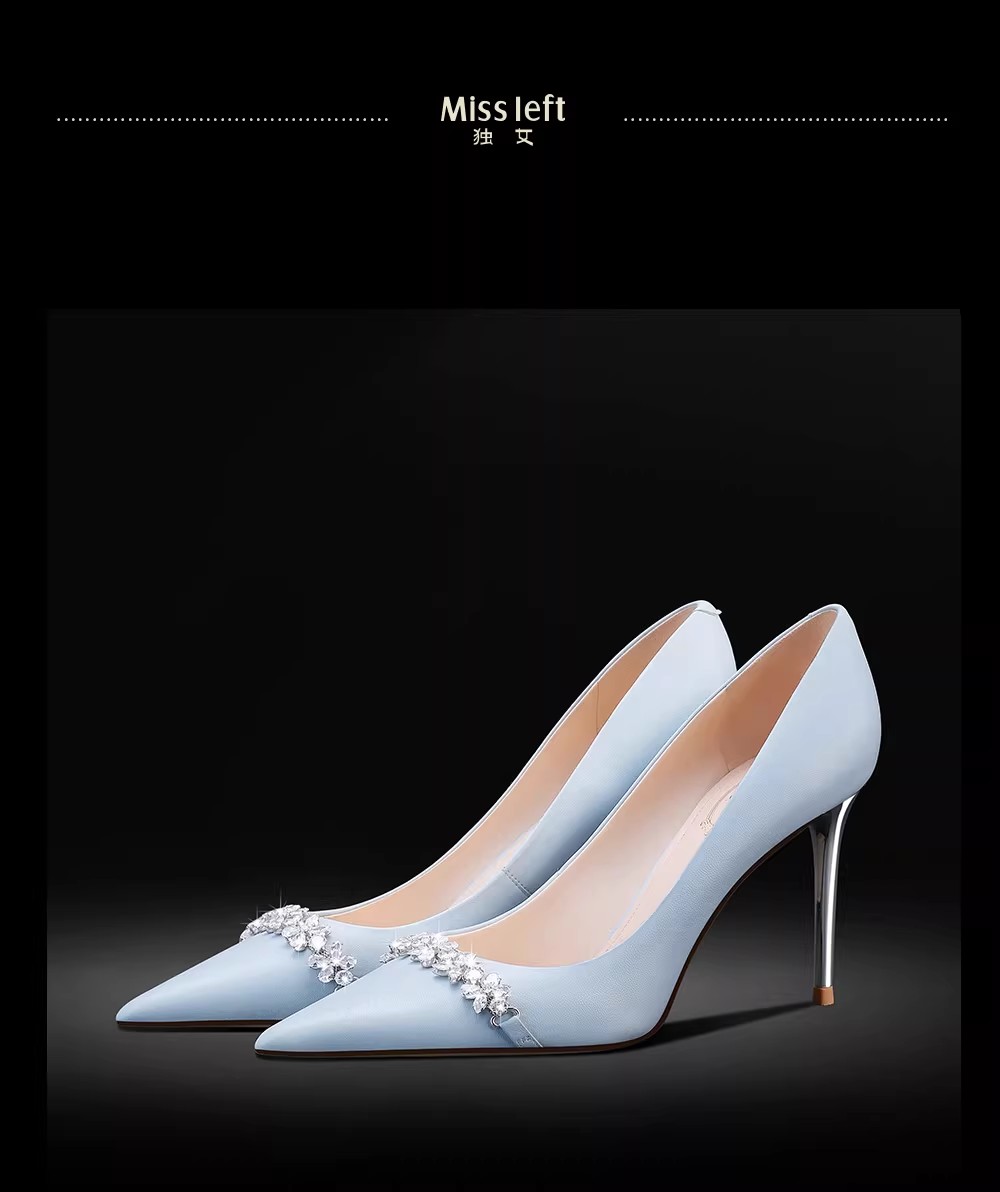
Two pairs worth looking at if you want to see how these details play out in practice: satin pumps with a pointed toe and a slim heel, which show how a 70mm pitch behaves, and pointed leather heels in a cool blue, which is the closest thing to green in the same family of shades.
One more check that costs nothing: stand on a piece of paper, trace your foot, and measure the widest point. If it’s over 100mm, a narrow pointed toe will be a gamble no matter what the size label says.
Scuffs, rain, and the care that actually works
Green shows damage differently from black. A scuff on black is invisible until it catches the light. On green, a scuff turns the surface pale and draws the eye straight to the toe.
Patent and polished leather are the easy ones. A damp cloth and a bit of matching cream will lift most marks, and a light buff brings the shine back. Suede is the difficult material: water leaves a dark ring, and the ring doesn’t fade evenly. If you get caught in the rain, blot rather than rub, stuff the shoe with newspaper, and let it dry away from a radiator. Heat sets the stain.
I got caught in a proper downpour on the way home from that 22°C afternoon. The shoes came through because the leather was treated, but the suede pair I wore the week before still has a faint mark near the heel. That’s the trade: suede looks softer and shows everything.
Storage matters more than people think. Green leather will pick up dust and lose its depth if it sits in a box for months. Keep them out of direct sun, because UV fades green faster than black, and use shoe trees or rolled paper to hold the shape. A pair that keeps its shape looks newer for longer than a pair that’s been cleaned more often.
When green heels are the wrong call
There are situations where a green shoe is simply the wrong tool, and it’s worth saying so before you spend $150.
If you need one pair of heels to cover work, a wedding, and a dinner in the same month, buy black or nude. Green is a second pair, not a first pair. If your office is conservative and your manager notices shoes, a bright green will be read as a statement whether you meant it or not. And if you’re shopping at the cheap end, be careful: inexpensive green dye often looks yellow under office lighting, which is the one thing that makes a green shoe look cheap.
I’d also skip green if your wardrobe is almost entirely warm earth tones. Olive can work there, but emerald will fight with rust and terracotta. Take the shoe to your closet and hold it against five things. If two of them look wrong, you’ve got your answer.
None of this means green is hard. It means green is specific. The people who wear it well tend to own fewer shoes and choose them more carefully.
Here’s the one thing I’d do before buying: take the pair to a window at 4pm, put them on with the legwear you’d actually wear that day, and walk to the end of the street and back. If the colour still looks right when you turn around, and your heel hasn’t started to lift, they’re yours. If either of those fails, put them back. The daylight test for ankle straps and open shoes follows the same logic, and it’s saved me from more bad purchases than any size chart.
