

You see them at a car boot sale on a Sunday, or in a resale app listing at 11pm: soft pink heels, worn once, half price. The photo is flattering. The seller says “barely worn, no marks”. You’re standing there deciding whether to message, and the honest answer is that light pink is the single hardest colour to buy second-hand, and also the one where a good pair is worth the trouble.
Here’s the split. Pale pink hides nothing: every scuff shows as a dark line, every dye transfer shows as a grey patch on the lining, every UV-faded toe shows as a duller pink than the heel. That’s bad news if the seller is careless. It’s good news if you know what to look for, because a genuinely clean pair will look genuinely clean, and you’ll pay a third of retail for shoes that were worn twice.
Five checks decide it. Look at the toe from three angles, press the insole at the ball, look inside the heel counter, flex the whole shoe, and ask what size the seller usually wears. That takes about four minutes and it filters out most of the disappointments.
Light pink shows every hour of wear, which is your advantage
Darker colours forgive. Black hides a scuff at the toe, burgundy hides a crease, nude hides a bit of grime. Pale pink does none of that. The surface is light enough that a mark reads as dark, and pink dyes are less stable than black under UV, so a pair that sat in a window for a summer will have a lighter toe than heel.
That’s why light pink heels turn up so cheap used. Sellers know the pair looks tired in photos and price accordingly. If you can inspect in person, the same property works for you: what you see is what you get, no surprises after a month.
Two things to accept going in. First, you will not find a flawless pair for a third of retail unless it’s genuinely unworn. Second, some fading is not fixable. Pink that has gone pale at the toe from sun exposure is chemically changed, and no cream brings it back. Scuffs and grime can be cleaned. Colour loss can’t.
Light pink also photographs brighter than it is. Phone cameras lift pale colours and cool the white balance, so a listing that looks candy pink on your screen may be closer to dusty rose in daylight. Ask for a photo outdoors, on a plain surface, with no filter. Most sellers will send one. The ones who won’t have told you something.
The four-minute inspection, in order
Do this at the door, before money changes hands, in daylight if possible. Work in this sequence because each step can end the conversation.
- Turn both shoes over and look at the heel tips. Worn tips mean real mileage. A tip worn flat on one side also tells you the previous owner loaded the outside of the heel, and the shoe will have adapted to that gait.
- Press the insole at the ball of the foot with your thumb. A soft, springy insole has life left. A hard, flat one that won’t rebound has taken thousands of steps. Also check whether the insole has a visible footprint imprint in a different shape from your own foot.
- Look inside the heel counter, both shoes. A dark, polished patch means heel slip and rubbing. On pale pink, the lining often goes grey before the outside shows anything.
- Flex the shoe at the ball, gently, and listen. Leather flexes quietly. A creak or a crack sound means the sole is drying out or a shank is loose.
- Ask what size the seller usually wears, and compare. If they wear a 38 and the shoes are a 37, the shoe has been worn by someone else’s foot shape for however long. That’s not fatal, but it tells you how much moulding has happened.
Bring a tissue and a small bottle of water. A damp tissue wiped across the toe tells you in one second whether a mark is surface dirt or damage to the finish. Cheap test, saves arguments.
And look at the pair side by side, not one at a time. Uneven wear, one heel taller than the other, one toe box slightly collapsed: those show up instantly in comparison and never in a single photo.
Inside the shoe is where the truth lives
Outside marks you can fix. Inside wear is harder to reverse and it’s where a used pair most often fails.
The insole is the main event. A leather insole darkens and compresses under the ball of the foot and under the heel. On light pink shoes, the lining is often a light cream or beige, so that darkening is very visible, which again helps you judge honestly. If the insole is smooth and even, the pair has few miles. If there’s a clear foot-shaped depression, it has many.
The heel counter is second. This is the stiffened cup at the back that holds your heel. Press it from both sides with your thumb and forefinger. It should be firm and spring back. If it’s soft, creased or collapsed inward on one side, the shoe will let your heel slide and no amount of adjustment fixes a tired counter.
Third, the toe lining. Feel inside the point with two fingers. Roughness or a hole where the big toe sits means the previous owner’s toe was pressed against the end, which usually means the shoe was too short for them and may be short for you.
Materials age differently and it’s worth knowing which you’re buying. Suede holds up beautifully if it was brushed and kept dry, and looks wrecked if it got soaked once. Patent leather keeps its shine for decades but creases permanently where the toe flexes, and the crease can’t be filled. Smooth leather is the most repairable of the three and the only one where a good cobbler can genuinely reset the finish.
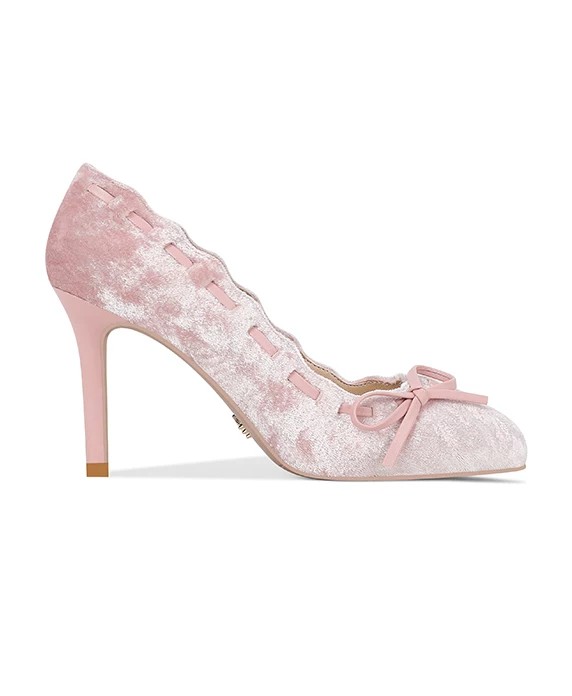
What a used pair is actually worth
Resale pricing on light pink heels follows a pattern, and knowing it stops you overpaying for someone’s old mistake.
| Condition | What you should pay | What you’re getting |
|---|---|---|
| Unworn, tags on, box | 50 to 65% of retail | Effectively new, no risk beyond colour accuracy |
| Worn once or twice, clean | 30 to 45% | Moulded to someone’s foot slightly, cosmetically fine |
| Regular wear, tidy | 15 to 25% | Visible insole wear, needs a tip check |
| Faded toe, scuffed heel | Under 15%, or skip | Colour damage you can’t repair |
Add the cost of a heel tip replacement, roughly $10 to $18, to anything in the third row. If that pushes the total above what a new pair costs on sale, walk. That happens more often than people expect with pale colours, because new-season pink gets discounted heavily in late summer.
The exception is construction. A pair with a stitched sole and a real leather upper is worth repairing for years. A pair with a moulded sole and a coated upper isn’t worth a $15 tip. Check the sole edge before you fall in love with the colour.
One more number that reframes the whole decision: cost per wear. A $40 used pair you wear twenty times is $2 a wear. A $160 new pair you wear six times because you’re scared of marking them is $27 a wear. Pale pink is exactly the colour people baby, and babying a shoe is how it ends up unworn in a box for four years, which is how it ended up on the resale app in the first place.
Sizing when you can’t try them on
Second-hand means no returns, so sizing has to be settled before you pay. Three things matter more than the number on the box.
The stated size is a starting point only. EU sizing measures last length, and every brand builds its last differently. A 38 from one maker can run 5mm longer than a 38 from another. Ask the seller for the internal length in centimetres, measured heel to toe inside the shoe with a tape. If they can’t, ask for a photo of the shoe next to a ruler.
Previous moulding. A leather shoe moulds to the first owner’s foot in the first twenty wears. If their foot was wider than yours, the shoe may now be slightly too roomy at the ball. If narrower, it may pinch you in a place their foot never touched. Neither is a dealbreaker, but both are reasons to go half a size up rather than down when you’re between sizes.
Heel height and pitch. A used 100mm heel that’s been worn in will feel different from a new one, and the tip wear tells you how the previous owner walked. If the tips are worn hard on the outer edge, the shoe has been walked on the outside of the foot for a long time, and the sole may have taken a set.
If you’re buying online and the seller gives you real measurements, compare them to your own foot length taken standing at the end of the day. That single comparison beats every size chart on the internet.
One sizing factor that gets skipped in every resale listing: the width of the heel cup. Pale pink styles lean toward slingbacks and d’Orsay cuts, and both depend on a snug heel counter to stay on. Ask the seller to photograph the inside of the back of the shoe with a ruler across it. If it measures wider than your own heel by more than 5mm, the shoe will slap when you walk, and no strap adjustment changes that.
Cleaning what you brought home
Nothing you buy used should touch your foot before it’s been cleaned. That’s hygiene, not fussiness.
Start with the inside. Wipe the insole and lining with a cloth dampened with a little rubbing alcohol diluted in water, then let them air dry away from heat for a full day. Don’t soak. A wet insole takes 24 hours to dry properly and heat will crack it.
Then the outside, matched to the material. Smooth leather: damp cloth, then a pH-neutral leather cleaner, then a thin conditioner. Suede: a suede brush in one direction only, then an eraser on any dark spot. Patent: a barely damp cloth and nothing else, because patent is a coated surface and conditioner sits on top of it and goes cloudy.
Pink needs one extra step: test anything you use on the inside of the heel first. Pale dyes lift more easily than dark ones, and a cleaner that works fine on black can leave a light patch on pink that’s impossible to blend.
If the shoes smell of someone else’s feet, put a tablespoon of bicarbonate of soda in each one, leave them overnight, then shake out and air for a day. It works about as well as anything sold for the purpose, and it costs nothing.
Air drying is the step people rush. Shoes cleaned in the evening and worn the next morning are still damp inside, and damp insoles compress faster than dry ones. Give them a full day in a room with moving air, stuffed with newspaper to hold the shape, and they’ll come out closer to their original fit.
What a cobbler can do with a pale pair, and what’s hopeless
Before you buy a slightly tired pair, know which problems a repair shop can genuinely solve, because the answer is narrower on pink than on black.
Solvable: worn heel tips, a loose heel column, a sole that needs grip, a seam that’s opened at the back of the heel, a stretched-out ankle that needs taking in. All of these are structural or mechanical, and none of them touch the colour.
Partly solvable: a scuff on the toe that’s gone through the finish. A cobbler can fill and tint it, and the result reads well from a metre away. Up close you’ll see it, and on pale pink the tint is hard to match exactly because pale pigments have less hiding power than dark ones.
Not solvable: sun fading, dye transfer from dark trousers into the lining, a permanent crease across the toe of patent, and water stains on suede. Four problems, no fix, and any of them is reason enough to leave the pair on the table.
The test is simple. If the problem is shape or structure, a cobbler can work. If the problem is colour, it’s over. That’s why the inspection order matters: check the colour before you fall for the fit, because fit is the part that can sometimes be adjusted.
Expect $10 to $20 for tips, $25 to $45 for a seam repair at the heel, and $20 to $40 for taking in a stretched ankle. Add those to the purchase price before you decide, and compare the total to a new pair in the same shape. Our Hepburn-style heels are the kind of silhouette that turns up second-hand constantly, which means you can usually find a clean used pair or buy new at a similar total.
When to put them back and walk away
Some pairs aren’t worth the four minutes. Here’s the list I’d use.
Walk away if the toe is faded relative to the heel, because that’s sun damage and it’s permanent. Walk away if the heel counter is soft on either shoe. Walk away if the insole has a deep foot-shaped depression that isn’t yours, since the shoe has already been shaped by someone else’s gait.
Also walk away if the seller can’t tell you the brand, the size, or how often they wore them. Not because they’re lying, but because you’ll have no way to judge anything else they say.
And walk away from any pair you’d have to repair before the first wear. Used shoes should save you money, not hand you a project. A pair that needs tips, a clean and a stretch is a $60 commitment on top of the price, and at that point the new pair on sale is the better buy.
If you want light pink without the inspection work, buy it new in a shape you already know fits. Our pink heels with a rounded toe and the pink heels with an embroidered finish both come with a return window, which is the thing second-hand can’t offer.
And if the pair you’re eyeing is above a certain size, the fit changes more than the colour does. Our notes on pink shoes above a size 16 cover where the toe box and heel counter need different numbers, and that applies to second-hand pairs too.
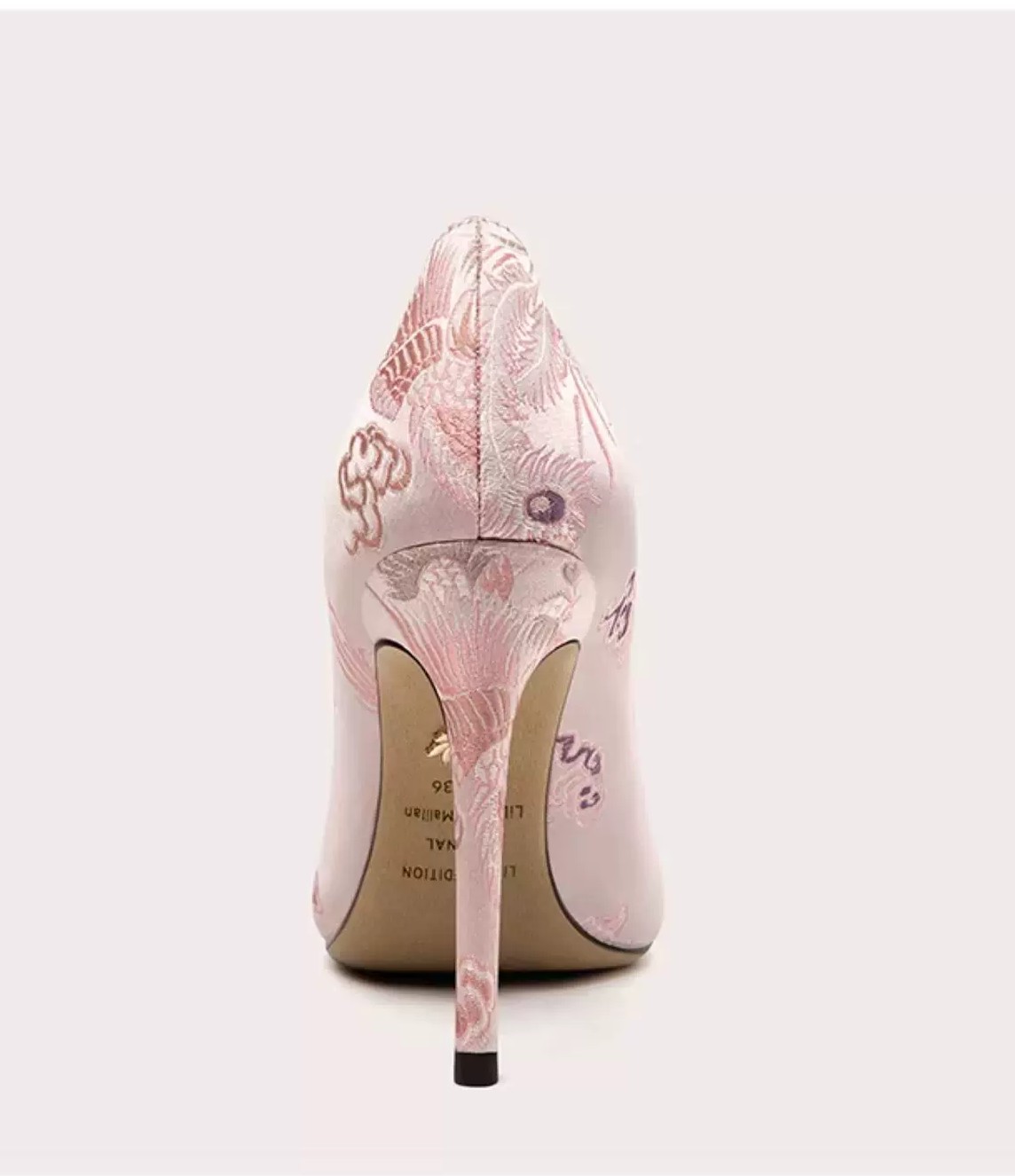
Before you message the seller, ask one question that does most of the work: “Can you send a photo of both shoes, outside, on a plain floor, with the insoles visible?” If the answer is a clear photo, the pair is probably as described. If it’s a screenshot of the original listing, keep scrolling. The full women’s range will still be there tomorrow.
