

The first step out of bed is the honest one. Not the walk to the car, not the ten minutes at the school gate. That single step to the bathroom at 6:40 in the morning, when your heel feels like it’s standing on a pebble that isn’t there.
If that sounds familiar, you’re probably already searching for the best walking shoes for plantar fasciitis in women’s sizes. Fair enough. Buying a pair is the fastest thing you can change. It’s also the thing most people get half right, because they buy cushioning when the problem is tension, or they buy arch support when the problem is width.
Here’s the honest version before you spend anything. No shoe cures plantar fasciitis. What a decent pair does is lower the load on the fascia for the 8,000 to 12,000 steps you take on an average day, so the tissue can settle instead of being re-irritated every morning. That’s a smaller promise than the product pages make, and it’s the one that holds up.
So the useful question isn’t which shoe is best. It’s which shoe suits the foot you have on the morning you’re limping. Those are rarely the same shoe, and this is where a five-minute check saves you a hundred dollars.
Why the first ten steps in the morning tell you more than any product page
Plantar fasciitis is irritation where a thick band of tissue runs from your heel bone to your toes. It tightens overnight while your foot sits in a shortened position, then stretches hard on the first steps while it’s still cold. Hence the stab at 6:40 that fades by 7:15. The clinical description of plantar fasciitis puts morning pain first on the symptom list for exactly that reason.
What that means for shopping: your shoes have to work with a tight calf and a stiff arch, not against them. A soft, squishy shoe feels wonderful in the shop and does very little for the tension side of the problem. A firmer shoe with a slight heel lift feels less exciting and helps more.
Most women I hear from bought three pairs before they worked this out. The pattern is always the same. Pair one is too soft. Pair two is too flat. Pair three is the one they keep wearing, and it’s usually the least attractive of the lot.
There’s a reason soft shoes keep winning at the till. Cushioning is the easiest thing to feel in thirty seconds, and the shop floor rewards it. Support and heel drop take a week to judge, so nobody judges them in the shop.
It’s also worth knowing what the tissue responds to. The background on plantar fasciitis is blunt about it: load management does most of the work, and footwear is one lever among several. That lines up with what you’ll hear from anyone who has had it twice. The second time, they change the shoes and the routine, not just the shoes.
Try a different test instead. Press your thumb into the arch of the shoe. If it sinks without resistance, the shoe will let your foot roll inward all day. Now hold the shoe at both ends and try to fold it in half. A walking shoe should bend at the ball of the foot and resist at the middle. If it folds like a paperback, put it back.
One more thing before you compare brands. Decide what job the shoe has. Walking the dog, a 40-minute commute on foot, and a job that keeps you standing for six hours are three different shoes in an ideal world. Pick the pair that covers your worst day, not your best one.
The 30-second arch test, done on a hard floor
Wet your foot and stand on a dark tile, or on a sheet of paper if the floor is carpeted. Step off and look at the print. A wide band down the middle means a low arch. A thin strip with a hook on the outside means a high one. Roughly half of women land somewhere in between, which is why generic advice fails so often.
Why bother? Because the two extremes need opposite things from a shoe.
- Low arch or flat feet: the fascia gets stretched all day. You want a firmer midsole and a shoe that doesn’t fold in the middle when you twist it.
- High arch: the foot is stiff and doesn’t absorb shock well. You want more cushioning under the ball of the foot and a shape that doesn’t squeeze the top of your foot.
- Neutral arch: most walking shoes will work. Fit and heel drop matter more than any support feature.
If you can’t face the wet-foot test, use your old shoes instead. Look at the wear pattern on the sole. Worn down on the inner edge points to a low arch that rolls inward. Worn on the outer edge points to a high, stiff arch. That’s free information sitting in your hallway.
The print doesn’t need to be perfect, and you don’t need a diagnosis. You’re looking for one of two answers. Does this foot need holding up, or does it need room and give? Everything after that is fit and numbers.
If the print is so faint you can’t tell, you probably have a high, rigid arch that only touches the ground at the heel and ball. That foot needs cushioning more than support, and it’s the foot that gets forgotten in all the flat-feet advice online.
Keep the print somewhere for a month. When you try shoes on, take a photo of your foot in the shoe from the side and look at where the crease lands. A crease over the ball of the foot means the shoe bends where your foot bends. A crease further back, near the arch, means the shoe is too long or too stiff in the wrong place. That one photo explains more than a dozen reviews.
Heel drop and stack height: the two numbers worth checking
Heel drop is the height difference between heel and forefoot, and it’s the number nobody prints on the box. Walking shoes usually sit between 6mm and 12mm. A 10mm to 12mm drop takes strain off the calf and the Achilles, which is often the tight chain pulling on your heel in the first place.
A zero-drop shoe, the kind barefoot-running people love, asks your calf to stretch further with every step. For a healthy 28-year-old that’s fine. For a tight calf and an angry fascia at 7am, it’s a gamble that usually loses.
Stack height is the total thickness under your foot. Under 20mm feels every stone through the sole. Between 25mm and 35mm you get real protection without turning the shoe into a platform you can roll off. Rocker-shaped soles, the ones that curve up at the toe, also reduce how much your toes have to bend. Plenty of women with heel pain find that curved shape easier than a flat sole.
Weight belongs in the same conversation. A walking shoe between 240g and 300g in a women’s size 38 moves with your foot. Above 380g you start lifting a brick with every step, and at 10,000 steps a day that adds up to real fatigue by late afternoon.
Two numbers, then. Drop around 10mm. Stack around 30mm. Write them on your hand before you go shopping and you’ll skip half the wall.
And ignore the shoe that claims to fix your gait with a built-in wedge. Some motion control still helps a genuinely flat foot. For most people, a neutral shoe plus a firm insole does the same job with less bulk.
Rotate two pairs if you walk daily. Foam recovers in about 24 hours, and a pair worn every single day packs down in the heel long before the upper looks tired. Two cheaper pairs, alternated, usually outlast one expensive pair worn to death, and your heel gets a fresher midsole every other day.
Width, toe box, and the 4mm that changes everything
Here’s a detail that gets buried: women’s shoes are built on a last that assumes a B width. If you’ve spent years buying wide-fit shoes in a D or a 2E, a standard B will press the sides of your forefoot together, and your gait changes to avoid the pressure. That altered gait loads the heel differently.
Measure both feet at the end of the day, standing up. Feet swell, and almost nobody has two the same size. Add 8mm to 10mm of space at the longest toe. If the shoe has no removable footbed and no laces, you have almost no way to fine-tune the fit, so don’t buy that style for a painful foot.
Wide widths exist for a reason, and a pair like these flat-soled women’s board shoes with a thick sole shows the trade-off clearly. You get room across the ball of the foot, and you give up some of the tailored look. That’s the deal most days.
The toe box matters just as much. If you can see the outline of your toes pushing against the upper when you stand, the shoe is too shallow. A knit or mesh upper forgives a millimetre or two. Patent leather does not.
Heel hold is the other half of width, and it’s the bit people skip. A wide forefoot with a narrow heel needs laces you can pull tight at the top, or a strap. If your heel lifts more than 5mm when you walk, the shoe will rub and you’ll tighten the laces until the top of your foot aches. Neither problem helps a sore heel.
Try the lace trick before you return anything. Skip the second-to-top eyelet and take the lace straight up to the top one on both sides. That single change lifts pressure off the top of the foot and pulls the heel back into the cup. It takes ten seconds and rescues a surprising number of pairs.
What a removable insole actually buys you
If the shoe’s footbed lifts out, you can swap in a prescription orthotic or an off-the-shelf arch support without changing the shoe’s fit. That single feature is worth more than most marketing claims on the box, and it’s the first thing to check when you pick a pair up.
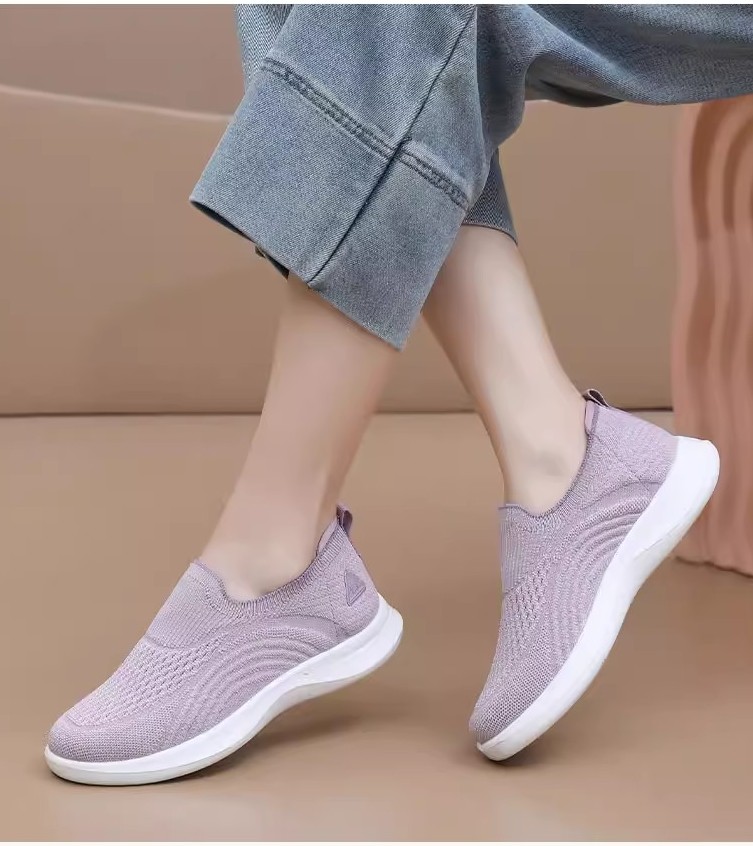
Glue-down footbeds are common in cheaper shoes. They look neater inside and they lock you out of every insole option later. For a foot that hurts in the morning, that’s a bad trade. Our breathable mesh casual walking shoes have a removable one, which is why they keep turning up in this conversation.
Two practical notes on insoles. First, a thick insole eats volume, so buy a half size up if you plan to add one. Second, cushioning insoles and support insoles are different products. Gel pads feel lovely for a week and then flatten. A firm arch shell takes a fortnight to get used to and then keeps working.
You don’t need to spend a lot. A basic firm arch support under $35 does most of what a custom pair does for mild cases. Custom orthotics earn their price when your shape is unusual or when the pain has lasted more than three months.
Replace them every 12 months or so. An insole that has taken your shape is comfortable, but it has also stopped supporting anything. Same rule as the shoes themselves.
Check the heel cup when you slide one in. A shallow cup lets the fat pad around your heel spread sideways under load, which is precisely the tissue that hurts at 6:40am. A deep cup holds it in place. If the insole sits proud of the shoe’s edge, size down or trim it, because a lifted edge will rub the arch raw on the first long walk.
Give it two weeks indoors, not on the pavement
This is the part where people waste money. You put the new pair on, walk 6km on day one, and your heel screams by evening. Then you decide the shoes are wrong. Usually the shoes are fine. The foot just met a new load.
Wear them indoors for an hour on day one. Two hours on day two. Keep the tags on and walk on carpet, because most shops accept returns on unworn soles and refuse them on scuffed ones. Build to a full day inside before you take them outside.
If your heel still complains after two weeks of that ramp, the shoe isn’t the answer, and no amount of breaking in will fix it. Send them back. A good returns policy is part of the product, and I’d rather buy from a shop with a 30-day window than save $12 elsewhere.
Stretch your calf before you judge the shoes. Thirty seconds on a stair edge, twice a day, changes how the first step feels within a week. Shoes support the fix. They don’t replace it.
Write the date you bought them inside the tongue with a marker. Walking shoes lose roughly a third of their cushioning by 500km, which for a daily 5km walker is about four months. Most people keep wearing them for a year and wonder why the pain came back.
Socks are part of the fit, not an afterthought. A thin cotton sock and a thick wool one can be half a size apart, so try the new shoes with the socks you actually wear. Cushioned socks with a padded heel help some women more than a change of insole, and they cost a fraction as much.
When a new pair won’t be enough
If the pain has been there for six months, or if it’s sharp enough that you’re limping by lunchtime, shoes are not your first stop. See a physiotherapist or a podiatrist. Persistent heel pain has a few lookalikes, including nerve irritation and stress changes in the heel bone, and those need a different plan.
Signs that mean book an appointment rather than a shopping trip: pain that wakes you at night, numbness in the toes, swelling that doesn’t settle overnight, or pain in both heels with no obvious cause. None of those are shoe problems, and buying a fourth pair won’t touch them.
For everyone else, the plan is boring and it works. Firmer shoe, 10mm drop, room at the width, a removable footbed, a gentle two-week ramp, and calf stretches on the stairs. Most women notice a difference in the morning step somewhere in week three or four, not on day one.
If you want to compare what else is on the shelf, the walking-friendly sneaker range covers the soft-sole end of the shop, and a second opinion never hurts. For a leather option that survived an 11°C morning, see this three-pair leather walking shoe test. If you prefer a slip-on, the 22mm gusset fit guide explains why elastic panels vary so much.
Start with the arch test tonight. It takes half a minute, and it will save you a return.
