Walking on a treadmill looks like the gentlest thing you can do in a gym. There is no traffic, no curb to trip over, no weather to negotiate. And yet the belt under your feet is doing something a sidewalk never does: it keeps moving backwards while you stay in one place, which means every step ends with your foot being pulled out from under you a fraction earlier than it would be outdoors. That single detail changes what a shoe has to do. It is the reason the best shoes for treadmill walking are not simply the softest pair on the shelf, and the reason so many women end up with a closet full of “comfortable” shoes that feel wrong the moment they step on a belt for forty minutes. Over the past few seasons we have watched the treadmill quietly become the centre of home fitness for women — walking pads under desks, incline sessions replacing evening runs, 12-3-30 routines passed around group chats — and the footwear conversation has not kept up. Most advice still assumes you are outside. This guide is written for the belt, not the pavement. If you want a broader overview of everyday pairs before narrowing down, our walking shoes collection is a reasonable place to start, but the specifics below are what actually decide whether a shoe works indoors.
Why treadmill walking asks something different from a shoe
Outdoor walking gives your foot information. The ground is uneven in small ways, and your ankle, arch and toes spend the whole walk making tiny corrections. On a treadmill that feedback loop narrows dramatically. The deck is flat, the surface is uniform, and the belt moves at a fixed speed you did not choose with your muscles — you chose it with a button. The result is that your stabilising muscles do less improvisation and your joints absorb load in a more repetitive, more predictable pattern. Repetition is the operative word. Three thousand identical steps on a flat belt will irritate a hot spot far faster than three thousand varied steps on a footpath, because there is no variation to redistribute the pressure.
There is a second difference that gets discussed less often: the belt itself. Most home and gym treadmills use a two-ply rubber belt over a deck that flexes slightly under load, and that flex adds a small amount of rebound to each footfall. Shoes designed purely for road walking sometimes feel vague or slightly unstable on that surface — the outsole is built for abrasive asphalt, not for gripping a moving rubber band. You do not need a special treadmill-only shoe, but you do want an outsole with enough rubber coverage and a flat, continuous contact area rather than deep lugs or a strongly rockered forefoot that rolls you forward before your foot has settled.
Finally, treadmill walking is usually indoor walking, which means temperature. Gyms run warm, home setups run warmer, and a walking pad under a desk traps heat in a way an outdoor walk never does. Feet swell. Socks get damp. A shoe that fits perfectly at 7 a.m. in a cool hallway can feel a half size tight by minute thirty. All of this adds up to a fairly specific brief: a shoe with predictable cushioning, a stable platform, restrained geometry, breathable upper materials and a fit that leaves room for expansion. That is a different brief from “running shoe” and a different brief from “walking shoe for trails,” which is why the best shoes for treadmill walking tend to look unremarkable and feel surprisingly neutral. Women who walk indoors for a living — instructors, physiotherapists, the staff at specialist running shops — almost always converge on the same plain, flat, well-fitted shoe, and that convergence is not an accident.
It is also worth saying plainly that you do not need to spend a lot. The features that matter on a belt are not exotic: a well-shaped last, a foam that does not pack out in six weeks, an outsole that grips rubber, and a heel counter that holds without pinching. Plenty of shoes under a hundred dollars deliver all four. What you should avoid is paying for features built for terrain you will never see.
Cushioning: how much is enough, and where it should sit
Cushioning is the most oversold variable in footwear and the one women most often get wrong on a treadmill. The instinct is to buy the softest shoe available, because soft reads as gentle. On a flat belt, though, excessive softness works against you. A very plush midsole compresses under load and returns slowly, so your foot sinks and stays sunk through midstance, and your ankle has to work harder to find a stable position. Walk forty minutes like that and you will feel it in your shins and the outside of your knees rather than in your feet, which is a confusing outcome when you bought the marshmallow shoe specifically to protect your feet.
What you want instead is cushioning that is soft on contact and firm at the end of the compression — the midsole should absorb the first part of the impact and then stop moving. Foam chemistry matters here more than stack height. Modern EVA blends, supercritical foams and the better proprietary compounds all behave this way; older, denser EVA does not, and it is usually the reason a cheap shoe feels dead after a month. As a rough rule, look for a heel stack in the 28 to 36 mm range for walking. Below that you are on firm ground that gets tiring on long sessions; well above it you start to lose the ground feel that keeps your stride honest.
Where the cushioning sits is the part almost nobody checks. Treadmill walking loads the heel heavily because the belt pulls your foot backward as you land, so heel cushioning earns its keep. But the forefoot is where the push-off happens, and a shoe with a plush heel and a thin, hard forefoot will feel fine for ten minutes and punishing at thirty-five. Press your thumb into the forefoot of any candidate — it should give, then resist, just like the heel. If it feels like a board, keep looking.
One more consideration specific to indoor use: cushioning and stability trade against each other, and on a flat deck you can afford to lean slightly toward stability. A broader base, a modest medial post or a denser foam wedge on the inner side all help if you overpronate, and none of them will bother you on a belt the way they might on cambered roads. If your feet are neutral, stay neutral — do not buy a stability shoe as insurance, because the extra density will just feel like a lump under your arch for the entire walk.
The rocker question: toe drop and forefoot roll
Rocker-bottom shoes have become the default answer for anyone with foot discomfort, and for walking on pavement they can be genuinely useful: the curved sole reduces the work your toes do at push-off and spares a stiff first metatarsophalangeal joint. On a treadmill the calculus shifts. A pronounced rocker, combined with a moving belt, can make your foot feel like it is being handed forward before you have finished your step. Some women love that sensation — it produces a brisk, rolling gait that makes an incline session feel smoother — but if you are prone to feeling unsteady, a strong rocker is the wrong choice.
Toe drop, the height difference between heel and forefoot, matters just as much and is easier to reason about. Most walking shoes sit between 8 and 12 mm. Lower drops (4 to 6 mm) encourage a flatter, more midfoot-led landing, which many women find comfortable on a treadmill because the belt is flat and there is no downhill to manage. Higher drops (10 to 12 mm) shift load toward the heel and suit anyone with tight calves or a history of Achilles trouble. Neither is better in the abstract. The mistake is switching abruptly: if you have walked in 12 mm shoes for years and buy a 4 mm pair because a review called it “more natural,” your calves will file a complaint within a week.
There is also the question of how stiff the forefoot is. Treadmill decks flex under load, and a shoe with a very stiff forefoot plate can feel like it is fighting the deck rather than working with it. For pure walking, a forefoot that flexes where your toes flex is usually the better call; leave the carbon plates to runners chasing pace. Test this in the shop by holding the shoe at the heel and pressing the toe into the floor — it should bend at roughly the ball of the foot, not halfway down the midfoot and certainly not only at the very tip.
If you use incline regularly, geometry deserves a little more attention. Walking uphill on a belt effectively shortens your stride and increases ankle dorsiflexion, so a shoe that is too stiff at the forefoot becomes obvious quickly. A moderate rocker plus a flexible forefoot is the combination that survives a 12 percent grade without turning your calves into knots, and it is also the combination that feels least strange when you drop back to zero incline for a cooldown.
Fit details that matter more indoors than outside
Fit is where most treadmill discomfort actually originates, and indoor walking punishes fit errors more severely than outdoor walking because there is no distraction and no variation. When women ask why the best shoes for treadmill walking rarely turn out to be the most heavily advertised models, the answer is usually that advertising sells cushioning while discomfort comes from fit. Start with length: you want a thumb’s width, roughly 8 to 10 mm, between your longest toe and the end of the shoe, measured standing up with the laces loose, and measured late in the day when your feet are at their largest. Women routinely buy a half size too small because the shoe “felt snug and supportive” in the shop at 10 a.m., then wonder why their toes go numb at minute forty. Snug is not supportive. Snug is a compression injury waiting for a schedule.
Width is the variable most often ignored, and it is where women’s feet differ most from the lasts many shoes are built on. A shoe that is long enough but too narrow will squeeze the fifth metatarsal and the small toes, and on a treadmill — where the same pressure lands in the same place thousands of times — that produces blisters and, over months, a widening of the forefoot that makes every future pair feel tight. If you have bunions, a tailor’s bunion or simply a wide forefoot, look for shoes offered in wide widths rather than sizing up, because sizing up gives you length you do not need and does not fix the squeeze.
The heel counter deserves its own paragraph. On a moving belt, your heel lifts slightly with each step, and a soft, collapsing counter lets the heel slide, which creates friction at the Achilles and along the top of the heel. You want a counter that is structured at the base and padded at the rim, and you want to check the lock by walking on a slight incline in the shop — most stores will let you use a treadmill for two minutes, and two minutes tells you more than any spec sheet.
Volume is the last piece. Some shoes are roomy through the instep, others are shallow, and if the top of your foot feels pressure under the laces you will feel it constantly indoors. Try the shoe with the socks you actually wear on the treadmill, not thin dress socks, and re-lace with a heel-lock pattern if the midfoot is loose while the toe box is right. A $5 pair of decent walking socks and a two-minute lacing adjustment solve more problems than an upgrade to a more expensive shoe.
Breathability, heat and the sock question
Indoor walking generates more heat than most people expect, and the upper is where that heat either escapes or accumulates. Engineered mesh, knit uppers and perforated synthetics all breathe; coated leathers, heavy overlays and waterproof membranes do not. A waterproof shoe is the wrong tool for a treadmill in a warm room, because the membrane that keeps water out also keeps vapour in, and your foot ends the session damp. Save the waterproof pair for actual weather.
Look at where the mesh sits. Breathability is only useful where air can reach the foot, so you want open weave over the toe box and along the midfoot rather than only at the collar. Knit uppers are excellent in this respect, with one caveat: very soft knits can stretch over months and lose the lateral hold that keeps your foot from sliding on the platform. A knit with a reinforced midfoot cage, or a mesh with synthetic overlays at the quarters, tends to age better than a pure sock-fit knit, especially if you walk at an incline where your foot wants to slide forward.
Socks are not a detail. Cotton holds moisture against the skin and is the single most common cause of treadmill blisters in women who otherwise bought good shoes. Thin merino or a synthetic blend with a seamless toe moves moisture away and reduces friction, and a lightly cushioned sole adds a useful millimetre under the ball of the foot. If your feet swell noticeably during long sessions, a thinner sock plus a roomier toe box is a better fix than a looser lace job, which lets the whole foot slide.
Two small practical notes that come up again and again. First, if your treadmill sits in a room without airflow, a fan pointed at your feet does more for comfort than any shoe feature — heat is the enemy, and moving air beats a clever upper. Second, if you walk on a walking pad under a desk, your stride is short and your cadence is high, so you want a shoe that is light and flexible rather than maximally cushioned; heavy, stiff shoes feel clumsy at 3 km/h and encourage you to shuffle.
What a women’s-specific last actually changes
Marketing has made “women’s specific” sound like a gimmick, and sometimes it is. But there is a real anatomical basis for the category, and it matters for treadmill walking precisely because the loading is so repetitive. On average, women’s feet have a narrower heel relative to forefoot width, a higher prevalence of a wider forefoot at the metatarsals, and a slightly different arch length distribution. A last shaped for those proportions reduces heel slip without requiring you to cinch the laces hard, and it puts the widest part of the shoe where your widest part actually is.
The measurable differences in a genuinely women’s-specific shoe are usually these: a narrower heel and midfoot, a slightly higher arch curve, a toe box that is wider at the ball but not longer, and a lower instep volume. Cushioning is sometimes tuned softer as well, though evidence for that is thinner than the marketing suggests — what matters more is total shoe mass, since a lighter shoe reduces the work your hip flexors do over thousands of steps. If a shoe fits your foot well, the label on the box is irrelevant. If it does not, no amount of “women’s specific” branding will save it.
The practical test is simple and takes thirty seconds. Stand up in the shoe with the laces snug but not tight. If your heel lifts when you rise onto your toes, the last is too wide at the heel for you. If the widest part of your foot sits ahead of the shoe’s widest point, the shoe is too short regardless of what the size tag says. If you feel pressure at the top of your instep before you even tie the laces, the volume is wrong. Any of those three, and you should try another model rather than another size.
One thing worth resisting is the urge to buy a men’s model in a smaller size because it is cheaper or better stocked. Men’s lasts are typically wider through the heel and midfoot and have a straighter medial line, which for many women produces heel slip and arch pressure. It works for some feet, and if it works for yours there is no reason to pay more — but try it on a treadmill, not just on the shop floor.
Matching the shoe to the session you actually do
Not all treadmill walking is the same, and the best shoes for treadmill walking depend on which version you do most. If your routine is a walking pad at 3 to 5 km/h while you answer email, prioritise low weight, a flexible forefoot and a low-profile outsole. Cushioning can be moderate; you are not generating much impact, and a bulky shoe will just make you shuffle. If your routine is 30 to 45 minutes at 5.5 to 6.5 km/h, you are in the sweet spot for a proper walking shoe: neutral, 8 to 10 mm drop, forefoot cushioning that matches the heel, and a stable platform.
Incline work changes the brief again. At 8 to 15 percent incline you spend more time on the forefoot, your ankle dorsiflexes further, and your calf does considerably more work. Here a flexible forefoot and a secure heel lock matter more than maximum cushioning, and a shoe with a slightly firmer midsole actually feels better because it does not compress away under the increased load. If incline is your main thing, resist the plush maximalist shoe no matter how good it feels flat.
Long sessions — 60 minutes or more — reward a slightly different set of priorities: a roomier toe box, because your foot will swell; a midsole that resists packing out; and a heel counter that stays put when your form degrades in the last fifteen minutes. This is where cheaper foams show their limits. If you regularly walk an hour, spending more on the midsole compound is money well spent, and you will replace the shoe less often, which usually works out cheaper overall.
Finally, interval sessions mix everything: fast walking, incline, recovery. For those, choose the most neutral, most predictable shoe in your rotation — the one that does not require you to think about your feet. If you own several pairs, keep one dedicated to treadmill work and let it dry out between sessions; foam recovers better with 24 hours of rest, and a shoe that is never allowed to decompress will feel flat long before its outsole is worn.
Replacement, wear patterns and what to watch
Treadmill walking is unusually kind to outsoles and unusually hard on midsoles. Because the belt is smooth, there is very little abrasion, so the rubber on the bottom can look nearly new after a year of steady use while the foam underneath has already lost most of its rebound. Do not judge replacement by the outsole. Judge it by feel: if a shoe that used to feel springy now feels flat and you can feel the deck through the forefoot, the foam is done, regardless of how the bottom looks.
A reasonable rule is 500 to 800 kilometres for a walking shoe, which for a woman walking 45 minutes a day at 5.5 km/h works out to roughly four to six months. Rotating two pairs extends the life of both, because foam needs time to recover. If you walk on a treadmill exclusively, you may get longer than the outdoor estimates, since there is no heat from pavement, no grit and no UV exposure breaking down the upper — but the compression cycles are just as numerous, and compression is what kills foam.
Watch the wear pattern for information about your gait. Wear on the outer heel edge is normal and says little. Heavy wear under the ball of the foot suggests you push off hard and might benefit from more forefoot cushioning. Wear concentrated on the inner forefoot points toward overpronation and is worth a stability option next time. And if the upper collapses at the heel or the lining wears through at the Achilles before the midsole is done, you have been walking in a shoe with a heel counter that never matched your foot — that is a fit problem, not a durability problem.
Keep the shoes clean and dry, but skip the washing machine: heat and agitation destroy adhesives and foam. Air them out after each session, stuff them with newspaper if they get damp, and let them dry away from direct heat. A pair treated this way will hold its shape noticeably longer, and shape is most of what you are paying for.
A short buying checklist before you commit
Take the checklist into the store rather than the marketing copy. Measure your foot standing, late in the day, in the socks you walk in. Confirm a thumb’s width at the toe. Check that the widest part of your foot matches the widest part of the shoe. Press the forefoot and the heel and make sure both give and then resist. Bend the shoe at the ball. Walk on a treadmill for at least two minutes at your usual speed, then at an incline if you use one, and pay attention to your heel and your small toes, which are where problems announce themselves first.
On materials, favour a breathable upper with reinforcement at the midfoot, a rubber outsole with continuous contact under the forefoot, and a removable insole — removable matters because it lets you swap in an orthotic or a firmer insert without changing the shoe’s volume much. A slightly structured heel counter is worth more than a fancy cushioning name. And if you can only afford one good pair, buy for the session you do most often, not the one you aspire to.
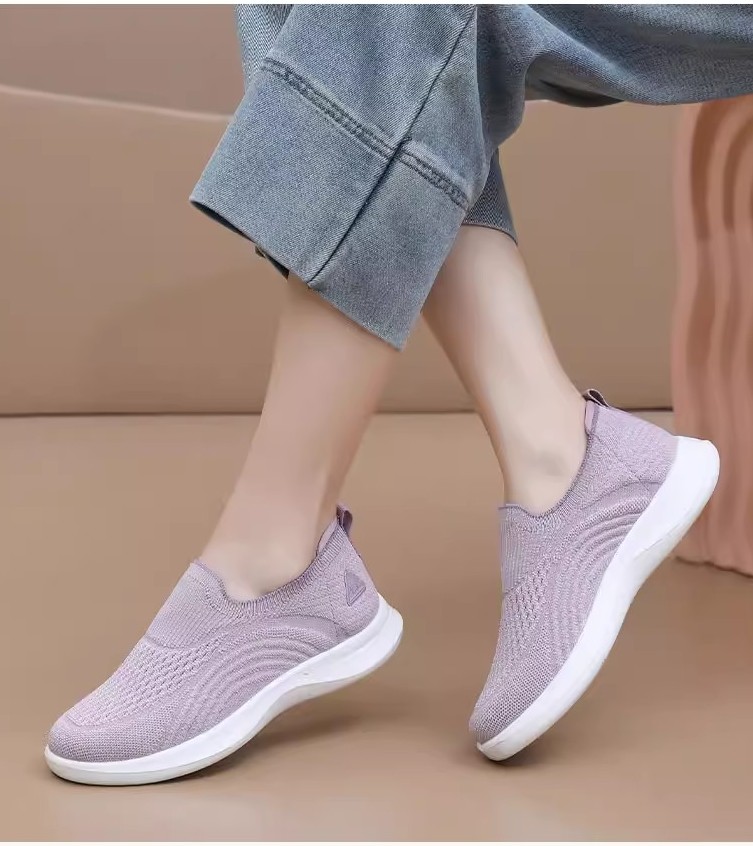
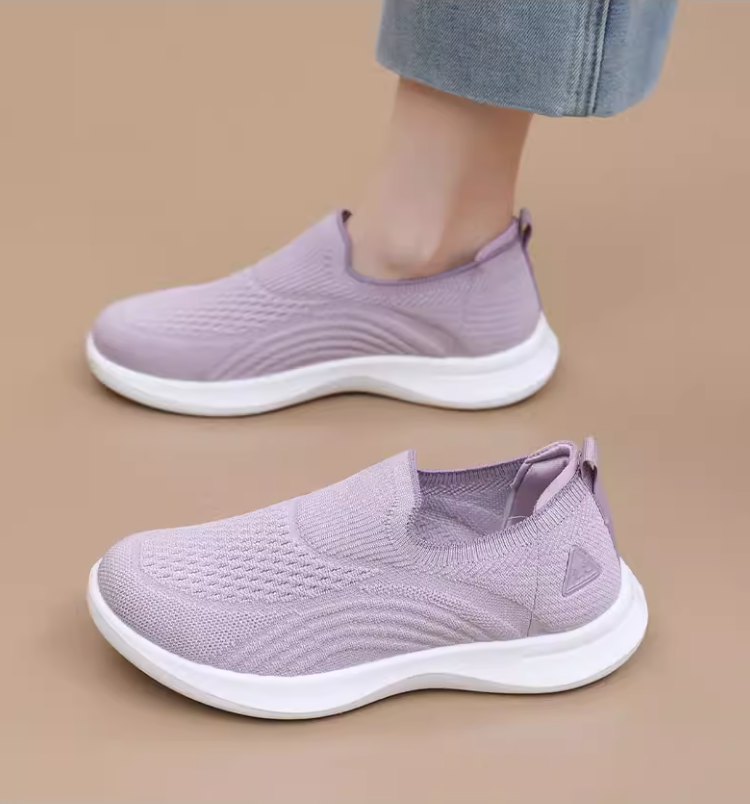
Where to look matters less than people think. If you want a starting point for a breathable mesh pair built for casual walking rather than running, this mesh walking shoe sits in the right category for desk-side and light treadmill use, and it is the kind of flat, flexible, low-profile build that works well at walking-pad speeds. Beyond that, the choices that matter are the ones you can feel in two minutes on a belt.
For context on how much walking actually buys you, the World Health Organization’s physical activity guidance recommends adults accumulate 150 to 300 minutes of moderate-intensity activity a week, which a daily treadmill walk covers comfortably. The NHS exercise guidance makes a similar point about building activity into ordinary routines rather than treating it as an event. And if you are curious about the machine itself, the history of the treadmill is a genuinely strange story — it began as a nineteenth-century prison labour device before becoming gym equipment. None of that changes what you should put on your feet, but it is a useful reminder that the belt is a tool, and tools work best when the equipment matches the job.
The short version: the best shoes for treadmill walking for most women are neutral, moderately cushioned, flexible at the forefoot, breathable, and correctly sized late in the day. Not the softest, not the most technical, not the most expensive. Get the fit right, ignore the features aimed at terrain you will never walk on, and replace the pair when the foam goes flat rather than when the rubber wears through. Your feet will tell you the rest within a week.