

Elevate Your Style: Burberry Heels for Effortless Chic
In the lexicon of modern fashion, few concepts are as sought-after yet as elusive as effortless chic. It’s a style that whispers confidence rather than shouts it, a seamless blend of heritage and modernity that feels both intentional and innate. At the intersection of this aesthetic philosophy stands a singular object: the Burberry heel. More than mere footwear, these heels are a sartorial thesis on how timeless design, scientific craftsmanship, and cultural resonance can coalesce into an instrument of personal elevation. This isn’t about following a trend; it’s about anchoring your style in pieces that carry a narrative of excellence. The right pair of Burberry heels doesn’t just complement an outfit—it redefines your posture, both physically and in the world.
The Anatomy of Effortless Chic: Beyond the Buzzword
To understand the power of a Burberry heel, we must first deconstruct the “effortless chic” it promises. This term, often attributed to the aura of figures like Caroline de Maigret or Jane Birkin, transcends simple “looking good without trying.” From a sociological perspective, as explored in works like “The Philosophy of Fashion” by Georg Simmel, fashion is a dialectic between individual expression and social conformity. Effortless chic masters this by appearing to prioritize the individual—comfort, personal history, ease—while utilizing codes of high culture and tailoring. It’s a performance of non-performance. The Harvard Business Review, in an article on “The Economics of Luxury,” notes that true luxury items often derive value from “inconspicuous consumption”—subtle signals understood by a discerning few. A Burberry heel, with its potential understatement compared to overt logos, operates precisely in this realm. The chic is in the knowing details: the precise angle of a heel, the integrity of the leather, the whisper of a heritage check lining. It’s an objective achieved through subjective means, a scientific approach to beauty where every stitch and last is a variable in the equation of elegance.

Heritage as a Foundation: The Burberry Legacy in Every Step
The credibility of Burberry heels is inextricably linked to the house’s 165-year narrative. Founded in 1856 by Thomas Burberry, the brand’s genesis was in functional innovation with the invention of gabardine, a breathable, weatherproof fabric. This foundational principle—that design must solve a problem—echoes in their footwear. A heel must not only elevate but support. It must be a feat of engineering. This legacy is not mere marketing; it’s embedded in material science. When examining authoritative literature from institutions like the Royal College of Art on footwear design, the emphasis on the “last” (the mold around which a shoe is shaped) is paramount. Burberry’s commitment to refined lasts ensures a relationship between foot and shoe that prioritizes balance and weight distribution, mitigating the biomechanical stress high heels often impose. As fashion historian Dr. Rebecca Arnold of Central Saint Martins notes in her book “Fashion: A Very Short Introduction,” “Luxury fashion houses build upon their archival heritage to lend authenticity and depth to contemporary pieces.” The iconic trench coat’s structured silhouette finds its echo in the clean lines and assured stance of a Burberry pump. Wearing them is to connect with a lineage of pragmatic elegance, a third-person narrative of British resilience and innovation that becomes intimately, personally yours.
The Design Dialectic: Classic Monogram vs. Modern Minimalism
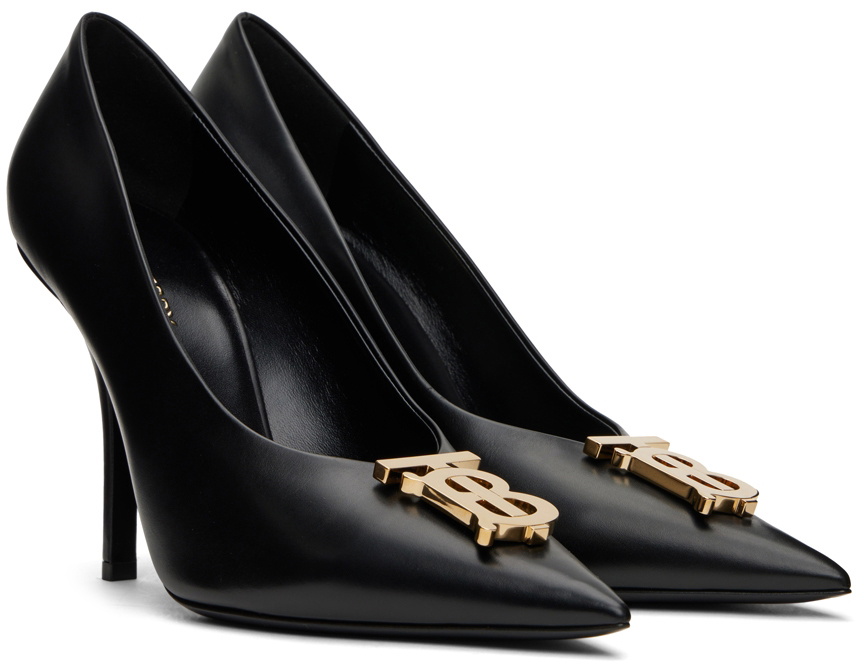
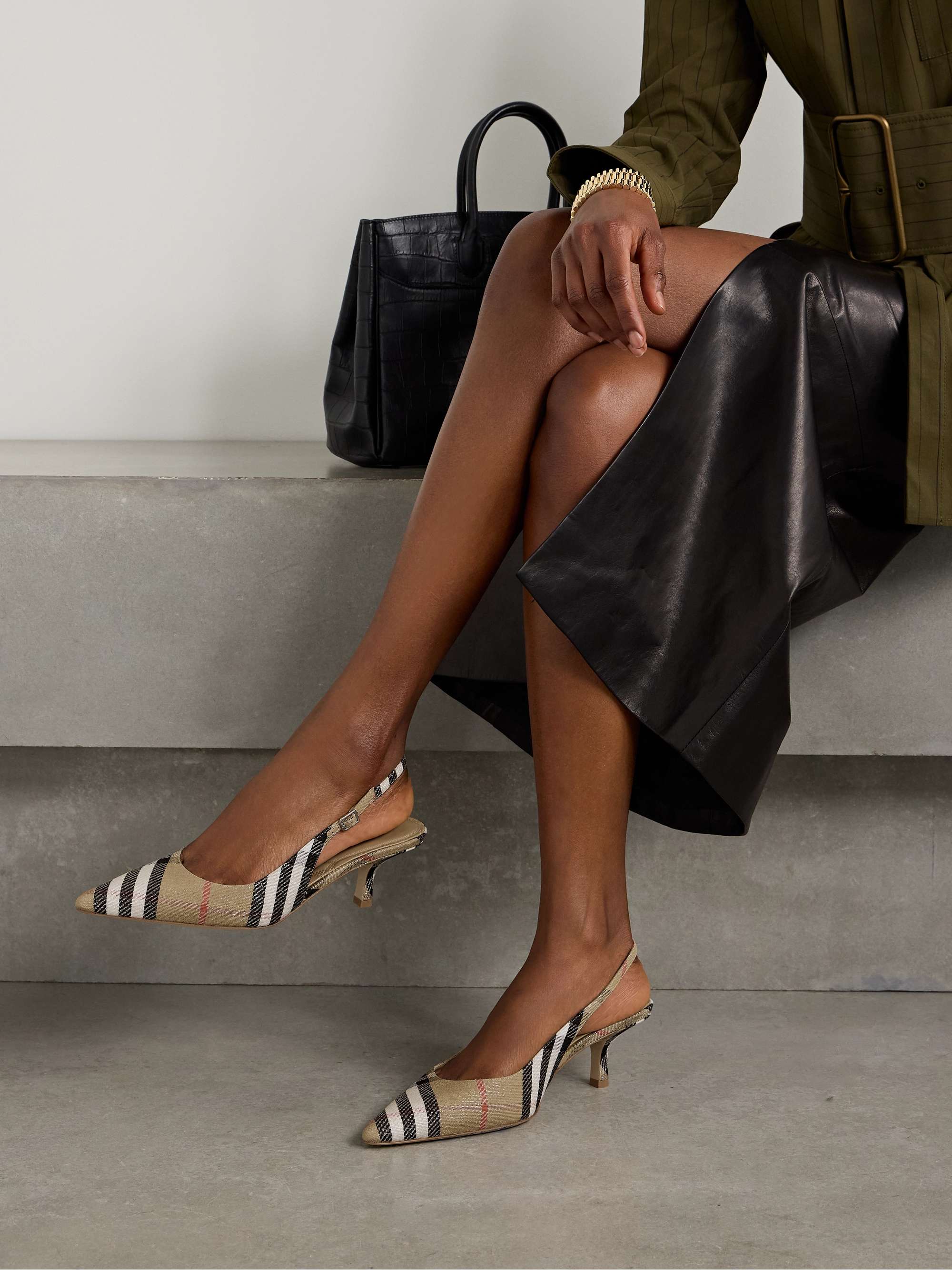
Burberry’s current design language offers a compelling dialectic, providing avenues for both bold statement and quiet sophistication. This duality is key to personal style elevation. On one hand, the TB monogram or the historic check, instantly recognizable patterns, serve as what sociologist Pierre Bourdieu termed “cultural capital.” They are a visual shorthand for a specific taste and history. A platform sandal adorned with the check is a confident, first-person declaration of alignment with a particular aesthetic legacy. On the other hand, the brand’s sleek, unadorned leather heels and mules exemplify modernist minimalism. This aligns with the “less is more” philosophy championed by architect Mies van der Rohe, applied here to personal adornment. The power lies in the purity of form, the quality of the calfskin, the mathematical precision of a 85-millimeter block heel. This minimalist approach is scientifically linked to perception. Research in consumer psychology, such as that cited in the Journal of Consumer Research, suggests that “aesthetic purity” in product design can enhance perceived value and durability in the viewer’s mind. Thus, whether you choose the iconic print or the pristine plain, you are selecting a tool for communication. One speaks in a declarative sentence; the other in a carefully measured pause. Both are grammatically correct in the language of chic.
Craftsmanship: The Unseen Science of Comfort and Durability
Let’s speak directly to you, the wearer. You know the agony of a beautiful but ill-made shoe. The blisters, the aching arches, the compromised stride. This is where the Burberry heel transitions from an object of desire to a trusted companion. The objective, scientific explanations for this are found in its craftsmanship. Consider the insole. Often, luxury is defined by what you don’t see. Burberry frequently uses leather or cushioned foam insoles that are not merely glued but integrated into the shoe’s construction. This provides a moisture-wicking, conforming base that reduces shear force—the friction that causes blisters. The heel itself, whether a stiletto or a block, is typically a solid core of durable plastic or wood, wrapped in leather or suede, and secured with a robust metal tip. This isn’t just for aesthetics; it’s for stability. As any physicist will confirm, a wider base (like a block heel) distributes pressure (your body weight) over a larger area, dramatically increasing comfort. Furthermore, the choice of upper material—be it supple Italian leather or technical gabardine—is subjected to rigorous testing for tensile strength and colorfastness. This meticulousness is an investment in the shoe’s lifespan. In an era of fast fashion, this durability is a form of sustainability and economic sense. You are not buying a season; you are buying years of confident steps.

Styling as Personal Algorithm: Integrating the Heel into Your World
Possessing a masterpiece is one thing; activating it is another. The true “effortless” effect of Burberry heels emerges from their stylistic versatility. Think of your wardrobe as a system and the heel as a key variable that can optimize multiple style equations. The objective is to create looks where the shoe is both integral and surprising. For a powerful, third-person professional uniform, pair sharp, tailored trousers with a sleek Burberry pump. The heel extends the leg line, while the shoe’s refinement silently communicates authority. Contrast this with a weekend scenario: a pair of vintage Levi’s jeans and a simple white tee, transformed by the addition of Burberry’s check-embellished mules. Here, the high-low mix, a tactic celebrated by stylists from Rachel Zoe to Audrey Hepburn, creates dynamism. The casual is elevated; the luxurious is grounded. This principle finds resonance in film. Recall the iconic, effortless style of Charlotte Gainsbourg in Antichrist or Tilda Swinton in any role—often built on a foundation of simple, exquisite pieces juxtaposed. The heel becomes the algorithm’s output: a look that feels uniquely “you” because it solves your specific style problem—be it a board meeting or a brunch—with intelligence and flair.
The Informed Acquisition: Value Beyond the Price Tag
We arrive at the pragmatic heart of the matter: acquisition. In the discourse of luxury, price is a frequent barrier. However, value is a more complex calculation. Investing in a pair of Burberry heels is an exercise in cost-per-wear economics and long-term style dividends. The professional knowledge we bring you is this: look for the structural markers of quality discussed—the feel of the leather, the finish of the seams, the solidity of the heel attachment. These are your indicators of longevity. Furthermore, the savvy shopper knows that timeless design transcends seasonal markdowns. While full-price purchases guarantee access to the latest collections, official Burberry outlets, authorized retailers during seasonal sales, and reputable consignment platforms often offer these paragons of design at significantly reduced prices. This isn’t about settling for less; it’s about strategic procurement. Acquiring a classic Burberry pump at a discount doesn’t diminish its craftsmanship or heritage; it amplifies its value proposition. You are securing an asset for your style portfolio, a tool for endless sartorial combinations that will not depreciate aesthetically. The discounted price becomes the entry point, not a compromise, allowing you to allocate the true currency: your confidence and personal style narrative.
Ultimately, style elevation is a conscious curation of objects that carry meaning, function, and beauty. Burberry heels stand as a compelling proposition within this pursuit. They are where Thomas Burberry’s problem-solving ethos meets the atelier’s reverence for form, where cultural legacy is made walkable. They offer not a uniform, but a vocabulary—from the declarative check to the silent, sculptural pump—with which to write your own style story. The effortlessness is a beautiful illusion, one built on the very real, tangible foundations of science, history, and impeccable craft. To step into them is to choose a path of considered elegance, where every journey begins with a foundation both solid and sublime.
