

Nude Heels for a Wedding, Picked by Skin Undertone
My cousin got married in a barn last September. Ceremony at four on gravel, dinner at seven on a floor that had been a hayloft a week earlier. I was a bridesmaid, which meant twelve hours in the same pair of shoes and a lot of standing around while photographs happened.
I wore nude heels. Not because a stylist told me to, but because I’d already learned the hard way that a black pump with a pale ankle cuts your leg in half at the worst possible moment.
One shade decision, twelve hours of consequences. Here’s what I’d do again, and the parts I’d skip.
Why nude makes the leg look longer
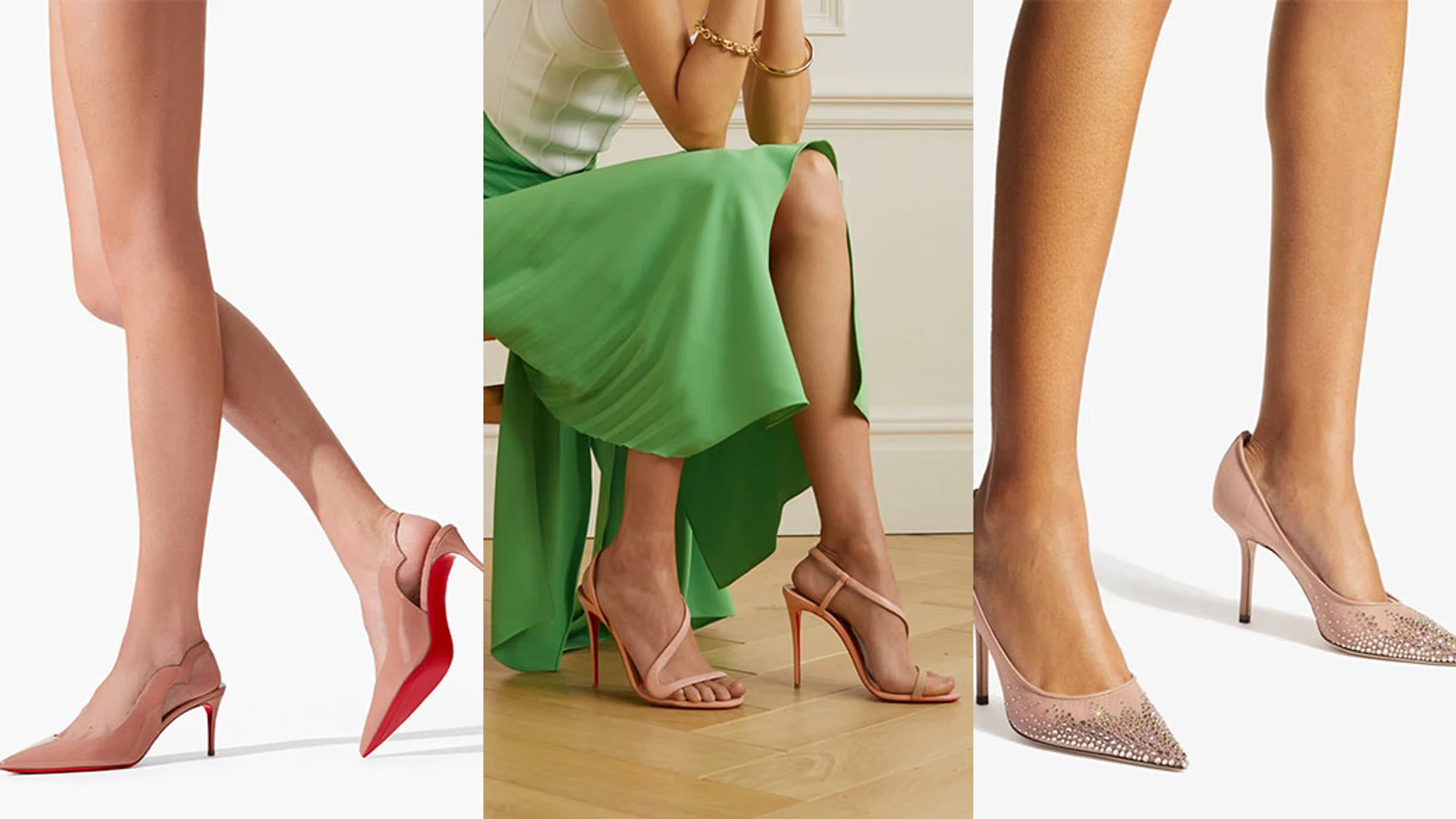
Your eye follows an unbroken line and reads it as longer than it is. Put a dark shoe on a pale foot and you’ve drawn a horizontal stripe across the ankle. The leg ends there, visually. Match the shoe to the skin and the line keeps going.
It works in photographs, which is the only place it really matters. In a full-length shot the difference between a nude shoe and a black one is startling once you start looking for it, and it has nothing to do with how tall you are.
Two things people get wrong about this. First, hem length does more work than the shoe. A midi skirt with a nude heel still shortens you if the hem cuts at the widest part of your calf. Second, the effect collapses if the shade is two tones off. A pale beige on warm skin reads as a separate object, not a continuation.
Straps are the quiet variable. A slingback or a thin ankle strap breaks the line you just built, and a pointed toe extends it. If you want length in photographs, a pointed toe with no strap beats a round toe with one, even at the same heel height.
Heel height is the other half. A 60mm heel with a slim ankle strap lengthens the line more than a 100mm stiletto with a thick platform, because the platform adds visual weight at the bottom. If you want the elongation without the pain, go lower and keep the shoe visually light.

Your nude isn’t one colour
The word covers everything from pale porcelain to deep espresso, and the only version that works is the one that matches you. That sounds obvious. It isn’t, judging by how many brides buy “nude” online and end up with a shoe the colour of a manila envelope.
Skin has an undertone as well as a depth. Cool undertones lean pink or blue, warm ones lean yellow or gold, and neutral sits between. A shoe with a rosy base disappears against cool skin and looks slightly dusty against warm skin. A peachy base does the opposite. Both can be the same depth and still read wrong.
How to find your shade in twenty minutes
Do it at the ankle, not the hand. Ankles are paler than faces and usually closer to the shade the shoe needs to match. Take three pairs into daylight, ideally near a window or outside the shop door, because shop lighting is designed to flatter and will lie to you about beige.
Look at the gap between the shoe and your skin, not at the shoe alone. If you can see a clear edge, it’s the wrong shade. If your eye slides over the transition, it’s right. Then look again at a slight angle, since colour changes with the light hitting it.
If you’re between two shades, take the slightly deeper one. Pale shoes photograph lighter than they look in person, and a shade that disappears in the shop can look chalky under flash. I learned this from a photographer who spent ten minutes explaining why my first choice looked grey in the photos.
Bring fabric with you. A scrap of your dress, or a photo of it in daylight, changes the decision entirely and takes no extra effort. A champagne dress and a porcelain shoe can work together, but only if you’ve seen them side by side before the morning of the wedding.
Comfort shows up in the photos
A bride who is comfortable stands differently. Shoulders drop, the jaw unclenches, and she stops shifting her weight between feet every thirty seconds. You can see it in a group shot. You can absolutely see the opposite.
Nude styles have an advantage here that has nothing to do with colour. Because the whole point is a skin match, brands that sell a lot of them tend to build wider toe boxes and lower heels, since the same shoe gets bought by people who intend to wear it to work afterwards. Look for a block heel or a 50mm kitten. Neither will ruin the line, and both let you get through a receiving line without calculating the distance to the nearest chair.
Wearing them after the wedding
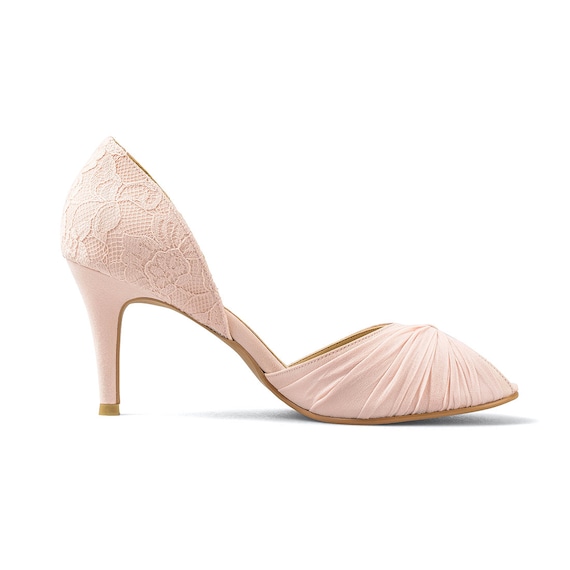
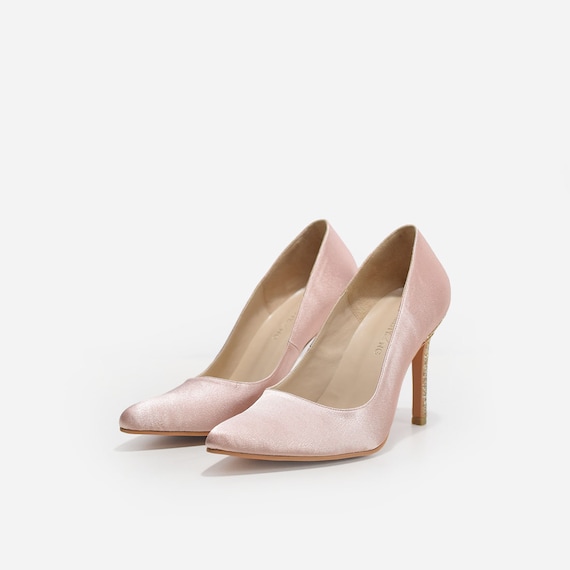
The satin pair stays in the box. The suede or matte leather pair goes to work. That’s the split I’d plan for, because a nude heel in a sturdy material is the most useful shoe in a wardrobe and a nude satin pump is a prop.
Practical notes from someone who has done this twice. Break them in for a week before the wedding, twenty minutes at a time, with the tights or bare feet you’ll actually wear. Buy heel grips before you need them, not after. And if the ceremony is outdoors, skip suede entirely: grass stains and a damp lawn will mark it permanently, and no cobbler in the world will get it back.
My barn pair came home with two small marks on the left toe that never came out. I still wear them. I just don’t wear them to weddings any more.
Winter is the other test nobody plans for. A nude heel with sheer tights in October looks fine until you’re standing in a church doorway waiting for a car. Opaque tights change the equation and the skin-match trick stops working, so most people switch to a closed shoe and stop worrying about elongation altogether.
Where to buy, and what to pay
Designer prices are not the only route, and for a shoe whose whole job is to be invisible, they’re rarely the best one. Small makers on Etsy will dye to a swatch you send them, which used to be a service reserved for couture clients. It costs less than a designer pair and gets you an actual match rather than the closest of six factory shades.
If you go that route, ask for a photo of the dyed shoe next to a colour card before it ships. Two of the three sellers I contacted offered it without being asked. The third went quiet, which told me what I needed to know.
Secondhand is worth a look as well, though you need to be patient. Bridal shoes appear on resale sites constantly, often worn once, and a nude pair is the least risky category to buy used because the style doesn’t date and the colour hides small marks better than white. Check the inside heel and the toe box for creasing, and ask whether they’ve been worn outdoors.
On the high street, the wide-fit ranges are worth checking even if you’ve never needed a wide before. Wedding shoes are worn for longer than any other pair you own, and a slightly roomier toe box is the difference between dancing at eleven and sitting with your shoes off at nine.
What I’d skip: the crystal-embellished pair, the ankle strap that ties rather than buckles, and anything bought in the final week. The first two snag on hems and take three minutes to fasten, which is three minutes you’ll spend standing in a hallway while everyone else is greeting guests.
Buy the shade that disappears in daylight, in a material that survives a lawn, at a height you can stand in for six hours. That’s the whole brief. Everything else about wedding shoes is somebody else’s taste, and on the day itself nobody will be looking at your feet except you.
