

You’ve got one hand in a boot and a lint roller in the other, and the cat is watching from the sofa like it’s a spectator sport. That’s the reality of black footwear in a house with pets, and it’s worth planning for before you buy rather than after.
Women’s black boot heels are the worst case for two reasons. Black shows every pale hair against the nap. A boot shaft sits exactly where a cat rubs, and the ankle area collects hair faster than any other part of a shoe because it’s the part that brushes against furniture, tights, and the floor.
Here’s how to choose a pair, test it in five minutes, and decide honestly whether the fight is worth it.
Start with the material, because that decides everything else
Four finishes cover most black heeled boots, and they behave differently around pet hair. Get this decision right and the rest is maintenance. Get it wrong and no amount of rolling will save you.
- Smooth leather with a polished finish: hair sits on the surface and wipes off with a hand. Best case.
- Patent: hair slides off, but scratches show and the shine goes dull where you wipe it repeatedly.
- Suede and nubuck: hair weaves into the nap and needs a brush, not a roller. Worst case, and the one most people buy.
- Knit or stretch fabric: grabs hair at the seams and pills where the friction is highest.
If you own a long-haired pet, smooth leather is the sensible default. It costs a little more than suede at the same quality level, and it saves you a weekly ritual that eats ten minutes and your patience.
The nap direction matters as much as the material. Run a finger down the side of a suede boot and then up. Down is smooth, up is rough. Pet hair that lands on the rough direction stays there. On smooth leather there’s no nap to trap it, which is why the same hair that ruins a suede boot is a two-second wipe on a polished one.

The five-minute test, done properly
Before you decide a pair is a lost cause, run this sequence in the order given. Each step takes a minute and each one fails for a different reason.
Start with the dry hand. Wipe the shaft with a dry palm, downward. If most of the hair comes away on your hand, the surface is smooth enough to manage. If it smears and stays, you’re dealing with nap or static.
Next, the rubber glove. A damp rubber glove or a clean silicone mitt pulls hair off suede better than any roller. Wipe in one direction, then flick the glove into the bin. This works because the rubber grips the hair without pushing it deeper.
Then the roller, used correctly. Lint rollers fail on boots because people press hard and roll back and forth. Light pressure, one direction, lift between strokes. Pressing pushes hair into the nap, which is exactly what you don’t want.
After that, the brush. A soft suede brush or a clean toothbrush, short strokes with the nap. This lifts what the roller left behind. Do it before the roller, not after, or you’ll just redistribute the hair.
Finally, check under light. Hold the boot at eye level near a window. Side light shows what overhead light hides. If you can still see a grey haze on black, the job isn’t done.
Worth knowing what you’re fighting. Most of the grey fuzz on a black boot is lint and loose fibre carried on pet hair, which is why a roller lifts some of it and leaves the rest. The hair is the carrier. The fibre is the visible part.
Five minutes, four tools, one honest look. If the pair still looks grey after that, the material is wrong for your house, and it’ll be wrong again tomorrow.
Why hair collects where it does
Pet hair on a boot isn’t random. It gathers at four predictable places, and knowing them tells you where to spend your attention.
The ankle shaft is first, because it’s the largest surface and the one that touches trouser hems, sofa cushions, and the car seat. The seam is second: any stitched join creates a ridge that hair catches on as it slides. The elastic gusset is third, and it’s the worst offender in a stretch boot because the ribbing acts like Velcro. The heel counter is fourth, since that’s where your own hand goes when you pull the boot off.
Static is the invisible factor. Synthetic linings and dry indoor air build a charge that pulls hair toward the boot even when nothing touches it. A dryer sheet wiped over the shaft reduces that charge for a day or two, which is enough to stop hair sticking on the way out of the door.
The practical consequence: if your boots have an elastic gusset, expect to clean that panel more often than the rest. A small brush kept by the door solves it in thirty seconds. If your boots are pull-on with a smooth shaft, the whole job is one wipe.
One more pattern worth knowing. Hair collects most where the boot is warm. A shaft that sits against your calf stays a couple of degrees warmer than the rest, and warm surfaces hold a static charge longer. It’s a small effect, and it explains why the inside of the shaft is always worse than the outside.
You can test the nap in the shop in five seconds. Stroke the upper downward with two fingers, then upward. If the upward stroke feels rough and leaves a visible line, that’s a nap, and it will hold hair. If both directions feel the same, the surface is closed and hair will wipe off. The test works on suede, nubuck, and most grained leathers.
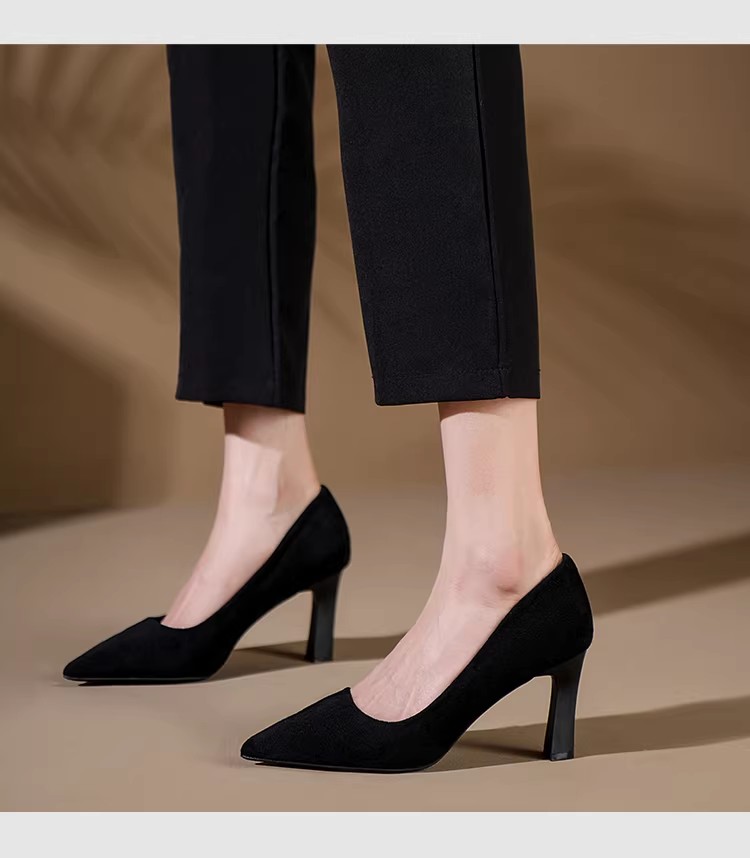
Heel height and the hair you bring home
Heel height doesn’t attract hair, but it changes how much of the boot touches the world. A 40mm block heel keeps the shaft at a different angle to your trouser hem than a 90mm stiletto, and that angle decides whether the hem brushes the boot on every step.
With a slim heel and a long wide-leg trouser, the hem swings and grazes the shaft about twice per step. With a block heel and a cropped trouser, it barely touches. If you’re choosing between two pairs and one of them will double the contact, that’s a real cost in a house with pets, even if it isn’t on the price tag.
The heel also decides where hair ends up in the car. A tall slim heel puts the shaft higher against the seat, and the seat is where most of the hair is. Lower shafts collect less, simply because they touch less.
There’s a fit angle too. A boot that’s slightly loose at the ankle moves against your leg as you walk, and movement creates friction, and friction transfers hair. A boot that fits closely at the ankle collects less on the inside of the shaft. That’s an argument for a half size down if you’re between sizes, provided the toe box has room.
None of this is a reason to avoid the heel height you like. It’s a reason to notice the interaction before you buy, especially if the pair will be worn daily rather than once a month.
Keeping black black, not grey
Hair is the visible problem. The slow problem is the grey haze that builds up when black leather dries out and picks up dust in the micro-creases. That haze reads as “old boots” even when the structure is fine.
Two habits fix it. Wipe the pair down weekly with a barely damp cloth, then buff with a dry one. Every four to six weeks, use a black cream polish on smooth leather, working it into the creases at the toe and the ankle. Suede needs a suede brush and a protective spray instead, and the spray should go on when the boots are clean and dry, not before a night out.
Salt is the seasonal killer. Winter grit leaves a white tide line around the heel and the sole edge, and it pulls moisture out of the leather. A weak vinegar solution, one part to four parts water, lifts it. Wipe, let it dry away from heat, then condition. Don’t put wet boots near a radiator, because the leather hardens and the creases set permanently.
The structure of suede explains the care routine: it’s leather with the grain side sanded, which opens the fibres and makes it absorbent. That’s why it takes a spray, a brush, and a bit of patience, and why it hates rain.
Storage matters more than most people think. Boots crammed into a dark cupboard collect dust in the nap and lose shape at the shaft. A boot tree or rolled newspaper holds the shape, and a breathable bag keeps the dust off. A closed plastic bag traps moisture and is worse than nothing.
Boots or shoes: where the problem actually changes
A boot has more surface than a shoe, roughly 40% more on an ankle boot with a 12cm shaft, and more surface means more places for hair to land. That’s the obvious part. The less obvious part is that a shaft also keeps your trouser hem off the floor, and the hem is usually where hair gets picked up in the first place.
So the trade is this: a boot gives you more black fabric to clean on the boot itself, and less hair transferred to the trousers that then brushes the boot. In a house with one cat, boots usually win. With two or more, the maths gets closer, because the shaft cleans less easily than a trouser leg does in a wash.
A shoe concentrates the problem at the topline and the heel. Those are the two places where your hand goes and where the shoe touches your ankle, so they collect hair from skin and from the floor. A smooth topline wipes clean in a second. A padded rolled topline traps hair in the seam and needs a brush.
There’s a hidden transfer route worth naming: socks. Wool socks and thick tights hold hair from the floor and deposit it inside the boot, where you can’t see it until you take the boot off in front of someone. Washing socks inside out fixes most of it, and it’s a much cheaper habit than any boot treatment.
If you’re choosing between a boot and a shoe in the same black leather, pick based on your day rather than your pet. Commuting, standing, cold floors: the boot earns its place. Sitting at a desk and driving: the shoe is easier to keep clean and much quicker to wipe.
When to stop fighting it
There’s a point where the maths stops working, and it’s worth naming. If you have two or more long-haired pets, wear black boots daily, and don’t want a five-minute routine at the door, suede is the wrong material for you. Not a character flaw, just a mismatch.
Three workable alternatives, in order of effort. Smooth leather with a polished finish, which wipes clean in seconds. A black boot in a grained leather, where the texture hides both hair and scuffs. Or a dark charcoal or deep brown, which shows pale hair less starkly than true black while still reading as dark with most outfits.
What doesn’t work is buying a heavily textured suede boot and hoping. Texture and hair are natural allies, and the two of them will win every argument you have with a lint roller.
One honest limit: no material makes a black boot hair-proof. Even polished leather picks up a visible hair or two on the way out. The realistic goal is a pair you can clean in under a minute, not a pair that never needs cleaning.
That’s the whole decision. Pick the finish for your house, not for the product photo. Test with the hand, the glove, the roller, and the brush in that order. Then decide whether the routine fits your week, because a beautiful boot you avoid wearing is the most expensive thing in the wardrobe.
For a black pair that needs the least maintenance, the satin-finish black heels wipe down faster than any suede, and the soft-soled suede pair is the one to choose only if you’re willing to keep a brush by the door. Either way, start from the black heel range and read the finish before the heel height.
And if you’re replacing a pair that’s been through a few winters, the three-winter wear report on black heels is a useful reality check on what actually lasts.
