

The box landed on the hall floor at 6:40pm, and under that old 2700K bulb the shoes looked like a brass door handle. You had a December wedding in mind, a navy dress, and about four minutes of patience left in the day. So you did what most people do: propped them on the shoe rack, told yourself you’d look again in daylight, and spent the next three evenings wondering whether you’d just wasted 90 euros.
That gap, between the parcel arriving and the moment you decide, is where most gold heel purchases actually get made or lost. Not in the product photos. Not in the reviews. In the nine or ten days you have to look at them properly before the return window shuts.
This is a walk-through of that window. What to check, in what light, in what order, and which flaws are worth sending a pair back over.
Your hallway light is lying to you about the colour
Gold is the most light-sensitive colour in the whole shoe shop, and almost nobody tests for it. A 2700K bulb adds yellow. A cool white LED at 6500K pushes the same shoe toward green. Phone cameras then apply auto white balance and make a warm champagne look like a solid 18-carat band, which is rarely what turns up.
Do this instead. Take the pair to a window at around 10am, hold one shoe at arm’s length, and look at it against your own skin rather than against the box. Skin is the only background that matters, because that’s what the shoe will sit next to for six hours.
Three things become obvious in daylight that you cannot see indoors:
- Whether the finish is brushed or mirror-bright. Brushed gold forgives scuffs; mirror gold shows every one.
- Whether there’s a green cast in the metallic layer. Cheap plating often goes olive under daylight.
- Whether the tone reads yellow or pink against your ankle. Warm gold on cool skin can look slightly costume.
If the answer to all three is fine, you’ve probably got a keeper. If the colour only works in your hallway, it will only work in your hallway.
Product photos make this harder than it needs to be. Most listings shoot against pure white, which reflects light straight back into the shoe and lifts the metallic by a full stop. On-model shots are worse, because studio lighting is built to make skin look even. The only reliable read is a photo taken outdoors in shade, and most sellers don’t include one. When a listing has no shade shot, assume the real thing is half a shade deeper and slightly less shiny than the grid image, then decide whether you still want it at that colour.
There’s a second, quieter problem with buying gold online: the same product gets relisted under three different names by different sellers, and the gold in each listing is not the same gold. If you’re comparing two options, compare the hex-ish tone in the flat-lay photos rather than the names.
Four checks that take ten minutes and no mirror
Mirror checks tell you how a shoe looks standing still. They say nothing about how it behaves, which is the part you’ll be living with. Here’s the sequence worth running on the kitchen floor before you take the tags off.
One: tap the heel tip on tile. A hollow, plasticky knock means a thin toplift that will be down to the nail in a season. A duller thud is better. Replacement tips cost about 12 to 15 euros a pair, so this isn’t fatal, but it tells you what grade of hardware you bought.
Two: flex the strap between thumb and finger. Ankle straps on gold heels are usually the first thing to fail, and they fail at the buckle hole. If the strap feels like a strip of card with no give, expect a crease across the top of your foot within a month.
Three: press the toe box from above. You want 3 to 5mm of clearance over your longest toe, not zero. Gold pointed toes are cut narrower than black ones in the same style more often than you’d think, because the finish makes the shape harder to judge.
Four: stand on one foot for 20 seconds. Not to test balance. To see whether the counter behind your heel holds. If your heel lifts more than a centimetre, the shoe is either half a size too long or the last is wrong for your foot, and no insole will fix the second problem.
None of that requires a mirror, and all of it takes less time than reading another 400-word review.
Sizing runs about half a size off across most of the gold heels in this price bracket, and it goes both ways. Pointed gold pumps are usually cut narrow, so if you’re between sizes and have a wider forefoot, go up. Round-toe and mesh-front styles often run generous, and going up there leaves you with a shoe that flaps at the heel. The 20-second stand test catches the second case immediately, which is why I put it last: it’s the dealbreaker check rather than the comfort check.
Gold isn’t one colour, and the difference shows at 4pm
There are roughly three golds you’ll meet at this price point, and they behave differently over a long day.
Warm 14k-style gold sits close to honey. It flatters olive and golden skin, photographs warmly, and looks expensive next to cream and camel. It also shows dark scuff marks badly.
Brassy 22k-style gold is brighter and more yellow. Under office lighting it can go full trumpet. Good for evening, harder to wear at 11am.
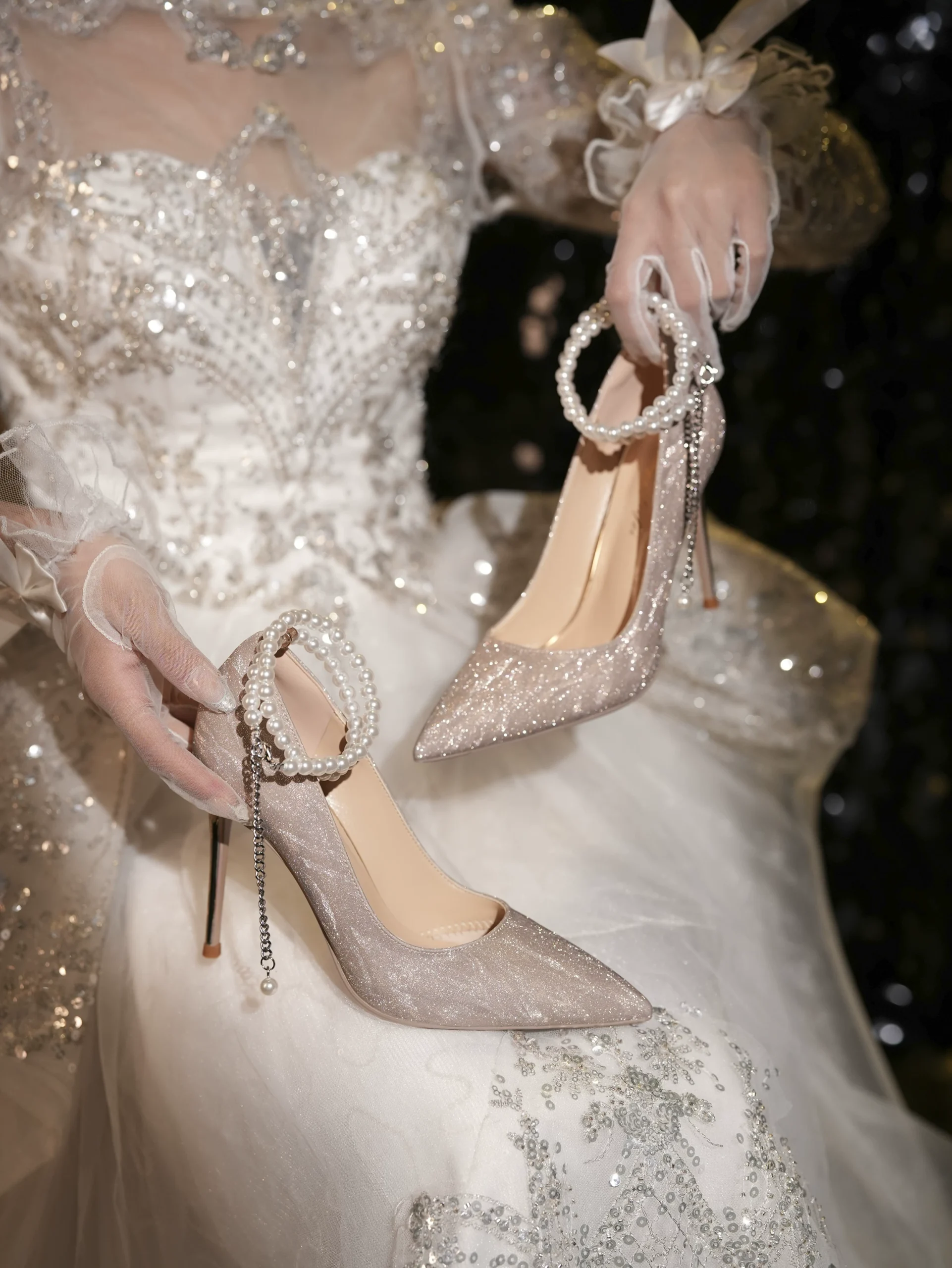
Rose and champagne metallics read almost nude from a metre away and only flash pink when they move. That’s why they sell so well for wedding season. The catch is that rose finishes on synthetic uppers can look slightly plastic in flat daylight, and the colour is nearly impossible to touch up if you scuff the toe.
Skin undertone decides most of this, not taste. Look at the veins on the inside of your wrist in daylight. Blue-ish veins usually pull toward silver, champagne and cooler golds. Green-ish veins carry warm gold and brass without looking like costume jewellery. If you’re somewhere in between, champagne is the safe middle and it’s the tone most brides end up in anyway.
Pairing matters as much as undertone. Warm gold against olive, rust, chocolate and cream looks deliberate. Warm gold against icy blue or lilac can look like two different outfits sharing a body. Cool champagne against black, charcoal and grey is almost impossible to get wrong, which is why it dominates evening ranges. And rose gold against red is the one combination that reliably photographs badly, even when it looks fine in the mirror.
Weather changes the read too. Gold looks warmer in low winter sun and flatter under grey skies, so a pair you loved in July can feel dull in February. If you’re buying for a specific date, look at them at roughly the hour you’ll be wearing them, even if that means waiting until Saturday morning to decide.
Temperature is part of the same question. A closed gold pump in July will feel different from the same shoe in November with tights, mostly around the toes. If the pair is for cold months, it’s worth reading what boot heels do across a 12°C morning and a 22°C afternoon first, since the layering rules are similar and the failure points are not.
One useful reference if you want to see how metallics get positioned each season: Pantone’s Color of the Year archive tracks how warm and cool tones rotate, and gold tends to follow the same cycle with a two-year lag.
The 20-minute carpet test, which beats every review you’ll read
Put them on with bare feet or thin socks, walk one lap of your flat, then sit down for ten minutes and get up again. That’s it. Twenty minutes, and you’ll learn more than a week of scrolling.
What usually shows up:
- A hot spot at the back of the heel, right where the counter seam sits. That one gets worse, never better.
- Pressure on the ball of your foot after eight minutes of standing. That’s a heel height problem, not a padding problem.
- Your third and fourth toes curling under. The toe box is too shallow and the size won’t save you.
- Ankle wobble on turns. Either the heel is too thin for the surface you walk on, or the strap is doing nothing.
Gold heels in the 65 to 75mm range pass this test far more often than 90mm pairs, and the reason is boring: at 75mm your weight still lands mostly over the arch instead of the ball. If you’re set on something higher because of a dress hem, at least wear them on carpet for half an hour before the event rather than stepping straight onto a tiled venue floor.
Worth adding a width check while you’re at it. Stand barefoot on a piece of paper, trace the outline, and compare the widest point of your foot to the widest point of the shoe’s insole. More than 4mm of overlap at the ball and you’ll feel it after an hour, no matter how soft the upper is. Gold finishes don’t stretch the way plain leather does either. A matte leather shoe gives up a couple of millimetres over two weeks; a metallic coated one usually doesn’t budge.
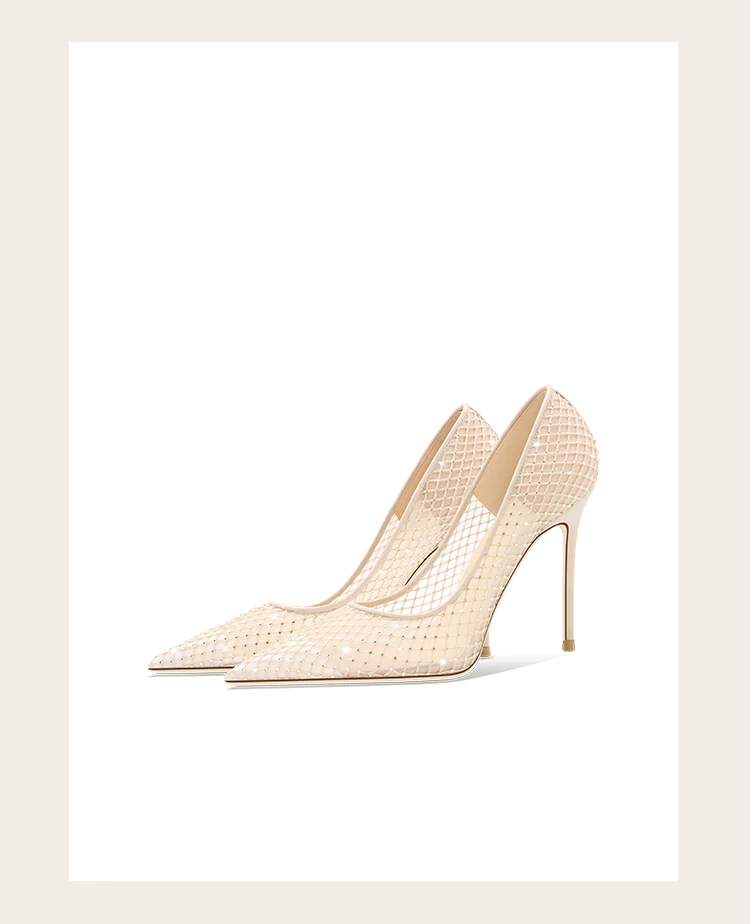
If you want a starting point that passes the lap test more often than most, the diamond mesh nude heels with a low front are the shape I’d look at first. The mesh front gives a little where a solid gold leather toe wouldn’t, and the nude base keeps the metallic from taking over the whole outfit.
Where a gold heel fails first is almost never the heel
People worry about the heel snapping. In practice the heel is the strongest part of the shoe, and the bits that break are the ones nobody inspects.
The strap, first. Then the lining. Then the glue line where upper meets sole, usually at the inside edge near the little toe. A gold finish hides that glue line well for the first month and then lets go all at once, which is why a pair can look fine on day 20 and shabby by day 50.
Lining matters more than the outer finish for comfort, and it’s the one spec sellers list least often. If a listing does mention a certified lining, OEKO-TEX Standard 100 is the label to look for, since it covers tested limits on the substances that cause most contact irritation. Not a comfort guarantee, but a useful floor.
Suede lining grips your foot and stops heel slip. Synthetic lining is cooler for summer and slippier. PU lining is the one to be wary of in a closed gold pump, because it doesn’t breathe and starts to smell after a dozen wears, no matter what you spray in it.
Heel height gets blamed for problems that belong to the last. A 90mm heel on a shoe with a proper arch and a wide platform under the ball is easier to walk in than a 70mm stiletto with a flat footbed, and the price tag rarely tells you which one you’re getting. The tell is the gap under your arch when you stand. If you can slide a finger under the middle of your foot with no pressure, the shoe is doing some of the work for you.
One more thing worth saying plainly: metallic finishes at the affordable end scuff permanently. There’s no polish that restores them. A gold heel worn three times a week on public transport will look worn by month four, and if that bothers you, buy the brushed finish rather than the mirror one.
Thirty days, one photograph, and the return you won’t get
Return windows are stricter than most shoppers assume. In the UK, distance selling gives you 14 days from delivery to tell the seller you’re returning, plus another 14 to send them back. In the US, 30 days is common but it’s policy, not law. Either way, the clock starts on delivery, not on the day you first wear them.
So photograph them on day one. Soles, heel tips, the inside of the strap, the box label. If a seam splits on the second wear, that photo set is what gets you a refund instead of an argument.
The trap: wearing them outside usually voids the return. One scuffed sole and you’re in “worn once” territory, which many sellers refuse. Test indoors, decide indoors, and only then take the tags off.
Postage is the part that surprises people. Many sellers refund the item but not the original shipping, and return postage on a shoebox is rarely under 6 euros. On a 90 euro pair, a return can cost you 12 to 15 euros net, which is exactly why some people keep a pair they’re lukewarm about. If you’re ordering two tones to compare, check whether the seller offers free returns before you do it, and check whether both boxes have to come back intact.
Resale is the other exit. A gold heel worn twice sells for maybe 40% of new on the secondhand market, and considerably less if the finish is scuffed. That’s a worse deal than a clean return, which is the whole argument for deciding inside the window rather than hoping it works out.
There’s also a costing angle people skip. If a pair costs 90 euros and you wear it 40 times over two winters, that’s 2.25 euros a wear, which is cheaper than one coffee. If you wear it twice and it sits in the wardrobe, it’s 45 euros a wear and you’d have been better off renting. The arithmetic on this is worth doing before the return window closes, not after; there’s a longer version of that maths in this breakdown of cost per wear for women’s shoes.
If you keep them, wear them like a neutral, not like jewellery
The reason gold heels get called hard to wear is that people match them. Gold shoe, gold bag, gold earrings, gold belt, and suddenly the outfit looks like a display shelf.
Pick one gold element and let the rest stay quiet. Denim and a white shirt, with the gold doing all the talking at ankle level. Navy dress, no necklace, gold heel. Cream trousers, grey knit, same shoe. The pair that works hardest is usually the one that’s the only shiny thing in the frame.
Two practical notes. Gold reflects, so it makes feet look wider than a matte finish does; a pointed toe and a low vamp counter that. And gold heels photograph bright under flash, which is why they’re common at weddings and uncommon in office photos.
Hem length decides more than most styling advice admits. A 70mm heel with a midi hem that hits just below the calf reads balanced. The same heel with a hem at the ankle looks stumpy, and the fix isn’t a higher heel, it’s a shorter dress or a longer one. Tights complicate it further: 40-denier black tights make a warm gold look brassier, while sheer nude tights keep the tone closer to what you saw in the box.
If your wardrobe is mostly black and navy, a champagne or silver leaning pair will get more wear than a true yellow gold. Something like champagne and silver pointed heels for evening wear pulls double duty, since it reads neutral at a desk and metallic under a restaurant light.
If you’re still working out which tone belongs in your rotation, browse women’s shoes sorted by shape and heel height and compare two or three tones side by side on screen before ordering. Ordering two and returning one is a legitimate strategy, as long as you keep both boxes and don’t wear either outdoors.
And if the colour still looks wrong at 10am on day two, send them back. The right gold is the one that looks like skin-adjacent warmth in daylight, not the one that looked promising under a hallway bulb at 6:40pm.
