

Gold shoes have a reputation problem. They get bought for one wedding, worn once, and then sit in the back of the closet waiting for another occasion formal enough to justify them. That is a waste. A well-chosen pair of gold heels can do more work than three pairs of black pumps, because gold is the one colour that behaves like a neutral while still catching light. The trick is choosing the right gold — not the shiniest one, not the cheapest one, and definitely not the one that only photographs well under flash.
If you have been searching for heels for women gold in finish rather than gold in name, you have probably noticed how wide the range is. Two pairs can both be labelled gold and look nothing alike: one is a soft champagne that flatters bare legs, the other is a hard yellow metallic that reads like costume jewellery. They are not interchangeable, and the difference has nothing to do with price. It comes down to undertone, finish, and how much surface area the shoe exposes.
This guide skips the “gold goes with everything” line, because it doesn’t — not automatically. What follows is the practical version: how to judge a shade in daylight, which heel shapes actually survive a long evening, which materials still look good after two seasons, and how to build outfits that make the shoes look intentional instead of borrowed.
What Gold Does to an Outfit That Beige Heels Never Will
Nude and beige heels are praised for disappearing. Gold does the opposite. It creates a bright point at the lowest part of the silhouette, and that changes how the whole outfit is read. A plain black dress with a nude heel looks quiet; the same dress with a warm gold sandal looks like someone made a decision. That is the entire appeal, and it is also the reason gold is harder to style badly — you cannot hide a wrong gold behind “it blends in”.
The colour has a long history of signalling status rather than neutrality. Gold leaf and gilded surfaces have been used for centuries to mark objects as valuable, and the association carried into footwear long before metallic synthetics existed. Even the history of the high heel itself is a story of status rather than comfort: according to the historical record on high-heeled shoes, elevated heels were originally practical for riders and later became a marker of courtly rank before settling into womenswear. Gold, in other words, arrives at the shoe with meaning already attached. Wearing it well means deciding whether you want that meaning loud or whispered.
There is also a mechanical reason gold heels flatter. Metallic finishes reflect ambient light upward, which softens the transition between leg and floor and makes ankles look more defined in photographs. Under warm restaurant lighting this works in your favour. Under harsh overhead light it can look flat and slightly grey. That is why the same pair can look expensive at 8pm and cheap at noon — the shoe is not changing, the light is.
Compare gold to its nearest rivals. Silver reads cooler and more modern, but it fights with cream, camel, and anything with a warm undertone. Bronze and copper are the safest metals for daytime because they sit closer to skin tones. Gold sits in between: warm enough to pair with earth colours, bright enough to hold its own against black. If you own only one metallic pair, gold is usually the more versatile choice — provided you get the undertone right.
Reading the Shade Before You Read the Price Tag
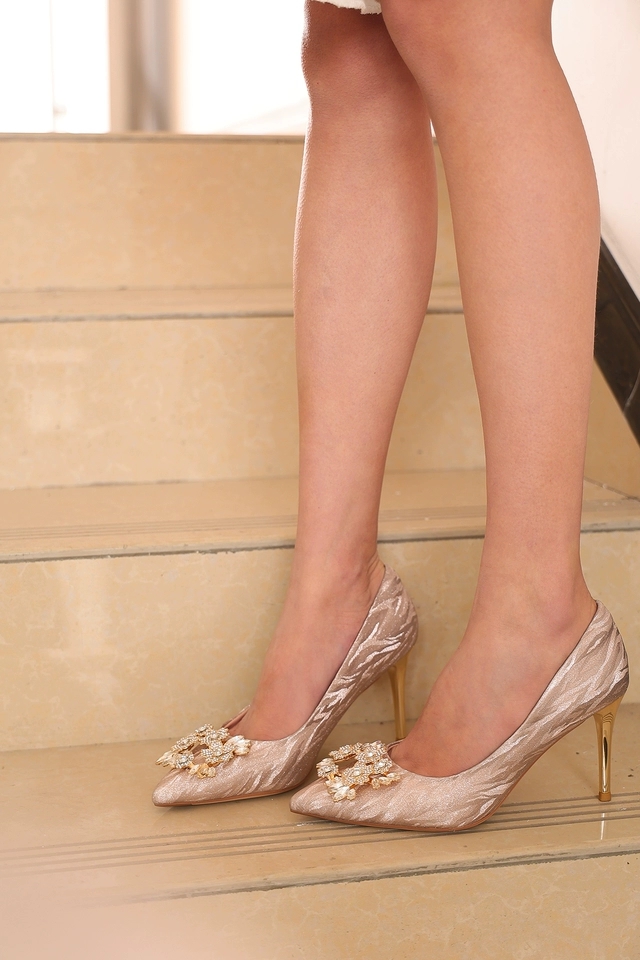
Most heels for women gold in tone fall into three families, and knowing which one you are looking at saves a lot of returns. The first is champagne: pale, slightly pink or peach, closer to a warm nude than to metal. Champagne is the most forgiving option and the easiest to wear to daytime events. The second is antique or brushed gold, which has a matte, slightly darkened surface and looks like old jewellery. It hides scuffs and reads more expensive than it costs. The third is bright yellow-gold, high shine, unmistakably metallic. This is the boldest and least versatile of the three.
Skin undertone matters here, though less than beauty counters would have you believe. Cool undertones generally look better in champagne and pale gold with a hint of silver in the mix. Warm and olive undertones carry antique and yellow gold easily, and often look washed out in very pale champagne. If you are between two shades, hold both against your bare forearm near a window. The one that makes your skin look even rather than sallow is the one to buy. Artificial light in a shoe shop will lie to you.
Then there is the question of finish inside the shade. A high-polish metallic leather reflects like a mirror, which means it also reflects the colour of whatever is next to it — grass stains at a garden wedding, grey carpet in a hotel ballroom. A satin or brushed finish diffuses that reflection and stays closer to its own colour. For a first gold pair, brushed or satin wins on practicality every time.
One more check that most shoppers skip: look at the sole edge and the heel tip. On cheaper metallic shoes, the finish stops abruptly at the sole and the exposed edge is a different, flatter colour. On better-made pairs, the metallic treatment wraps or the edge is deliberately finished in a contrasting tone. It is a small detail that tells you whether someone thought about the shoe from all angles.
Heel Height and Shape: Matching the Shoe to the Evening
Gold amplifies shape. A block heel in a matte neutral is unremarkable; the same block heel in gold becomes a design statement, so the proportions have to be right. The good news is that gold flatters almost every heel height, because the metal draws the eye to the shoe’s line rather than its size.
For anything involving standing — gallery openings, cocktail hours, long dinners — a 60 to 75mm heel is the sweet spot. It lifts the arch enough to change posture without forcing the foot into a position it cannot hold for three hours. A slim 70mm stiletto in champagne is the single most useful gold shoe you can own. Above 90mm, the shoe becomes an event shoe: beautiful in photographs, punishing on marble floors.
Shape matters more than height. A pointed toe elongates but pinches if the toe box is shallow; check that the widest part of your foot sits at the widest part of the shoe, not behind it. An almond or soft square toe gives up a little length and gains hours of comfort. Strappy sandals in gold are the most flattering option for bare legs because the horizontal lines break up the foot and make it look narrower, but every strap is a potential rub point — more straps means more places to blister.
Mules and slingbacks deserve a mention because they solve a specific problem: they let you walk in a high gold heel without a closed back cutting into your Achilles. A slingback in brushed gold with a 65mm heel is close to a perfect summer evening shoe. If you want something with more presence, a gold platform balances a very high heel by reducing the effective pitch of the foot, though it adds weight and makes stairs a negotiation.
Boots and booties in gold are the exception that proves the rule. They work when the metallic is muted — an antique gold ankle boot reads as a neutral, while a high-shine gold boot reads as a costume. If you are shopping for winter, look at champagne-toned crystal-detail heels as a reference point for how a warm metallic should behave against fabric: the glitter should catch light in small points, not flatten into one solid sheet.
Materials That Age Well and Materials That Don’t
Metallic leather is the most durable way to do gold. The finish is applied to a leather base and bonded, so it flexes with the foot instead of cracking off in sheets. It creases, and it will crease across the toe, but the creases stay the same colour as the rest of the shoe. Look for a finish that feels slightly waxy rather than plasticky under your thumb.
Metallic synthetic and PU are the reason so many people think gold shoes are disposable. On a synthetic base, the foil layer separates from the backing at flex points, usually within a season, and once it lifts there is no repair. If the price is very low and the surface feels like foil on cardboard, that is exactly what it is. You are not buying a shoe, you are renting one for four wears.
Satin is the dressiest option and the most fragile. Gold satin shows every water mark, and a single splash of champagne is permanent. It is, however, unmatched for evening wear because it holds colour softly and does not throw hard reflections. Buy satin for a specific dress, not for a general-purpose pair. Suede in a muted gold or bronze is the underrated middle ground — it absorbs light, wears well in dry weather, and looks expensive in a way that shiny finishes rarely do.
Glitter and crystal finishes sit in their own category. Glitter applied to a fabric backing sheds; crystal embellishment set into metal prongs or glue can loosen. Both are fine for occasional wear and both are a bad idea for anything involving cobblestones, gravel, or a long walk from a car park. If you love the effect, keep the glitter to a smaller area — a heel, a strap, a toe cap — rather than the whole shoe.
Whatever the material, the construction underneath decides comfort. A leather lining wicks moisture; a synthetic lining turns the shoe into a greenhouse by hour two. A padded insole of at least 3mm makes a measurable difference on hard floors. And check the heel tip: a plastic tip on a high gold heel will wear to the nail in a few months, while a rubber or composite tip can be replaced cheaply at any cobbler.
Building Outfits Around Gold Heels Instead of Apologising for Them
The mistake most people make is treating heels for women gold in colour as the loudest thing in the outfit and then dressing around them defensively — all black, no jewellery, minimal everything. That usually makes the shoes look borrowed. The opposite approach works better: echo the metal once somewhere else, then let the shoes be the second-loudest element.
Start with the obvious pairings. Warm gold with navy is close to foolproof, because navy is dark enough to make metal glow and blue enough to keep it from going yellow. Gold with cream or ivory looks expensive in daylight and slightly bridal at night. Gold with olive and khaki is the most underrated combination in the book — the green mutes the shine and makes the whole outfit look considered. Gold with burgundy works for winter, particularly in brushed finishes.
Denim is the great equaliser. A straight-leg indigo jean with a gold slingback and a plain white shirt is a legitimate outfit, and it is the fastest way to make a formal shoe look like it belongs to your wardrobe rather than to an event. The same logic applies to tailoring: a gold heel under a grey suit reads as confidence, not as a costume, because the suit does the serious work.
Repeat the metal once, and only once. A thin gold chain, a gold-toned buckle on a bag, hoop earrings — one of these is enough to make the shoes look deliberate. Two is fine if they are small. Three or more and the outfit starts to look like a display. The same rule applies to other metallics: gold shoes with a silver bag is a specific styling choice that very few outfits survive.
Runway seasons keep returning to the same idea from different angles — the collections cycle through gold as a finishing note far more often than they push it as a full look, which is a useful hint about proportion: a little metal goes a long way. The footwear industry reads that same signal. Trade bodies such as the Footwear Distributors and Retailers of America track how quickly dress categories move in and out of favour, and metallic finishes consistently behave like a small, stable niche rather than a passing fad — bought in low volumes, worn for years.
Finally, mind the hemline. Gold heels look best when the ankle is visible or the fabric is long enough to skim the floor. A midi skirt that stops exactly at the widest part of the calf, combined with a bright metallic shoe, cuts the leg into three competing sections. Either raise the hem or drop it. Wide-leg trousers in a fluid fabric are the exception — a gold toe peeking out from a long hem is one of the better tricks in evening dressing.
Fit and Comfort: What to Check in the First Ten Minutes
Shoe shopping for metallics has one extra rule: try them on at the end of the day, when your feet are at their largest. Gold finishes do not stretch the way plain leather does, so the fit you get in the shop is roughly the fit you keep. If the shoe is tight across the toes at 6pm, it will be unbearable at 11pm.
Walk on a hard surface, not carpet. Carpet hides instability, and a high gold heel with a narrow base will feel completely different on tile. If the shoe wobbles, put it back — no amount of practice fixes a heel that is structurally unstable. Then stand still for a full minute and notice where the pressure sits. Pressure at the ball of the foot is normal and manageable with a gel pad. Pressure at the top of the toes or the back of the heel means the last is wrong for your foot.
Check the instep. A shoe that gapes at the sides when you stand will rub the moment you walk, and metallic finishes show rub marks badly because the surface scuffs to a different colour. If there is a visible gap between the shoe and your arch, size down or choose a different style. Slingbacks should hold the heel without pulling; if you can slide a finger easily under the strap, it will slip off within an hour.
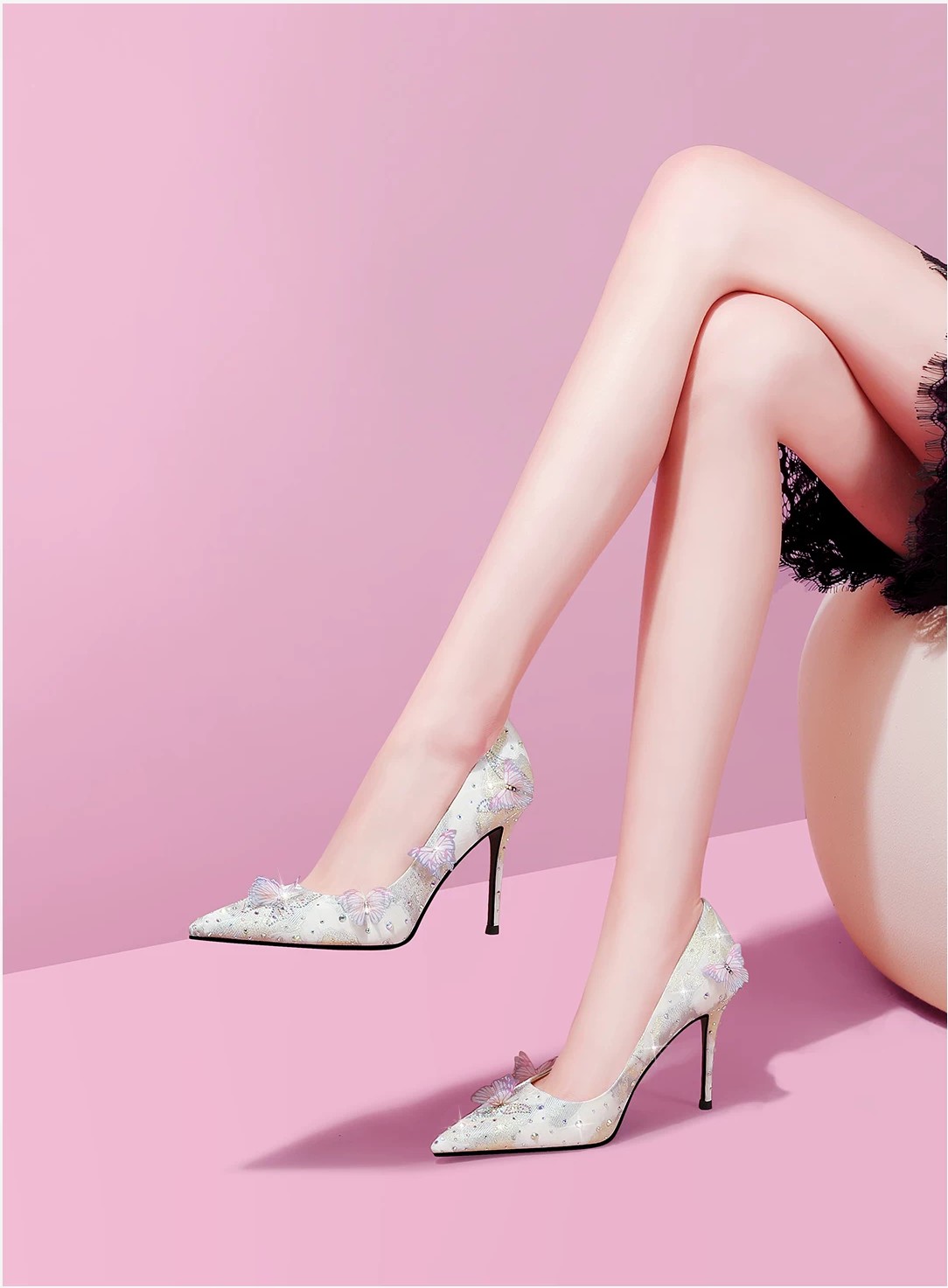
Break them in properly. Wear new gold heels indoors for twenty minutes on two separate days with thin socks, which softens the lining and reveals rub points before you are far from home. Carry blister plasters for the first real outing — not because the shoe is badly made, but because every new pair, metallic or not, has one spot that needs to settle. Keep a heel grip in your bag for slingbacks and pumps with shallow heel counters.
If a pair of heels for women gold in a high-shine finish turns out to be slightly too wide, an insole with a raised arch can change the fit more than a size change would. If it is too narrow, a cobbler can stretch leather but not synthetic metallic, which is another argument for buying the leather version in the first place.
Care, Storage, and Making the Metallic Last
Metallic finishes fail in predictable ways: scuffing at the toe, cracking at the flex point above the heel, and dulling from repeated contact with the other shoe in the box. All three are manageable. Wipe the shoes with a soft dry cloth after each wear to remove dust before it bonds to the surface, and never use a standard cream polish on a metallic finish — it fills the shine and leaves a grey film.
Store them separately. Two gold heels rattling against each other for months will produce a fine network of scratches that no polish can fix. Keep each shoe in a cotton dust bag, or wrap them in tissue, and use shoe trees only if they are the correct size; an oversized tree will stretch the metallic surface at the vamp. Avoid storing metallics in plastic, which traps humidity and encourages the finish to lift.
Watch the weather. Water is the enemy of every gold finish, satin most of all. A light rain will leave water spots on metallic leather that dry into rings, and salt from winter streets will pit the surface. If you get caught out, blot rather than rub, and let the shoes dry at room temperature, away from radiators — direct heat makes the finish blister.
When the heel tip wears down, replace it immediately. A worn tip changes the angle of the shoe, which puts stress on the heel structure and eventually cracks the metallic layer at the base. A cobbler can replace tips on most good gold heels for very little, and it is the single cheapest way to extend their life by years.
One thing worth accepting: gold heels are not meant to look new forever. A brushed or antique finish develops a patina that reads as character. A high-shine finish that has lost some of its mirror quality still works in warm light. What you are protecting is not the factory shine but the integrity of the surface — no lifting, no cracks, no exposed backing. Everything else is wear, and wear is fine.
None of this requires spending a lot. The point of heels for women gold in a brushed or champagne finish is that they upgrade clothes you already own — jeans, a grey suit, a plain dress — without asking you to buy anything else. That is a better return than another pair of black pumps that disappears into the outfit.
The case for owning a pair is simple. Gold heels solve the problem that black heels create — they make an outfit look chosen rather than safe, and they do it without requiring a new wardrobe. Buy the shade that matches your skin in daylight, the material that survives a season of real wear, and the heel height you can genuinely stand in for three hours. Then wear them to dinner, to a gallery, to a Tuesday. The shoes get better with use, and so does your instinct for what to put them with.
