

White shoes have a reputation problem that has nothing to do with design and everything to do with maintenance. A woman buys a bright pair in April, wears it through a wet May, and by June the same shoe looks like it lost an argument with a parking lot. That cycle explains why so many shoppers talk themselves into grey or black and then spend the summer feeling slightly underdressed. The truth is less dramatic: white walking shoes hold up perfectly well if you understand what the upper is made of, how the midsole behaves after 200 miles, and where the color actually sits on the shoe. Get those three things right and the white pair becomes the one you reach for without thinking. Get them wrong and you will be scrubbing mesh with a toothbrush at 11 p.m. wondering why you bothered. This guide is about the first outcome. It covers construction, fit, cleaning routines that take four minutes instead of forty, and the outfit math that makes a white walking shoe look deliberate rather than accidental. If you already know you want the category and just need the shortlist logic, skip ahead to the checklist at the end. Otherwise, start with why the color keeps winning.
Why White Walking Shoes for Women Keep Winning the Color Debate
There is a practical reason white outsells almost every other colorway in women’s walking footwear, and it has little to do with fashion cycles. White reflects light. On a warm day, a white upper stays measurably cooler in direct sun than a black one, which matters more than most people expect once you are past the two-mile mark with the sun on your feet. That single property explains a lot of the category’s loyalty in southern Europe, in the Gulf, and across the American South, where summer walking is a genuine daily habit rather than a seasonal hobby.
The second reason is visual. A white shoe creates a continuous line from ankle to hem. With cropped trousers, a midi skirt, or wide-leg linen, that line makes the leg read longer and the whole outfit read lighter. Stylists call it column dressing; walkers just call it the reason the white pair photographs better than the grey one. It is the same trick that keeps white sneakers in circulation decade after decade, and it works even harder on a walking shoe because the silhouette is already low and quiet.
Third, white hides a specific kind of wear that other colors advertise. Creasing along the toe box, the faint compression lines where the upper flexes — those show up brutally on dark leather and barely register on white knit or white leather with a matte finish. A white pair at 300 miles looks broken in. A black pair at 300 miles looks tired. That distinction matters if you are the sort of person who wants one pair to serve both a school run and a coffee meeting without a costume change.
None of this means white is maintenance-free. It means the maintenance is predictable and cheap: a soft brush, a mild detergent solution, a microfiber cloth, and thirty seconds of prevention with a protective spray when the shoes are new. Compare that to the cost of replacing a pair every eight months because the color made you self-conscious, and the math favors white clearly. The women who complain loudest about white shoes are usually the ones who never treated them, never rotated them, and wore the same pair through two rainy weeks. Rotation alone — two pairs alternating — roughly doubles the usable life of the upper, because each pair gets 24 hours to dry out and shed surface dirt.
What a Walking Shoe Actually Has to Do That a Sneaker Does Not
Walking is not running slowed down. The gait is different in ways that change what the shoe needs to deliver. In walking, both feet are on the ground for part of every stride, the vertical impact forces are lower, and the foot rolls through the heel, midfoot, and toe in a long, continuous arc. Running shoes are built around a brief, violent impact and a fast turnover. Walking shoes are built around a slow roll and a lot of time spent in the middle of the foot. Put a woman in a running shoe for daily walking and she often feels the shoe fighting her at toe-off, because the rocker is tuned for a gait she is not using.
The features that matter most, in order: midsole density, heel-to-toe drop, flex point, and weight. Density comes first because it determines whether the shoe still feels supportive at mile four. A soft, squishy midsole feels wonderful in the store and collapses under a 160-pound walker within a few months. A slightly firmer EVA or a dual-density foam holds its shape far longer, and the difference in comfort at mile one is small enough to live with.
Drop — the height difference between heel and forefoot — usually lands between 8mm and 12mm in walking-specific shoes. A higher drop suits women who heel-strike hard or spend hours on concrete. A lower drop, 4mm to 6mm, encourages a flatter foot strike and can feel better for anyone with a long, smooth stride, but it asks more of the calf and Achilles, so it is not the place to start if you are coming off a decade in dress shoes. Flex point is the detail almost nobody checks and almost everybody feels: the shoe should bend where your toes bend, right at the ball of the foot. Bend it in your hands before buying. If it folds in the middle of the arch, it will fight you with every step.
Weight is the last and least understood variable. A 9-ounce walking shoe and an 11-ounce walking shoe feel nearly identical standing still. Over 10,000 steps, that 2-ounce gap becomes roughly 1,200 extra pounds of lifted mass across the stride cycle, and it shows up as fatigue in the hip flexors before it ever shows up in the feet. For most women walking three to five miles a day, the sweet spot sits between 8 and 10 ounces in a US size 8.
Breathability, Cleanability, and the Upper Material Trade-Off
Every white upper is a negotiation between airflow and stain resistance, and the material you choose decides which side of that negotiation you are on. For white walking shoes for women, that trade-off is the single most consequential decision after fit, because the wrong upper will either trap heat in July or look exhausted by September.
Engineered mesh is the most breathable option and the most common in the category. It moves air well, dries fast after rain, and weighs almost nothing. It also holds fine dust in the weave, which is why mesh shoes go from crisp white to a soft off-white in about six weeks of city walking. The fix is not a deep clean; it is a light one, done often. A soft-bristle brush with a drop of mild detergent, worked in circles on dry fabric, lifts most of it. Rinse with a damp cloth, never soak the shoe, and let it air dry away from radiators.
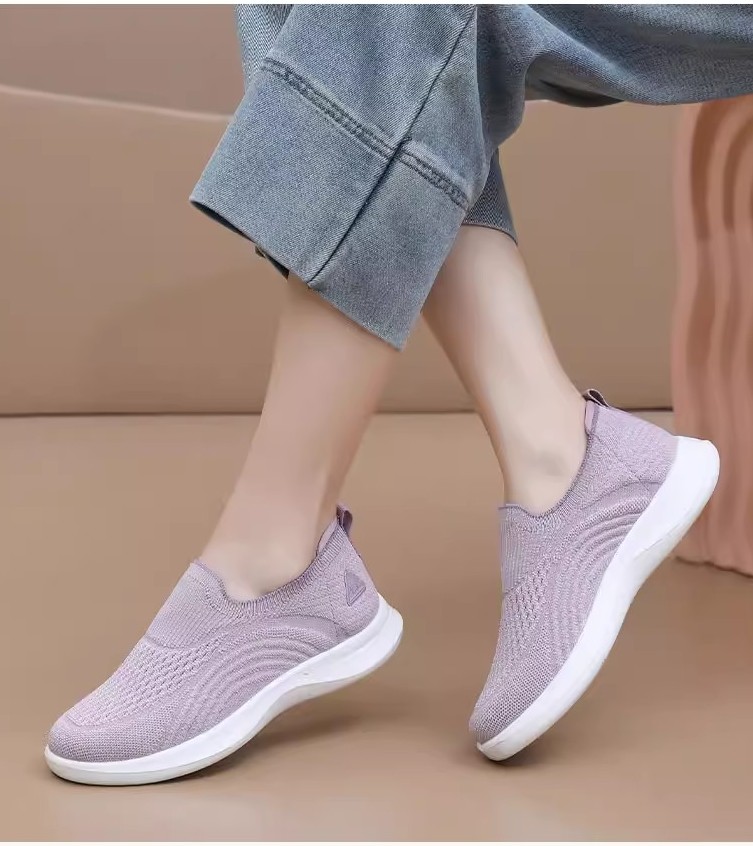
Knit uppers behave like mesh with more stretch and slightly better shape retention. They are comfortable from the first wear and mold to the foot, which is a genuine advantage for anyone with a bunion or an uneven toe line. The downside is that knit can sag over time, particularly at the collar, and the sag is permanent.
White leather and synthetic leather are the easiest to keep clean and the hardest to keep cool. A wipe with a damp cloth handles almost everything, scuffs come off with a melamine sponge used gently, and the material holds its shape for years. But leather does not breathe the way mesh does, and in a humid climate the inside of the shoe becomes the problem rather than the outside. A perforated leather upper is the usual compromise: the perforations are decorative in cool weather and essential in July.
There is a fourth option worth knowing about — recycled textile uppers with a water-repellent finish. These are the fastest-growing segment in women’s walking footwear, and the good ones handle a light shower without turning translucent. They are not waterproof, and no walking shoe in this class truly is. If you need genuine wet-weather protection, that is a different category of shoe with a membrane and a corresponding loss of breathability.
Whatever the upper, treat it before the first wear. A fluorocarbon-free protective spray applied to clean, dry material buys you time on every subsequent spill, and it makes the difference between a shoe that looks new at month six and one that looks retired. Reapply every six to eight weeks if you walk daily.
Fit Notes That Decide Whether the Pair Survives Daily Use
Most women wear walking shoes that are too short and too narrow, and they blame the shoe for the resulting soreness. Feet swell through the day, and they swell more in heat and after long periods on hard surfaces. The reliable method is to try shoes late in the afternoon, ideally after a walk, and to leave a thumb’s width — about half an inch — between the longest toe and the front of the shoe.
The toe box deserves its own paragraph. Walking pushes the foot forward inside the shoe with every stride, and a tapered toe box turns that forward slide into pressure on the big toe and the nail bed. Look for a shoe with a toe box that stays wide until the last inch of the shoe. If the shape narrows sharply, size up or choose a different model. This one feature explains most of the difference between a pair that feels fine for twenty minutes and a pair that feels fine for four hours.
Width matters as much as length, and many brands now offer a wide option in their most popular walking models. A simple test: stand up in the shoe and check whether the upper bulges outward over the sole at the widest part of the foot. If it does, the shoe is too narrow regardless of what the size label says. Heel slip is the opposite failure and is usually fixable — lace the top two eyelets in a heel-lock pattern, which pulls the collar tight around the ankle without crushing the instep.
Socks change fit more than most shoppers expect. A thin cotton sock and a cushioned merino sock can be a full half size apart in effective volume. Decide which sock you will actually walk in, and fit the shoe with that sock on. If you walk in summer heat and your feet swell noticeably, going up a half size in a white walking shoe is usually the safer call than fitting snug and hoping the upper stretches. Mesh and knit stretch a little; the midsole does not, and a snug fit that felt fine in March feels punishing in August.
Finally, break the pair in properly. Two short walks of twenty minutes, then a normal day, then your usual distance. Walking shoes do not need a long break-in period, but the footbed does need a few hours to compress and take the shape of your arch. Going straight to a ten-mile day on the first wear is how people end up with blisters and a pair they never trust again.
Making White Work With a Real Wardrobe
The outfit question is where most women hesitate, and the answer is simpler than the styling coverage suggests. White walking shoes for women function like white sneakers in every combination that already works for white sneakers, with one adjustment: the silhouette is lower and often a touch more technical, so the outfit should not be too precious.
Start with the trouser hem. A cropped straight-leg trouser that ends above the ankle is the easiest partner, because it leaves a clean gap and shows the shoe’s shape. Full-length wide-leg trousers work if the hem breaks just at the top of the shoe; if it drags, the white upper picks up street grit within a block. Tailored shorts and midi skirts both work well, and a white shoe under a bias-cut midi skirt is one of the more reliable warm-weather formulas there is.
If you are building the outfit from the shoe up, the broader women’s casual shoe range is worth a look for the in-between pairs — the low-profile leather sneaker and the soft loafer that cover the days when a technical walking shoe is more shoe than the outfit needs.
Color is less restrictive than people assume. White reads as a neutral against navy, olive, camel, rust, and every shade of denim. It also lifts an all-black outfit in a way that a black shoe cannot, because the eye needs somewhere to land at the bottom of the frame. The one combination that consistently disappoints is white shoes with a very pale cream or ivory base layer — the two whites fight each other and neither looks clean. If you want to wear cream, pick a shoe with a visible midsole stripe or a slightly warmer off-white upper to create separation.
Denim deserves a note of its own. Raw or dark indigo denim can transfer dye onto a white upper at the heel collar, especially in humid weather. It washes out, but it is easier to avoid: cuff the jean, or wear the white pair with a lighter wash until the denim has been through several washes.
For a more polished look, treat the white walking shoe as you would a loafer. Straight-leg dark trousers, a fine-gauge knit, and a white walking shoe reads as deliberate minimalism rather than gym wear, provided the shoe is clean and the sole is not chunky. The chunkier the sole, the more casual the outfit needs to be. That single rule resolves most of the styling uncertainty in this category.
Mileage, Terrain, and Knowing When to Retire the Pair
The volume of walking most women are trying to support is not small. The World Health Organization recommends that adults get 150 to 300 minutes of moderate-intensity aerobic activity every week, and brisk walking is the most accessible way to reach that number without a gym membership or a schedule. The NHS makes the same point in plainer language: walking is “simple, free and one of the easiest ways to get more active”, and a brisk pace is what turns a stroll into training. Read those two guidance notes side by side and the shoe stops being a fashion decision. At 30 minutes a day, five days a week, a single pair accumulates upward of 130 hours of wear a year, and every gram of poor construction gets multiplied by that number.
A walking shoe does not fail dramatically. It fades. The midsole foam compresses gradually, the outsole lugs round off, and the shoe keeps feeling acceptable long after it has stopped providing the support you paid for. The standard industry guidance is to replace walking shoes somewhere between 300 and 500 miles, which for a woman walking three miles a day works out to roughly four to six months of daily use. That range is wide because terrain and body weight both matter; concrete wears a shoe faster than a track, and a heavier walker compresses foam sooner.
Watch the outsole first. When the tread pattern at the heel and under the ball of the foot has worn smooth, the shoe has lost the part that grips and the part that distributes pressure. Then twist the shoe gently: a fresh midsole resists, an exhausted one folds easily in the middle. Finally, compare it to a new pair if you can. Almost everyone who does this discovers the old pair was two-thirds dead and had simply adapted to wearing less shoe.
Terrain changes the calculus, and so does the season you buy in. Pavement and asphalt favor a firmer midsole and a smoother outsole, because grip is not the limiting factor and a lugged sole just adds weight and noise. Gravel paths and packed dirt trails want a slightly deeper tread and a more protective rock plate under the forefoot. Boardwalks, treadmill work, and indoor walking are hardest on the upper rather than the sole, because there is no abrasion to wear the tread, so the shoe gets retired for cosmetic reasons long before it is functionally spent.
Rotation is the cheapest performance upgrade available. Two pairs in alternating use last longer than two pairs used sequentially, because foam needs about 24 hours to recover its shape after a long walk. If you walk daily and want one pair to last a full season, that is the argument for buying two and treating them as a system rather than an indulgence.
Retirement does not have to mean disposal. A pair that has lost midsole support is still fine for gardening, garage work, and short errands where cushioning matters less than coverage. Many women keep the retired white pair exactly for that, which also explains why the second pair in the rotation gets bought in the same colorway.
A Buying Checklist for White Walking Shoes for Women
Before you commit, run through the specifics. None of these steps take more than a minute, and together they prevent almost every disappointing purchase in this category.
Check the flex point. Hold the shoe at both ends and bend it. It should fold at the ball of the foot, not the arch. A shoe that folds midfoot will cause arch fatigue on longer walks.
Press the midsole with your thumb. You want resistance, not a deep dent. If your thumb sinks easily, the foam is too soft for daily distance walking and will collapse early.
Measure late in the day and fit with your walking sock on. Leave half an inch at the toe. If the widest part of your foot bulges over the sole, look for a wide fit rather than sizing up again.
Confirm the upper suits your climate. Mesh or knit for hot, humid conditions; perforated leather for a mix of weather and easier cleaning; treated textile if you walk through light rain regularly.
Look at the heel counter. A firm, structured heel counter keeps the foot stable through the roll of a stride. If it collapses when you squeeze it, the shoe will feel loose within a month.
Plan the cleaning routine before you need it. A soft brush, mild detergent, a microfiber cloth, and a protective spray cost less than one replacement pair and will keep a white upper presentable for the whole life of the shoe.
Buy for the walk you actually do. If most of your mileage is pavement and errands, a lighter, smoother shoe is the right call. If you walk trails on weekends, prioritize tread and forefoot protection. The best white walking shoes for women are not the most cushioned or the most technical — they are the ones that match the surface under your feet five days a week. Most women overbuy cushioning and underbuy fit, and fit is what determines whether the pair gets worn.
Get those seven items right and the color question answers itself. White works when the shoe fits, breathes, and gets four minutes of care a week. It fails when it is bought too small, in the wrong upper for the climate, and worn until the midsole is dead. The difference between those two outcomes is entirely in the buying decisions, which is good news — it means the next pair can be the one you keep.
