

You’ve got a wedding in three weeks, a dress in a colour you’d describe as “warm but not orange”, and one pair of gold shoes in your hand that looked great on the website and slightly insane in the shop mirror. The heel is thin, the shine is loud, and you’re fairly sure you’ll either look like a guest of honour or a Christmas decoration.
Swap the thin heel for a block and the whole calculation changes. Not because gold gets quieter, but because the shape underneath it stops arguing with it.
That’s most of what this comes down to. Gold block heels for women work when the metal is muted, the block is solid, and the height stays under 80mm. Get any one of those three wrong and the shoe starts looking like it cost less than it did.
Gold is not one colour, and the wrong one shows
There are at least four golds on the market, and only two of them look expensive on a foot.
Yellow gold is the bright, saturated version. It’s the one that photographs beautifully and reads as costume jewellery in daylight. If the finish is a painted coating rather than a foil or a plated leather, it scuffs to a lighter yellow within weeks.
Champagne gold is paler and slightly pink. This is the safe one. It reads as metallic without announcing itself, works with ivory and cream, and doesn’t clash with silver jewellery.
Antique or brushed gold is darker and less reflective, closer to bronze. Best for winter outfits and darker skin tones, and the one most likely to survive two seasons of wear because the finish is usually a brushed foil rather than a mirror plate.
Rose gold has a copper base. Gorgeous with warm colours, genuinely difficult with cool blues and greys, and it photographs much pinker than it looks in the hand.
The difference between these is measurable, not mystical: it’s hue and reflectance. The colour range that gets sold as gold runs from a pale yellow at roughly 45 degrees of hue to a deep amber near 35, and your eye picks up that spread instantly even when a product page doesn’t mention it.
Here’s the practical bit. If you’re buying online and the listing just says “gold”, assume it’s yellow gold and it will be brighter than you expect. Champagne is the word to look for if you want something wearable to a daytime event.
A block heel is what makes gold wearable
Metallic shoes draw the eye downward. That’s the entire point and also the entire risk, because a thin heel under a shiny shoe looks like a stiletto that’s trying too hard, while a solid block gives the shine something to sit on.
There’s a mechanical reason too. A block heel spreads your weight across 25 to 40mm of surface instead of 6mm, which means you can actually walk on grass, gravel, or a terrace with gaps between the stones. Weddings happen on all three. The case for block heels on uneven ground is mostly about physics rather than taste.
And there’s a visual effect that nobody talks about. A block heel in a metallic finish reflects light from the sides as well as the front, so the heel reads as part of the shoe rather than as a separate stalk. On a thin heel, the metal makes the heel look thinner and the shoe look less stable. On a block, it makes the whole thing look deliberate.
Height recommendation: 60 to 75mm. Below 50mm the block starts looking like a work shoe with a party finish. Above 85mm, the block gets heavy enough that you notice the weight by the end of the ceremony. A 70mm gold block is the version you’ll wear to three events and not resent.
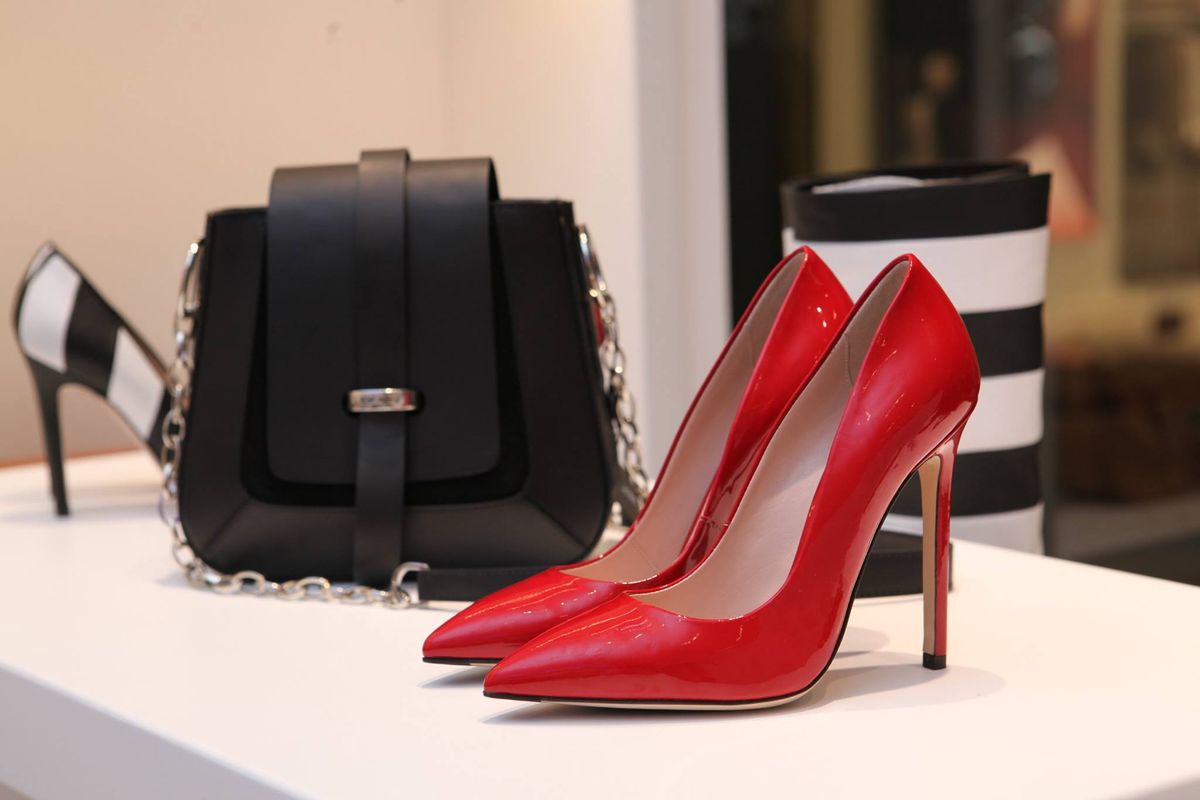
Which gold suits you, without the colour-analysis rabbit hole
You don’t need a professional draping session. You need one test and one shortcut.
The test: hold the shoe next to your bare forearm in daylight, near a window, not under shop lighting. If the metal makes your skin look yellow or sallow, it’s too warm. If your skin looks pink next to it, the gold is too cool and you probably want champagne or rose. If your skin looks normal and the shoe just looks like an object, that’s the one.
The shortcut: look at the jewellery you already wear without thinking. If your everyday earrings are yellow gold, buy yellow gold. If they’re silver but you own one gold necklace you love, buy champagne. Your existing habits are more reliable than any seasonal colour chart.
Two more things worth knowing. Pale gold almost always works with pale skin and dark hair, because the contrast is gentle. Deep gold works better with deeper skin tones because the contrast is stronger and the metal doesn’t disappear.
And ignore the rule that says you can’t mix metals. You can, and most people do without noticing. What you can’t do is wear a bright yellow gold shoe with a cool silver bag and a cool grey dress. That’s not a mixing problem, it’s a temperature clash, and it reads as a mistake even to people who couldn’t explain why. Runway styling leans on this deliberately, which is why catwalk coverage of metallic footwear so rarely translates to a wedding in July.
What they actually go with
Gold block heels are more useful than their reputation suggests, but they’re not neutral. Here’s where they work.
- Navy and black. The easiest pairing. Gold against dark blue is the most reliable combination in the whole colour wheel, and it works at any formality.
- Ivory, cream and off-white. Reads as bridal without being bridal. This is why champagne outsells yellow gold six to one in wedding ranges.
- Burgundy and forest green. Strong contrast, works beautifully in autumn, and looks expensive in a way that black shoes never do with those colours.
- Denim. Yes, really. A gold block heel with straight-leg indigo jeans and a plain white shirt is the outfit that converts people who think metallics are only for evenings.
- Anything with a print that contains gold. Free coordination, no thinking required.
Where they fight you: pastel blue, pale pink, and anything with a strong cool undertone. Also full sequins. Gold shoes with a sequinned dress is two competing light sources on one body, and the result looks like a costume.
Worth saying plainly: most gold block heels for women get bought for one event and then sit in a box. If you’re buying with that future in mind, pick the outfit pairing you’d actually wear on a Saturday, not the one that matches the wedding. Denim and navy are the two that keep the shoe in rotation.
If you want a neutral comparison, a grey heel does the same job with less risk, and it will get worn on ordinary Tuesdays, which gold won’t.
The wear problem nobody mentions
Metallic finishes fail differently from plain leather, and it’s worth knowing before you spend.
Foil finishes, which is what most mid-priced gold shoes use, are a thin metallic layer bonded to the leather. They crease at the toe flex point within ten wears. Once the crease opens, the foil lifts at the edges and you get a pale line across the top of the foot. Nothing repairs it.
Painted finishes are worse. They crack in a pattern that looks like dried mud and start peeling from the heel counter, where your hand grips the shoe to put it on. If you see a gold shoe with a visible brush texture, that’s paint.
Plated or metallic-tanned leather is the good version. The metal is in the finish layer rather than on top of it, so it wears like normal leather: it scuffs, but it scuffs as gold rather than as grey. You’ll pay more for it and it’ll last three times as long.
Care is simple and slightly counterintuitive. Don’t polish metallics. Polish contains abrasives that dull the finish. Wipe with a barely damp cloth, dry away from heat, and store in the dust bag rather than a plastic box, because trapped humidity clouds the foil.
One more: keep them away from hairspray and perfume. Alcohol in both will lift a foil finish in a single evening. Spray first, shoes on afterwards.
My own pair developed a light patch on the left toe after about fifteen wears, right where my big toe flexes. I’ve stopped noticing it. A stranger will notice it in a photograph.
The place gold block heels for women fail first is the inside edge of the block itself. That’s where your other heel knocks against it when you cross your legs under a table. Look at the inner face of the heel on a worn pair and you’ll see a constellation of small chips. Nothing prevents it. You can slow it down by not resting one foot on the other, which nobody manages for a whole evening.
Fit, and the 3mm that decides everything
Metallic leather stretches less than plain leather. That’s the single most useful thing to know when you’re trying a pair on.
Where a soft calf leather might give 3mm across the ball of the foot over a fortnight, a foil-finished metallic gives closer to 1mm. So if a gold pair feels tight in the shop, it will still feel tight in August. Size up rather than hoping.
The exception is a suede-backed metallic, which behaves like suede and does relax. Check the inside of the upper with your thumb: if it feels like fabric rather than smooth leather, you’ve got the stretchy version.
Three checks worth doing in the shop:
- Stand up and press down on the top of the toe box. You want 4 to 5mm of clearance above your longest toe, not 2mm.
- Walk 20 steps on hard floor. Metallic shoes are often stiffer at the sole, and stiff soles slap.
- Look at the heel from behind. The block should be centred under your heel bone, not offset to the outside. An offset block rolls your ankle inward, and you’ll feel it after an hour.
Width matters more than length here. A gold block heel with a 75mm-wide toe box fits most forefeet. Under 70mm and you’re relying on the shoe breaking in, which metallics won’t do.
One last fit detail, and it’s the one that separates a two-hour shoe from a six-hour shoe: the insole under the ball of your foot. Press it with your thumb. If it gives less than 2mm, there’s nothing cushioning the part of your foot that carries most of your weight in a heel. A gel insert costs £6 and adds roughly 3mm, which is often the difference between dancing and sitting down. Most gold block heels for women have a flat cardboard insole, so budget for the insert.
Buckles and straps are worth a second look too. A buckle with four holes gives you roughly 8mm of adjustment. Two holes gives you 3mm, which is close to useless once the leather softens.
Where to spend, where to save
Save on the trend, spend on the finish. That’s the rule I’d give anyone buying their first pair.
If you want gold for one wedding and you’re not sure you’ll wear them again, buy the cheaper pair with a champagne finish and accept that the toe will crease. £50 to £70 gets you a shoe that photographs well and lasts a season. That’s fine value for a single event.
If gold is going to be part of your regular rotation, the finish is where the money should go. A plated or metallic-tanned leather at £120 to £160 will look better in year two than a £60 pair looks in month three. Check the listing for the words “metallic leather” rather than “metallic effect”, and look at the inside of the heel counter: a leather lining means the manufacturer spent money where you can’t see it.
The metal-toe designer pair is the sort of thing that works as a single statement shoe, and the champagne pair with a slim heel is the safer option if you want the colour without the block. If you’d rather browse by height, the wider women’s range lets you filter without wading through the party section.
One thing I’d push back on: the idea that gold shoes are only for evenings. The pair I wear most is a 65mm champagne block with a slightly scuffed toe, worn with jeans on Saturdays. Nobody has ever commented on them being dressy. They’ve commented that they look expensive, which is a different thing entirely.
Buy the muted gold, buy the block, buy the 70mm. Then wear them to the supermarket once before the wedding, because the first walk is always the one that tells you the truth.
If you’d rather compare shapes before committing, the two-tone alternative covers the same events with a lower risk of looking like a decoration.
