

You’ve seen the pair on someone else and it worked. White sneakers with a gold stripe, a gold heel tab, sometimes just gold eyelets, and the whole thing looked expensive in a way plain white never does. So you buy a pair, wear them for a fortnight, and notice the gold has gone the colour of weak brass where your foot flexes. Nobody warned you that the trim is the part that ages first.
That’s the whole risk with white and gold sneakers. The white is easy. The gold is a coating, a foil, or a thread, and each one fails differently. Here’s how to tell what you’re buying before you pay, and what six weeks of daily wear actually does to each version.
Why the gold is the risky half
Gold on a shoe is almost never metal. It’s a finish applied to something else: a polyurethane film, a foil transfer, a painted edge, or a metallic yarn woven into the upper. Each has a different failure mode, and all of them fail faster than the white underneath.
The reason is mechanical. Metallic finishes are thin, and they sit on the surface rather than in it. Every step flexes the vamp, and every flex works the finish against the underlying material. Foil lifts at the edges first. Paint chips at the crease. Metallic yarn dulls as the fibres abrade against each other.
There’s a chemistry layer too. Polyurethane coatings, which is what most metallic films are built on, degrade with UV exposure and hydrolysis, which is a fancy word for moisture breaking the polymer chains. The chemistry of polyurethane coatings explains why a gold film goes cloudy rather than simply wearing through. Once it clouds, no polish brings the shine back.
None of this means don’t buy them. It means buy them knowing which gold you’re getting, and expect the trim to be the thing that dates the pair rather than the white.
Picking the white: optic, cream, or bone
Gold reads warm, so the white it sits on has to agree with it. Put a cool optic white next to a warm gold and the gold looks cheap by comparison, because the contrast is doing the wrong work. Put bone or cream underneath and the gold suddenly looks intentional.
Optic white is blue-based and bright. It photographs brilliantly and looks slightly clinical in person, especially in winter light. It also shows every scuff, because there’s no warmth in the base to hide a grey mark.
Cream and bone are warmer, softer, and more forgiving. They read as white from two metres and as ivory up close. Gold on cream looks like a deliberate pairing. Gold on optic white looks like two separate decisions.
Then there’s the trim placement, which matters as much as the shade. Gold on the heel tab is the safest version: it’s away from the flex point, it doesn’t touch the ground, and it catches light when you walk. Gold on the toe bumper is the riskiest, because that’s where scuffs land. Gold eyelets sit in between. They chip, but nobody sees the chip from standing height.
For a sense of how colour temperature changes a pale pair under different light, the notes on how a pale sneaker reads on camera cover the same problem in a different colourway.

The trim test you can run in the shop
You can identify the type of gold in about thirty seconds, and the answer tells you how the pair will look in eight weeks.
Look at the edge of the gold panel under a light, tilting it slowly. Foil has a hard, mirror-like reflection and a visible edge where it stops. Paint has a softer sheen and a slightly raised lip. Metallic yarn looks woven, with a directional texture you can feel with a fingernail.
- Foil: brightest at first, lifts at the edges within weeks, and can’t be repaired. Best on panels that don’t flex.
- Painted or coated: a slightly duller shine, chips at creases, but holds colour longer than foil. Common on mid-price pairs.
- Metallic yarn: the least shiny of the three, and the only one that ages without looking damaged. It dulls evenly.
Then bend the shoe at the ball and watch the trim. If the gold film wrinkles into fine white cracks on the first flex, it will do that every day for a year. If it flexes smoothly, it’s a better film.
Finally, rub the gold with a dry thumb. A good coating doesn’t transfer. If you get a faint metallic smudge on your skin, the finish is loose and will come off on socks, tights, and the inside of a bag.
A note on what “gold” means across price bands, because it changes the test. Under 50 euros you’re usually looking at a printed film or a painted edge, and both will show wear by month two. Between 60 and 100 euros, foil transfer becomes common and it looks dramatically better on day one. Above that, you start finding metallic yarns and gold-tone leathers, which behave more like a material and less like a coating. The craft behind gold leaf and thin metallic finishes is the same idea in a different application: a very thin layer bonded to a surface, brilliant until the bond or the layer fails.
One more thing to check while you’re at it: the stitching around the gold panel. Metallic film is usually stitched through, and every stitch hole is a place where the film can start to lift. Dense stitching through a gold panel is a long-term risk, even though it looks more finished.
Six weeks of daily wear, in numbers
I wore a white and gold pair for six weeks, roughly five days a week, about 3.5km a day. Here’s what actually happened, because this is the part that product pages never tell you.
- Week one. Nothing. The gold looked identical to the day I bought them, and I started to think the warnings were overblown.
- Week two. The gold on the outer heel began to dull where it rubbed against the other shoe when I walked. Not visible from standing height. Very visible when you sit down and cross your legs.
- Week three. The first fine crack appeared in the gold film at the flex point, roughly 4cm back from the toe. It was hairline, and it only showed at an angle. After that, it spread about 2mm a week.
- Week four. The gold eyelets lost paint on the top edge of two eyelets, where the lace runs. This is the failure I’d predicted and it’s the one that bothers me most, because it sits exactly where your eye lands when you tie them.
- Week five. A scuff on the toe took the gold down to the base material in a patch about 3mm across. Nothing fixes that except a touch-up pen, which never matches.
- Week six. Honest assessment. From a metre away the pair still looks good. From arm’s length, the trim looks like it’s been worn for a year. The white held up better than the gold by a wide margin, which is the opposite of what most people worry about when they buy a pale pair.
Two things surprised me beyond the trim. The first is that the white upper stayed cleaner than I expected, mostly because the cream base hides dust better than optic white does. The second is that the insole compressed noticeably by week five, which changed how the shoe felt more than any cosmetic issue. A 3mm flat insole fixed it for four euros, and I’d budget for that from the start on any white and gold sneakers you plan to wear daily.
Would I buy them again? Yes, with one change: I’d pick a pair with the gold confined to the heel tab and the side stripe, and skip gold eyelets entirely. The eyelets are where the finish fails first and where the failure is most visible, and there’s no upside to them that justifies the wear.
Outfits where the combination earns its place
Gold and white is a warm pairing, and it works best when the rest of the outfit picks up either the warmth or the shine. It fails when the outfit is cool and matte and the shoes are the only bright thing in the frame.
Navy and denim. This is the safest combination and the one I’d build around. Gold against navy reads as deliberate, and the white keeps it from looking formal. Straight-leg jeans, a navy knit, and you’re done.
Camel, tan, and chocolate brown. Warm on warm, and the gold becomes a highlight rather than an accent. A camel coat over cream trousers with these shoes is the outfit that makes people ask where they’re from.
All white, head to toe. This works only if the whites are close in temperature. An optic white shirt over cream trousers with gold-trimmed shoes looks mismatched. Cream over bone over warm white looks intentional.
And the combination to avoid: black tailoring with a cool grey coat. The gold fights the grey, the white fights the black, and the whole thing reads as three outfits in one. If you’re wearing head-to-toe dark, wear a dark sneaker.
There’s a seasonal angle worth planning for. Gold reads warm, so it’s at its best from October to March, when most wardrobes are already warm-toned and the light is low. In high summer, against linen and pale skin, the same pair can look slightly heavy. That’s not a reason to avoid them, but it does mean a white and gold sneakers purchase pays back more if you buy in autumn and wear them through winter than if you buy in June and put them away in September.
One practical rule: keep the metals consistent. Gold trim with silver jewellery looks like a mistake to most eyes, and the effect is stronger than it sounds. Wear gold-toned earrings or none at all. For the ankle, a bare ankle or a cream sock works better than a white sport sock, which introduces a second shade of white that competes with the shoe.
The care routine that keeps the trim alive
Most sneaker care advice is about the upper. With a metallic trim, the routine has to be about protecting the finish, which means fewer liquids and more brushing.
Brush the shoes dry after every wear, with a soft brush, in one direction. Dust is mildly abrasive, and dust worked into a metallic film by a wet cloth is how the shine goes first. Thirty seconds, dry, no product.
Clean the white and gold sneakers with a damp cloth and a drop of pH-neutral soap, and keep the cloth away from the gold. Metallic films hate repeated wetting more than they hate dirt. If the gold looks dull, a dry microfibre cloth is the only thing I’d use. No polish, no cream, no magic eraser.
Dry them at room temperature, stuffed with newspaper, never near heat. Heat is what makes polyurethane films go yellow, and yellow gold is the one look nobody is going for. Store them out of direct sun for the same reason, because UV does the same damage more slowly.
For the eyelet chips, a fine-tip metallic paint pen in the closest shade is the only realistic fix. Apply a dot, let it dry, and accept that it will look slightly different. It’s better than a bright chip catching the light.
If you want to compare a lower-maintenance white pair, the 6cm casual white dad shoe has no metallic finish to worry about, and the sports and leisure pair is the version I’d pick for wet weather. Neither will look as good on day one. Both will look better on day two hundred.
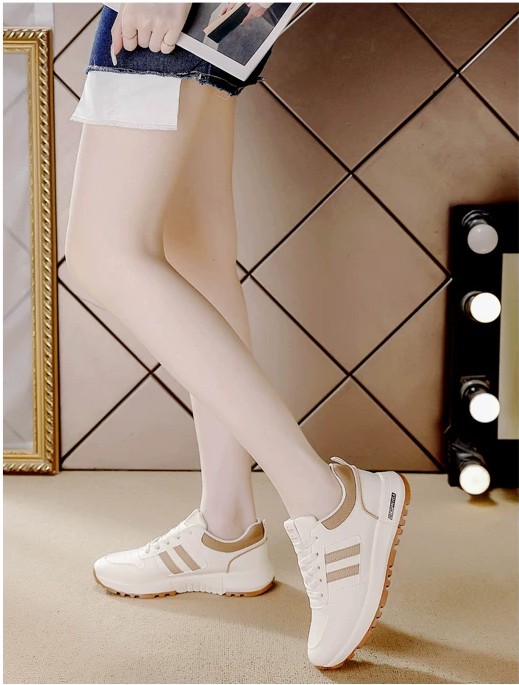
So here’s the short version, for anyone buying white and gold sneakers in the next month. Choose cream or bone over optic white, put the gold where it doesn’t flex, test the finish with your thumb before you pay, and dry brush rather than wash. Do those four things and a pair of white and gold sneakers stays a good purchase for a year instead of looking tired by autumn.
And if the trim on yours has already gone dull, don’t throw them out. A pair with slightly aged gold reads as lived-in rather than broken, as long as the white is clean. Clean white plus tired gold looks like a favourite pair. Dirty white plus bright gold looks like a mistake. Keep the white clean and the rest follows.
If you’re still deciding between colourways, the sneakers category is the place to compare, and the fit notes in this slip-on fit test on a pale sneaker apply to almost any light colourway you’re considering.
