

You’ve got a wedding in three weeks, the dress is a deep green slip, and the shoes you own are either too formal or too beat up. That’s how most people end up typing “rose gold sneakers” into a search bar at 11pm. It’s a colour that solves a specific problem: you want something flat enough to dance in and shiny enough to not look like you came from the gym.
The catch is that metallic finishes on shoes are the least honest materials in the shop. They look expensive under shop lighting and slightly plastic in daylight, and the coating can wear through at the toe crease faster than the sole wears out. So this is really a piece about what that shine is made of, and where it stops being worth it.
Short version: buy rose gold for evenings and photos, not for a daily commute. Check the finish at the flex point before you pay. And if you’re between two pairs, take the one with a matte sole.
What rose gold actually is on a shoe
Real rose gold is a gold-copper alloy. The copper gives it that warm pink cast, and the mix is usually something like three parts gold to one part copper. On jewellery that matters because the metal is the object. On a shoe, it’s almost never solid metal. It’s a coating, and the coating is where all the quality differences live.
There are two main ways to get the colour onto a sneaker. The cheap one is a pigment or foil layer under a clear topcoat. It looks bright for about six weeks and then the topcoat scuffs and the shine goes chalky in patches. The better one is PVD, physical vapour deposition, where a thin metal layer is bonded in a vacuum chamber. PVD holds its colour far longer and doesn’t flake in sheets.
You can usually tell them apart by looking at the edges. Foil and pigment finishes have a visible seam where the coating stops, often around the eyestay or the collar. PVD wraps more cleanly and the colour doesn’t lift at the edge of a panel.
One more thing worth knowing: rose gold on a shoe is almost always a coated synthetic or a coated leather split. That’s fine. It just means you’re buying a finish, and finishes have a lifespan measured in wears, not years.
The two-week test nobody does in the shop
Before you pay, bend the shoe. Not gently. Push the toe up the way it will bend when you walk, and look at the crease line. If the coating already shows a lighter line there, it will be white within a month. Every metallic sneaker creases at that exact spot, and there’s no repair for it.
Then turn it over and look at the sole edge. A rose gold upper on a bright white sole reads cheap quickly, because the sole yellows and the contrast gets harsh. A gum sole or a slightly off-white sole ages better and makes the metallic look deliberate rather than novelty.
Last check: scratch the inner side of the heel with a fingernail. Not the outside, you’ll be buying it. If colour comes off on your nail, walk away. That pair will look patchy by autumn.
None of this takes more than ninety seconds. It’s just that nobody behind the till will suggest it.
Skin tone, and why “rose gold suits everyone” is nonsense
Rose gold does flatter a wide range of skin tones, which is why the claim gets repeated. But “flatters” and “looks good on you” aren’t the same thing. The copper in the colour pushes warm, so on very warm or olive skin it can blend in and lose all its definition. On cooler skin it pops.
The practical test is a photograph, not a mirror. Take one in daylight with the shoe next to your bare ankle. If the shoe and your skin sit at the same temperature, the effect is soft and a bit muddy. If there’s a small contrast, it looks sharp.
There’s also a wardrobe question. Rose gold is a warm metallic, and it fights cool silver jewellery. If you wear silver most days, the shoes will look like they belong to a different outfit. If you wear gold, they’ll feel like they were bought together.
And if you’re pale with pink undertones, be careful with the very peachy versions. They can make your feet look flushed. A rose gold with more copper and less pink is the safer pick.
Where they work, and the one place they don’t
Rose gold sneakers are excellent at three things: weddings where you’re a guest, dinners that start early and end late, and any outfit where you want the shoe to be the only interesting thing. They’re also good for travel, because a metallic reads dressier than a white trainer in photos and still walks like a trainer.
They’re bad at one thing: offices. Even a casual office. The shine is too much at 9am under fluorescent light, and it makes everything above the ankle look underdressed by comparison. Save them for after six.
What about the actual walking in rose gold sneakers? Metallic coated uppers are usually stiffer than a knit or a soft leather, because the coating sits on top of the material. That means a break-in period of maybe three or four wears, with a bit of pressure across the top of the foot. Not painful. Just noticeable.
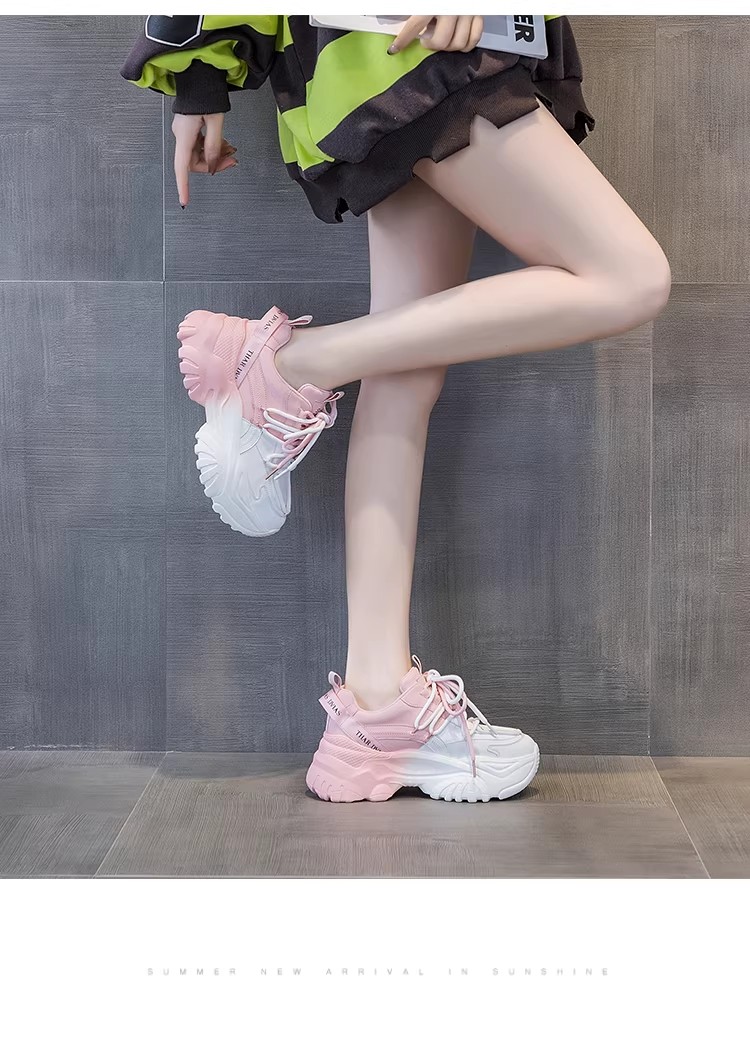
If you want the same mood without the maintenance, plain rose gold sneakers are the easier daily option, but so is a pair that skips the coating entirely. These small-platform white dad shoes are cut from the same silhouette and are far kinder on a long day. Same idea, different finish.
How to wear them without looking like a hen party
The mistake is matching the metallic. Rose gold shoes with a rose gold bag and a rose gold belt is a costume. Pick one metallic element and let everything else be matte.
- Deep green, navy or black: the safest backdrop. The metallic reads as jewellery.
- Denim: works if the wash is dark and the hem is raw. Light stonewash makes the shoe look tacky.
- Cream and oatmeal: risky. Warm neutrals compete with the copper and both go slightly off.
- Prints: only if the print has no warm tones in it. A cool blue floral is fine.
Length matters more than colour here. A midi skirt with a rose gold sneaker looks considered. A mini skirt with the same shoe looks like a night out in 2016. The extra fabric balances the shine.
Socks are the other decision. No-show socks keep it clean and slightly formal. A white ankle sock makes it sporty and much more casual. There’s no middle option that works, so pick a lane.
If you’re nervous, start with the outfit you already trust and swap only the shoes. That’s the whole trick. A metallic sneaker doesn’t need a metallic outfit, it needs a quiet one.
Keeping the shine alive past the fortieth wear
Metallic coatings hate three things: acetone, abrasive erasers, and heat. So no nail polish remover on a scuff, no magic eraser on the toe, and no radiator drying. All three strip the topcoat and leave a dull patch that can’t be blended.
Cleaning is a soft damp cloth and a tiny amount of mild soap. Wipe, don’t scrub. Then dry at room temperature with the shoes stuffed with newspaper so they hold their shape.
Scuffs on the metallic itself are mostly permanent. What you can do is stop them spreading. A clear protective spray before the first wear helps a little, and touching up the sole edge with a matching cream hides the worst of the visual damage.
The realistic lifespan is forty to sixty wears before the toe crease shows a pale line. That’s not a defect. It’s what a coating does. If you want the colour to last years, you’d need to buy a metallic leather that’s dyed through rather than coated, and those are rare and expensive.
Rotate the pair, keep them out of a hot car, and don’t wear them in the rain. That’s most of the care advice that actually works.
What I’d skip, and what I’d pay extra for
Skip anything with rhinestones or crystals on a rose gold base. Two shiny elements on one shoe is one too many, and the glue on cheap crystals fails within a season. Skip the very pale pinkish gold, which photographs well and looks like a children’s shoe in person.
Skip platform versions with a metallic upper. The sole takes the scuffs, the upper takes the light, and the two fight each other.
Pay extra for three things: proper stitching instead of glued panels at the toe, a rubber outsole rather than a hard plastic one, and a lining that’s a light colour. A dark lining on a metallic upper bleeds at the ankle, and that grey ring is the first thing anyone notices.
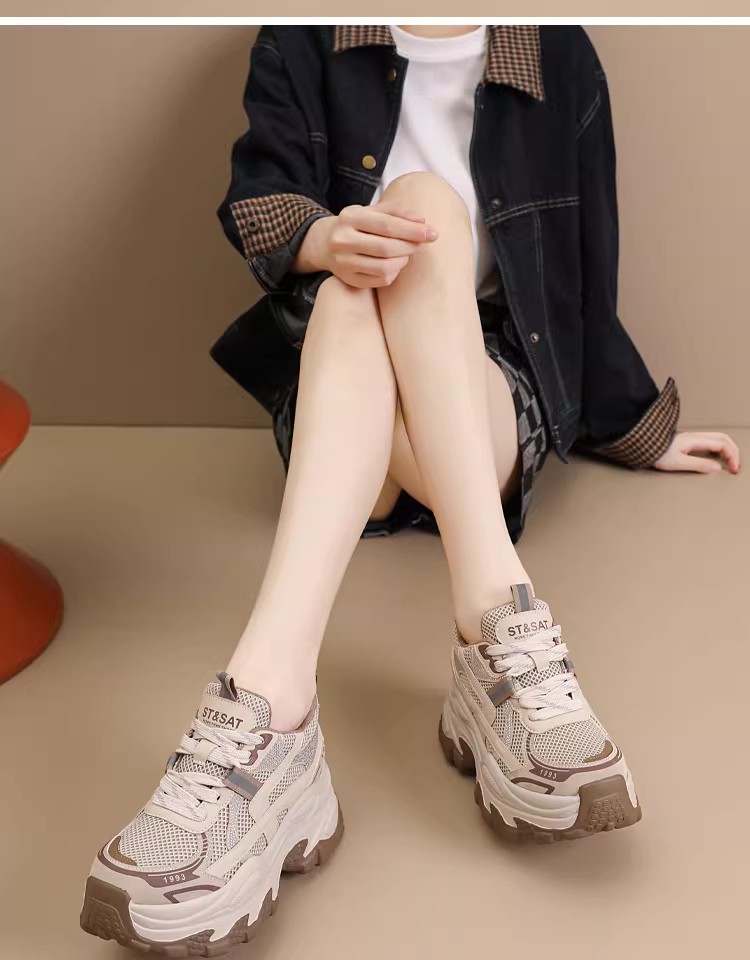
If the coating question has put you off entirely, these thick-soled dad shoes with a hidden lift take a scuff without showing it, which is the opposite trade-off.
You don’t need to spend a fortune. The mid range is where the PVD finishes live. The very cheap end is where the foil is, and the very expensive end is mostly paying for a name on the tongue.
Sizing a coated shoe, and the half-size question
Metallic uppers don’t stretch much. A knit sneaker will forgive a tight fit within a week; a coated leather or synthetic won’t. So the fit you get in the shop is the fit you’ll have in six months, give or take a millimetre of lining compression.
That changes the sizing advice. With a normal canvas shoe, buying slightly snug is a gamble that often pays off. With rose gold sneakers, buy the size that feels right on the first try, and size up rather than down if you’re between two. You’ll want the extra room anyway once you add a no-show sock with a silicone heel grip, which is thicker than it looks.
Try them on in the afternoon. Feet swell during the day, and a coated upper has no give at the widest point of your foot. If the pair pinches at 9am, it’ll be unbearable by 6pm at a wedding.
Heel slip is the other thing to watch. Metallic coatings are smoother than leather, so the lining has less grip against a sock. Walk on a hard floor for a full minute and check whether your heel lifts. If it does, either the shoe is too long or the collar is too soft, and no insole will fix it properly.
Width is where most returns happen. If you have a wide forefoot, look for a pair with a rounded toe box rather than an almond one. The coated material doesn’t mould, so the shape you buy is the shape you keep.
And if you’re ordering online, order two sizes if the shop allows it. Return postage on one pair is cheaper than a pair you never wear. That’s the unglamorous truth about buying a finish instead of a fabric.
If you only take one thing from this
Buy the pair you can bend without fear. If the coating holds at the crease in the shop, it’ll hold on the dance floor. If it doesn’t, no amount of care will save it.
Rose gold sneakers are a colour that rewards restraint. One shiny thing per outfit, a matte sole, and a wardrobe that’s mostly cool and dark. That combination looks expensive. The alternative, matching metallics head to toe, looks like a theme.
For the chemistry behind the colour, the alloy itself is worth five minutes of reading, and electroplating explains why thin metal layers behave the way they do on a curved surface.
If you’re still deciding between finishes, the piece on getting the fit right the first time covers the sizing side properly, and what’s worth personalising is useful if you’re tempted by a custom colour.
And if the wedding is the actual deadline, order now and wear them around the house for two evenings. Three or four hours on carpet is enough to find the pressure point before it finds you at the reception.
