

Six months is roughly how long a pair of office shoes lasts before the owner decides it has “gone”. The outside usually still looks acceptable at that point. The inside is where the damage is, and it’s cumulative in a way that’s easy to miss because each individual day feels fine.
Women office wear shoes take a specific kind of punishment that casual shoes don’t. Nine hours a day, mostly sitting, with 3,000 to 5,000 steps, on carpet, tile and polished concrete. Under-desk heat from a laptop charger. Occasional rain on the walk from the car park. And almost no drying time, because the pair goes back on the next morning.
That combination wears a shoe in a predictable order. Knowing the order lets you catch each failure before it becomes the reason you replace the pair. You don’t need special products to do it, and you don’t need to spend more than about £20 a year on care.
Month one: almost nothing looks wrong
In the first four weeks, a decent pair of office shoes looks and feels new. That’s the problem. Nothing about month one tells you how month seven will go, and most buying decisions are made on month-one evidence.
What’s actually happening in that month is settling. The leather takes the shape of the foot at the flex point and around the heel. The footbed compresses by 1mm to 2mm under the heel. The top line softens where the ankle presses. None of this is visible, and all of it is permanent.
The one thing worth watching in month one is where the crease forms. Take the shoe off after a normal day and look at the vamp. A single soft crease across the ball of the foot is normal. A fan of sharp creases radiating from one point means the upper is too thin for the wear it’s getting, and that’s the pair that will crack at month eight.
Two more early signals, both easy to check with a thumb:
- Press the insole at the heel. If it has already flattened to the board after 20 wears, there was never a cushioning layer.
- Flex the heel counter. If it has gone soft and folds inward, the pair will start slipping within two months.
Neither is a reason to return the shoes. Both are reasons to start protecting them earlier than you’d planned, which mostly means alternating pairs and letting them dry properly between wears.
If you check only one thing in month one, check the heel. Put the shoe on a flat surface and look at it from behind. If the heel block sits at an angle rather than flat, you’re already wearing it down unevenly, and that’s a gait issue you can slow with a tip replacement but not fix with a better shoe.
Most women office wear shoes on the high street are built for a 4,000-step day, which is roughly what a desk job involves. If your day is closer to 8,000 steps, you’re asking the pair to do twice the work, and the same shoe will need twice the care. That’s worth knowing before you judge a pair as “bad quality” at month nine.
Month three: the crease, the heel tip, the top line
By week twelve, three failures start showing, and they show in a fixed order. The heel tip goes first, usually on the outside corner where the foot lands. Then the top line loses its shape. Then the crease deepens into something that catches dirt.
The heel tip matters more than it looks. A worn tip changes the angle of the heel by a couple of degrees, which sounds trivial until it changes how the foot lands, which then shows up as knee or lower back discomfort by the end of the week. Replacing tips costs very little and is the single highest-return maintenance task on office shoes. Most people wait until the tip is worn through to the nail, which is about 200 wears too late.
The top line is the edge of the shoe where the ankle sits. On cheaper pairs it’s a folded edge with paint; on better ones it’s a rolled leather edge. The painted version flakes within a season and then the leather underneath dries and splits, because the paint was also the seal.
If the top line is already flaking, a thin layer of clear wax slows it down but won’t reverse it. The pair is on a clock from that point, and the clock runs faster if you wear it with bare ankles in winter, because skin oils break the finish down faster than socks do.
And the crease. Every leather shoe creases. What differs is whether the crease stays a crease or becomes a crack. Three things push it toward cracking:
- No cream, ever. Dry leather cracks; conditioned leather folds.
- Heat. A radiator, a car footwell in summer, or a warm cupboard all accelerate it.
- Salt. Winter grit dries on the crease and pulls moisture out of the leather as it crystallises.
Anyone who has watched a pair of grey heels worn five days a week will recognise the pattern. The shoe that survives isn’t the most expensive one. It’s the one that gets ten minutes of attention every couple of weeks.
Cleaning: what actually works on scuffs and salt
Most office-shoe damage comes from two things: scuffs on the toe and salt lines in winter. Both are manageable, and both are made worse by the wrong product.
Scuffs first. A scuff is usually transfer, not damage: the other shoe’s finish, a desk leg, a car door. It sits on the surface and comes off with a damp cloth and a small amount of mild soap. What makes it permanent is scrubbing with an abrasive, which takes the finish with it and leaves a dull patch that nothing fixes.
This is where most women office wear shoes get ruined by good intentions. A household cream cleaner feels like it’s working because the mark disappears, and the dull ring it leaves behind only shows up in daylight three weeks later.
For scuffed patent or coated finishes, a tiny amount of petroleum jelly on a cotton bud lifts the mark without cutting the surface. For smooth leather, a cream polish in the matching shade does the job and feeds the leather at the same time.
Salt is the winter problem and it’s a different mechanism. Salt crystals draw moisture out of leather and leave a tide line. The standard fix is a dilute solution of water and white vinegar, about one part vinegar to three parts water, dabbed on and wiped off, then dried away from heat. It works because the acid dissolves the salt rather than pushing it deeper. Warm water alone makes it worse by driving the salt into the fibre. Anyone wearing women office wear shoes through a British or northern European winter will meet this problem at least twice a season.
What not to do, in order of how often it happens:
- Do not dry wet leather on a radiator. It will stiffen and crack at the crease.
- Do not use a hairdryer. Same reason, faster.
- Do not machine wash anything with a leather upper, even on a delicate cycle.
- Do not store a damp pair in a closed cupboard. That’s how a lining starts to smell by February.
The reference material on what shoe polish is actually made of explains why cream works and why wax is for the surface rather than the fibre. Cream carries conditioners into the leather; wax sits on top and shines. Office shoes need cream once a month and wax only when you want the shine back.
One detail that surprises people: the inside matters more than the outside. A pair that’s polished weekly and never aired will fail at the lining before the upper shows any wear. More on that below.
If you’re cleaning a pair for the first time, do one shoe and leave the other. You’ll see the difference immediately, and you’ll also see whether the product is lifting colour, which is the one thing you want to know before you do the second shoe.
Storage between wears decides half the lifespan
If office shoes had one instruction, it would be this: give them 24 hours between wears. Moisture from the foot, roughly a quarter of a cup per day per foot, has to go somewhere. If it can’t evaporate, it sits in the lining, and the lining is the first thing to fail.
A rotation of two pairs worn on alternate days will outlast one pair worn daily by a wide margin, even if the two pairs cost half as much each. That’s not a claim about quality, it’s about drying time.
What actually helps, in order of effect:
- Air them for an hour before they go away. Loosen the laces or strap, pull the tongue forward, and let them sit somewhere with airflow.
- Cedar shoe trees. They absorb moisture and hold the shape of the vamp while it dries, which is what prevents a crease from setting deep.
- Store open, not stacked. A rack with 20cm of air around each pair beats a box every time.
- Newspaper inside, if you’re caught out. Crumpled paper draws moisture out overnight. Change it once.
The mistake almost everyone makes is storing shoes in the hall cupboard, which is usually the darkest, dampest, least ventilated spot in the flat. It’s also where the smell starts. If the cupboard has no airflow, the shoes are effectively marinating for 12 hours a day.
A shoe rack by the door costs less than a single pair of office shoes and does more for their lifespan than any product in this section. If you have the space, keep the rotation visible. If you don’t, a breathable cotton bag beats a plastic box, and a plastic box beats nothing at all only if the shoes went in dry.
There’s a second storage rule that’s less obvious: never store a pair with the shoes touching each other. The finish transfers, and you get a dull patch on the side of the toe that looks like wear but isn’t. The same rule applies to storing them against a dark leather bag, which is how a surprising number of pale pairs get a grey smudge on one side.
For anyone replacing a worn pair, the current range of women’s office-appropriate shoes is worth browsing by shape rather than by trend, since the shapes that survive a five-day week are rarely the ones featured on the front page.
Repair or replace: the three-month rule
The decision point comes around month nine for most office shoes, and people tend to get it wrong in both directions. Some throw away a pair that a cobbler could fix for a fifth of the price. Others keep paying for repairs on a pair that has passed the point of no return.
A simple rule: repair if the repair costs less than a third of replacement and the upper is structurally sound. Structural soundness means no cracks at the crease, no split at the side seam, and a heel counter that still holds its shape.
Repairs worth doing on office shoes:
- Heel tips: cheap, fast, and they protect the heel block. Do this every time, without thinking about it.
- Heel lining patch: a leather or suede patch at the back of the heel cup. Worth it the moment the lining starts to feel rough, which is well before it wears through.
- Resole: only if the sole is stitched. On a cemented sole the cobbler can sometimes rebuild the edge, but the result depends on the shoe.
- Stretching: a cobbler can gain about 2mm across the widest part. That’s enough for a tight pair, not enough for a wrong size.
What is not worth doing: relining a £60 pair, repairing a cracked corrected-grain upper, or resoling a shoe whose footbed has already compressed to the board. In each case the repair costs more than the remaining life of the shoe.
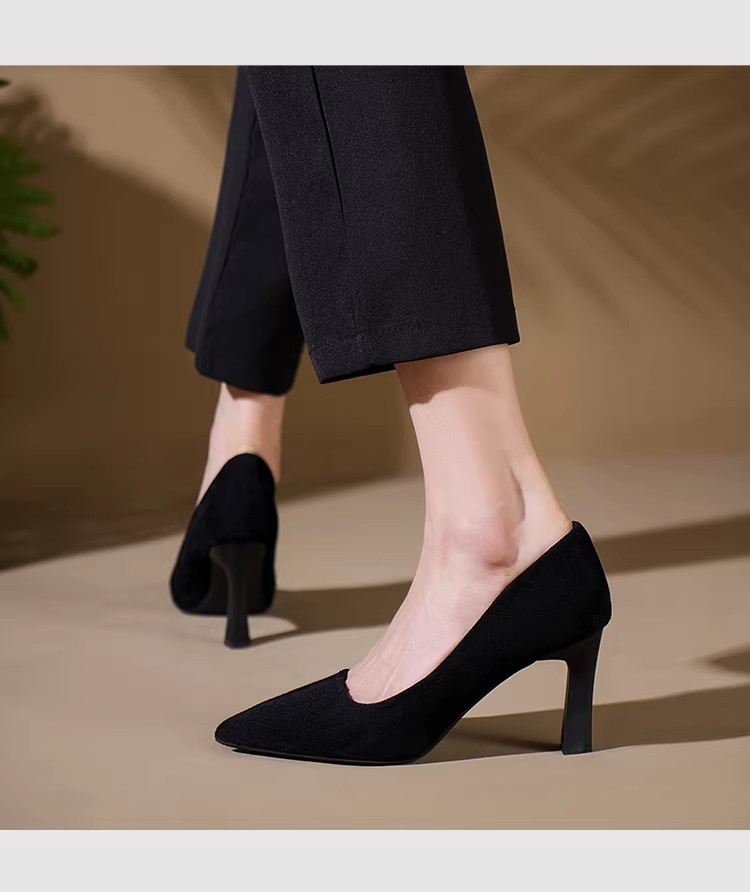
For anyone buying a replacement, the practical test is the one described in how to read the one measurement the size chart leaves out, and the shapes that hold up under a five-day week are usually the plainer ones. A pair like a plain satin-finish black heel for desk days survives because there’s nothing on it to fail.
Feet themselves are the other variable. A pair that fits at 8am and pinches at 5pm will fail early no matter how well it’s made, because the pressure point wears both the lining and the leather from the inside. Blisters from that kind of friction are a fit problem first and a shoe problem second, as the general guidance on friction blisters and moisture makes clear.
The last thing worth saying is about expectations. A pair of office shoes worn five days a week, ten hours a day, is doing about 2,500 hours of work a year. Nine months from a pair in that rotation is reasonable. What isn’t reasonable is expecting the pair to also survive being worn in the rain, stored in a damp cupboard, and never cleaned. Those three habits will halve the lifespan of a good pair faster than any difference in price.
So the practical version, if you’re starting from scratch: two pairs, alternated, aired for an hour, cedar trees if you can, cream once a month, heel tips the moment they look worn. That routine turns a £70 pair into a two-year pair, and it makes the choice of a simple pointed office heel far less risky than it looks on the shelf.
And if you only change one habit after reading this, change where the shoes spend the night. Airflow is free, and it’s the difference between women office wear shoes that last a year and the same pair lasting two.
