

It’s 7:40 on a Tuesday. The black flats by the door have a grey scuff across the toe, the ankle boots are too warm for an office with the heating stuck at 23°C, and the pair that actually works is somewhere under the bed with a sock stuffed inside it. You leave in nine minutes.
That gap between “shoes I own” and “shoes I can wear today” is the exact slot a leather slip-on fills.
One pair can carry five workdays, but only when three numbers line up: 22 mm or more of elastic gusset, a heel between 25 and 40 mm, and a vamp that crosses the top of your foot without pressing on the bone. Miss one and the shoes end up living in the car, which is a €90 mistake most people make exactly once.
Five days from one pair is a fit question, not a style question
The average office week is harder on a shoe than most people expect. Two days of 8,000 to 11,000 steps if you commute by train. Four hours of sitting with your feet swelling quietly under a desk. A stairwell with no lift. Rain on Wednesday that nobody forecast.
A slip-on that photographs well can fail all of that by Thursday afternoon. A plain one with the right measurements will still be on your feet in March.
What actually decides it is boring. The depth of the elastic panel. The angle of the topline behind the heel. Whether the leather has been sanded flat (corrected grain) or left with its original surface (full grain). The insole, which is either foam that flattens in six weeks or a fibre board that holds its shape for a year.
Style comes after. Most people shop in the opposite order and then wonder why the pair they loved in the mirror only lasted a fortnight. If you want a wider look at the category first, the shoes section is sorted by shape rather than by trend, which makes the comparison easier.
Run the maths before you fall in love with a pair. A €110 leather slip-on worn four days a week for two years works out at about 27 cents a wear. The €45 pair that lasts one season costs more than double that, and it also costs you the morning of the day the sole separates.
That calculation only holds if the fit is right on day one. A shoe that needs an insole to be bearable wears out the lining twice as fast, because the insert moves with every step and sands the heel counter from the inside.
The gusset decides whether it’s a shoe or a slipper
Turn the shoe sideways and look at the elastic triangle near the ankle. That panel is the whole mechanism. Too shallow and the shoe has to be gripped by your toes to stay on. Too deep and the upper collapses the moment you take a step.
Twenty-two millimetres is the number to remember for a closed leather slip-on. Below 18 mm, the heel lifts with every step and you develop the toe-claw walk that makes a 40-minute commute feel like a hike. Above 28 mm, the panel gives so much that the shoe starts to feel like a house slipper by the third week.
You can measure it with a ruler on your own foot. Put the shoe on, press a thumb into the elastic, and watch how far the material stretches. If it moves more than a centimetre and a half without resistance, the pair is going to be loose within a month. If it barely moves, it will pinch the top of your arch on warm days.
There’s a second measurement that matters almost as much: the topline height at the back. Anything under 55 mm behind the heel bone will slip. Anything over 70 mm will rub the tendon above it, usually on the third wear, usually on the same ankle.
What you wear inside changes the number you need. A 60-denier tight adds roughly 2 mm of volume across the instep, which is enough to turn a comfortable gusset into a tight one. Bare feet in summer need about 3 mm less room than a thin cotton sock. If you plan to wear the same pair through both, size for the sock and accept a slightly loose feel in July. Sizing for bare feet is the mistake that leads to blisters in November.
This is the same test that decides whether a walking slip-on stays on during a proper walk; the shoes are different but the mechanics don’t change. There’s a detailed version of it in the 22 mm gusset test on slip-on walking shoes, and it applies almost word for word to leather.
Heel height by desk, not by taste
The right heel for a work shoe depends on what you do between 9 and 6, not on what you like in a shop window. Three ranges cover most situations, and the difference between them is bigger than the 15 mm suggests.
- 25 mm (one inch). Standing desk, site visits, a commute with two changes. Feels flat by lunchtime. Best for anyone who walks more than 6,000 steps at work.
- 40 mm (1.6 inches). The default office height. Enough lift to change the line of a trouser hem, low enough that the calf doesn’t shorten. Survives a nine-hour day if the heel is block-shaped rather than tapered.
- 60 mm and up. Sit-down meetings, presentations, dinners. Not a walking shoe, whatever the product page implies.
The shape of the heel matters more than the number. A 60 mm block spreads load across the whole heel pad; a 60 mm stiletto puts it on a coin-sized area, and that’s what makes the last hour of the day hurt. Someone wearing a tapered heel for eight hours absorbs roughly twice the pressure per square centimetre of someone in a block of the same height.
A quick comparison of the two heights most people end up choosing between:

| What you’re measuring | 25 mm block | 40 mm block |
|---|---|---|
| Steps before the ball of the foot aches | 9,000+ | 5,500 to 6,500 |
| Works with wide-leg trousers | Yes, if the hem is short | Yes, at any hem length |
| Stairs and escalators | No adjustment needed | Fine, if the heel is rubber-tipped |
| Weight distribution on the heel pad | Almost flat | Concentrated at the back third |
| Best for | Commutes over 45 minutes | Desk days and meetings |
If the week includes a client presentation and a site visit, two pairs is the honest answer. One 40 mm block for the desk days, one 25 mm for everything else. People who try to do both with a single 50 mm compromise usually end up with a shoe that’s slightly wrong for both, which is one reason where the extra $60 goes on business casual shoes is mostly about construction rather than height.
Leather grades that survive a commute
Four words on a product page tell you almost nothing. Full grain, top grain, corrected grain, bonded. Only the first two belong on a shoe you plan to wear five days a week.
Full grain keeps the outer surface of the hide, including the small scars and pores. It creases in soft folds at the toe and those folds stay soft. Corrected grain has been sanded and stamped to look uniform, which is why cheap pairs photograph so well, and why they crack along the crease line after about four months of daily wear.
Bonded leather is leather fibres glued to a backing. It peels in sheets, usually starting at the flex point behind the toes. A pair like that has a lifespan measured in weeks, not seasons.
You can test the surface with a thumbnail. Press in near the toe box. Full grain springs back with a faint mark. Corrected grain shows a hard, shiny dent that stays. The difference comes down to how the hide is finished, and the mechanics of how leather is tanned and split explain why the cheap version cracks rather than folds.
There’s a useful primer on tannage and finishing at the OEKO-TEX leather standard page, which also explains what the certification label does and doesn’t cover for footwear.
Upkeep matters almost as much as grade. A full-grain shoe conditioned every six to eight weeks stays supple at the flex point; the same shoe left dry cracks along the same line within a year. Cream takes ten minutes and a rag. Skipping it is the most common reason a good pair dies early.
One practical note from the shop floor: black and dark brown hide scuffs less visibly than tan, but it also shows every scratch as a light line. Tan forgives scratches and hides dust. Neither is better. Pick based on whether your week involves a car park, a train platform, or a bike.
Monday to Thursday: what rotates around one pair
One pair of leather slip-ons can carry four days if the rest of the outfit does the changing. The shoe stays constant and reads as deliberate; the trousers, tights, and hem length do the work.
- Monday. Straight-leg wool trousers, hem sitting 5 mm above the vamp. No sock visible. Reads formal enough for a client call.
- Tuesday. Dark jeans, 40 mm block heel, thin merino sock in the same tone as the shoe. Extends the wear window by about two months in winter.
- Wednesday. Midi skirt with opaque tights. The tights change the fit slightly, so try the combination at home first; a 60-denier tight can add half a size of volume.
- Thursday. The same trousers as Monday with a knit instead of a shirt. Nobody notices the shoes at all, which is the point.
What breaks the rotation is colour, not shape. A black slip-on works with navy, charcoal, and dark denim. A tan one works with navy, olive, and cream, and looks wrong with black trousers in a way that’s hard to explain until you see it in a lift mirror.
Pair one, either finish, gets used four days out of five. Pair two only makes sense if your wardrobe splits cleanly into two colour families. A plain leather slip-on in a mid-tone works across both, and something like a genuine leather shallow-mouth pair sits in that middle ground. A lighter option for spring weeks is woven white leather heels, though white needs cleaning every ten days or so if you commute outdoors.
Friday, and the meeting-day upgrade
Friday is where the five-day plan usually collapses. The dress code loosens, the sneakers come out, and the leather pair sits in a bag under the desk. That’s fine, as long as you’ve decided it in advance rather than at 7:40 in the morning.
A cleaner version of the same idea: keep the leather slip-on and change the trousers. Dark straight-leg denim, a plain knit, and a 40 mm block reads relaxed without looking like you gave up. It’s the same principle behind wearing one pair of black-soled sneakers five days a week, applied to leather.
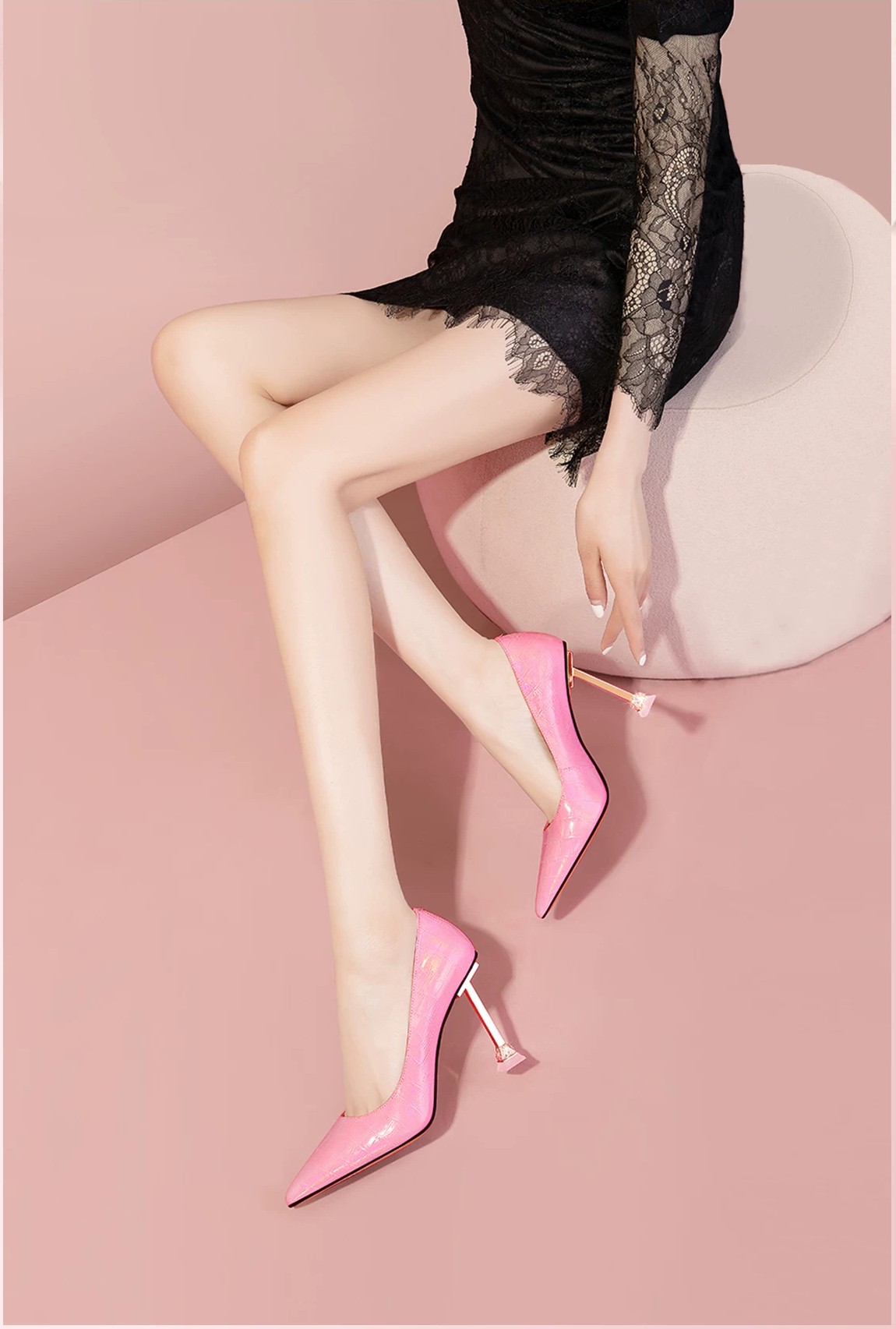
For meeting days, the upgrade isn’t a higher heel. It’s a cleaner line. A pointed toe with a 40 to 50 mm block, in the same colour family as the trousers, makes the leg read longer without asking your feet to do anything new. Something like commuting heels with a low block does that job without the “dressed up” signal of a stiletto.
One office rule that nobody writes down: the sound matters. A block heel on a hard floor is audible from three desks away. If your building has wooden floors and quiet meeting rooms, a rubber-tipped 40 mm is the pair that gets worn, and the beautiful, clicky one stays in the drawer.
What breaks first, and in which month
Honest timelines, based on daily wear rather than occasional use. The insole flattens first, usually between week five and week nine. You won’t notice the shape changing; you’ll notice that the ball of your foot aches at 4 pm in a way it didn’t in October.
The outsole follows. A thin leather sole worn on pavement five days a week is good for roughly eight to ten months before the heel edge rounds off and the shoe starts to feel tilted. A rubber sole with a 4 mm tread gets closer to eighteen months. Resoling costs about a third of a new pair, which is worth it if the upper is full grain and the fit was right from the start.
The elastic gusset is the part people forget. It loses tension slowly, and by month fourteen the shoe has quietly become half a size bigger. If you’re between sizes, buy the smaller one and let the gusset give, not the other way round.
Rotating two pairs changes all three timelines more than any product feature does. Alternating gives the leather 24 hours to dry out between wears, which roughly doubles the life of the lining and keeps the insole from compacting. Two pairs worn in rotation outlast four pairs worn in sequence, and that’s the cheapest upgrade available to you.
Then there’s the crease. Any leather shoe creases across the toe box; it’s not a defect. What you can control is where. A crease that runs diagonally toward the little toe means the shoe is too narrow at the ball. A crease straight across means the length is right and the fit is fine.
Who should skip a leather slip-on entirely
Not everyone should own one, and the shop-floor version of this conversation is usually shorter than the marketing version.
- High instep. If the top of your foot sits more than about 65 mm above the floor when seated, the vamp will press. Laces or a monk strap give you the adjustment you need.
- Narrow heel with a wide forefoot. The classic combination for heel slip. A slip-on can’t be tightened at the back, so you’ll either walk out of it or clamp with your toes.
- Plantar fasciitis that’s still active. A slip-on has no lacing to hold the midfoot, and the arch support is only as good as the insole. Get the pain settled first; laced shoes are the better tool until then.
- Heavy daily walking. Above roughly 9,000 steps a day at work, a leather sole wears out fast enough that you’re buying twice a year. A rubber-soled walking shoe is cheaper per wear.
There’s also the sweaty-feet case. Leather breathes, but a closed slip-on with a synthetic lining doesn’t. If your feet run hot, look at the lining specifically, not the upper. Unlined leather or a cotton lining is the difference between comfortable and unbearable in July.
One more thing worth saying plainly: this is not a shoe for weather. A 20-minute walk in proper rain will leave a leather slip-on waterlogged at the toe, and it will dry with a visible tide mark. Wear the boots on those days and keep the leather for the other four.
The five-day test, run before you commit
Before you take the tags off, do the boring version of a trial. Put the pair on at 6 pm, when your feet are at their largest. Walk up and down stairs for two minutes. Stand still for five minutes and see whether the vamp presses anywhere. Then take one shoe off and look at the imprint on the insole; it should show a full heel and a clear ball, with no gap under the arch.
If all three pass, you have a work shoe. If the heel lifts on the stairs, the gusset is too shallow. If the vamp presses while standing, no amount of breaking in will fix it.
Five workdays from one pair isn’t a fantasy, and it isn’t about finding the perfect shoe either. It’s about buying the one whose three numbers are right, then letting the rest of your wardrobe do the work. heel styles in the shop give you the height options; the gusset measurement is the part you have to do yourself.
