

The invitation says 4pm, the ceremony is outdoors, and the last shuttle back to the hotel leaves at eleven. Somewhere in those seven hours you’ll be standing for most of it, on grass that’s softer than a pavement and harder than it looks, holding a glass and trying not to shift your weight like someone waiting for a bus.
If your feet need support, that’s the day the shoes get tested properly. Orthopedic dress shoes for a wedding aren’t a compromise you make instead of looking good. They’re a set of measurements you get right before the day, so that hour six doesn’t become the thing you remember about the photos.
Here’s the order that works. Measure at the ball of the foot rather than the heel. Find the one size where the toe box has depth as well as length. Then decide where you’ll spend your comfort budget: heel height, upper softness, or width. You can usually have two of the three in a dress shoe. Almost never all three at a wedding-appropriate silhouette in a single pair.
Why these shoes fail when ordinary heels don’t
A wedding is a specific load case. Six to eight hours of intermittent standing with brief walks, on two or three different surfaces, with a change in temperature between the ceremony and the evening. That’s harder on the foot than a two-hour dinner and easier than a full walking day.
The failure point is almost always the forefoot. Standing shifts weight forward onto the metatarsal heads, and a dress shoe with a thin sole and a narrow toe box concentrates that load on a small area. Add a slight heel and the load moves further forward. By hour four, people are doing the thing where they stand on the outside edges of their feet to relieve the ball. By hour six, they’ve stopped dancing.
Shoes designed for support solve this in three ways that have nothing to do with how they look. A wider toe box lets the metatarsals spread instead of stacking. A thicker, denser sole spreads pressure across the whole foot. A firm heel counter holds the heel in place so the toes don’t grip to keep the shoe on, which is the invisible cause of most forefoot pain.
None of that requires an ugly shoe. It requires knowing which of the three is missing, because each one is measured differently and each one fails at a different point in the day.
There’s a fourth factor that’s specific to weddings and rarely mentioned: the ground. Grass gives under the heel, which sounds forgiving and isn’t. The heel sinks slightly on each step, so the shoe rocks back and your toes have to work harder to keep it stable. Gravel does the opposite and throws your foot sideways. If the ceremony is outdoors, the width of the heel matters more than the height of it, and a 45mm block beats a 35mm kitten heel on grass every time.
Measure at the ball of the foot, not the heel
Most women know their shoe size. Almost nobody knows the width of their foot at the widest point, which is the measurement that predicts whether a wedding shoe will be wearable at 9pm.
Do this the evening before you shop, standing, on a sheet of paper. Trace both feet with your weight on them. Mark the widest point across the ball, which is roughly where your big toe joint sits. Measure that line, then measure heel to longest toe. Write both numbers down, in millimetres, and take them with you.
Shoe sizes only encode length. Width is either sold as a separate fitting or not sold at all, and in the dress segment it’s usually not. That means the width you get is whatever the last happens to be, and the only way to know is to measure your own foot and compare it to the shoe’s internal width at the ball. A shoe that’s 3mm narrower than your foot at the ball will hurt by hour two, no matter what the length says.
The number on the box isn’t even a fixed quantity. Shoe sizing systems differ between countries and between brands within the same country, which is why a 38 from one label can measure a full size off from a 38 in another. Treat the number as a starting point for the fitting, never as the answer.
Two more numbers worth knowing. The first is your arch length, heel to the ball, which decides where the shoe’s flex point should sit. If the shoe flexes ahead of your ball, it fights your foot on every step. The second is toe height, measured at the big toe with you standing. Anything under about 18mm of internal depth will press on the nail, and that’s the pressure people describe as “the shoe is too small” when the length is fine.
Now the size question, which is where women’s orthopedic dress shoes for a wedding usually get decided wrongly. Between one size and the next, length changes by roughly 6 to 7mm. Width at the ball changes by around 2 to 3mm. Toe box depth changes by about 1 to 2mm. If your foot is wide and short, going up a size buys you length you don’t need and only 2mm of the width you do. Going up two sizes is worse than choosing a different last.
That’s why the answer is often not a size at all. It’s a different shape.
One practical note on when to measure. Feet swell through the day and reach their largest in the late afternoon, which is exactly the hour most weddings reach their standing phase. A foot measured at 9am can be 3 to 5mm longer by 6pm. If you’re shopping in the morning, add a couple of millimetres to what you write down, and try the shoes on again at the end of the day before the return window closes.
What actually changes between two sizes
Try both sizes with the same sock, at the same time of day, and walk twenty steps in each. The differences worth noting are not the ones people look for.
- Ball width. The one that matters most. If the smaller size presses across the ball when you stand, it will not stretch enough to fix itself.
- Toe box depth. Press down on the top of the toe box with your thumb. Less than a finger’s width of give over your longest toe means pressure all evening.
- Heel counter grip. Walk and watch: more than 5mm of lift means the shoe is too long or the counter too soft, and a heel grip only masks it.
- Flex point. Bend the shoe where your foot bends. If the crease lands behind your ball, the larger size is wrong even if it feels roomier.
The pattern most people hit: the smaller size grips the heel beautifully and pinches at the ball. The larger size is comfortable at the ball and slips at the heel. That’s not a dilemma, it’s a signal that the last is too narrow for your foot. Neither size is right, and the honest move is to change the model rather than pick the lesser of two problems.
If you must choose between them for a single event, take the one that’s comfortable at the ball and add a suede heel pad from a cobbler. Pressure at the ball gets worse through the day. Heel slip gets better with a 4-dollar pad.
One more thing changes between sizes that nobody talks about: where the arch support lands. The insole’s arch curve is fixed to the length of the shoe, so sizing up moves that curve forward relative to your foot. On a foot with a high arch, half a size too much is enough to put the support in front of where it’s needed, which feels like a pressure point under the instep after an hour. If the arch feels wrong in one size and right in the other, buy the one where it’s right and solve the width with an insole rather than the other way round.
Where to spend the comfort budget
Three variables decide how a dress shoe behaves over seven hours, and in ready-to-wear you usually get two.
Heel height. Under 50mm, the forefoot load stays manageable and the calf doesn’t shorten enough to matter. Between 50 and 70mm, you need a wider heel block and a denser sole to compensate. Above 70mm, the shoe becomes an event shoe rather than a standing shoe, and no insole changes that. A block heel at 45mm is the single most useful shape in this category.
Upper softness. Soft leather with a padded collar forgives a slightly imperfect fit and hides the break-in. The trade is that soft uppers don’t hold the foot as firmly, so the toes grip more. For a wedding, softness wins if the fit is 90 percent right and loses if it isn’t.
Width and toe shape. A rounded or almond toe gives more room than a pointed toe at the same nominal size. This is the cheapest upgrade available: same brand, same size, different toe shape, noticeably more room. The mechanics of a bunion make the point bluntly: pressure across the first joint doesn’t resolve with time, it accumulates.
My order of priority for a wedding, if you’re choosing: width and toe shape first, heel height second, upper softness third. Buyers usually reverse that, because softness is what you feel in the first thirty seconds in the shop.
Then there’s the question of what to put inside. A thin leather insole adds maybe 2mm and almost no weight, and it changes the feel of a hard footbed more than the price suggests. A gel ball-of-foot pad is the other cheap fix, and it’s the one that works: it spreads load across the metatarsals instead of letting three small points take it. What doesn’t work is stacking a gel pad on top of a thick foam insole. You end up raising the heel inside the shoe, which shortens the effective length and pushes the toes into the front.
Getting them ready before the day
Do not wear a new pair to a wedding. Two weeks of short wears is the minimum, and it’s the difference between a shoe that behaves and a shoe you’re thinking about during the vows.
Start with twenty minutes indoors, then a two-hour stretch that includes stairs and a hard floor. Real pavement comes after that, because tile and carpet hide the way a thin sole transmits grit. If a hot spot appears at the heel, deal with it at that stage rather than on the morning of the wedding.
Prepare a small kit and put it in someone else’s bag, not yours. A fabric plaster for the heel, a gel pad for the ball of the foot, and a suede brush if the shoes are suede. The ball pad is the one that saves the evening, and it takes thirty seconds to place.
Have a second pair within reach. Not because the dress shoes will fail, but because the walk from the ceremony to the reception is usually longer than anyone planned for, and a pair of flat shoes in the car costs nothing and removes the anxiety. Half the bridesmaids I’ve watched take their shoes off at 9pm would have kept them on if a backup had existed earlier.
The two weeks of preparation should include one long wear, not just short ones. Pick a day when you’ll be on your feet for four hours and wear the pair for the last two of them, then look at your feet that evening. Red marks that fade in twenty minutes are normal. Marks that are still there the next morning are a fit problem, and you have time to return the shoes if you find out two weeks early rather than two days.
If you’re shopping now, these bridal shoes with a soft insole are cut with a lower heel and a padded footbed, and these engagement pairs built for standing show what a wider heel block does to stability on grass. The rest of the women’s shoes collection sorts by heel height, which is the fastest way to narrow the field.
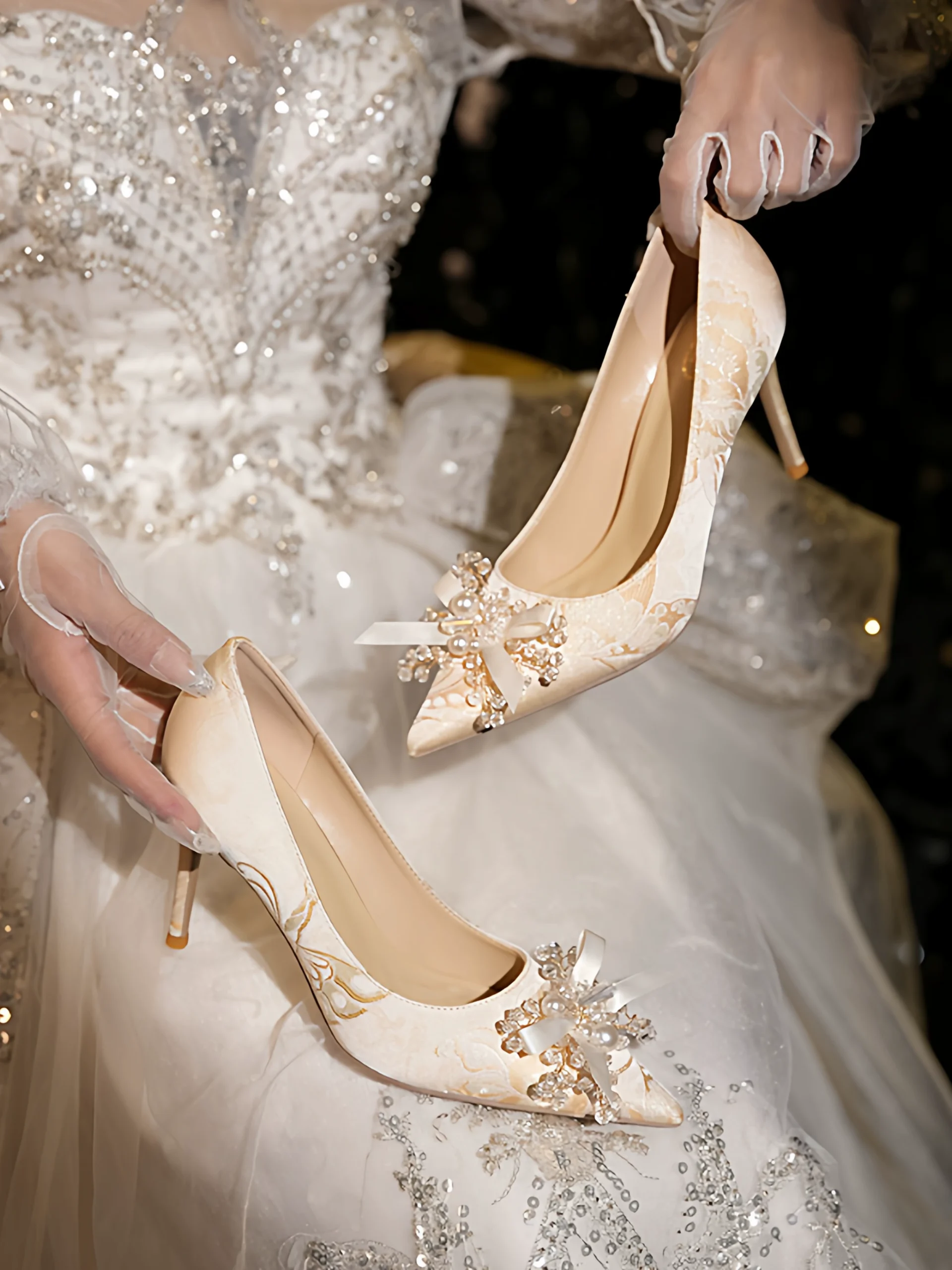
Two related reads: the 6mm that decides whether you can walk in a pointed toe, and the 4mm the size chart hides.
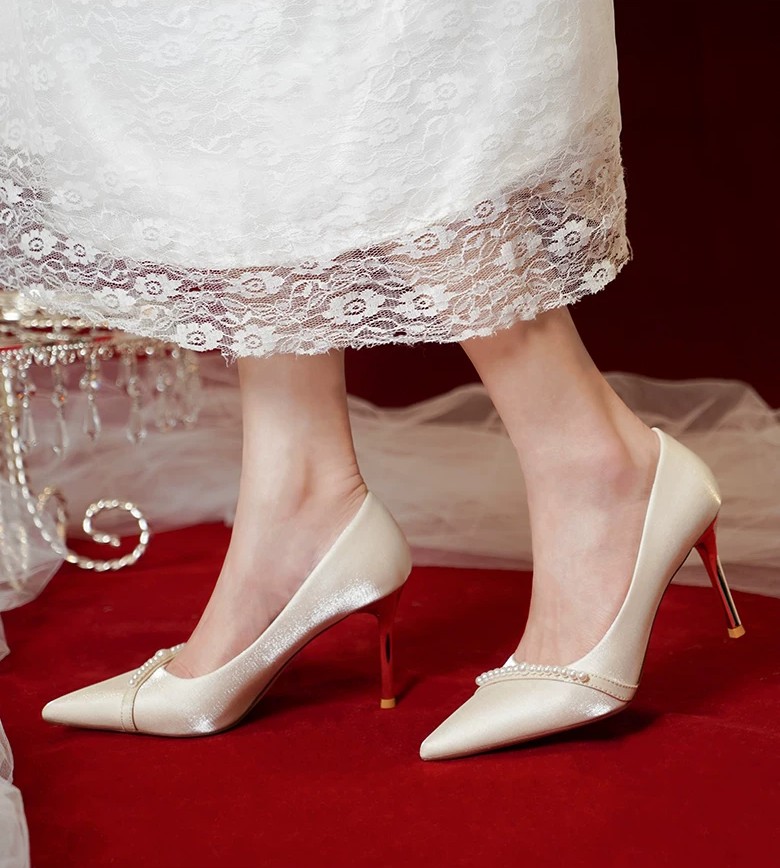
Before you commit, one last check in the shop: stand still for two full minutes in the pair you’re about to buy, both feet down, and see what your body does. If you find yourself shifting weight to the outside edges before the second minute is up, the shoe has already told you what hour four will feel like. Put them back.
