

I spent an hour and a half in a shop in March trying to find a pair of dress shoes that didn’t make my arches ache by lunchtime. The assistant kept bringing out shoes with a raised bump in the middle of the footbed, and every single one of them felt like standing on a pebble.
That’s the thing nobody tells you about flat feet and dress shoes. The “support” that gets added to a shoe is often in the wrong place, or too high, or paired with a toe box so narrow that your forefoot spreads and the whole thing gets worse.
Four pairs and about fourteen months later, here’s what I’d tell anyone starting the same search. A 25 to 40 mm heel with a firm heel counter and a removable insole works better than a flat shoe with an arch bump. Pointed toes are the enemy. And the pair that feels right in the shop at 10 am will feel different at 4 pm, so try everything late in the day.
Four pairs, four outcomes
I wore each of these for at least six weeks, mostly to an office with concrete floors and a stairwell, plus one wedding and a lot of train platforms. None of them was a miracle. Two of them earned a permanent place by the door.
| Pair | Spec | What it did to my feet | Still wearing it? |
|---|---|---|---|
| Pointed flat | 8 mm heel, synthetic lining, glued insole | Arch ache by 2 pm, rubbed the outside of the little toe | No, donated at month four |
| 60 mm block heel | Wide block, leather lining, removable footbed | Better than the flat. Calf tired, feet fine | Yes, for meetings |
| Wedge | 40 mm rise, continuous sole, soft leather | Comfortable for four hours, then the toe box pressed | Occasionally |
| Laced derby | 25 mm heel, firm counter, wide last | No ache at all after a week of break-in | Yes, most days |
That table is the whole article in miniature, and it surprised me. The shoe with the highest heel was more comfortable than the flattest one, because the flat shoe had a narrow last and a raised arch pad that hit the wrong spot.
How I tested, since this is the part reviews usually skip: six weeks minimum per pair, four days a week, on a route that included 900 m of pavement, two flights of stairs and a concrete office floor. I kept a note on my phone at 11 am and 4 pm, because the difference between those two times is the whole story with flat feet.
If you’re doing the same experiment, log three things: where it hurts at 4 pm, whether your heel lifts on stairs, and whether the shoe still feels the same width at the end of the day. Those three answers will thin the shortlist faster than any product description.
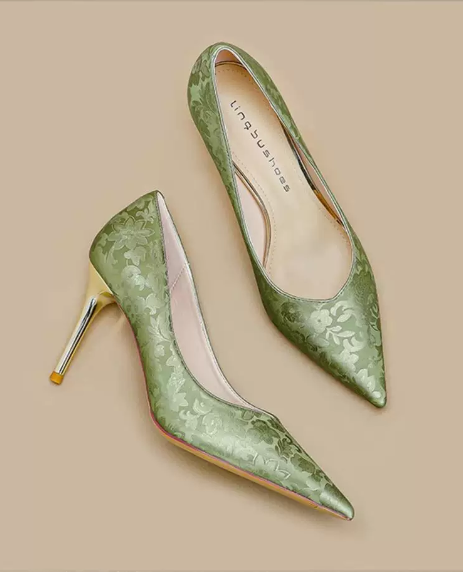
Pair one: the pointed flat, and why it failed
I bought these for a wedding in October. They looked right with the dress, they cost €85, and the shop assistant said the arch support would “train my foot”. It did not train my foot.
The first wear was four hours of standing and 6,000 steps, and by the end of it my arches felt bruised rather than tired. The next morning, walking to the kitchen hurt. That’s not normal break-in, and I should have returned them the same week instead of persevering for four months.
Looking back, three things were wrong. The toe was pointed, so my forefoot had to compress sideways to fit. The insole was glued in, so I couldn’t swap it. And the sole was 8 mm thick at the heel with almost no structure, which meant the shoe flexed in the middle rather than at the ball.
The insoles were the part I got wrong twice. A pointed flat with a flat footbed lets the arch drop, and the ankle rolls inward a little more with each step. Over 8,000 steps, that’s a lot of small corrections for the tendons on the inside of the ankle to make.
What I’d do now: buy the wide version of the same style if it exists, or skip pointed toes entirely. A leather shallow-mouth pair with a slightly wider forefoot is the shape that would have worked, and the difference is about 8 mm across the ball.
The four months cost me more than the €85. I bought two sets of insoles trying to fix the shoe, and neither helped because the problem was the last, not the padding. That’s the trap with a pointed toe: you keep buying accessories for a shape that can’t be fixed.
Pair two: the 60 mm block, which beat the flat
This one still feels counterintuitive. A 60 mm heel should be worse for a flat foot than a 1 cm flat, and it wasn’t, because the block was wide and the heel counter was firm enough to hold the ankle.
The mechanism is simple once you feel it. A raised heel shifts weight forward onto the ball of the foot, which shortens the pull on the arch. That’s why some people with flat feet find a modest heel easier than a completely flat shoe. It’s not universal, and anyone with a tight Achilles will hate it.
What made this pair work was everything around the heel. Leather lining rather than synthetic, so no sliding. A heel counter I could squeeze and feel resist. A removable footbed that came out in one piece, which let me put my own 6 mm felt insole in without stacking foam on foam.
I wore these for six hours at a work event on a stone floor and took them off in the car park, which felt like a win at the time. The calf was tired. The feet were not.
The trade-off is real though. Anything above 50 mm changes how you walk, and if you’re on your feet for nine hours, a lower heel with a better last beats a higher heel with a good block. I keep these for meetings and dinners, not for site visits. Styles like a thick heel built around a wide base are the closest thing to a compromise I’ve found.
Stairs are the test I now run in the shop. Walk up two flights in the pair you’re considering. If your heel lifts more than a couple of millimetres at each step, the counter is too soft and you’ll be gripping with your toes by the end of the week. With the block heel, my heel stayed put, which is why it survived a full winter.
Pair three: the wedge, and the four-hour limit
Wedges are the sensible choice on paper. The sole is continuous, so there’s no pressure spike under the ball, and the rise is usually gentler than the heel height suggests.
They worked for about four hours, which is a strange thing to say about a comfortable shoe. After that, the toe box started pressing on the top of my toes, and by hour five I was shifting weight from foot to foot at a drinks reception. The wedge itself was fine. The upper was too shallow.
That’s the lesson I keep relearning: the sole gets all the attention and the upper does half the work. A wedge with a deep toe box and a soft leather upper is a genuinely good shoe for flat feet, because there’s no arch to speak of and the whole foot is supported from below.
Mine failed on volume, not structure. If your toes sit high or your forefoot is thick, look for a wedge with at least 22 mm of internal height at the toe, measured from the footbed to the top of the upper.
The other issue is weight. A solid wedge is heavier than a heeled shoe of the same height, and 400 g per shoe gets noticeable on a long day. Mine are now a two-hour shoe, worn knowingly.
Summer is where wedges earn their place. With bare feet, the toe box has more room than it does with a sock, so mine went from a four-hour shoe to a six-hour one between May and September. If you’re buying one pair to cover both seasons, size for the sock and accept a slightly loose fit in July.
Pair four: the laced derby, which won
This was the least exciting purchase and the best one. A 25 mm heel, a wide last, laces, firm heel counter, removable footbed. Nothing about it looks clever.
Laces matter more for flat feet than most people realise. When the arch drops, the midfoot spreads, and a shoe that’s only held by elastic or a slip-on construction can’t follow that change. Laces give you 5 to 6 mm of adjustment across the instep, and that’s enough to keep the shoe snug through a whole day.
It took a week to break in. Not painful, just stiff across the flex point for three or four wears. After that, no arch ache at all, including a day with 11,000 steps and two train journeys.
This is also the pair that survived rain, which the others didn’t. Full-grain leather with a rubber sole handles a wet platform; a suede wedge doesn’t.
If I could only keep one pair, it would be this shape. The 25 mm height is low enough to walk in, high enough to keep the arch from collapsing flat against the ground, and the lacing solves the volume problem that killed the wedge.
Wear pattern after a year tells you whether a shoe is doing its job. Mine shows even wear across the heel with a slight bias to the inner edge, which is normal for a flat foot and small enough that it hasn’t changed the shape of the sole. Compare that with the pointed flats, which were worn through on the inner heel in four months.
You can check the same thing on any pair you already own. Turn it over. Inner-edge wear on the heel means your ankle is rolling in, and the shoe is absorbing it. Wear concentrated on the outer edge means the opposite, and it usually comes with a callus on the little toe.
What flat feet actually change about fit
Three measurements, and you can take them at home with a tape and a piece of paper.
- Ball girth. Around the widest part of the forefoot, standing. Mine is 235 mm at size 38, which is on the wide side, and it’s the number that predicts whether a shoe will press on the little toe.
- Instep height. Floor to the top of the foot while seated. Above about 65 mm and you need a looser lacing panel.
- Heel width. Around the back of the heel, at the widest point. A narrow heel with a wide forefoot is the classic combination that makes shoes slip at the back and pinch at the front.
Flat feet usually come with a low instep and a wider forefoot, which is why so many dress shoes feel wrong at both ends. The last is built for a high arch and a narrow ball, and your foot is the opposite shape.
The ankle position matters too. If your ankle rolls inward when you stand, the inner side of the shoe wears faster and the outer side of the heel lifts. Look at the sole of an old pair: wear on the inner edge of the heel is the tell.
Most flat feet cause no pain at all, and that’s worth knowing before you spend money solving a problem you don’t have. The NHS guidance on flat feet is a sensible starting point, and it’s clear that treatment is only needed when there are symptoms.
Where width comes from is another thing worth understanding. Most brands build dress shoes on one or two lasts, and a last is a fixed 3D shape. If your foot is wider at the ball than the last, the shoe will press no matter what size you buy. That’s why measuring your own foot beats reading size charts: a chart tells you length, and length is rarely the problem.
Insoles: what to buy and what to skip
I tried five. Two helped, one did nothing, two made things worse.
Worked: a 6 mm felt insole with a low, soft arch that sits under the arch rather than behind it. Cheap, replaceable every few months, and thin enough that the shoe still fits.
Worked: a thin leather-covered insole with a firm heel cup. The heel cup is the part that stops the ankle rolling, and it does more for me than any arch bump.
Did nothing: the 3 mm gel insert sold as arch support. Too thin to change anything and it slid forward inside the shoe within a week.
An insole is a pad; an orthotic is a shaped device, and the difference explains why off-the-shelf versions disappoint. How orthotic devices are designed is a useful primer before you spend €40 on something a machine moulded in ninety seconds.
Made it worse: any rigid orthotic with a high medial arch. It pressed exactly where the arch was lowest, which felt like standing on a coin. A podiatrist can fit one properly; an off-the-shelf high arch is a gamble.
The practical rule is thickness. Most dress shoes have 4 to 6 mm of room above the standard footbed. Anything thicker and your heel lifts out of the shoe with every step, which creates a new problem while solving the old one.
If the shoe has a glued insole, you can’t do any of this. That single detail rules out about half the dress shoes in a typical shop, and it’s the first thing I check now. There’s a longer version of this argument in what actually helps with arch support, which covers the same trade-offs for walking shoes.
Two practical habits made the insoles last longer. Trim them 1 mm inside the outline of the original footbed so the edge doesn’t curl, and buy two pairs so you can rotate them while one airs out. A felt insole that never dries smells like a gym bag within a month, and no amount of spray fixes that.
The office and wedding problem
Knowing what works and wearing it are different problems, because dress codes don’t care about your arches.
For an office with a smart dress code, the laced derby shape passes in black or dark brown. It reads formal, it has laces, and nobody looks at the sole. A 25 mm heel is invisible under trousers.
For a wedding, the shape that worked was a 40 to 50 mm block with a closed toe and a soft upper. Not a pointed stiletto, not a ballet flat. The block spreads the load, the closed toe keeps the shoe on, and the soft upper lets the forefoot spread without pressing.
What I’d avoid at a wedding: anything with a strap across the instep, because it cuts exactly where a low arch needs room, and any shoe with a decorative bow at the toe, which usually means a shallow toe box underneath.
One honest compromise: bring a second pair. I now take flat sandals to weddings and change after the photographs. Nobody has ever noticed, and I’ve stopped limping to the car.
Cheap dress shoes are a false economy in this category specifically, because the sole board is the first thing that fails and it’s the part doing the structural work. The maths on that is laid out in why cheap orthopedic dress shoes cost more by March, and it matches what I spent learning it.
Tights are the detail that ruins a good fit without anyone noticing until the second hour. A 60-denier tight adds about 2 mm of volume, and a shoe that fits perfectly on bare feet will press across the instep with tights on. Try the wedding pair with the tights you actually plan to wear, not with the thin socks you had in your bag.
What I’d do differently
Four things, in order of how much time and money they’d have saved.
Try shoes at 5 pm, not 10 am. My feet are half a size bigger in the afternoon, and every pair I bought in the morning ended up too tight by the end of the day.
Check the insole before anything else. If it doesn’t come out, put the shoe back. That one rule would have saved me three purchases.
Ignore the word “orthopedic” on a product page. It means nothing legally in most countries. What matters is the last width, the heel counter stiffness, and whether the footbed is removable.
See someone if it hurts. Mine was manageable with better shoes, but pain in the arch that persists for weeks, or anything that changes how you walk, is a conversation for a podiatrist rather than a shopping trip. Shoes help with comfort. They don’t fix a foot.
The pair by the door
The laced derby is the one I reach for without thinking, and that’s the only review that counts after a year. The 60 mm block comes out for meetings. The wedge is for short evenings. The pointed flat went to a charity shop in July.
If you’re starting this search, do the boring thing: measure your ball girth at the end of the day, buy the pair with the removable insole and the firm heel counter, and ignore any shoe that claims to retrain your foot. Heel heights in the shop go from 25 mm up, and the 25 to 40 mm range is where most flat-footed people I know end up. The clinical description of pes planus is worth reading if you want the anatomy behind the shopping advice, though it won’t tell you which shoe fits.
