

It’s 4:20 on a Saturday afternoon in mid-October. The sun is low enough that your shadow runs two metres ahead of you across the pavement, and you’re on the front step with two pairs of walking shoes and a phone, taking one photo of each to see which one looks like a shoe you’d actually wear somewhere.
Autumn light is unkind to shoes. It turns amber around four, the shadows stretch out, and every overlap in the upper becomes visual noise. I’ve shot the same two pairs on the same step once a week since the first cold morning, mostly out of stubbornness.
Two pairs. One step. Eight weeks.
This is a personal comparison of two pairs of walking shoes for autumn, not a verdict. I won’t tell you one pair beats the other, because I can’t measure that and a photo can’t either. What I can tell you is which pair I kept reaching for, which one held up better in the frame, and what I’d check before you spend your own money.
What I actually compare when two walking shoes are side by side
Three things decide it for me, and none of them are performance claims. First, whether I can read the shape of the shoe at a glance. If the upper is a blur of panels, the photo has failed no matter how good the shoe is on your foot. Second, how the colour behaves in warm light, because white mesh goes cream and black leather goes brown around five o’clock. Third, whether the shoe looks like it belongs on a person walking somewhere, instead of floating in a catalogue cut-out.
None of that tells you which pair is right for your feet. It tells you which pair reads well in a photo, which is a different question and, if you sell anything online, a question you’ll end up asking sooner or later.
Your test will probably differ from mine. If you’re shooting for a shop, you want a clean silhouette and visible detail. If you’re shooting for yourself, on your own step, you want the pair that makes you think: yes, that’s the one for the market on Sunday.
Both shoes here are women’s walking shoes in the loose sense. Low, cushioned, built for pavement rather than trail. That’s the whole comparison. Everything past this point is my opinion, so treat it as one.
There’s a practical reason I keep doing this. Over the past two autumns I’ve photographed somewhere north of forty pairs on that same step, most of them for shop listings, and the pattern is boringly consistent: the shoes that read best in photos are rarely the ones I want after a two-hour walk. Photos reward contrast and simplicity. Feet reward cushioning and room in the toe.
Which is the tension running through this whole comparison. If you want one pair to do both jobs, you’ll compromise on one of them, and it’s worth deciding which compromise you can live with before you open a product page.
Two different jobs, one pair of shoes.
Most walking shoes for autumn are built around the same idea: a low profile, a slab of foam under the heel, and an upper that keeps a shower off for the length of a bus stop queue. The differences live in the details, and the details are exactly what a photo flattens.
Colour is the other half of it. A shoe that’s mid-grey photographs as a shape. A shoe with a light sole and a dark upper photographs as two shapes, which reads faster on a phone screen. I notice that more every year, and it has changed which pairs I recommend to people who photograph their outfits.
Here’s the first thing that surprised me. The pair I liked less in photos is the pair I wore more.
What low autumn sun does to a shoe photo
Late afternoon sun runs warm. Depending on how you measure it, the light sits somewhere around 3,000 to 4,000 K against roughly 5,500 K at midday, which is why everything at four in the afternoon looks like it’s been through a sepia filter (colour temperature, explained). Warm light flatters skin. It doesn’t flatter pale mesh.
What happens in practice is that the shoe loses contrast. A light grey upper in 5,500 K light has edges you can see. The same upper at 3,600 K sits on warm pavement and the two colours merge. If your pair is monochrome, and most walking shoes are, the outline is the only thing separating the shoe from the ground.
Then there’s texture. Open mesh photographs lighter than it is, because the light passes through the holes and bounces back off whatever is behind it. Knit photographs denser, because the loops catch light on the surface. If you’re choosing between two pairs on looks alone, walk outside with both at four o’clock and photograph them on the pavement, not on your kitchen floor.
A short shadow helps. A long one ruins the toe box.
White balance is the trap. Phones at four in the afternoon will warm a grey pavement toward beige, and once they’ve done that, your shoe has shifted with it. If you’re shooting a listing, lock the white balance on a sheet of white paper first and then shoot. If you’re shooting for yourself, don’t bother, because the warm version is usually the one you’ll keep.
Ground matters as much as light. Tarmac goes grey-blue in shade, stone flags go yellow in sun, and a pale shoe on pale stone disappears. I’ve had better results putting the shoe half on a shadow line than putting it in full sun, because the shadow gives your eye something to compare against.
Half a step into the shade is usually the answer.
The best window where I live is roughly 3:45 to 4:30, when the sun clears the building opposite but hasn’t dropped behind the trees. After 5:15 the light goes blue and everything looks like a hospital corridor. If you’re taking one photo for a listing, that half hour is your whole margin.
Adidas, the parts you can check instead of taking my word for it
The brand needs no introduction, but I’d rather put the verifiable bits on the table before I start talking about how a shoe looked on my own foot. Adidas is a German sportswear company, registered in 1949 by Adolf Dassler, and it has spent most of the decades since making running and walking shoes in volume (background on the company).
On the technical side, the details that come up most often are these. Boost midsoles are made from expanded thermoplastic polyurethane pellets fused together rather than poured as one foam block. Primeknit uppers are knitted in a single piece. Some models ship with Continental rubber outsoles, per the manufacturer’s spec on the product pages. Women’s sizing on the current charts runs US 5 to 11 in most of the walking and running line, again per the manufacturer’s spec.
I’m not measuring any of that, and I’m not going to pretend I did. I’m putting it here so you know exactly which shoe I’m talking about when I describe what I saw at four in the afternoon.
What I will say is that the design language is consistent. Three stripes, a knit or mesh upper, a chunky midsole, a colour story that leans dark in autumn and pale in spring. You can spot the family from across a room, which is a real advantage if you care about a photo reading instantly.
It’s also a disadvantage. Familiarity doesn’t photograph as personality.
When you look at walking shoes for autumn from the big sportswear labels, the pattern is consistent across the range. Lighter uppers in spring, darker ones now, a midsole that grows a few millimetres every generation, and a colour story that repeats on a two-year cycle.
The line moves, too. Colourways rotate every season, and photos of a two-year-old pair are close to useless if you’re trying to work out what this year’s version looks like, since the upper material and the midsole shape both drift. Check the current product page rather than a photo from an old review.
One more thing I’d flag. The size chart isn’t the same as fit. A chart tells you the length of the last, not whether the toe box suits your foot, and going down half a size because a chart implies it is how people end up with sore toes on a Sunday.
If you can try a pair on in a shop before ordering online, do it. It costs you twenty minutes and saves a return.
The Adidas pair in the frame, and after two hours on my feet
On the step at 4:20, the dark upper read as one mass. The stripes vanished into the shadow, the midsole went the colour of milky coffee, and the whole shoe photographed like a footprint rather than a shoe. At 11am the same pair looked sharp and deliberate. That’s two completely different photographs of one object, and the only variable was the hour.
So if you’re shooting a dark walking shoe in autumn, go earlier than you think. The Instagram-friendly golden hour is not your friend when the shoe is charcoal.
On my feet, the story flipped. The heel collar sat where I wanted it, the midsole felt soft in a way I like on pavement, and I did a two-hour walk along the river at 11°C without thinking about my feet until the last twenty minutes. Then my little toe started complaining. For my feet, the toe box is narrow, and by the ninety-minute mark I could feel the upper pressing on the outside edge. That’s not a defect claim. It’s my foot shape, and it’s the sort of thing you only find out by walking.
Gravel was less comfortable. The soft midsole that felt generous on tarmac felt vague on loose stone, and I spent the last kilometre of a park loop placing my feet carefully. If your walking is mostly pavement and indoor floors, you won’t notice. If it’s towpaths and bridleways, you will.
Two details I noticed in the frame. The laces photographed as a pale stripe across the dark upper, which pulled the eye to the middle of the shoe and made the toe look shorter than it is. And the heel tab caught the light in a way that made the whole shoe look smaller at the back. Neither is a fault. Both change what the photo says.
By the end of the walk the pair looked worn in rather than new, which is a good look in person and a bad one in a listing photo. If you’re photographing a used pair to sell, shoot it before the first walk, not after.
One more thing, and it’s the obvious one. This pair costs several times what the pair from our shop costs. That’s not a knock. It’s a fact you should factor in before you read the rest of this as a recommendation.
Our mesh pair, three weeks in
The pair I’ve been wearing is the breathable mesh walking shoe listed at $49 on the product page. The upper is an open mesh, the sole is thin and flat, and the colour is a pale grey that reads almost white in warm light.
In photos, that paleness is the whole story. The mesh sits lighter than the pavement, the outline stays crisp at 4:20, and the shoe looks airy in a way the dark pair never did. When I put the two images next to each other, this is the one that looks like it belongs on a person walking to a coffee shop. It’s also the one with less visible detail, because a tonal upper has nothing for the eye to land on.
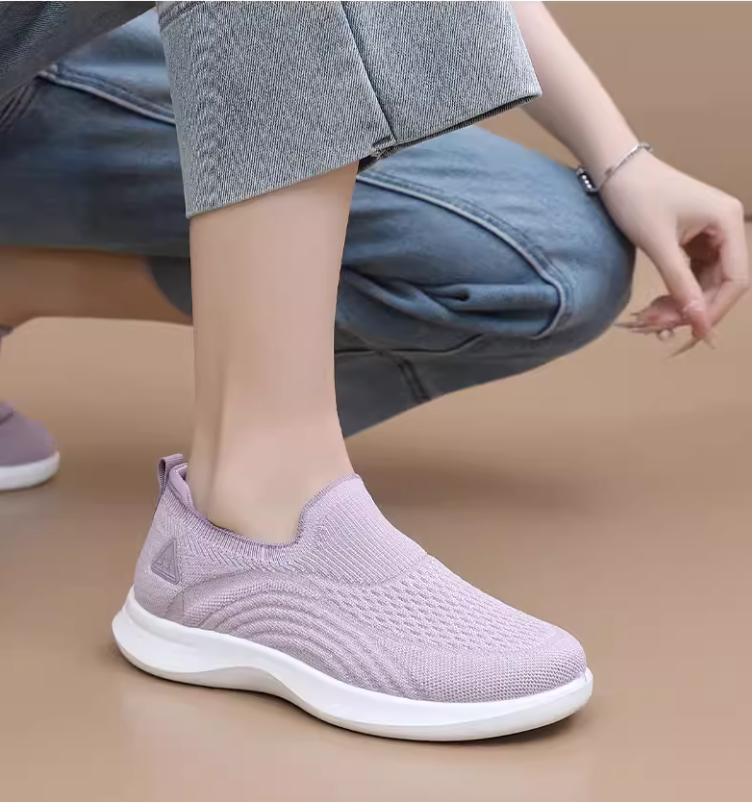
On my feet, the mesh needed no breaking in at all. I wore them for a forty-minute walk on day one and got one small hot spot on the right heel that disappeared by day three. Three weeks in, I’ve taken them to the Saturday market twice, worn them through a nine-hour office day, and walked about 40 km in total. They’re the pair I reach for when I don’t want to think.
The honest drawback is the sole. It’s thin, and on cobbles I felt every joint between the stones. If you have any plantar issue, or you’re walking more than an hour a day on hard surfaces, I’d look at the cushioned running-style pair at $88 instead, which has more foam under the heel. The mesh pair is for short trips and flat ground, and I’d rather say that plainly than sell you the wrong shoe.
One useful side effect of open mesh: it dries fast. I got caught in a shower on the way back from the market, and the uppers were dry within about half an hour indoors while the insole needed the whole evening. If you walk in a wet climate, that matters more than any line on a spec sheet.
Photograph them at 11am and they look almost white. At 4:20 they look like warm bone. Same shoe, two moods, and the second one is the photograph I’d use.
If you want a middle option with a bit more structure, the women’s mesh soft-soled sports shoes at $46 sit between the two in feel. The full range is in our women’s sneaker and walking section.
Which pair I’d pick for which scene
Here’s where the comparison gets useful, because the right answer changes with the occasion rather than the shoe. No single pair of walking shoes for autumn covers all six scenes below, and that’s the point.
I keep coming back to the same conclusion. The surface decides. Walking shoes are a category built around one variable, which is how long you stand on something hard, and everything else is decoration on top of that. Once you accept it, the brand question gets a lot smaller.
- Saturday market, 4 to 6 km of pavement, one coffee stop. Ours. The mesh pair disappears on your foot, and the pale upper photographs better in the low sun.
- A full day at an airport, standing in queues. The Adidas pair. More foam under the heel matters more than a nice photo when you’re on your feet for fourteen hours.
- Cobbled old town, uneven ground. Neither, honestly. Thin soles and soft foam both do badly on stone, and I’d want something with a firmer outsole.
- A wet week in November. Neither of these. Read four days, one bag, one pair for what actually held up in rain.
- Five office days in a row. The navy slip-on version, which I wrote about in five workdays in one pair of navy slip-ons.
- Photographing shoes for a shop listing. Whichever has more contrast against your floor. That single variable matters more than the brand.
- A long museum day on polished floors. Ours, no question. Smooth floors are where a thin flat sole stops being a drawback.
- A city weekend with tram tracks and paving gaps. Something with a firmer outsole than either of these, and I’d budget for it rather than improvise.
If you’re packing for a trip and you can only take one pair, take the one that survives the worst surface you’ll meet. Not the one that looks best on the first morning. A pair you can’t walk in becomes luggage by day three, and you’ll end up buying a replacement in a city where everything costs double.
If you only take one thing from this, take the list. The brand question is a distraction. The surface and the hour you’re standing on it decide more than the logo does.
The one thing that would stop me recommending either pair to you
For the mesh pair, it’s sizing. In my experience they run about half a size short, and I’d size up if you’re between sizes or you have wide feet. I bought my usual size, wore them for three weeks, and I still notice the toe on long walks. That’s my foot, not a defect, but it’s the piece of information I’d want if I were you.
For the Adidas pair, it’s the price and the toe box together. If you have a narrow foot and walk long distances on pavement, the combination probably works. If you don’t, you’re paying a premium for a shape that may not suit you.
Returns are the other thing I’d plan for. If you’re between sizes, order both and send one back, and read the return window before you do it. A walking shoe that’s half a size off is the most common reason people stop wearing a pair they otherwise liked, and it’s the cheapest problem to fix at the checkout.
Two sizes, one return label, and you’ll know by Thursday.
None of this is a knock on either brand. It’s the ordinary arithmetic of buying shoes you can’t try on: fit first, photo second, price third.
Both pairs also share one flaw nobody mentions. Pale mesh shows pavement dust at the toe by day four. Dark knit shows it on the heel. There’s no walking shoe that looks clean after a week of real use, and any photo that suggests otherwise was taken on day one.
So if you’re buying walking shoes for autumn this week, shoot at 4:20, walk for two hours before you decide, and buy the pair that fits your surface rather than the pair that fits the photograph.
One last thing worth knowing if you’re new to this kind of walking: the guidance on walking for fitness puts more weight on consistency and posture than on footwear, which is a useful counterweight to any shoe article, including this one.
We’re not affiliated with Adidas. Brand names are used for identification only. All opinions here are my own, based on my own feet and my own step at four in the afternoon.
