

You know the feeling. Two miles in, the cushioning under your heel is just gone. Not worn out over months, gone within one walk, and the shoe was fine when you tried it on in the shop.
Nothing is wrong with your feet. The shoe was built for a lighter person, and it’s compressing flat under you far sooner than the marketing copy promised.
What works instead: a denser midsole rather than a thicker one, an outsole that’s wider than your foot, a proper wide width with a deep toe box, and full rubber under the heel. Those four things matter more than brand, price, or how the shoe looks on the shelf.
Every step puts two to three times your weight through the shoe
Walking isn’t a gentle activity for footwear. At a normal pace, the force through your heel at landing runs around 1.2 times body weight, and the peak under the ball of your foot during push-off gets closer to 2.5 times. The basics of ground reaction force explain why the number climbs faster than your body weight does. Walk faster and those numbers climb.
So a 100kg woman puts something like 250kg through the front of a shoe several thousand times a day. Foam doesn’t care about your intentions. It only knows load and cycles, and it compresses in proportion to both.
This is why the best walking shoes for plus size women are usually not the ones with the deepest, softest stack. A soft shoe under a heavier walker bottoms out in weeks. Once the foam is fully compressed, you’re effectively walking on the insole board, and every step goes straight into your heel and knee.
There’s a second effect that gets less attention. Heavier walkers tend to land harder and pronate further, because the same ankle has more mass to control. That extra roll wears the inner edge of the sole and stresses the arch. Support for overpronation is worth reading even if you’ve never thought of yourself as a pronator.
None of this is about blame. It’s just physics, and physics tells you what to check.
There’s a practical consequence that surprises people: the shoe that felt perfect in the shop at 10am can feel dead by 4pm on the same day, because foam doesn’t fully recover between steps when the load is high. If a pair feels flat after a two-hour walk, don’t talk yourself into a break-in period. It won’t get denser.
Good walking shoes for plus size women are engineered around exactly this. They don’t shout about it, because the marketing is aimed at runners, but the spec sheet gives it away once you know which numbers to read.
Density beats thickness every single time
Two shoes with a 32mm heel stack can behave completely differently, because stack height says nothing about how the foam responds to load. What you want is high-density EVA, or a TPU-based foam, or a dual-density midsole with a firmer core.
Here’s the shop test. Press your thumb hard into the heel of the midsole and hold for three seconds.
- Springs back with a firm push: good density, will last.
- Sinks in and stays dented: too soft for daily walking at your weight.
- Barely moves at all: probably too firm, though a firm heel plus a good insole can still work.
You can also squeeze the midsole sideways at the arch. If it collapses between your fingers like cake, it’ll do the same underfoot by month three.
Weight also changes which foam you should chase. A 60kg walker can get away with a soft EVA because there isn’t enough load to flatten it quickly. At 90kg the same foam is half-compressed by the end of a season. That’s the whole argument for density in one sentence, and it’s why the best walking shoes for plus size women rarely come from the softest end of the shelf.
Dual-density midsoles are the quiet winner here. They put a firmer post on the inner side and softer foam under the outer heel, which gives you cushioning where you land and control where you roll. They’re rarely advertised clearly, so look for phrases like “firm medial post” or check whether the midsole has two visible colours of foam.
One more thing on density: compression happens fastest in the first 50 miles. That’s why a new shoe feels great for two weeks and then settles into what it will actually be. Judge the shoe after 60 miles, not after the first walk, and keep the receipt either way.
What to ignore: any shoe sold mainly on softness. Cloud foam, marshmallow foam, pillow-soft anything. That language is aimed at light walkers who want a plush feeling for an hour, and it’s the opposite of what holds up under a heavier stride.
Width and volume are two different measurements
Most women buy shoes that are too narrow, and it gets worse with weight because the foot spreads under load. A shoe that fits at 8am can be tight by four in the afternoon.
Width is the horizontal measurement at the widest part of your foot. Volume is how much room sits above it, at the instep and over the toes. You can have a wide shoe that’s still too shallow, which is why people size up and end up with a shoe that’s long but still pinches.
Look for a wide or extra-wide width in the actual spec, not a roomy-looking photo. In most systems, D is standard for women, 2E is wide, and 4E is extra wide. If a brand only sells one width, treat it as a guess and expect to return half of what you order.
Then check the toe box depth. Stand up in the shoe and wiggle your toes. If they can’t lift, the box is too shallow even if the width feels fine. A removable insole helps here, because pulling it out buys you 3 to 4mm of depth and lets you swap in something more supportive.
Feet also get longer under load, and they change shape over the years. Measure both feet standing up, on paper, at the end of the day. Use the larger foot. It sounds basic and almost nobody does it.
Lacing deserves a mention too, because most people tie shoes the way they learned at seven. If the top of your foot feels tight, skip the top eyelet entirely and tie off lower. If your heel lifts, use a heel lock. If the middle of the shoe pinches, re-lace with a gap in the middle. Two minutes with the laces can fix a fit problem that no amount of sizing up will solve.
And if you’re between sizes, go up. The best walking shoes for plus size women are forgiving of a little extra length and unforgiving of a little too little width, because width can’t be stretched and length can be compensated with laces.
If you have a very wide forefoot, where the extra room actually needs to sit covers the shapes that work and the ones that just look wide.
The platform has to be wider than your foot
Turn the shoe over and look at the outsole from underneath. The rubber should extend slightly past the upper at the heel and across the ball. That flare is what stops your ankle rolling when you land on a kerb edge or a bit of uneven pavement.
A narrow sole under a wide upper is the most common flaw in budget walking shoes, and it’s invisible when the shoe is on your foot. Look at the shoe from above while it’s on. If your foot bulges over the sole edge, your weight is going somewhere the shoe can’t support.
Stability comes from three things working together: sole width, torsional rigidity, and heel counter firmness. Twist the shoe lengthwise. It should resist in the middle and flex near the toes. Then squeeze the back. Firm, not foldable.
If you have flat feet as well, add an arch check to the list. A wider base helps, and a contoured footbed helps more. What actually supports a flat arch is the short version of that problem.
Some heavier walkers do better in a low-profile shoe rather than a tall stack, simply because the centre of gravity stays lower and the ankle has less leverage against it. If you’ve ever felt wobbly in a thick-soled sneaker, that’s your answer. Shorter stack, wider base.
Test it standing on one foot in the shop, if you can do that safely. A stable shoe lets you hold that position without your ankle wobbling for ten seconds. An unstable one has you reaching for the shelf. It’s a crude test and it’s more informative than anything written on the box.
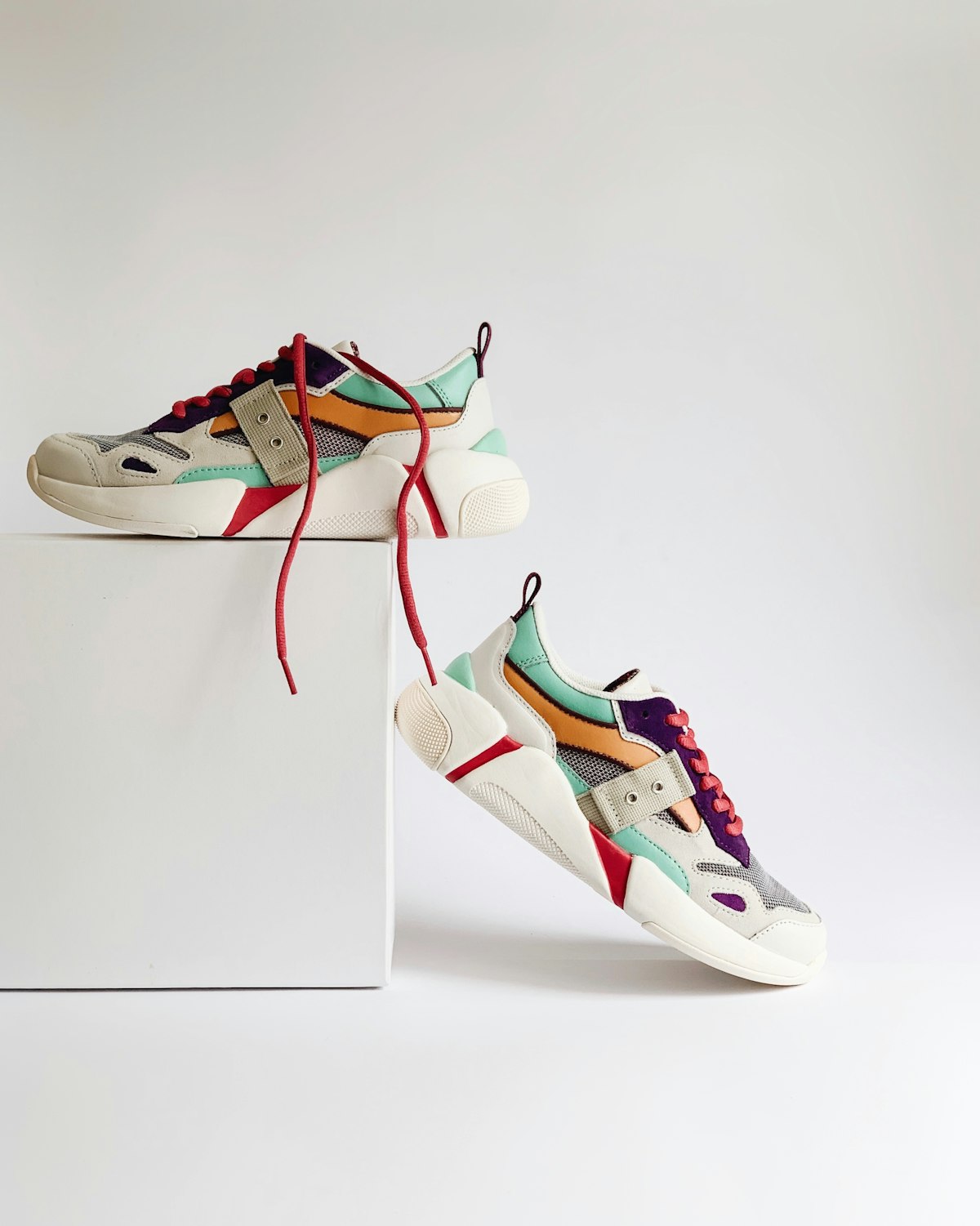
Thick soles can still work when the platform is genuinely wide. Something like these thick-soled dad shoes have a broad base relative to their height, which is the ratio you’re judging, not the height alone.
Outsole rubber is where the money shows up
Flip the shoe over again. If you can see bare foam at the heel, the outsole is a cost cut that will show in three months. Heavier walkers wear through exposed foam fast, and once the foam is scuffed open it absorbs water and crumbles.
You want rubber under the heel and across the ball, ideally with a harder compound at the outer heel where everyone lands first. Look for a visible wear indicator, a slightly different colour patch in that corner. A few brands do this well and it makes the replacement decision easy.
Mileage expectations, honestly: 300 to 500 miles for a walking shoe, and the heavier you are, the closer to the low end. If you walk 4 miles a day, that’s roughly four months. Not a year, not “until they look bad”. The upper usually looks fine when the midsole is already dead.
The crease test tells you when to replace them. Bend the shoe at the ball. If deep creases have formed across the midsole and the foam feels flat compared to a new pair, the cushioning is done. Wearing dead shoes is how a mild ache turns into a six-week problem.
Rotating two pairs stretches total life by maybe 30 percent, because foam recovers between wears. It’s the cheapest upgrade available if you walk daily.
Rubber compound matters as much as coverage. Soft, grippy rubber feels secure on wet pavement and wears quickly. Harder compounds last longer and can feel slick on smooth tiles. For most city walking, a medium compound with a tread pattern that has actual depth beats a flat sheet of soft rubber every time.
Where you walk changes the maths as well. Pavement is harder on midsoles than a treadmill, and a mixed route with kerbs and slopes loads the shoes unevenly. If you walk the same 2-mile loop every day, the foam wears in the same pattern and dies faster than the mileage suggests. Two different routes beats one long one.
What fails first, and it’s rarely the upper
People assume the mesh will tear. It almost never does. Here’s the order things actually break down.
- The insole packs out in six to ten weeks, leaving you standing on hard board.
- The midsole foam compresses unevenly, usually on the inner heel.
- The heel counter softens and your heel starts sliding.
- Stitching at the flex point gives out, long after the sole was finished.
Notice that three of the four are cushioning failures rather than build failures. The upper is usually the strongest part of a walking shoe, which is why judging a pair by how sturdy it feels in your hands tells you almost nothing. Squeeze the sole instead.
That’s why an insole replacement at week eight is the highest-value move you can make. A supportive insole costs 25 to 40 dollars and resets the shoe for another few months. If you’ve never swapped one, how shoe inserts are built is worth ten minutes, because the difference between a cushioning insert and a supporting one decides whether it helps at all.
The insole is also the cheapest place to test your assumptions. Buy a supportive insole first, put it in the shoes you already own, and walk a week. If that fixes the ache under your arch, you’ve learned that support was the missing piece, and you can shop for a shoe with that footbed built in rather than guessing.
Things I’d skip: memory foam anything, because it packs out fastest of all; slip-on shoes with no laces, because a heavier walker needs the lockdown that laces give; and any shoe you can fold in half, whatever the label says about support.
Heavier walkers also tend to need a firmer break-in than light ones, so don’t judge a dense shoe on day one. Give it three short outings before you decide. The exception is any sharp pain at the heel or the arch, which means stop, not persevere.
One unpopular opinion: you probably don’t need to spend 180 dollars. Mid-range shoes with a dense midsole and full rubber outsole outperform expensive fashion sneakers for actual walking, and the difference at the 200-dollar mark is mostly branding and materials that look nice in photos.
A five-minute fit check that saves a return
Shop in the afternoon, in the socks you walk in, after you’ve been on your feet a bit. Everything after that is mechanical.
- Measure both feet standing. Buy for the bigger one.
- Check there’s a thumb’s width in front of your longest toe while standing.
- Confirm your foot doesn’t spill over the outsole when viewed from above.
- Tie the laces and try to slide your heel. Over 5mm of movement, walk away.
- Walk on a hard floor for two minutes, not carpet.
- Ask about the return window for worn shoes.
Give the shoes a fair trial but not an endless one. Two weeks of short walks is enough to know. If your knees ache after a mile and it happens three times in a row, the shoe is wrong for you, and no amount of breaking in will change the density of foam.
If you’re ordering online, order two widths of the same shoe and return one. It costs nothing with most retailers and it answers the width question in a way no size chart can. Sizing charts are averages, and you are not an average.
Then wear them for an hour at home, then two, then a short walk. Foam needs a few outings to settle, and your calves will notice the change if you’ve been in flatter shoes. Give it a week before you judge.
The best walking shoes for plus size women are the boring ones: dense foam, wide base, real rubber, laces that hold. If you find a pair that fits all four, buy two and rotate them. The walking shoes category lists sole depth on most styles now, and this breathable thick-soled walking pair plus these shock-absorbing lightweight sport shoes are both worth a look if you want a wide platform without a tall stack.
And if your heel is already sore in the morning, fix that first. Shoes stop the irritation from repeating, and this guide to plantar fasciitis shoes covers the drop and heel counter details that make the difference.
