

You’re 5’2″ and the group photo is at 7pm. Someone hands you a pair of platform high heels and says try these, they’ll change your life. You put them on, walk four steps, and immediately understand why your friend never wears them.
Platforms are the most misunderstood shape in the shop. People buy them thinking they’ve found a loophole: extreme height with no penalty. The loophole exists, but it’s narrower than the marketing suggests, and it comes with its own set of problems.
Here’s the version of the story that actually helps you pick a pair.
The lift isn’t the heel height, it’s the gap between front and back
This is the one piece of physics worth knowing before you spend money. What your foot feels is the pitch, and the pitch is the heel height minus the platform height.
A 120mm heel with a 40mm front platform puts your foot at an 80mm angle. An 80mm heel with no platform does exactly the same thing to your ankle. Same strain, same calf position, same toe pressure.
Which means the pair of platform high heels for women that looks terrifying in the photo may actually be the gentler shoe. And a modest 90mm stiletto with a thin sole is doing more damage than its numbers suggest.
- 100mm heel, 20mm platform: 80mm of real pitch.
- 120mm heel, 50mm platform: 70mm of real pitch.
- 140mm heel, 40mm platform: 100mm of real pitch, which is a lot.
- 90mm heel, no platform: 90mm, no hiding it.
Do that subtraction before anything else. Most product pages list both numbers. If only one is listed, zoom into the side profile photo and estimate: the platform is roughly the thickness of the sole under the ball of your foot.
I got this wrong for years. I assumed a 130mm platform was for people with better balance than me. Then I measured a pair properly, found the pitch was 75mm, and realised it was closer to a court shoe than to the stilt I’d been picturing.
The flip side is real too. A high platform with a low heel, and yes those exist, gives you barely any pitch at all. You gain height, you lose nothing in ankle angle, and you look like you’re wearing a brick. There’s no free height. You’re always trading something.
Heel placement matters as much as the numbers. A heel set forward under the arch feels steadier than the same heel set at the very back edge, because your weight has less distance to travel. Look at the side shot: if the heel looks like it’s hanging off the back of the shoe, it will feel that way underfoot.
Where they go wrong: the ankle roll
Ask anyone who’s had a bad evening in platforms and they’ll describe the same moment. Not the toe. Not the arch. The ankle going over sideways on a surface that wasn’t perfectly flat.
The reason is sole stiffness. A platform sole has to be thick enough to hold its shape, which means it doesn’t flex at the ball the way a normal sole does. Your foot can’t roll through the step, so your ankle ends up doing the compensation work. Add a 40mm ledge under the front and the leverage gets worse.
That’s why the failures cluster in specific places. Cobblestones. Grass at a garden party. The gap between a lift and the floor. Any staircase with a narrow tread.
Fair warning: if you’ve sprained an ankle in the last couple of years, I’d skip platforms entirely. Not worth it. A block heel gives you most of the height with a fraction of the roll risk, and there are block heels built for standing through a reception that don’t look like nurse shoes.
The workaround for everyone else is unglamorous. Practise on tile at home, then on a pavement, then on stairs, in that order. Twenty minutes total. Platforms don’t fail on the first step. They fail on the four hundredth, when you’ve stopped paying attention.
There’s a second failure mode that gets blamed on balance and isn’t. A stiff sole stops your toes bending, so you start walking from the hip. That shortens your stride and makes you look like you’re marching. Anyone watching can see it before you feel it.
Softening helps a little. A decent cobbler can work the sole at the ball by hand so it flexes a few degrees more, and that costs far less than a new pair. Ask before you assume it can’t be done.
Chunky versus hidden: two different shoes with the same number
Two pairs can have identical numbers and behave nothing alike. The difference is whether you can see the platform.
Chunky, visible platform. A block of sole under the toe that everyone can see. Stable, because the base is wide and the weight sits low. Reads casual or deliberately heavy. Pairs with wide-leg trousers and denim without any effort.
Hidden platform. The lift is built inside the shoe, under the toe box, invisible from the side. Looks like an ordinary heel from most angles. Trouble is the ledge: your foot has to step off a small cliff at toe-off, and that’s where the awkward walk comes from.
Hidden platforms are the ones people buy for weddings and regret by 9pm. They photograph beautifully and they punish you slowly.
There’s a third type worth knowing about, the flatform, where front and back are nearly level. Almost no pitch, plenty of height, and a ride that feels like a boat. Good for standing. Bad for dancing. If your event involves a lot of standing and not much moving, it’s the smart pick of the three.
Telling them apart online is annoying but doable. Hidden platforms usually show a shadow line inside the toe box in the top-down shot, and the side profile has a suspiciously thick rim at the front. Chunky ones are obvious from across the room.
When the listing is vague, weight is the tell. Hidden platforms are lighter than chunky ones at the same height, because there’s less material hanging out in the open.
Price gives it away too. Building a lift inside a shoe takes a mould, which is more work than gluing a slab onto a sole. Cheap hidden platforms tend to be the worst of both: heavy and awkward, with none of the visual credit.
Weight is the number nobody lists
A standard leather court shoe weighs somewhere around 220g to 280g. A chunky platform with a rubber sole can hit 500g. That’s a near double, per shoe, and you’re lifting it 8,000 times on a normal day.
You’ll notice it in the calf before you notice it anywhere else. The first sign isn’t pain, it’s a certain laziness in the step, where you stop picking your feet up properly. That’s also when people trip.
Weigh them if you can. If you’re ordering online, read the shipping weight if the shop publishes it, and subtract packaging. It’s crude, but it tells you whether that’s a 400g shoe or a 700g brick.
Lighter doesn’t automatically mean better. A very light platform usually means a hollow sole, and hollow soles crack. The sweet spot is a shoe that feels solid in the hand without feeling like a doorstop.
There’s a quick hand test that beats any spec sheet. Hold the shoe by the heel and let it hang. A well-balanced platform hangs level or tips slightly toe-down. One that swings hard toward the toe has a heavy front slab, and that’s the weight you’ll be dragging with every step.
One more thing about the sole material. Rubber grips, and grips loudly on polished floors. Leather soles on platforms are rare for a reason. If the product shot shows a smooth plastic bottom, expect to slide on a marble lobby floor, and expect the tread to wear flat within a season.
Packing matters too. Two 500g shoes in a tote is a kilo you’re carrying all evening, and you’ll notice it in your shoulder before you notice it in your feet. If you’re bringing flats to change into, that’s a kilo and a half.
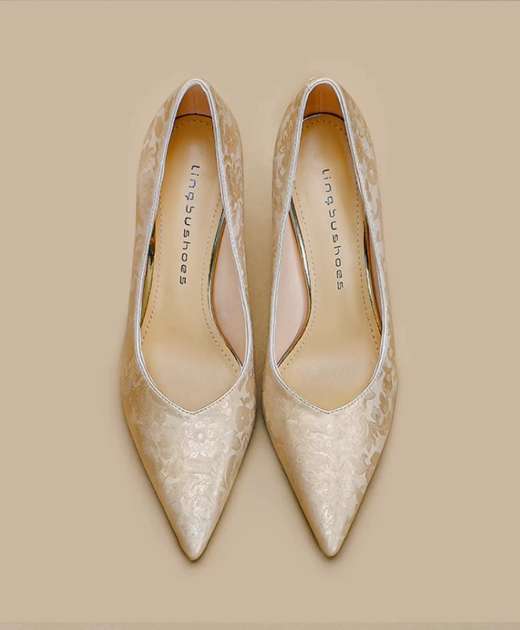
You can see the difference in profile on these thick-heeled wedding shoes: the sole under the ball is doing structural work, not decoration.
What they work with, and where they look like a costume
Platform high heels for women get sold as a going-out shoe, and that’s the least interesting thing you can do with them.
The strong pairings are the boring ones:
- Wide-leg trousers that break just above the sole, so the platform reads as a continuation of the leg.
- A midi skirt with some weight to it, wool or heavy cotton, not chiffon.
- Straight-leg dark denim, hemmed to clear the ground by a centimetre.
- A leather jacket and nothing else clever.
The weak pairings are equally predictable. Skinny jeans with a cropped top and a chunky platform is a look with a very specific expiry date, and that date was a while ago. A floaty summer dress with a heavy sole looks like you borrowed the wrong shoes on the way out.
There’s a proportion rule that saves a lot of guesswork. The heavier the shoe, the more fabric it needs above it. Platforms want volume. They look silly under anything thin.
Colour matters less than you’d think. Black and dark brown disappear into an outfit. White platforms read as a statement and get dirty in a week, which I know because mine did. Metallic finishes photograph well and scratch badly.
Length is the other lever. A platform adds height at the bottom of the frame, which makes a long skirt look shorter and a short skirt look shorter still. If you’re already tall, the effect is dramatic rather than useful. If you’re not, it’s the cheapest leg-lengthening trick in the wardrobe, and that’s exactly why the shape keeps coming back around every few seasons according to WWD’s footwear coverage.
If you want to see how the shape changes the whole silhouette, the argument in why the sole decides whether a heel works applies here with more force. A platform is basically a sole decision with a heel attached.
Stairs, sizing and the first week
Stairs are the honest test. Go up and down one flight before you decide to keep a pair. Not because you’ll fall, but because you’ll find out whether the sole is short enough at the toe to clear a step edge. A long platform catches, and catching is how people go down.
Sizing runs differently than you’d expect. Most platforms have a deeper toe box than a court shoe, because the sole is thick and the upper has room to sit higher. Half a size down is often right, which is the opposite of what you’d do with a pointed heel.
Don’t trust that rule blindly either. Try the smaller size first if the shop stocks both, and check that your heel sits back against the counter without the shoe sliding off when you walk.
The first week is where the shoe either becomes yours or doesn’t. Wear them for twenty minutes a day at home, on hard floor, and pay attention to two places: the top edge of the platform where it meets your toes, and the back of your heel. Those are the two spots that rub.
Break-in is a slow stretch, not a miracle. Leather gives two millimetres over a month. The sole doesn’t give at all. If a platform sole feels like it’s pressing on the ball of your foot in the shop, it will still be pressing on it in March.
Mine took eleven days to stop feeling like skis. Now I wear them to work twice a week and forget they’re on. That’s the whole review, honestly: whether you forget.
If you’re still comparing shapes, the red heels buying guide covers shade and finish, and the women’s shoes range is the place to see how a 40mm sole changes a silhouette compared with a 10mm one.

One last check that catches more bad purchases than any review section: stand in them and look at your own ankle from the side in a mirror. If your ankle is rolling inward even slightly while you’re standing still, the shoe is already losing. No amount of breaking in fixes a base that doesn’t match your foot.
The history of the platform shoe is worth ten minutes if you like context, mostly because it keeps coming back every twenty years and always for the same reason: it gives height without the angle.
So do the subtraction first. Heel minus platform is the number that decides whether you can wear them for an evening or only for a photo. Then weigh them, then walk a flight of stairs.
And if the arithmetic says the pitch is under 80mm and the shoe still feels wrong, believe the shoe, not the maths.
