

You’ve seen the pair online: black suede, a line of small metal studs along the toe, a heel that looks like it could take a knock. Then you get them home and the first thing you notice is that they’re heavier than your other heels. The second thing is a stud digging into the side of your big toe.
Womens studded high heels live or die on the details nobody photographs. Where the metal sits, how it’s fixed, what’s under it, and how much weight the hardware adds all decide whether you can wear the pair for three hours or thirty minutes. Here’s what to check, and what to skip.
Studs are a weight decision, not a decoration
Every stud is metal fixed to a shoe. On a small pair with 20 studs, the hardware adds maybe 40 grams. On a heavily decorated pair with 200 pieces, it can add 300 grams or more, and that’s the difference between a shoe you forget about and a shoe your ankle notices on stairs.
Weight matters more than people think because it lands at the end of a lever. An extra 200 grams on your foot at 80mm of heel height feels like considerably more than 200 grams by the time your calf has lifted it 4,000 times in an evening.
You can test this in the shop. Hold the pair, then hold your current pair, and compare in your hands. If the difference is obvious in your hands, it’ll be obvious on your feet by 10pm.
The construction behind the stud matters as much as the count. Flat-back studs riveted through the upper sit tight and don’t move. Cone studs screwed into a base plate hold well but can loosen and rotate. Glued studs, which are the cheapest option, fall off in the first month and leave a small hole in the leather that you can’t repair at home.
Ask directly, or check the inside of the shoe. If you can see a metal backing on the lining, the studs are mechanically fixed and will stay. If there’s nothing but smooth lining, they’re glued, and you should expect to lose two or three.
Weight distribution matters as much as total weight. Studs clustered at the toe pull the shoe forward, and your toes end up gripping to keep it on. Spread across the vamp and counter, the same hardware feels balanced. Hold the shoe by the heel and see whether the toe drops. If it does, you’ll feel that pull with every step.
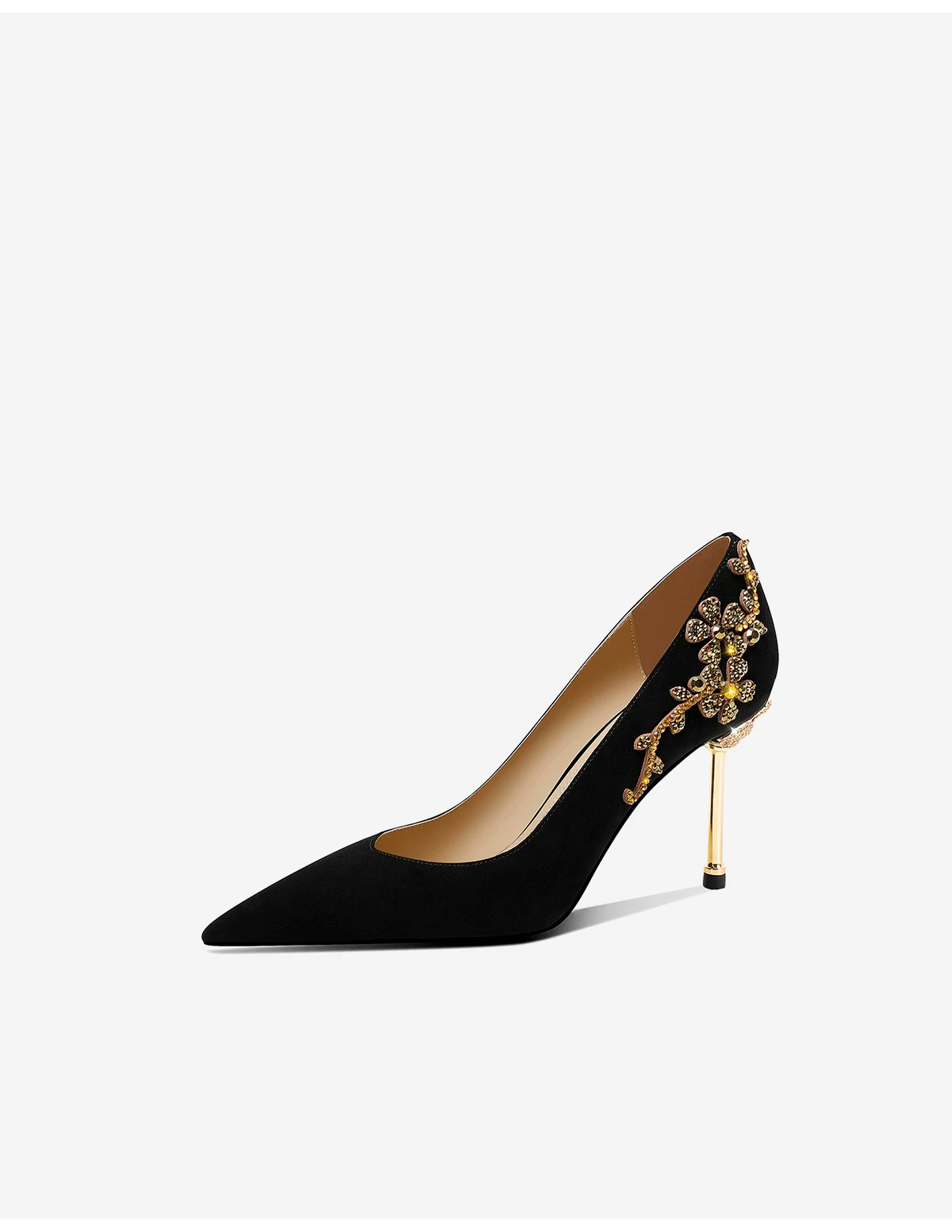
Where the hardware sits: toe, heel, or shaft
Placement decides comfort, and it decides how many outfits the pair survives.
Toe and vamp. The classic placement, and the most useful. Studs along the toe cap catch light without creeping into the flex zone. Avoid studs right at the crease above your toes, where the leather bends 40 times a minute while you walk. Metal there stops the leather flexing, and the shoe starts creasing in a hard line.
Heel counter and back. Studs at the back look sharp and rarely cause problems, because that area doesn’t flex. They can catch on tights, though, so check with the hosiery you’ll actually wear.
Straps and ankle. The riskiest placement. A studded ankle strap has to sit perfectly or the metal lands on your ankle bone, and no amount of adjusting fixes that. If the strap has studs, wear the pair for 20 minutes indoors before you commit.
Inside edge. Sometimes studs are set into the inner side of the shoe, where they rub against your other foot as you walk. Nobody warns you about this one. Stand with your feet together and see whether the hardware touches.
For a first pair, toe-cap studs are the safest bet. They read as intention rather than costume, and they don’t interfere with how the shoe moves. If you want a pair built around one clean band of hardware, the pointed black heel with a single rhinestone band is a good reference for restraint.
Also check the inside edge of the metal, the side facing your foot. Studs with a flat backing feel smooth against skin. Studs mounted the other way round have a small rim that catches the edge of a strap and creates a hot spot where nobody thinks to look until a blister has already formed.
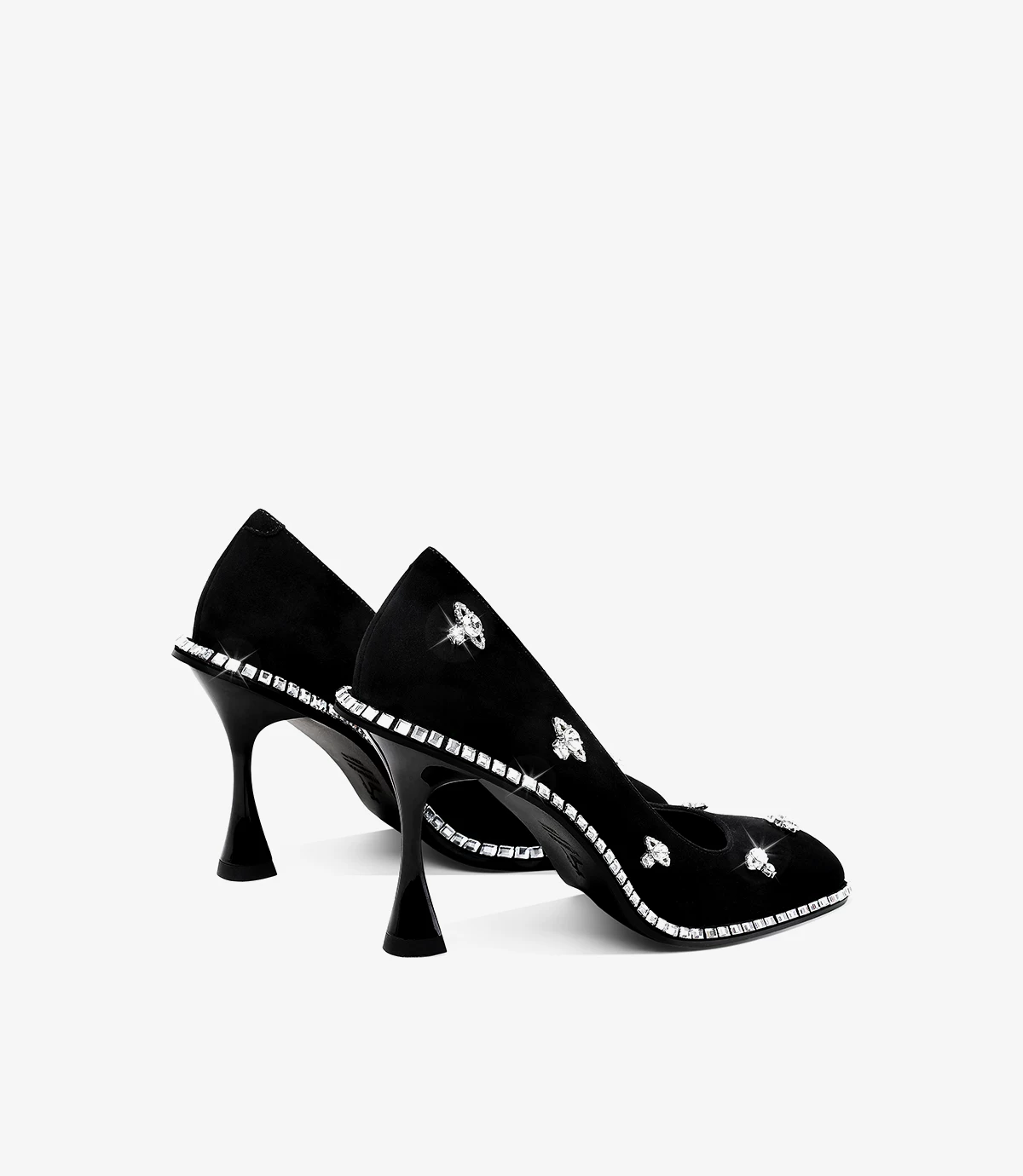
One placement to avoid outright is the sole edge. Some designs wrap studs around the welt, where they contact the ground. Those pieces take every impact, wear flat within weeks, and can scratch wooden floors. They look good in a product shot and terrible after a month of real use.
Metal finish and how fast it ages
Studs are usually brass, steel, or a zinc alloy with plating. What happens to that plating over a winter is the real quality question.
Antiqued brass and gunmetal finishes hide scratches and small chips well. Polished chrome and bright silver show everything, and once the plating chips you get a dark spot that reads as damage rather than patina. Matte black is the most forgiving of the lot, though it can wear to grey at the high points.
Salt and moisture are what kill plating. If you wear studded heels in winter, wipe the hardware with a dry cloth the same night, and don’t let them sit wet in a bag. A single snowy evening can start corrosion inside the fixing holes where you can’t see it.
There’s an argument for buying the cheaper pair here. Plated hardware at any price chips eventually, and a pair you replace every two years in good condition is often smarter than an expensive pair you baby and never wear. That’s the opposite of what most buying guides tell you, and it’s been true in my experience.
One detail worth checking is whether the studs are rhinestones rather than metal, since the two behave completely differently. Glass stones give more sparkle and fall out more easily. Metal studs weigh more and last longer. Crystal-looking pairs on the site usually mix both, so read the listing rather than the photo.
Magnet test time. A weak fridge magnet will stick to steel studs and barely grab a zinc alloy. That matters because alloy plating pits faster than steel in damp weather, so if the magnet drops off, keep them out of slush.
Colour plated hardware is a separate category again. Rose gold and bronze finishes are usually a coating over the same base metal, and that coating wears at the edges first. If the finish is the reason you’re buying, expect to lose it where your foot flexes and where the shoe rubs against a bag.
The inside of the shoe matters more than the outside
This is the part nobody reviews. Womens studded high heels get judged on the outside and worn on the inside, and the lining is where the difference between a good pair and a bad one shows up.
Look for a smooth lining under any area where metal sits. A stud fixed through leather with a rough backing will press into your foot every step, and a sock or liner only partly helps. Cheap pairs skip the backing entirely, and you feel it within an hour.
Check the insole too. Studded shoes tend to be built on fashion lasts with minimal padding, because the hardware is doing the selling. A 4mm foam or leather-covered insole costs the maker very little and changes the experience completely. If the insole is paper thin and hard, plan on adding your own.
Look at the stitching around the stud line while you’re in there. Repeated perforations for hardware weaken the upper, and a line of studs close together acts like a tear-along line. Spacing of 15mm or more keeps the leather strong enough to hold its shape for years.
Finally, check the heel tip and sole before anything else. Hardware on the upper is decorative. A worn heel tip is what makes a pair wobble and eventually unusable, and it’s the cheapest thing to replace on day one.
Pad the ball of the foot before you need it. A metatarsal pad costs less than lunch and sits under the forefoot where a stiff studded upper transfers pressure. The difference shows up around the third hour, which is exactly when most pairs start to feel like a mistake.
Smell the inside while you’re at it. Strong chemical odor usually means cheap adhesives and a synthetic lining that won’t breathe, and a shoe that traps heat will make your feet swell by the end of an evening. On a heavy studded pair that swelling is what turns a snug fit into a painful one.
Heel height with hardware: drop 10mm
Studs add weight, and weight changes how a heel feels. As a rule, take 10mm off whatever height you’d normally buy in a plain pump and you’ll land on a studded pair you can actually wear.
If 80mm is your comfortable ceiling, look at 70mm. If you wear 100mm without thinking, a studded 90mm will feel similar. That adjustment accounts for the extra mass and for the fact that studded shoes usually have stiffer uppers, which means less natural flex.
Heel shape matters here too. A chunky block heel under a studded upper balances the visual weight and handles pavement far better than a stiletto. The combination of heavy hardware and a thin stem looks unbalanced and behaves worse, especially on tile.
Platform versions are worth considering if you want height without pitch. A 20mm platform under the toe takes the angle out of a 90mm heel, and studs on a platform read as deliberate rather than fussy. Heel geometry and load distribution explain why that small change makes such a big difference to how long you can stand.
One thing to skip: studs on a very high, very thin heel with no platform. It photographs well and it’s miserable to walk in, and the weight of the hardware makes the wobble worse.
A 95mm version gets worn once and then lives in the closet, and the resale value on a scuffed studded heel is close to zero. Buy the version you’d still reach for on a Tuesday, not the one that looks best under shop lighting.
If you’re buying your first studded pair, aim lower than your instinct. A 60mm studded block heel gets worn twice a week through winter. A 95mm pair gets worn once and then lives in the closet, and the resale value on a scuffed studded heel is close to zero.
Sizing: studs don’t stretch
Hardware changes how a shoe fits. Studs set through the upper stop the leather from stretching in that area, so a studded pair keeps its shape far longer than a plain one. That’s good news for longevity and bad news if the fit is slightly tight.
Buy for the foot you have. If the pair pinches at the little toe in the shop, it will still pinch in March, because the stud line prevents any give. A plain suede shoe will relax. A studded suede shoe won’t.
Width matters more than length for most people here. Because the upper is stiffened by the hardware, a narrow fit feels narrower. If you’re between widths, go wider rather than longer, and use a thin insole to take up the extra space if needed.
Try the pair with the tights or socks you plan to wear. Studded shoes have more friction against hosiery than smooth leather, which is helpful at the heel and annoying at the instep. Fifteen minutes of walking will tell you which one you’ve got.
Check the weight again once they’re on your feet, not just in your hands. Some pairs feel fine on the shelf and heavy after 100 steps, and that’s the number that matters for an evening out.
Insoles are the practical fix for a pair that ends up slightly too big once the hardware stiffens the upper. A 3mm leather insole takes up slack at the heel and stops your foot sliding forward into the stud line, which is the exact problem most people hit with these shoes.
Insoles are the practical fix for a pair that’s slightly too big after the hardware stiffens the upper. A 3mm leather insole takes up the slack at the heel and keeps your foot from sliding forward into the stud line, which is the specific problem most people run into with these shoes.
What to wear with them without looking like a costume
Studded heels are loud. Everything else should be quiet, and the fastest way to get this right is to treat the shoe as the only metal in the outfit.
Good pairings: black straight-leg jeans and a plain knit, a leather midi skirt with a fine turtleneck, tailored trousers with a simple shirt. The hardware then reads as a detail rather than a theme.
Skip anything with its own hardware: zips on the ankle, buckles on a bag, a studded belt. Two metal stories in one outfit cancel each other out, and the result looks like a phase rather than a choice.
Proportion matters as much as colour. Studs pull the eye down, so cropped hems and ankle-length trousers keep the look sharp. A maxi skirt that hides the shoe wastes the pair entirely, and a midi that stops at the stud line cuts it in half visually. Heel height also changes the proportion, which is why the same outfit looks different with a 60mm and a 90mm version.
Proportion matters as much as colour. Studs draw the eye downward, so cropped hems and ankle-length trousers keep the look sharp. A maxi skirt that covers the shoe wastes the pair entirely, and a midi that stops right at the stud line cuts the shoe in half visually.
For colour, black and cream are the easy routes. Chocolate brown with brass studs is warmer and less aggressive, and it works through autumn with denim. A square-toe studded heel sits well with wide-leg trousers, since the toe shape echoes the trouser line.
If you want the styling logic in more depth, the guide to picking heels that read expensive covers how metal and finish change the price impression of a pair. Fit questions about slim feet are handled in the piece on narrow heels that hold the foot. Browse the full heels range on the site if you’re still deciding on height.
Care, storage, and the airport problem
Three practical things keep studded pairs wearable for years, and one of them involves airport security.
- Wipe metal with a dry cloth after every wear, before it goes back in the box.
- Stuff the toe with paper so the stud line doesn’t press into the upper in storage.
- Store in a dust bag, separate from other shoes, since metal scratches leather fast.
- Check every stud twice a season and tighten any that rotate.
- Skip them for air travel unless you’re wearing them. Metal in a carry-on gets flagged.
That last point surprises people every year. A pair with substantial hardware shows up on the scanner, and security may ask you to unpack them. Wearing them through is usually easier, though you’ll be taking them off at the checkpoint in most countries anyway.
If a stud does come loose, keep it. A cobbler can re-fix a single stud for very little, but finding a matching replacement for a discontinued pair is nearly impossible, and one missing piece on a visible line is the first thing anyone notices.
Give the pair a monthly five-minute check: studs tight, heel tips intact, lining still smooth where the metal sits. That’s the whole maintenance routine, and it’s less work than most people expect from a decorated shoe. Write the date of the last check on the dust bag if you own several pairs, because memory is unreliable over a season.
Womens studded high heels reward a specific kind of buyer: someone who’ll check the hardware fixing, buy for the foot they have, and take ten seconds to wipe the metal after a night out. Get those three habits in place, and the pair will outlast the trend it came from. Skip them, and you’ll be picking studs out of a carpet by February, wondering why the shoe felt heavier than expected.
